Process NMR Associates, LLC (Danbury CT) and Active Spectrum, Inc (San Carlos CA) are collaborating in the application of micro-ESR technology to petroleum applications. The initial work has focussed on crude oils but will soon be expanded to residues and cracker feedstocks.

Five samples of crude oil were tested by Micro-ESR spectrometry. The samples were:

1. Vasconia, Magdalena Basin, Columbia (V=39 ppm)
2. Merey, Eastern Venezuela Basin, Venezuela (V=303 ppm)
3. Oriente, Oriente Basin, Ecuador (V=65 ppm)
4. Qua Iboe, Agbada Formation, Niger Delta (V=2 ppm)
5. Basrah Light, Zubair Zone, Iraq (V=29 ppm)

The following spectra were observed:
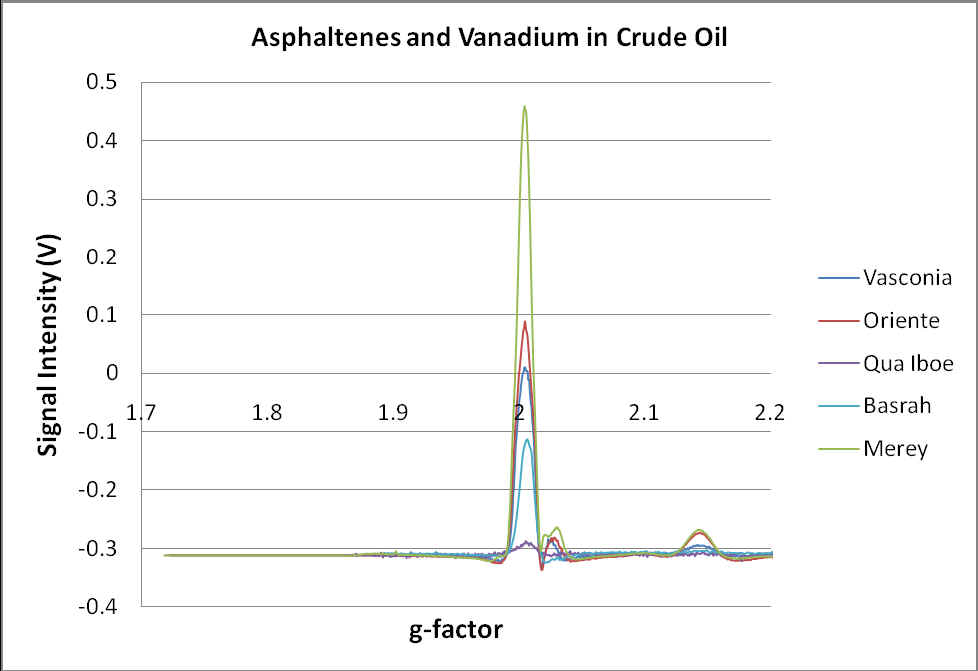
Micro-ESR Spectra of Crude Oils

Figure 1: Micro-ESR Spectra of Crude Oil

The central peak is a combination of a persistent carbon-centered organic radical (g = 2.003) found in asphaltenes, and a vanadyl (VO2+) peak. The additional smaller peaks are associated with vanadyl only.

For producers, the technique could be used to rapidly measure asphaltene concentration on-line. The spin density of the organic radical is a function of the maturity of the oil and will of course vary between deposits. Notwithstanding, rapid electronic measurement of asphaltenes remains a topic of great interest. Similar techniques have also been used to assess the quality of coals. For refiners, vanadium is a contaminant that poisons the refinery catalyst. ESR has been used by refiners since 1962 to rapidly measure vanadium content in crude oil feedstocks both on-line and in laboratories. Active Spectrum Inc.’s Micro-ESR is shown below. It is 2.25″ in diameter by 2.5″ high. Power input is 12-30VDC, and the data interface is USB. The device is available as either an on-line sensor or as a benchtop unit.

Micro-ESR Probe/Magnet Assembly

Figure 2: Micro-ESR Sensor

Higher resolution ESR spectrum of Merey Crude Oil

Figure 3: Higher Homogeneity Spectrum of Merey Crude

Micro-ESR is complimentary to NMR in that it observes paramagnetic metals and organic radicals which are unobservable by NMR. The stable free radical signal is indicative and quantitative to the amount of asphaltenes in the crude oil sample and vanadium metal content is an important processing parameter for cracking processes as it is active in the passivation of catalysts. NMR on the other hand observed the detailed hydrocarbon chemistry of the sample and yields chemico-physical parameters such as aromaticity, paraffinicity, naphthenicity, distillation, density, PAH distribution. In combination these two technologies yield a detailed picture of the petroleum materials before and during the refining process.

Samples provided by John Edwards of Process NMR Associates, LLC. Micro-ESR analysis provided by James White of Active Spectrum, Inc,

Active Spectrum Inc Logo
Active Spectrum, Inc. 110 Glenn Way #15, San Carlos, CA 94070 650-610-0720 | 626-628-1970 f | activespectrum.com

Process NMR Associates, LLC Logo
Process NMR Associates, LLC. 87A Sand Pit Rd, Danbury, CT 06810 203-744-5905 | 203-743-9297 f | process-nmr.com

PDF Version of Application Note

For more information contact John Edwards (203) 744-5905