9. Dryness and Further Scales Derived from the Spectrum
9.1 The sugar-based scales of North America
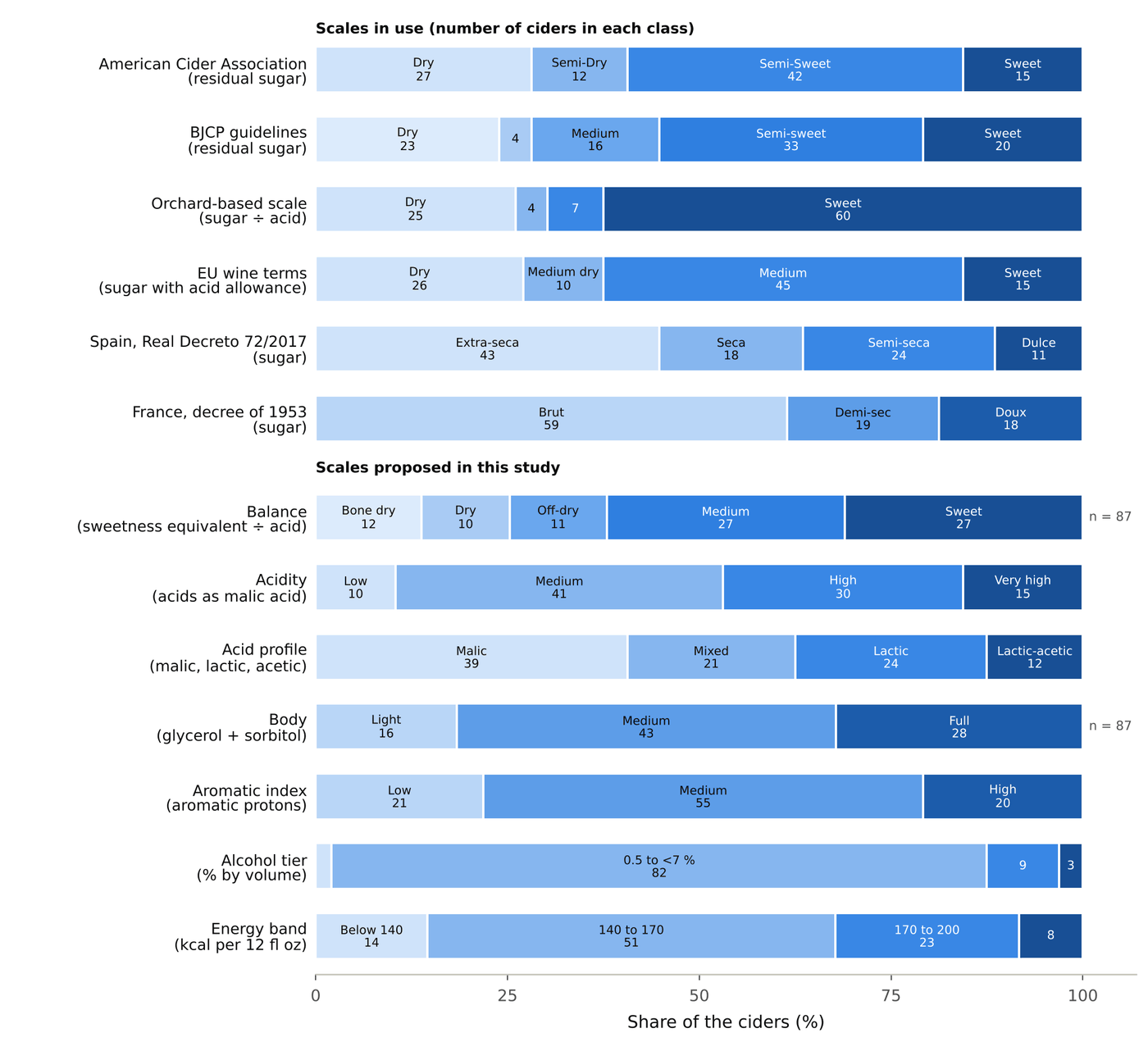
The residual sugar determined by qNMR places the ciders on the two sugar-based scales directly (Table 2, Figure 26). By the classes of the American Cider Association, 27 ciders are dry, 12 semi-dry, 42 semi-sweet and 15 sweet. The BJCP scale, with its lower boundaries, gives 23 dry, 4 semi-dry, 16 medium, 33 semi-sweet and 20 sweet. The two scales agree on the ordering and differ where they are meant to differ: four ciders that are dry for the association (4 to 9 g/L) are semi-dry for the judge, four between 18 and 20 g/L are medium instead of semi-sweet, and five between 40 and 45 g/L change from semi-sweet to sweet (Table 13). The distribution over the segments shows that no mass-market cider of this collection is dry by either scale, while 22 of the 63 regional craft ciders are.
The word dry on the label is a poor guide. Of the products whose name contains it, the three lots of Stormalong Legendary Dry (5 to 7 g/L) and Bad Seed Dry (0.2 g/L) are dry on the association's scale. Angry Orchard Stone Dry (14 g/L) and Citizen Cider The Full Nelson, which is dry-hopped and makes no claim about sugar, are semi-dry. Awestruck Eastern Dry (22 g/L), Hudson North Peach Mango Dry Cider (21 g/L) and Angry Orchard Traditional Dry (39 g/L) are semi-sweet, the last of them close to the boundary of sweet. The French designation brut, on Etienne Dupont Cidre Bouché Brut (13 g/L), corresponds to semi-dry.
Table 13. Classification of the 96 ciders on the three North American dryness scales: classes of the American Cider Association (rows) against the BJCP classes, the unadjusted ratio classes of the orchard-based scale, and the market segments.
| ACA class | n | BJCP: Dry | Semi-dry | Medium | Semi-sweet | Sweet | Ratio: Dry | Semi-Dry | Semi-Sweet | Sweet | Craft | Mass-market | European | Home | Non-alc. | Juice |
|---|---|---|---|---|---|---|---|---|---|---|---|---|---|---|---|---|
| Dry | 27 | 23 | 4 | 0 | 0 | 0 | 25 | 2 | 0 | 0 | 22 | 0 | 2 | 3 | 0 | 0 |
| Semi-Dry | 12 | 0 | 0 | 12 | 0 | 0 | 0 | 2 | 6 | 4 | 7 | 2 | 1 | 1 | 1 | 0 |
| Semi-Sweet | 42 | 0 | 0 | 4 | 33 | 5 | 0 | 0 | 1 | 41 | 26 | 11 | 4 | 0 | 1 | 0 |
| Sweet | 15 | 0 | 0 | 0 | 0 | 15 | 0 | 0 | 0 | 15 | 8 | 6 | 0 | 0 | 0 | 1 |
| Total | 96 | 23 | 4 | 16 | 33 | 20 | 25 | 4 | 7 | 60 | 63 | 19 | 7 | 4 | 2 | 1 |
9.2 The orchard-based scale
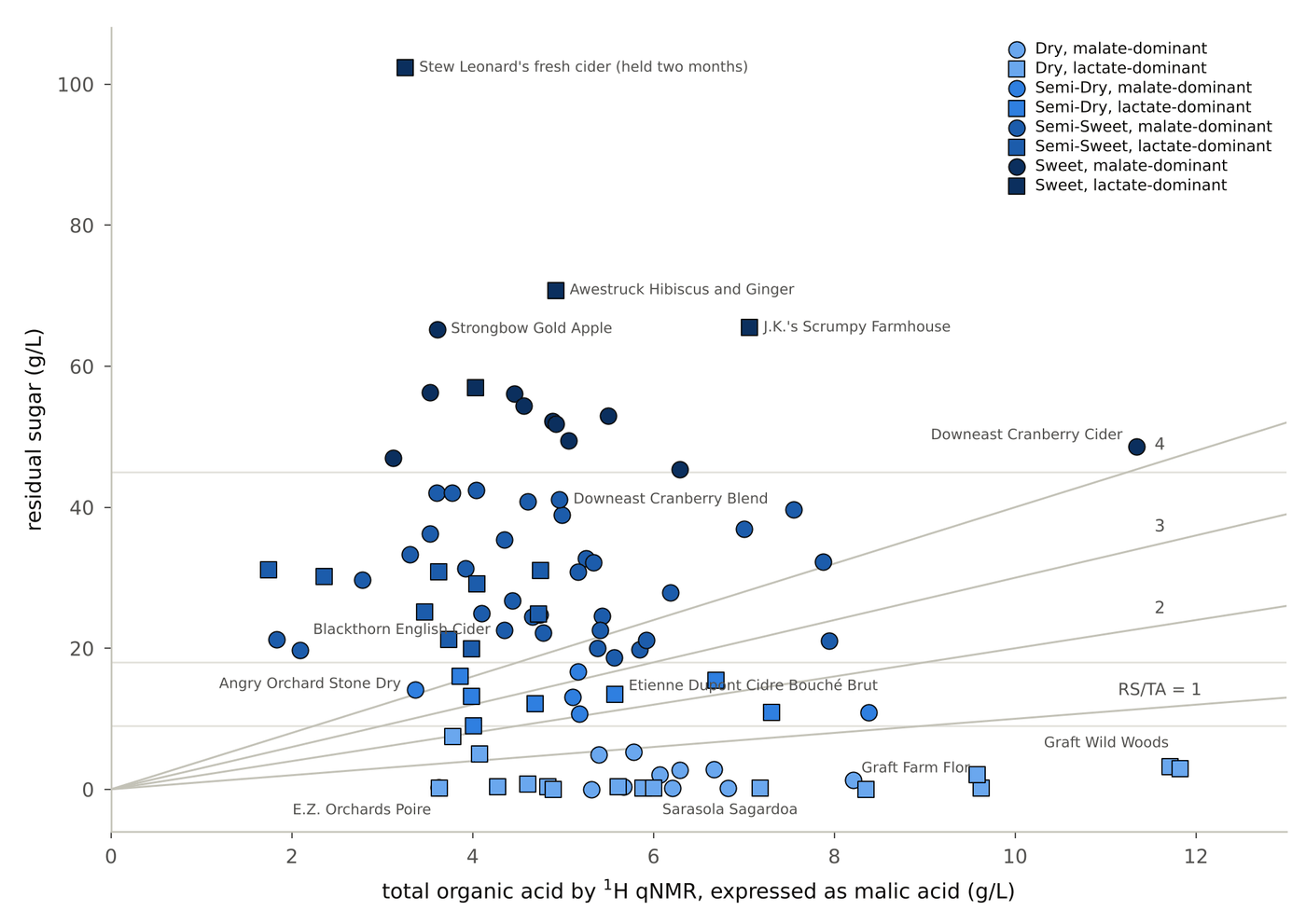
The orchard-based scale requires the titratable acidity and the total polyphenol content, neither of which is measured by NMR. The ratio was therefore calculated with the sum of the organic acids expressed as malic acid in place of the titratable acidity, and no adjustment for polyphenols was made. Both simplifications bias the result. The sum of the acids includes the fraction that is neutralized by the potassium of the juice, so it exceeds the titratable acidity and the ratio is too low; and the omitted adjustment would move ciders rich in tannin further toward dry. The numbers of Table 13 are consequently an approximation that errs, for most ciders, toward the dry side. Even so, the picture differs sharply from that of the sugar scales (Figure 30). Of the 96 ciders, 60 have a ratio above 3 and would be called sweet, 25 are dry, and only 11 fall into the two intermediate classes. Of the 42 ciders that are semi-sweet by their sugar content, 41 are sweet by the ratio. The median ratio of the whole set is 4.5, and a quarter of the ciders exceed 8.6.
This is not a contradiction but a difference of purpose. The orchard-based scale was devised for ciders in which sugar and acid are both those of the fruit, and within that population a ratio of 3 does mark a sweet cider. Applied to the market as a whole it has no resolving power above 20 g/L of sugar, because the acid content of commercial ciders is confined to a narrow band of 4 to 6 g/L and hardly any of them could reach a ratio below 3 at that sugar level. Its value lies at the dry end, where it separates ciders that the sugar scales lump together. Stormalong Legendary Dry, with 5 g/L of sugar, has a ratio of 0.9 in the lots that retain their malic acid and of 2.0 in the lot that underwent malolactic conversion; the sour ciders of Graft, with up to 12 g/L of acid, remain dry on any scale; and Downeast Cranberry Cider, sweet by its 49 g/L of sugar, has by virtue of its exceptional acidity a lower ratio (4.3) than many ciders with half as much sugar. For a full application of the scale the NMR measurement is combined with a titration and a polyphenol assay.
9.3 European designations
Applied to the same residual sugar contents, the European designations of Section 3.6 sort the ciders differently (Figure 31). By the Spanish standard for cider, 43 of the 96 ciders would be extra-seca, 18 seca, 24 semi-seca and 11 dulce; every cider that is dry or semi-dry on the American scale, and four of the semi-sweet ones, fall into the first class. By the French thresholds of 1953, 59 would be brut and 19 demi-sec, and 18 exceed the sugar content of doux. Only one of the latter, the fresh juice that had begun to ferment, also satisfies the alcohol limit of that designation; the commercial ciders of this group, with 4.4 to 6.6 % v/v of alcohol, combine a sugar content and an alcoholic strength that the French classification does not provide for. The terms of the European wine regulations agree most closely with the American scale: 26 ciders are dry, 10 medium dry, 45 medium and 15 sweet. Of the 27 ciders with less than 9 g/L of sugar, all but one are dry by the wine terms as well, either because they contain no more than 4 g/L or because their acidity, expressed as tartaric acid, is not more than 2 g/L below their sugar content.
The European ciders of the collection are placed as their labels lead one to expect. Sarasola Sagardoa and Etienne Dupont Cidre Triple, with less than 0.5 g/L of sugar, are dry on every scale. Etienne Dupont Cidre Bouché Brut, with 13.4 g/L, is brut in France, extra-seca in Spain, medium dry by the wine terms and semi-dry in the United States. Celt Cidre Breton Traditionnel (30.9 g/L) and Thatchers Green Goblin (30.2 g/L) are demi-sec, semi-seca and semi-sweet, and Blackthorn (22.6 g/L) and Samuel Smith's Organic Cider (24.4 g/L) are brut by the French and seca by the Spanish threshold while being semi-sweet for the American Cider Association. The comparison makes the point of Section 3.6 with real products: the same cider carries a different word in each market, and only the number is unambiguous.
9.4 Further scales that can be read from the same spectrum
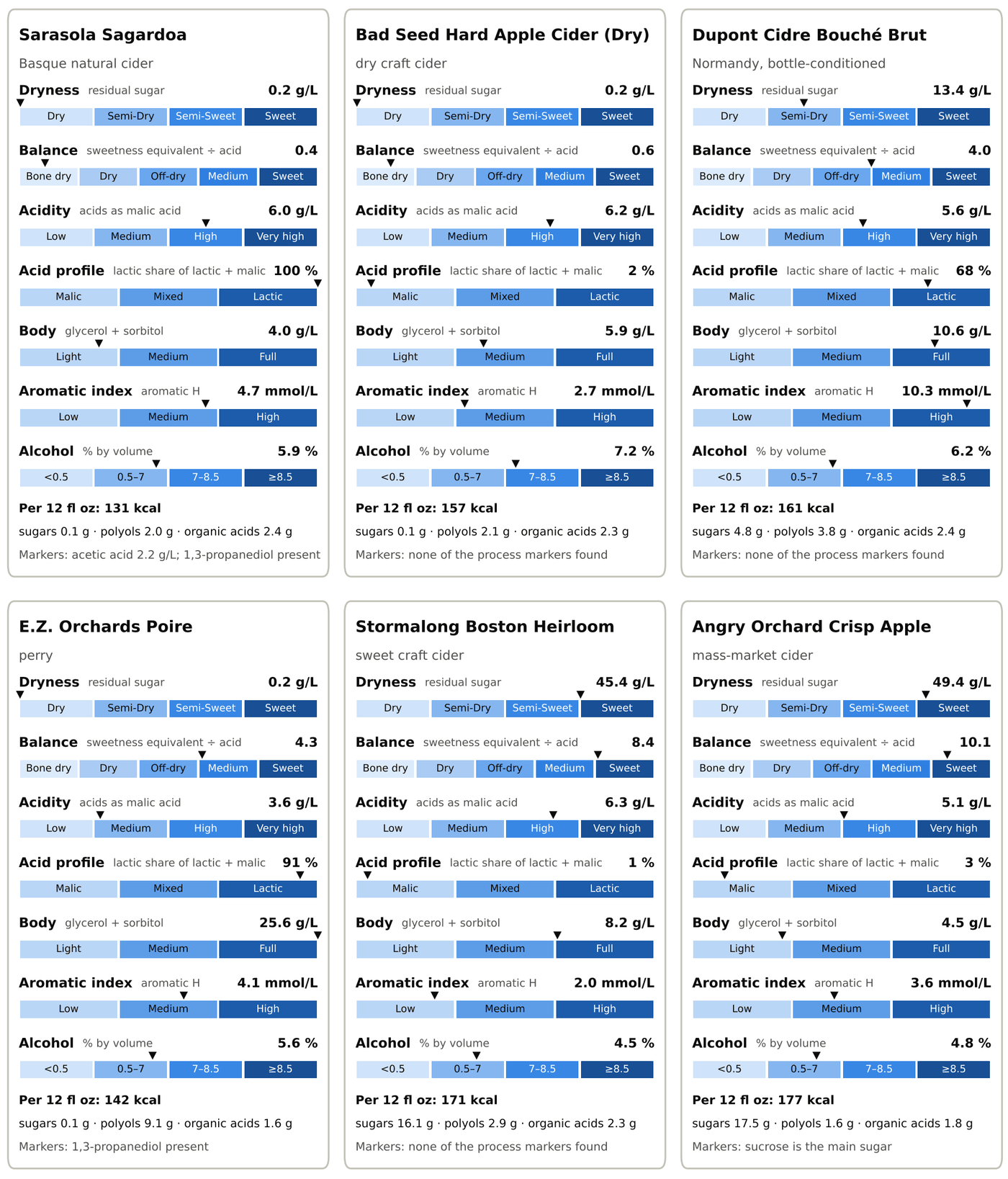
Residual sugar is only one of the properties that a consumer perceives and that a producer may wish to communicate, and the spectrum that yields the sugar content yields the others as well. Seven further scales were therefore derived from the qNMR composition. Their definitions are given in Table 14, the distribution of the 96 ciders over their classes in Figure 31, and the placement of six ciders of contrasting style on all of them in Figure 32. The boundaries are proposals, chosen from the distribution of the present survey and from the anchors named in the table.
Table 14. Further scales proposed for the description of cider, all derived from the ¹H qNMR composition.
| Scale | Quantity | Classes and boundaries | Basis |
|---|---|---|---|
| Balance | sweetness equivalent divided by the acids expressed as malic acid (both in g/L); sweetness equivalent = sucrose + 1.2 × fructose + 0.7 × glucose + 0.6 × sorbitol + 0.6 × glycerol | Bone dry, below 1; Dry, 1 to 2; Off-dry, 2 to 4; Medium, 4 to 8; Sweet, above 8 | relative sweetness of sugars and polyols;123,232–234 each class spans a doubling of the index |
| Acidity | sum of malic, lactic, succinic, citric, acetic and quinic acids, expressed as malic acid (g/L) | Low, below 3.5; Medium, 3.5 to 5; High, 5 to 7; Very high, above 7 | distribution of the survey; 4.5 g/L separates sweet from sharp juice in the Long Ashton classification |
| Acid profile | molar share of lactic acid in the sum of lactic and malic acids; acetic acid (g/L) | Malic, share below 0.1; Mixed, 0.1 to 0.5; Lactic, 0.5 or more; Lactic-acetic, 0.5 or more with at least 1 g/L of acetic acid | extent of malolactic conversion (Section 8.4) |
| Body | glycerol + sorbitol (g/L) | Light, below 5; Medium, 5 to 8; Full, above 8 | non-volatile polyols that add viscosity and sweetness24,235 |
| Aromatic index | aromatic protons between 7.80 and 6.76 ppm (mmol/L) | Low, below 2.5; Medium, 2.5 to 5; High, above 5 | integral measure of polyphenols (Section 8.6) |
| Alcohol tier | ethanol (% v/v) | below 0.5; 0.5 to less than 7; 7 to less than 8.5; 8.5 or more | regulatory boundaries in the United States (Section 3.7)67,117 |
| Energy band | energy per 12 fl oz, component basis (kcal) | below 140; 140 to 170; 170 to 200; above 200 | distribution of the survey (Section 10) |
The polyols require the freeze-dried tube, so that balance and body are available for 87 of the 96 ciders.
The balance index carries furthest. It divides a sweetness equivalent by the acidity. The sweetness equivalent weights each sweet constituent by its sweetness relative to sucrose, so that it credits a cider with the greater sweetness of fructose and with its glycerol and sorbitol, which the sugar scales ignore; the division by the acid content expresses, as the orchard-based scale does, that acidity suppresses the perception of sweetness. With boundaries at 1, 2, 4 and 8, 12 of the 87 ciders are bone dry, 10 dry, 11 off-dry, 27 medium and 27 sweet. Unlike the ratio of the orchard-based scale, the index resolves the upper half of the market: the ciders that are semi-sweet by their sugar content divide into 21 that are medium and 15 that are sweet by balance. Thatchers Green Goblin and Magners Original Irish Cider, with about 30 g/L of sugar but little acid, have indices of 12.8 and 11.2 and are sweet; Naked Flock Hard Cider, with 40 g/L of sugar and 7.6 g/L of acid (6.0), and Downeast Cranberry Cider, with 49 g/L of sugar and 11 g/L of acid (4.7), are medium. At the dry end the index separates the ciders that contain no sugar according to their polyols and their acidity: Sarasola Sagardoa (0.4) is bone dry, and Etienne Dupont Cidre Triple (1.4), with 10 g/L of glycerol and sorbitol, is dry.
The remaining scales describe properties that no dryness scale addresses. Acidity is classed by the sum of the organic acids expressed as malic acid; 10 ciders are low, 41 medium, 30 high and 15 very high, the last class consisting chiefly of the sour ciders and of those made with cranberry. The acid profile states which acid is tasted: malic acid in 39 ciders, a mixture in 21, lactic acid in 24, and lactic together with acetic acid in 12. It is the most direct indication of style that the spectrum offers. Of the nineteen mass-market ciders 14 have a malic profile and none a lactic-acetic one, whereas none of the seven traditional European ciders is malic. Body is represented by the sum of glycerol and sorbitol, the two non-volatile constituents that lend viscosity and a residual sweetness to a dry cider: 16 ciders are light, 43 medium and 28 full, with the perry of E.Z. Orchards and the French ciders at the upper end and the ciders whose glycerol has been metabolized (Section 8.5) at the lower. The aromatic index, the integral of the aromatic region, stands for the polyphenols that carry bitterness and astringency; it is low in 21 ciders, medium in 55 and high in 20, among them six of the seven European ciders. The alcohol tiers follow the regulatory boundaries of the United States: two ciders lie below 0.5 % v/v, 82 between 0.5 and 7 %, nine between 7 and 8.5 %, where the labeling rules for wine apply while the tax rate for hard cider is retained, and three at 8.5 % or above. The energy bands, finally, divide the collection into 14 ciders below 140 kcal per 12 fl oz, 51 between 140 and 170 kcal, 23 between 170 and 200 kcal and eight above.
The cards of Figure 32 show how the scales combine into a description of an individual product. Sarasola Sagardoa and Bad Seed Hard Apple Cider (Dry) are indistinguishable on the dryness scale, both with 0.2 g/L of sugar, and are bone dry by balance; but the first has a lactic-acetic profile, a light body and the markers of bacterial glycerol metabolism, while the second is a malic cider of medium body in the alcohol tier of 7 to 8.5 %. Etienne Dupont Cidre Bouché Brut combines a semi-dry sugar content with a lactic profile, a full body and a high aromatic index, the profile of a keeved cider from tannic fruit. The perry of E.Z. Orchards is dry by its sugar and medium by balance, because its 26 g/L of polyols, nearly all of it sorbitol, enter the sweetness equivalent. Stormalong Boston Heirloom and Angry Orchard Crisp Apple, finally, are both sweet, but the former owes its sweetness chiefly to fructose and glucose in the presence of more than 6 g/L of acid, the latter chiefly to sucrose. A description of this kind is obtained from the one spectrum that also supplies the nutrition values, and it can be printed on a label, used in a specification or followed from batch to batch.