8. Composition of the Ciders
8.1 Overview
The composition of all 96 ciders is tabulated in Appendix B and displayed as a heat map in Figure 25; summary statistics are given in Table 10. Among the 93 alcoholic ciders, ethanol ranges from 3.0 to 10.4 % v/v with a median of 5.9 % v/v. Residual sugar extends from nil to 102 g/L (median 21.7 g/L), the sum of the organic acids from 1.9 to 13.9 g/L (median 5.4 g/L) and the sum of the polyols, where the freeze-dried tube was available, from 1.8 to 25.8 g/L (median 7.3 g/L). The picture that emerges from the heat map is one of two largely independent axes of variation: the amount and kind of residual sugar, which is a decision of the producer, and the state of the acids and of glycerol, which records the microbiology of the fermentation.
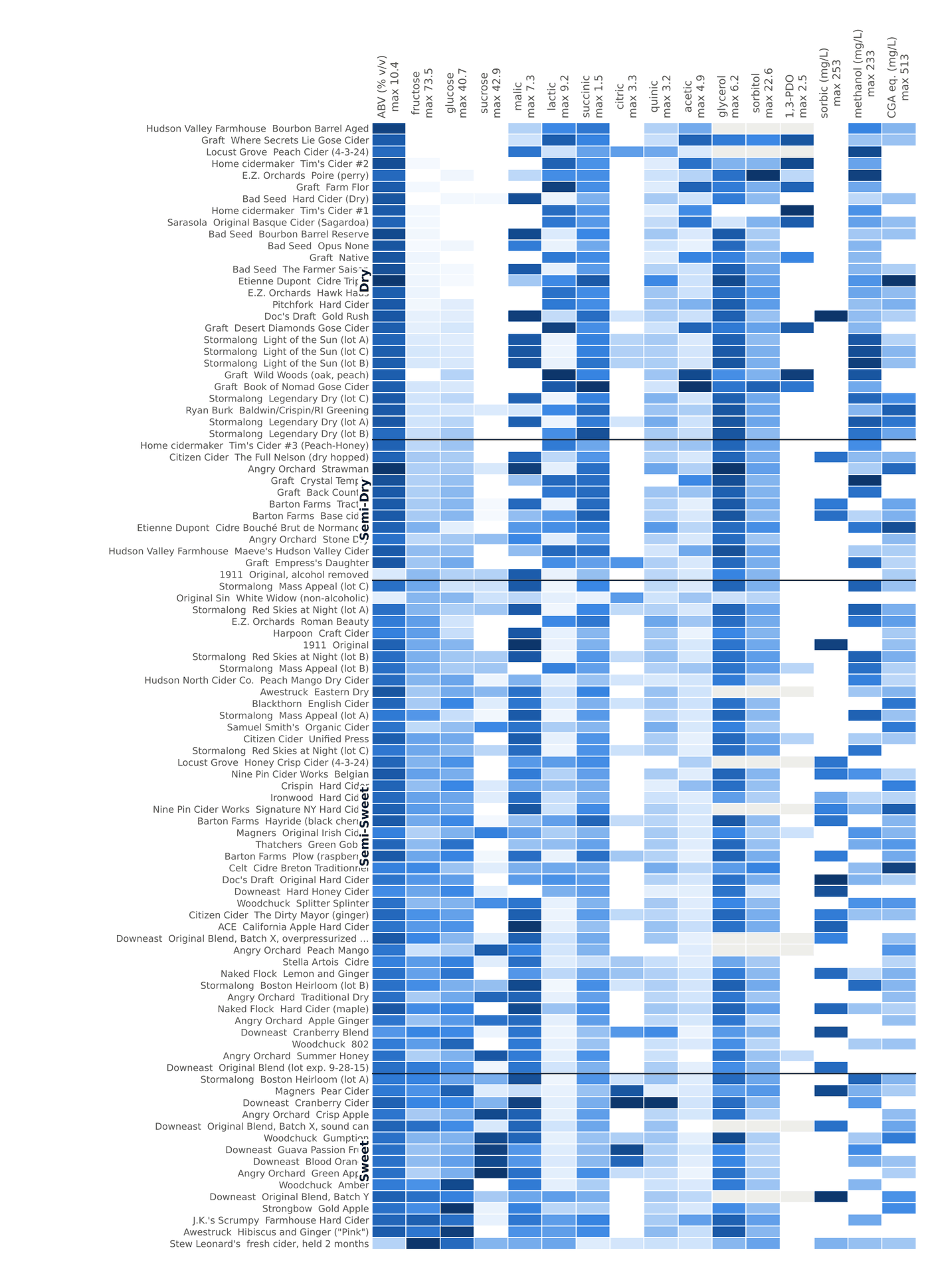
Table 10. Concentrations determined by ¹H qNMR in 96 ciders (mg/L unless stated otherwise): number of ciders measured, number in which the compound was found above the reporting limit, and the minimum, median and maximum of the findings.
| Compound | Measured | Found | Minimum | Median | Maximum | Cider with the maximum |
|---|---|---|---|---|---|---|
| Ethanol (g/L) | 96 | 96 | 1.1 | 46.5 | 81.7 | Angry Orchard Strawman |
| Methanol | 96 | 68 | 12.8 | 52.0 | 233 | Graft Book of Nomad - Crystal Temple (Cabernet Franc,… |
| Isoamyl alcohols | 96 | 93 | 33.1 | 126 | 232 | Angry Orchard Strawman |
| Isobutanol | 96 | 93 | 6.3 | 27.4 | 79.4 | Graft Desert Diamonds Gose Cider |
| 1-Propanol | 96 | 79 | 5.1 | 15.9 | 281 | Graft Wild Woods - Grim Wilderness Vol. 1 (oak aged p… |
| Acetic acid | 96 | 94 | 28.4 | 145 | 4863 | Graft Book of Nomad Gose Cider |
| Formic acid | 96 | 21 | 1.9 | 4.6 | 53.8 | Graft Back Country (sour cider, citrus and bourbon) |
| Sorbic acid | 96 | 24 | 44.1 | 125 | 253 | Doc's Draft Gold Rush |
| Malic acid | 96 | 79 | 213 | 3452 | 7335 | 1911 Original |
| Lactic acid | 96 | 96 | 28.2 | 361 | 9162 | Graft Wild Woods - Grim Wilderness Vol. 1 (oak aged p… |
| Succinic acid | 96 | 96 | 12.9 | 424 | 1540 | Graft Book of Nomad Gose Cider |
| Citric acid | 96 | 28 | 101 | 231 | 3304 | Downeast Cranberry Cider |
| Quinic acid | 96 | 93 | 37.5 | 257 | 3168 | Downeast Cranberry Cider |
| Fructose | 96 | 90 | 127 | 10433 | 73478 | Stew Leonard's Fresh apple cider, unpasteurized, held… |
| Glucose | 96 | 86 | 64.5 | 6914 | 40692 | Strongbow Gold Apple |
| Sucrose | 96 | 48 | 56.8 | 2268 | 42931 | Angry Orchard Green Apple |
| Glycerol | 87 | 86 | 186 | 3143 | 6230 | Angry Orchard Strawman |
| Sorbitol | 87 | 86 | 743 | 3754 | 22580 | E.Z. Orchards Poire (Forelle / Comice / Bosc perry) |
| 1,3-Propanediol | 87 | 14 | 103 | 1304 | 2492 | Home cidermaker (Tim) Tim's Cider #1 |
| 2,3-Butanediol | 87 | 84 | 25.8 | 94.8 | 652 | Stella Artois Cidre |
| Doublet at 5.18 ppm, as α-xylose (tentative) | 96 | 73 | 36.6 | 133 | 380 | E.Z. Orchards Poire (Forelle / Comice / Bosc perry) |
| Galacturonic acid, α anomer | 96 | 64 | 30.5 | 105 | 545 | Woodchuck 802 |
| Alanine (tentative) | 96 | 44 | 5.5 | 25.5 | 79.4 | Locust Grove Peach Cider (4-3-24) |
| 5-Hydroxymethylfurfural | 96 | 10 | 1.4 | 2.9 | 6.2 | Barton Farms Hayride (black cherry) |
| Hydroxycinnamoyl esters, as chlorogenic acid | 96 | 70 | 31.4 | 75.7 | 513 | Etienne Dupont Cidre Triple |
Polyols and 2,3-butanediol require the freeze-dried tube (87 ciders). Minimum and median refer to the ciders in which the compound was found.
8.2 Ethanol, methanol and higher alcohols
Most of the alcoholic ciders contain between 4.5 and 7 % v/v of ethanol. The exceptions at the upper end are two products that are sold as strong ciders, Angry Orchard Strawman (10.4 % v/v) and Etienne Dupont Cidre Triple (9.9 % v/v), and a group of barrel-aged craft ciders. A point of regulatory interest is the boundary at 7 % v/v that separates the jurisdictions of the two labeling agencies (Section 3.7). Only 3 ciders declare 7 % v/v or more, whereas 12 were found at or above that value. Declarations of 6.8 or 6.9 % v/v are conspicuously frequent, 20 ciders in all. The alcohol content measured in this group ranges from 5.0 to 8.6 % v/v with a mean of 6.8 % v/v, so the declarations are accurate on average; but 6 of the 20 ciders were found at or above 7 % v/v. Given the uncertainty of a single measurement and the tolerance allowed to a label, no individual product can be said to be mislabeled on this evidence. What the data show is that the ordinary variation between batches carries a craft cider declared just below the boundary across it in a substantial fraction of cases.
Methanol was found in 68 ciders at 13 to 233 mg/L. The highest values belong to ciders with added fruit or grape skins, to the perry and to the Stormalong ciders, and methanol was below the reporting limit in twelve of the nineteen mass-market products, which is consistent with its origin in the pectin of the fruit and with the lower juice content or the clarification of industrial ciders.84 The methyl signals of the higher alcohols correspond to 126 mg/L of isoamyl alcohols (median), with much smaller amounts of isobutanol and 1-propanol. The division of this overlapped multiplet among the three alcohols is approximate, and their sum is the more reliable quantity. The signal assigned to 1-propanol is strongly elevated in the sour ciders (up to 281 mg/L in Graft Wild Woods), which is consistent with a bacterial origin.
8.3 Residual sugars
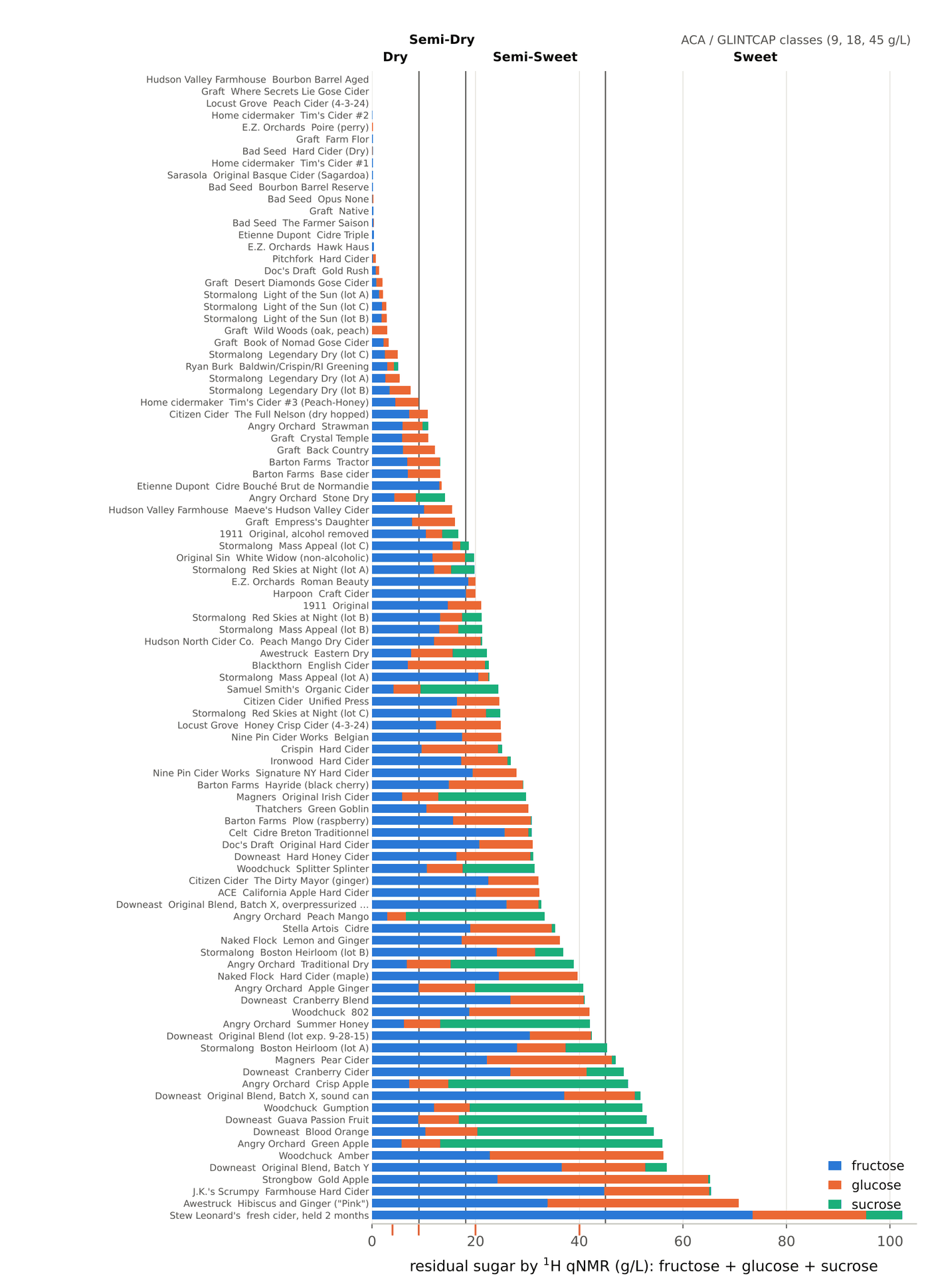
Residual sugar is the property in which the ciders differ most (Figure 26). Sixteen ciders contain less than 1 g/L and are dry in the strict sense; at the other extreme fifteen exceed 45 g/L. The composition of the sugar is as informative as its amount. Sucrose at 2 g/L or more was found in 24 ciders and reaches 43 g/L in Angry Orchard Green Apple. It is the principal sugar in 13 ciders: ten of the nineteen mass-market products, two fruit-flavored ciders of Downeast and Samuel Smith's Organic Cider. Because apples themselves contain sucrose and because sucrose is inverted on storage, neither its presence nor its absence is proof of the kind of sweetener; but yeast hydrolyzes and consumes sucrose early in the fermentation, and a cider in which sucrose exceeds the sum of glucose and fructose, as it does in 11 of these products, is best explained by the addition of refined sugar or a sucrose syrup after fermentation. Ciders sweetened with juice or by arrested fermentation show the opposite pattern, fructose in excess of glucose and little sucrose. The ratio of fructose to glucose has a median of 1.5 and exceeds 4 in 7 ciders, among them Etienne Dupont Cidre Bouché Brut (25), E.Z. Orchards Roman Beauty, two lots of Stormalong Mass Appeal and Harpoon Craft Cider. Such ratios are the mark of a fermentation that stopped, or was stopped, after the yeast had consumed nearly all of the glucose.
8.4 Organic acids and malolactic conversion
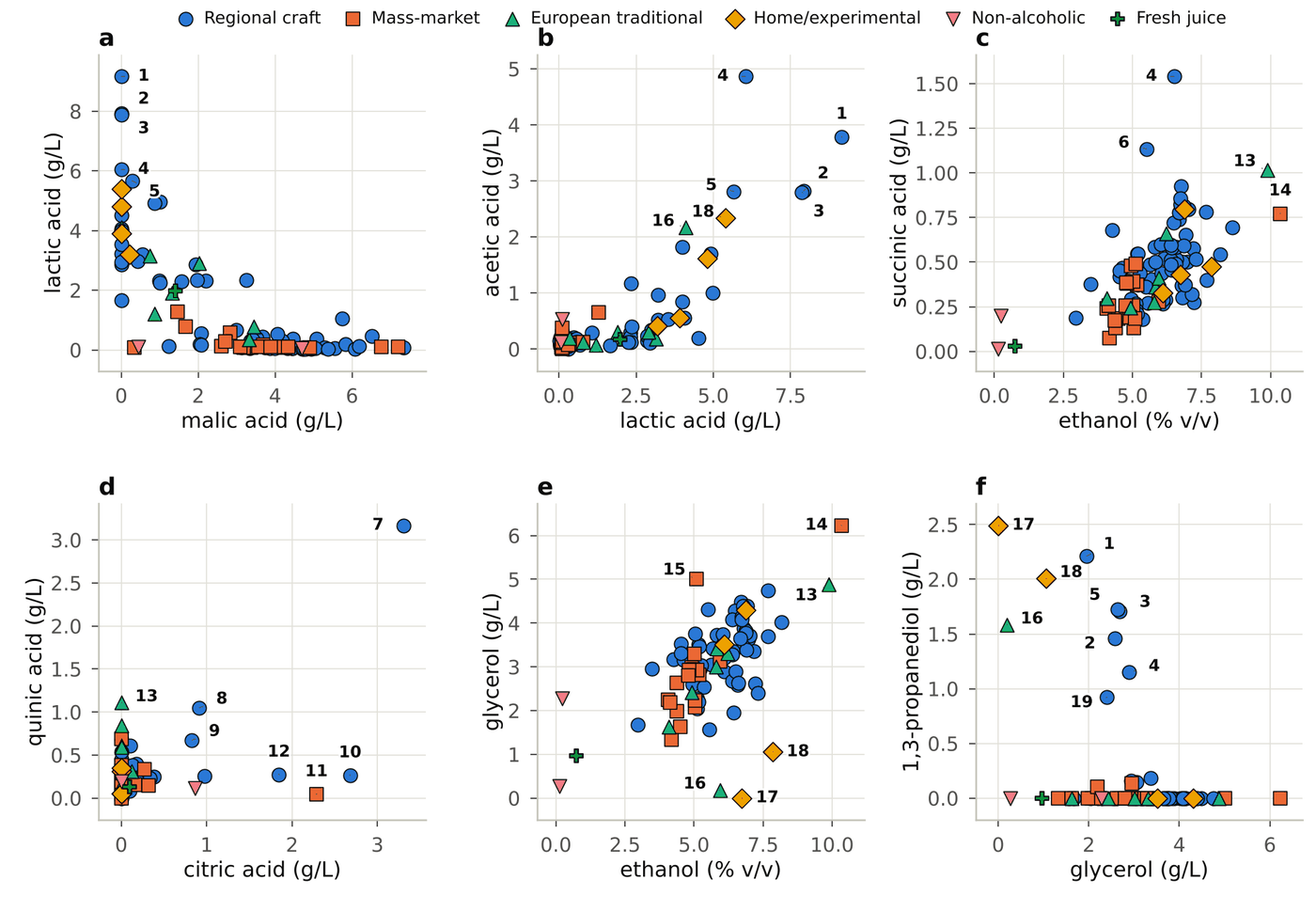
Malic and lactic acids are complementary (Figure 27a). In 39 ciders less than a tenth of the sum of the two is lactic acid, in 20 more than nine tenths, and malic acid was not detected at all in 17. By the criterion of Section 5.8, 36 of the 96 ciders are lactate-dominant. The distribution over the market segments is uneven: one of the nineteen mass-market ciders, five of the seven traditional European ciders, all four home-made ciders and 25 of the 63 regional craft ciders. Malolactic conversion is thus avoided almost without exception by the large producers and occurs, by intention or not, in two fifths of the craft products. The amounts are considerable. Lactic acid exceeds 1 g/L in 37 ciders and reaches 9.2 g/L in Graft Wild Woods, far more than the conversion of the malic acid of an apple juice can supply, so that in the sour ciders lactic acid must also have been formed from sugar.
Acetic acid follows lactic acid (Figure 27b). Its median is 145 mg/L, but 12 ciders contain 1 g/L or more, up to 4.9 g/L in Graft Book of Nomad Gose. All twelve are lactate-dominant ciders with more than 2 g/L of lactic acid: seven ciders of Graft, the Basque cider, the two home-made ciders and two farmhouse-style craft ciders. At such concentrations acetic acid is a defining element of the style, and the products concerned are presented as sour. Succinic acid, a product of the yeast, increases with the alcohol content (Figure 27c; correlation coefficient 0.57) and lies between 0.2 and 0.8 g/L in nearly all ciders. Citric acid was confirmed in 28 ciders. Above 0.8 g/L it occurs exclusively in products with declared fruit other than apple (cranberry, blood orange, guava and passion fruit, peach, strawberry, blackberry) and in Magners Pear Cider, and it may derive from the fruit or from acidification. Quinic acid, at a median of 257 mg/L, is a normal constituent of the apple; the two cranberry ciders stand apart with 3.2 and 1.0 g/L (Figure 27d), as expected from the composition of cranberry juice,229 and the three traditional French ciders contain 0.6 to 1.1 g/L.
8.5 Polyols, 1,3-propanediol and the signature of natural cider
Glycerol amounts to 3.1 g/L in the median cider, and its mass ratio to ethanol has a median of 0.069 with an interquartile range of 0.060 to 0.078, the range expected for the alcoholic fermentation (Figure 27e).80 The ciders that fall far below this relation are the instructive ones. In nine ciders 1,3-propanediol was found at 0.9 to 2.5 g/L (Figure 27f): Sarasola Sagardoa, the two home-made ciders of one cider maker, and six ciders of Graft. All nine are lactate-dominant and all contain more than 1.5 g/L of acetic acid. The combination of exhausted malic acid, high lactic and acetic acids and conversion of glycerol to 1,3-propanediol is the chemical signature of the heterofermentative lactic acid bacteria of natural cider (Section 3.5),98–100 and it is found here not only in the Basque cider but also in American ciders made by spontaneous or mixed fermentation. The determination of 1,3-propanediol rests on two independent signals, the quintet at 1.78 ppm and the triplet in the library decomposition, which agree.
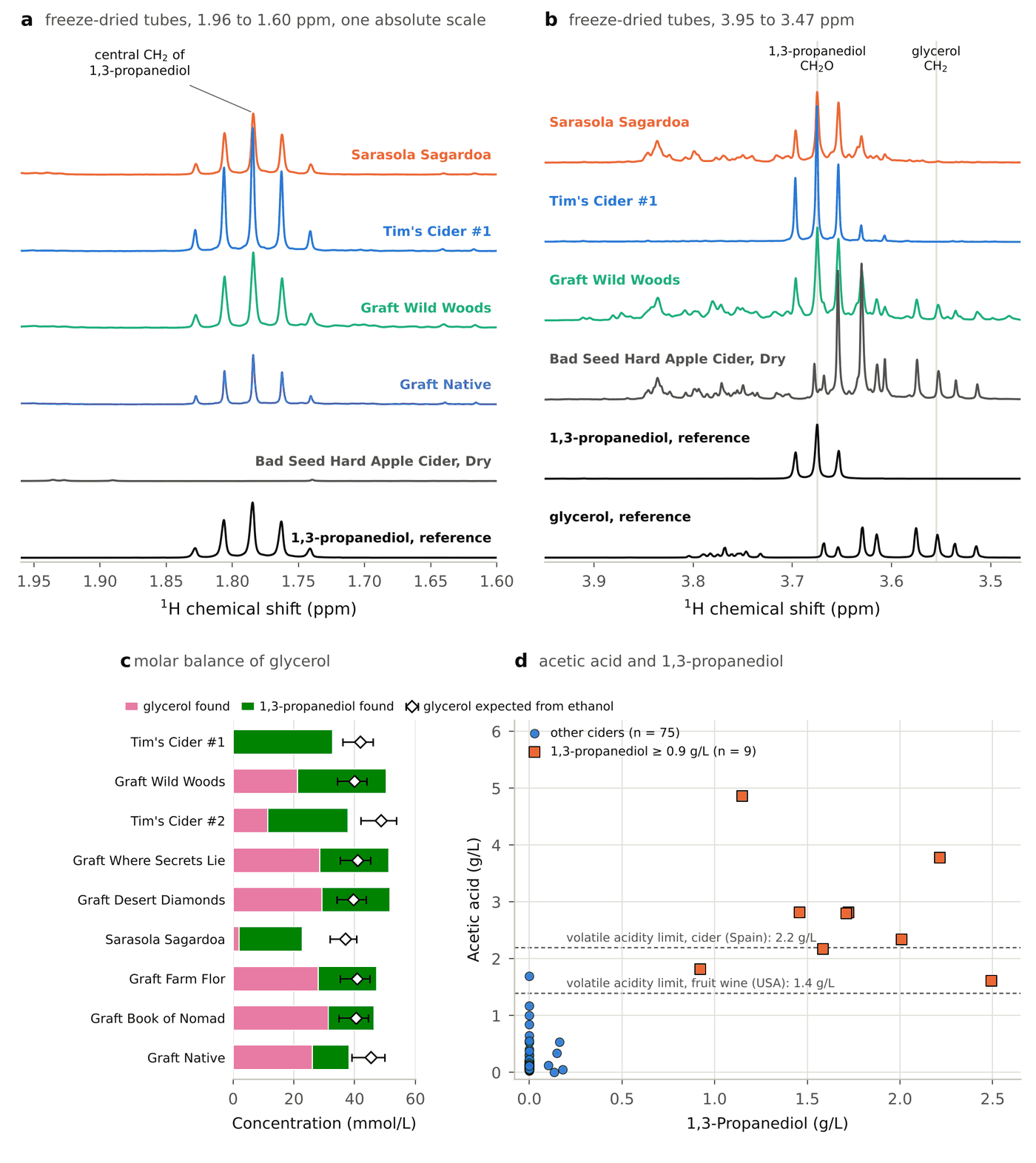
Sarasola Sagardoa, the one cider of the collection that was made in the Basque Country by the traditional method, shows the style in its purest form (Figure 28). It contains 5.9 % v/v of ethanol and 0.2 g/L of residual sugar. Malic acid is absent, lactic acid amounts to 4.1 g/L, and acetic acid, at 2.2 g/L, corresponds to the upper end of the volatile acidity that the standard admits for natural cider. Of the glycerol, 0.2 g/L remains, against some 3.4 g/L that a fermentation to this strength may be expected to produce, and 1,3-propanediol is present at 1.6 g/L. In the spectrum the quintet of the central methylene group of 1,3-propanediol stands alone at 1.78 ppm, and between 3.5 and 3.7 ppm its triplet takes the place of the doublets of doublets of glycerol, which are prominent in a cider of equal dryness that was fermented without the participation of these bacteria (Figure 28a and b). The same pattern is found, in various degrees, in the eight American ciders. In Tim's Cider #1 no glycerol is left at all; in the ciders of Graft glycerol and 1,3-propanediol are present side by side.
A balance in moles shows how far the conversion has gone (Figure 28c). In the 70 alcoholic ciders that are free of 1,3-propanediol the molar ratio of glycerol to ethanol has a median of 0.036, with an interquartile range of 0.031 to 0.040, and this ratio, applied to the ethanol content, gives the amount of glycerol that the yeast may be expected to have formed. In Sarasola Sagardoa the glycerol and the 1,3-propanediol that were found account together for 62 % of that amount, in the two home-made ciders for 78 %, and in Graft Native for 84 %; the remainder has gone to other products of the pathway, among which 3-hydroxypropionic acid and the adducts of acrolein with polyphenols are known (Section 3.5). In the other five ciders of Graft the sum exceeds the expectation by 15 to 30 %, which suggests that these mixed fermentations formed more glycerol than the typical fermentation and that only a part of it was converted. Acetic acid rises with 1,3-propanediol across the whole collection (correlation coefficient 0.83; Figure 28d), as the coupling of the two reactions in the metabolism of the bacteria requires. The limits that regulations place on volatile acidity, 1.4 g/L for fruit wine in the United States230 and 2.2 g/L for cider in Spain,93 are drawn in the figure for orientation; the acetic acid content determined by NMR is not identical with the volatile acidity of the official methods, which is obtained by distillation. For the producer the practical value of the measurement lies in its timing. 1,3-Propanediol is detectable at about 0.1 g/L, long before the glycerol is exhausted or bitterness develops, so that a spectrum of the maturing cider reveals the activity of glycerol-degrading bacteria at a stage at which racking, sulfiting or bottling can still be decided upon.
Sorbitol has a median of 3.7 g/L. It is by far highest in the perry of E.Z. Orchards (22.6 g/L), as the composition of pears demands,40 and elevated in Magners Pear Cider, in the traditional French ciders and in two of the Graft gose ciders, 13.6 g/L in Book of Nomad Gose. A sorbitol content well above 6 g/L in an apple cider is consistent with the presence of pear or of another sorbitol-rich fruit among the ingredients. Because sorbitol is not fermented, it also contributes to the difference between a cider that is dry by its sugar content and one that tastes dry.
8.6 Preservatives, minor markers and polyphenols
Sorbic acid was confirmed in 24 ciders at 44 to 253 mg/L (median 125 mg/L). Twenty-one of them are regional craft ciders, two are mass-market products and one is the fresh juice; twenty of the 24 are semi-sweet or sweet. This is the expected pattern. A large producer stabilizes a sweetened cider by pasteurization or sterile filtration, a small one by adding sorbate. 5-Hydroxymethylfurfural, a product of the thermal degradation of fructose, was detected in 10 ciders at 1.4 to 6.2 mg/L, including all four ciders of Barton Farms and four mass-market products; at these levels it indicates the use of concentrate, of a cooked sweetener such as caramel, or pasteurization. Formic acid was found in 21 ciders, mostly between 2 and 10 mg/L and at 54 mg/L in Graft Back Country.145
Polyphenols cannot be determined individually at 300 MHz in a matrix of this kind, but two integral measures are available. The doublet of the olefinic proton of the hydroxycinnamoyl esters, expressed as chlorogenic acid, corresponds to a median of 76 mg/L where it was detected, and the integral of the whole aromatic region, after removal of fumaric and sorbic acids, to a median of 3.4 mmol of protons per liter. Both measures single out the traditional European ciders: their mean hydroxycinnamate content is 287 mg/L against 57 mg/L in the regional craft ciders and 91 mg/L in the mass-market ciders, and their aromatic intensity is twice as high. The ciders of Etienne Dupont and the Breton cider of Celt lead the list, followed by a few American ciders made from fruit of high tannin content. This is the spectroscopic expression of the bittersweet apple, and it is the property in which most American ciders, made from dessert and heirloom fruit, differ from the European tradition.
8.7 Market segments
The medians of the principal constituents in the four larger segments are compared in Table 11. The mass-market ciders form the most uniform group: about 5 % v/v of ethanol, close to 40 g/L of sugar of which a substantial part is sucrose, malic acid intact, lactic and acetic acids low. The regional craft ciders contain more alcohol and about half as much sugar in the median, but the median conceals a range that reaches from completely dry to the sweetest products of the study. The traditional European ciders are distinguished by lactic acid and polyphenols, the home-made ciders by complete dryness and by the products of bacterial metabolism. The comparison describes the products that were collected; the segments are represented unequally, and the assignment of a producer to a segment is a matter of judgment.
Table 11. Median composition of the ciders by market segment.
| Quantity | Regional craft | Mass-market | European traditional | Home/experimental |
|---|---|---|---|---|
| Number of ciders | 63 | 19 | 7 | 4 |
| Ethanol (% v/v) | 6.4 | 4.9 | 5.8 | 6.8 |
| Residual sugar (g/L) | 19.9 | 39.0 | 22.6 | 2.6 |
| Sucrose (g/L) | 0.0 | 5.6 | 0.0 | 0.0 |
| Malic acid (g/L) | 3.34 | 3.37 | 1.32 | 0.00 |
| Lactic acid (g/L) | 0.40 | 0.10 | 1.90 | 4.36 |
| Acetic acid (g/L) | 0.14 | 0.10 | 0.20 | 1.08 |
| Total organic acids (g/L) | 5.6 | 4.1 | 5.2 | 6.0 |
| Glycerol (g/L) | 3.38 | 2.81 | 3.01 | 2.28 |
| Sorbitol (g/L) | 4.14 | 2.48 | 3.83 | 4.16 |
| Hydroxycinnamoyl esters, as chlorogenic acid (mg/L) | 59 | 68 | 235 | 0 |
| Aromatic protons (mmol/L) | 3.2 | 3.6 | 5.7 | 4.0 |
| Energy (kcal per 12 fl oz) | 161 | 165 | 159 | 154 |
| Lactate-dominant ciders | 25 of 63 | 1 of 19 | 5 of 7 | 4 of 4 |
| Sucrose ≥ 2 g/L | 11 of 63 | 10 of 19 | 1 of 7 | 0 of 4 |
| Sorbic acid found | 21 of 63 | 2 of 19 | 0 of 7 | 0 of 4 |
The non-alcoholic ciders (2) and the fresh juice (1) are omitted. Polyols from the ciders with a freeze-dried tube.
8.8 Variation between lots
The fourteen cans of Stormalong, two or three lots each of five products, all measured in 2020, show how reproducible a craft cider is from lot to lot (Figure 29, Table 12). Ethanol, residual sugar, glycerol and sorbitol of a given product agree within the range that might be expected for a blended, back-sweetened product: Light of the Sun, the driest, contains 2 to 3 g/L of sugar in all three lots, Boston Heirloom 37 and 45 g/L. The exception is of the kind that matters. One lot of Legendary Dry (lot B) and one lot of Mass Appeal (lot B) contain no malic acid and 2.9 and 3.5 g/L of lactic acid, whereas the other lots of the same products contain 4.3 to 4.7 g/L of malic acid and virtually no lactic acid. These two lots underwent a complete malolactic fermentation, in tank or in the can, which the others did not. The acidity perceived by the consumer and the dryness index of Section 9 differ accordingly between cans that carry the same label. The products can also be told apart by minor constituents that reflect their recipes: citric acid, at 0.14 to 0.26 g/L, is found in every lot of Red Skies at Night and Light of the Sun, which are made with passion fruit and hibiscus and with citrus zest and hops respectively,231 whereas it is at or below the reporting limit of 0.1 g/L in the other three products.
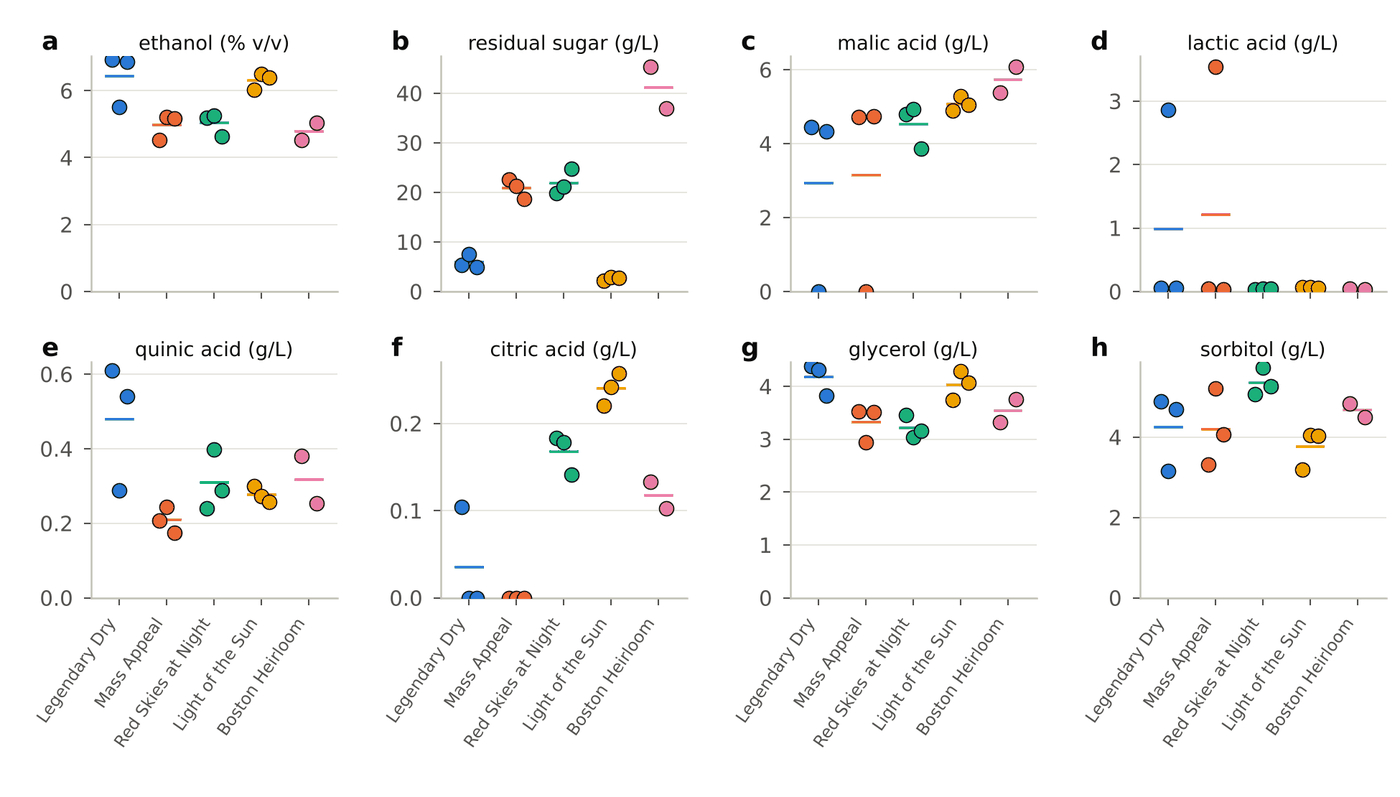
Table 12. Composition of fourteen lots of five Stormalong ciders (g/L unless stated otherwise).
| Product | Lot | Ethanol (% v/v) | Sugar | Sucrose | Fructose | Malic | Lactic | Succinic | Citric | Glycerol | Sorbitol | Methanol (mg/L) | kcal / 12 fl oz |
|---|---|---|---|---|---|---|---|---|---|---|---|---|---|
| Legendary Dry | A | 6.9 | 5.3 | nd | 2.56 | 4.45 | 0.05 | 0.65 | 0.10 | 4.38 | 4.89 | 152 | 162 |
| Legendary Dry | B | 5.5 | 7.4 | nd | 3.45 | nd | 2.86 | 1.13 | nd | 4.32 | 3.16 | 110 | 134 |
| Legendary Dry | C | 6.9 | 5.0 | nd | 2.45 | 4.32 | 0.05 | 0.59 | nd | 3.83 | 4.69 | 131 | 159 |
| Mass Appeal | A | 4.5 | 22.6 | 0.13 | 20.5 | 4.71 | 0.04 | 0.42 | nd | 3.53 | 3.32 | 137 | 136 |
| Mass Appeal | B | 5.2 | 21.2 | 4.56 | 13.0 | nd | 3.54 | 0.37 | nd | 2.94 | 5.21 | 116 | 148 |
| Mass Appeal | C | 5.2 | 18.7 | 1.69 | 15.5 | 4.74 | 0.04 | 0.55 | nd | 3.50 | 4.07 | 137 | 144 |
| Red Skies at Night | A | 5.2 | 19.8 | 4.59 | 11.9 | 4.80 | 0.03 | 0.55 | 0.18 | 3.46 | 5.06 | 142 | 147 |
| Red Skies at Night | B | 5.3 | 21.1 | 3.79 | 13.1 | 4.93 | 0.04 | 0.44 | 0.18 | 3.03 | 5.73 | 136 | 151 |
| Red Skies at Night | C | 4.6 | 24.8 | 2.77 | 15.4 | 3.86 | 0.05 | 0.47 | 0.14 | 3.16 | 5.26 | 108 | 142 |
| Light of the Sun | A | 6.0 | 2.1 | nd | 1.41 | 4.89 | 0.06 | 0.60 | 0.22 | 3.74 | 3.19 | 158 | 138 |
| Light of the Sun | B | 6.5 | 2.8 | nd | 1.85 | 5.29 | 0.07 | 0.72 | 0.24 | 4.28 | 4.05 | 207 | 150 |
| Light of the Sun | C | 6.4 | 2.8 | nd | 1.89 | 5.05 | 0.05 | 0.60 | 0.26 | 4.07 | 4.03 | 180 | 147 |
| Boston Heirloom | A | 4.5 | 45.4 | 8.04 | 28.0 | 5.38 | 0.04 | 0.45 | 0.13 | 3.31 | 4.84 | 132 | 171 |
| Boston Heirloom | B | 5.0 | 36.9 | 5.43 | 24.2 | 6.07 | 0.03 | 0.49 | 0.10 | 3.75 | 4.49 | 124 | 170 |
nd, not detected.
A second observation concerns two cans of the same batch of Downeast Original Blend, one of which had become overpressurized. The sound can contained 6.0 % v/v of ethanol and 51.8 g/L of sugar, the swollen can 6.8 % v/v and 32.7 g/L. Glucose had fallen by 55 % and fructose by 30 %, the order in which yeast consumes the two sugars, and the loss of 19 g/L of sugar is accompanied by a gain of 6.4 g/L of ethanol. The apparent yield of 0.33 g of ethanol per gram of sugar is below the 0.46 to 0.51 g/g of a fermentation, which is not surprising for two cans that need not have been identical when they were filled and one of which lost gas and vapor on opening. The can had refermented. The product is unfiltered and was, in the samples of 2015, preserved with sorbic acid at about 0.1 g/L, which evidently did not suffice in this can.