3. Cider: History, Practice and Chemistry
3.1 Cider in Europe through the ages
Fermented apple juice is probably as old as the cultivation of the fruit in temperate Europe, but its early history is thinly documented, because the classical authors did not distinguish it clearly from other fruit wines. Pliny, in the first century, records that wine was made from pears and from all kinds of apples, and the Hebrew shekar and the Latin sicera, from which the word cider descends, denoted any strong drink other than the wine of the grape.20,50 The first unambiguous references are Carolingian. The capitulary De villis, issued for the royal estates of Charlemagne about the year 800, requires every steward to keep men who know how to make beer, cider and perry, and it names the two fruit drinks separately, as pomatium and pyratium.50,51 By the later Middle Ages cider was established wherever the vine did not thrive: on the Atlantic coast of Spain, in Normandy and Brittany, and in the southern and western counties of England, where the Norman connection brought both varieties and practice.
On the Cantabrian coast the record begins with the orchards. A donation of the year 1014, by which Sancho the Great of Navarre endowed the monastery of Leyre, enumerates apple orchards among the properties and is regarded as the earliest written evidence of the Basque cider culture.52,53 In the sixteenth and seventeenth centuries the Basque whalers and cod fishermen who worked the waters off Newfoundland carried cider as the daily ration of their crews, two to three liters for each man.53 In neighboring Asturias cider (sidra) has remained the everyday drink to the present day, and the customs that surround it, among them the pouring of the cider from above the head into a wide glass held low, which aerates it at the moment of drinking, were inscribed in 2024 on the Representative List of the Intangible Cultural Heritage of Humanity.54 The natural ciders of both regions are considered in detail in Section 3.5.
In Normandy and Brittany cider gradually displaced beer as the common drink in the later Middle Ages, aided, according to tradition, by better varieties brought from Biscay, whose origin survives in Norman variety names such as Bisquet. The first printed treatise devoted to the subject, De vino et pomaceo, was published in 1588 by the Norman physician Julien Le Paulmier, who set cider above wine as a wholesome drink and described the varieties of the province.50,55 French practice developed the technique of keeving (défécation), in which pectin and nutrients are removed from the juice as a floating gel, so that the fermentation proceeds slowly and can be brought to rest with sugar remaining; the bottled, naturally sparkling cidre bouché that results is the model of the French style.24,27,56
England contributed the most extensive early literature. Cider appears in manorial accounts from the thirteenth century onward as a product and as a form of payment, and it is named in the English Bible of the Wycliffite translation, a copy of which at Hereford Cathedral is known for that reason as the Cider Bible.50 The seventeenth century was the age of improvement. Lord Scudamore propagated the Redstreak in Herefordshire, cider was bottled in the strong glass that the coal-fired English furnaces had begun to produce, and in 1662 John Beale reported to the Royal Society that a small quantity of sugar added at bottling made the cider sparkle, one of the earliest descriptions of a secondary fermentation in the bottle. John Evelyn collected this knowledge in Pomona (1664), and John Worlidge, in Vinetum Britannicum (1676), described the mill, the press and the management of the fermentation.50,57,58 The eighteenth century added two episodes of wider interest. The endemic colic of Devonshire, described by Huxham in the 1730s, was traced by George Baker in 1767 to lead that the acid cider dissolved from the presses and vessels, an early demonstration of a chemical cause of a dietary disease;59 and the cider excise of 1763 was met by riots in the cider counties and repealed in 1766. Farm cider remained part of the wages of agricultural laborers until the practice was prohibited in 1887, the year in which H. P. Bulmer began production at Hereford and the industrial phase of English cider making opened. The National Fruit and Cider Institute, founded at Long Ashton near Bristol in 1903, placed cider making on a scientific basis and devised the classification of cider fruit that is still in use (Section 2.2).24,26,50
The regions developed the styles that still define traditional cider. The naturally fermented, still and markedly acidic ciders of Asturias and the Basque Country, the bottle-conditioned ciders of Normandy and Brittany, whose residual sweetness is retained by a deliberately slow, nutrient-starved fermentation, and the dry, tannic ciders of the English West Country differ from one another in fruit, microbiology and chemistry.24,56,60–63 Other districts kept traditions of their own, among them the Apfelwein of Hesse and the ciders of Ireland, and present-day European production extends from industrial ciders made from concentrate to products with protected designations of origin, such as the ciders of the Pays d'Auge and of Cornouaille in France and the natural ciders of Asturias and the Basque Country.51,64
3.2 Cider in North America
Colonists brought seeds and scions with them, and for two centuries cider was the everyday drink of the rural North. It could be made on any farm from fruit that was otherwise of little value, it kept through the winter, and it was safer than water. An often-quoted estimate puts the consumption in Massachusetts in 1767 at more than a barrel, about 35 gallons, for every inhabitant, and the quantities consumed in the early republic are documented by Rorabaugh.20,65,66 Cider served as a means of payment and as an article of trade, that of Newark in New Jersey, made from the Harrison and Campfield apples, being the most celebrated,23 and it entered politics in 1840, when the supporters of William Henry Harrison made the log cabin and the barrel of hard cider the emblems of his campaign for the presidency.20 The decline during the nineteenth century had several causes that reinforced one another: the movement of the population into cities, the arrival of lager brewing with German immigration, the temperance movement, which was directed with particular force against the farm cider barrel, and finally national Prohibition, after which few orchards of cider fruit remained.20,21,25 The word itself changed its meaning. In American usage cider came to denote fresh, unfermented juice, and the fermented product had to be distinguished as hard cider, a convention that is followed in federal regulations to this day.67
The revival of the past two decades has been rapid. By 2023 about 1,070 producers were counted in the United States, roughly seven times as many as in 2011, cider was being made commercially in every state, and about half of the producers grew some or all of their own fruit.68 The structure of the market shifted at the same time. National brands, which had driven the first phase of the expansion, lost volume, while regional producers increased their share of off-premise dollar sales from 39 % in 2019 to 54 % in 2022.69 The scientific literature followed the industry: surveys of producers and of their research needs,32,33,70 evaluations of cider cultivars under North American conditions,30,31 studies of consumer perception and willingness to pay,71,72 and the development of sensory lexicons for American ciders.73–75 The ciders examined in this study reflect that market. They range from the sweetened, filtered and carbonated products of national brands to spontaneously fermented, bone-dry and sour ciders made by small producers in New York and New England.
3.3 The cider-making process
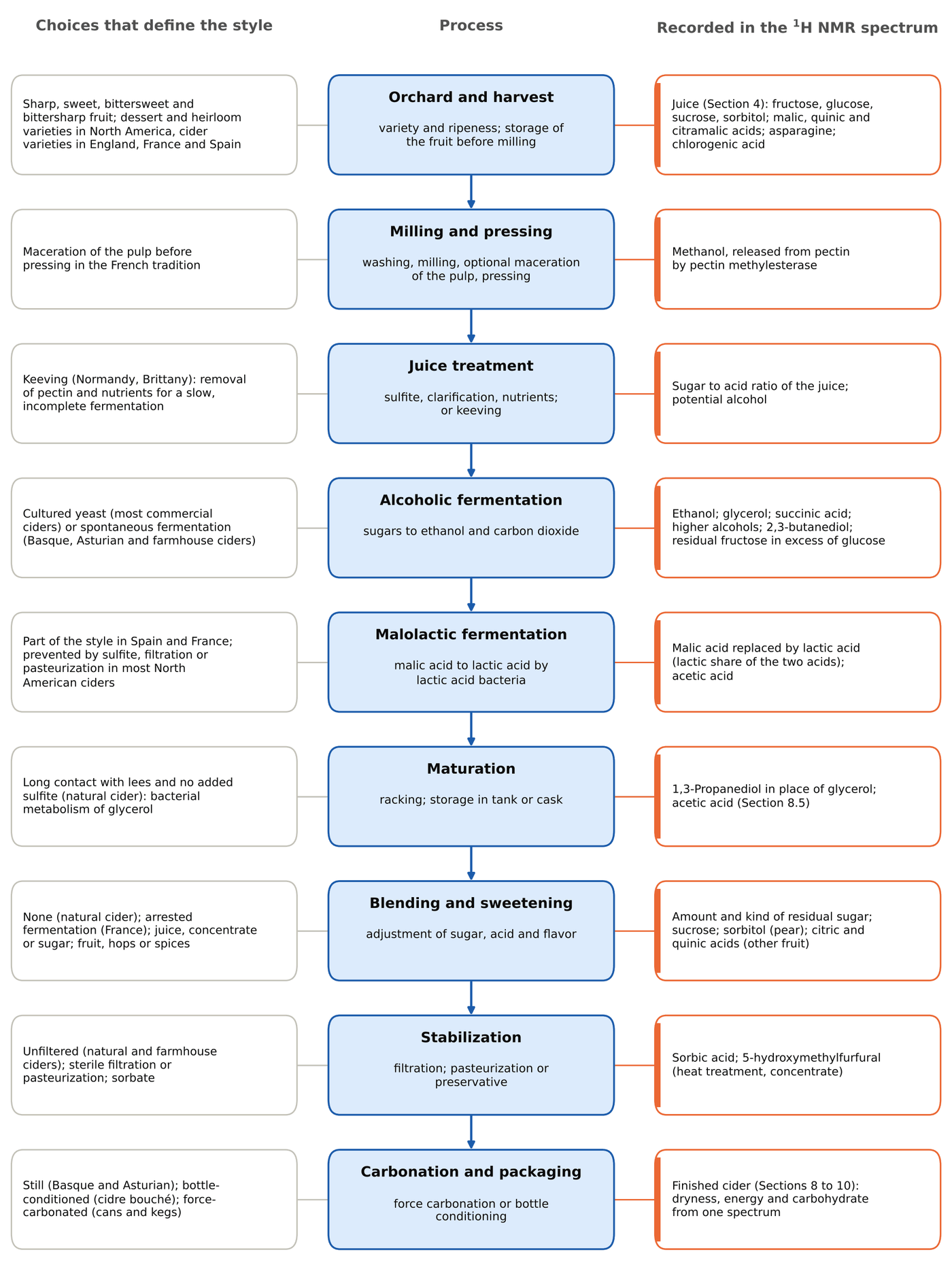
However different the styles, all ciders pass through the same sequence of operations, and the differences between them arise from a small number of choices made at each step. The sequence is set out in Figure 1, with the choices that define the principal styles at the left and, at the right, the constituents by which each step can be recognized in the ¹H NMR spectrum of the finished cider. The fruit is harvested ripe, in the traditional districts often after it has fallen, and may be stored for some weeks so that the starch is converted to sugar. It is washed, milled to a pulp and pressed; in the French tradition the pulp is left to macerate for some hours before pressing, which promotes the oxidation of the polyphenols and the release of pectin. The juice may then be sulfited to suppress the wild microflora, clarified with pectolytic enzymes, supplemented with nutrients or, in the opposite sense, deprived of them by keeving.24–27
The alcoholic fermentation is conducted either with a selected strain of Saccharomyces or spontaneously. In a spontaneous fermentation a succession of yeasts takes part: non-Saccharomyces yeasts such as Hanseniaspora and Metschnikowia in the first days, Saccharomyces species during the main phase, and frequently Brettanomyces during maturation.76–79 The malolactic fermentation may follow, accompany or be prevented, according to the style. The young cider is racked from its lees and matured in tank or cask, and it is at this stage, in ciders that are kept on their lees without sulfite, that the bacterial conversion of glycerol described in Section 3.5 takes place. Blending adjusts sugar, acid and tannin; sweetening, where it is practiced, is carried out with juice, concentrate or sugar, and fruit, hops or spices are added to flavored products. The cider is finally stabilized by filtration, pasteurization or the addition of sorbate and sulfite, and it is packaged still, carbonated under pressure, or conditioned in the bottle by a second fermentation.24,51,64 Each of these operations leaves a record in the composition. The fruit determines the acids, sorbitol and polyphenols; the fermentation leaves ethanol, glycerol, succinic acid and the higher alcohols; the bacteria exchange malic for lactic acid and, in some cases, glycerol for 1,3-propanediol; sweetening is recognized by the amount and the kind of sugar; and the preservative is itself observed. Sections 3.4 and 3.5 give the chemistry of these changes, and Section 8 reads the record in the ciders of this study.
3.4 The chemistry of cider making
The alcoholic fermentation converts the fermentable sugars of the juice to ethanol and carbon dioxide. A juice containing 110 g/L of sugars yields a cider of about 6.5 % alcohol by volume when fermented to dryness, and several by-products of yeast metabolism accumulate alongside the ethanol. Glycerol is formed in a quantity equal to several percent of the ethanol by mass,80 succinic acid at some tenths of a gram per liter,81 and smaller amounts of acetic acid, 2,3-butanediol and the higher (fusel) alcohols derived from amino acid metabolism.82,83 Methanol does not originate in fermentation; it is released from the methyl-esterified pectin of the fruit by pectin methylesterase, and its concentration depends on the fruit and on its processing.84 Sorbitol passes through the fermentation unchanged and contributes body and a residual sweetness even to a cider that contains no sugar.24
A second, bacterial transformation is at least as important for the character of the product. In the malolactic fermentation, lactic acid bacteria decarboxylate L-malic acid to L-lactic acid, which lowers the titratable acidity and replaces a sharp acid with a softer one.79,81,85 The conversion proceeds spontaneously in traditional French and Spanish ciders,60,61 whereas producers who value the fresh acidity of malic acid prevent it by sulfiting, sterile filtration or pasteurization. The same group of organisms is responsible for further changes. Heterofermentative strains raise the acetic acid content, and certain species convert the glycerol formed by the yeast to 1,3-propanediol, a transformation that is characteristic of natural cider and is described in Section 3.5.
Residual sweetness is obtained in several ways, and each leaves a recognizable composition. Fermentation may be arrested, by the keeving and repeated racking of the French tradition or by chilling and filtration, which leaves the natural sugars of the juice, enriched in fructose because yeast consumes glucose preferentially. A dry cider may be sweetened afterward with fresh juice or concentrate, which restores all three sugars together with malic acid and sorbitol, or with sucrose or another refined sweetener, which adds a single compound.24,51,86,87 Sucrose is hydrolyzed slowly at the pH of cider,88 so its presence indicates a comparatively recent addition, while its absence proves nothing. A sweetened cider that has not been pasteurized or sterile-filtered must be protected against renewed fermentation, and potassium sorbate is the usual means; sorbic acid is readily determined by ¹H NMR.89 Polyphenols and organic acids change comparatively little during the alcoholic fermentation,90–92 and the final composition therefore records, in addition to the process, something of the fruit.
3.5 Natural cider of the Basque Country and Asturias and the bacterial metabolism of glycerol
The Spanish quality standard distinguishes natural cider (sidra natural) from cider (sidra). Natural cider is made from fresh apples or their must alone, contains only sugar and carbon dioxide of endogenous origin, may not be sweetened with sucrose and has at least 5 % of alcohol by volume; cider, with at least 4 %, may be sweetened and carbonated. For both, the volatile acidity is limited to 2.2 g/L, expressed as acetic acid.93 The protected designation of origin Euskal Sagardoa, which covers natural cider made in the Basque Country from apples grown there, requires in addition an alcohol content above 5 %, a dry extract above 14 g/L, less than 100 mg/L of total sulfur dioxide and, in the specification published in 2023, no more than 0.2 g/L of glucose and fructose together; the cider is neither filtered nor carbonated.94
The process is the simplest of all cider-making methods and the one that depends most completely on its microorganisms. The apples, mostly acidic and bitter-acidic local varieties, are milled and pressed between late September and November, and the must ferments without added yeast in large vats of chestnut, oak or stainless steel in an unheated cellar. The alcoholic fermentation, carried out by a succession of indigenous yeasts, and the malolactic fermentation, carried out by indigenous lactic acid bacteria, proceed together or in close succession, so that the malic acid of the must has disappeared by the time the sugars are exhausted.61,76,95 The cider remains on its lees until it is tasted directly from the vat in the cider houses (sagardotegiak) during the txotx season, from January to April or May, and is then bottled without filtration. The product is still, cloudy, completely dry and sharply acidic, with lactic acid in place of malic acid and with a volatile acidity that is high by the standard of other ciders and belongs to the style.60,61,63,96
Because such a cider is neither heavily sulfited nor filtered, lactic acid bacteria remain active after the malolactic fermentation, and some of them attack glycerol, the principal by-product of the yeast. Lactobacillus collinoides, now classified as Secundilactobacillus collinoides,97 and related heterofermentative species possess a glycerol dehydratase that converts glycerol to 3-hydroxypropionaldehyde.98–100 The aldehyde is an intermediate (Figure 2). The cell reduces most of it to 1,3-propanediol, a reaction that regenerates the oxidized coenzyme required by the rest of its metabolism; a smaller part may be oxidized to 3-hydroxypropionic acid; and what escapes both reactions exists in solution in equilibrium with its hydrate and its dimer and can lose water to give acrolein.100,101 The strain studied by Claisse and Lonvaud-Funel could not grow on glycerol alone. It degraded glycerol only while it was fermenting glucose or fructose, fructose being preferred; 1,3-propanediol was the main product; and the presence of glycerol shifted the products of the bacterial metabolism from lactic acid toward acetic acid, because the reduction of the aldehyde takes over the disposal of the reducing equivalents.99
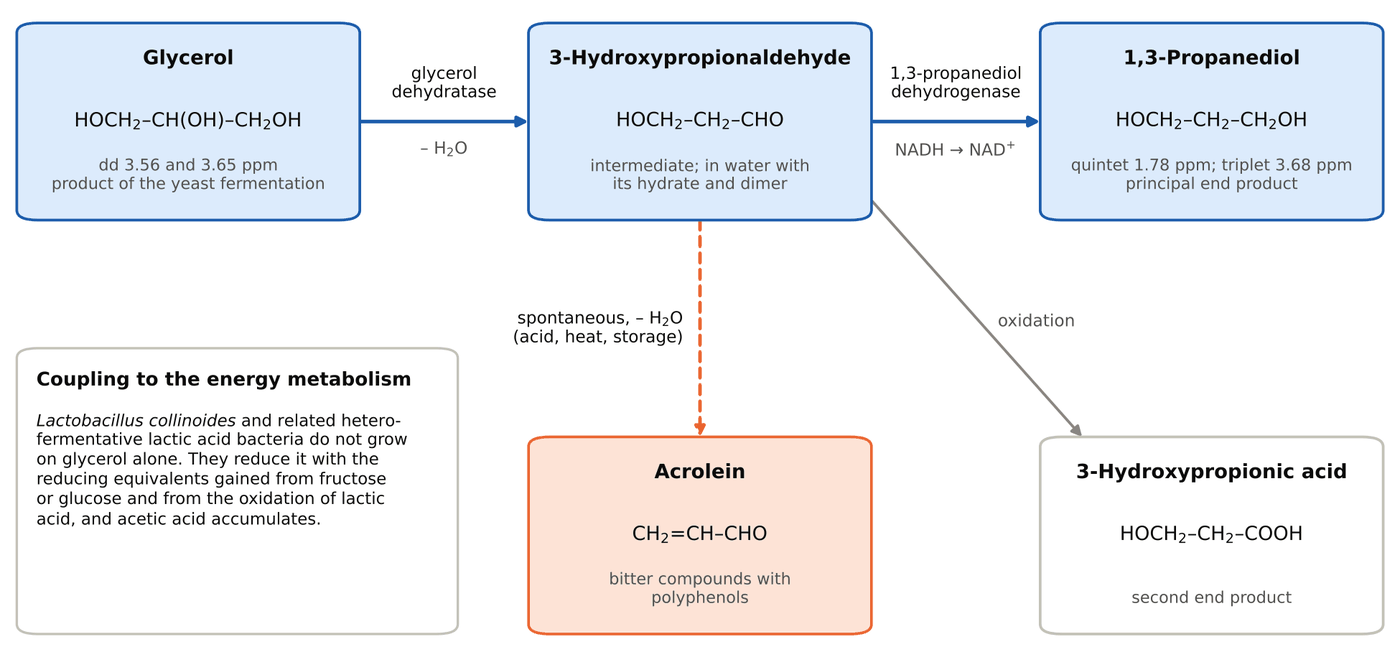
The consequences for the cider are of three kinds. Glycerol, which contributes to the body of a dry cider, is lost, in the extreme case completely. The acetic acid content rises. And acrolein, which is pungent, reacts with the polyphenols of the cider to give bitter products, the fault known in France as piqûre acroléique and the cause of the bitterness that is the most feared defect of Basque natural cider.100,102,103 1,3-Propanediol itself is without taste at the concentrations concerned, stable and not volatile, so that it remains in the cider as a permanent record of the conversion. In the ¹H NMR spectrum it gives a quintet at 1.78 ppm, in a region where no other constituent of cider interferes, and the spectrum therefore shows at a glance whether, and to what extent, the glycerol of a cider has been metabolized by bacteria. Section 8.5 applies this marker to the ciders of the present study, among them a natural cider from the Basque Country and eight American ciders in which the same conversion had taken place.
3.6 Dryness and its communication
No term on a cider label is used less consistently than dry. To a producer of traditional cider it means the absence of fermentable sugar; on the label of a mass-market product it has been applied to ciders containing 20 g/L of sugar or more. Three North American scales are used in this study. The American Cider Association endorsed, for use in its competition and in communication with consumers, four classes defined by residual sugar alone: dry below 9 g/L, semi-dry from 9 to 18 g/L, semi-sweet from 18 to 45 g/L and sweet above 45 g/L.104 The cider guidelines of the Beer Judge Certification Program use five classes with boundaries at 4, 9, 20 and 40 g/L.105 Both scales ignore what every taster knows, namely that acidity and astringency suppress the perception of sweetness.106–108 The orchard-based dryness scale introduced by the New York Cider Association, commonly called the Merlyn scale, addresses this by classifying on the ratio of residual sugar to titratable acidity, both in grams per liter, with boundaries at ratios of 1, 2 and 3, and by shifting the result toward the dry end for ciders of high polyphenol content.109,110 Sensory benchmarking has shown that the ratio predicts perceived dryness better than residual sugar alone, although a considerable part of the variance remains unexplained.111,112
European regulations also define their terms by residual sugar, but with boundaries that differ from the American ones and from one another. The Spanish standard designates cider as extra-seca up to 20 g/L, seca from 20 to 30 g/L, semi-seca from 30 to 50 g/L and dulce above 50 g/L.93 The French decree of 1953, which was in force when the French ciders examined here were made, defined brut as no more than 28 g/L, demi-sec as 28 to 42 g/L and doux as a higher sugar content combined with less than 3 % of alcohol; it has been replaced, with effect from July 2025, by a decree that defines the same terms by density and alcoholic strength.113,114 The terms of the European wine regulations, which are sometimes applied to cider, are stricter: dry means no more than 4 g/L, or 9 g/L where the acidity is sufficiently high.115 A cider with 25 g/L of residual sugar is thus semi-sweet in the United States, seca in Spain and brut in France, a difference of vocabulary that only a statement of the measured sugar content resolves. The definitions are collected in Table 2; their application to the ciders of this study, together with further scales that can be derived from the same spectrum, is the subject of Section 9.
Table 2. Definitions of the dryness scales and designations applied to the ciders.
| Scale | Basis | Classes and boundaries |
|---|---|---|
| American Cider Association104 | residual sugar (g/L) | Dry, below 9; Semi-Dry, 9 to 18; Semi-Sweet, 18 to 45; Sweet, above 45 |
| BJCP cider guidelines105 | residual sugar (g/L) | Dry, below 4; Semi-dry, 4 to 9; Medium, 9 to 20; Semi-sweet, 20 to 40; Sweet, above 40 |
| Orchard-based (Merlyn) scale of the New York Cider Association109,110 | residual sugar divided by titratable acidity (both in g/L), adjusted for polyphenols | Dry, ratio below 1; Semi-Dry, 1 to 2; Semi-Sweet, 2 to 3; Sweet, above 3; the ratio is lowered by 0.25, 0.5 or 0.75 for total polyphenols of 500 to 750, 750 to 1000 and above 1000 mg/L |
| Spain, Real Decreto 72/2017 (sidra)93 | residual sugar (g/L) | Extra-seca, up to 20; Seca, 20 to 30; Semi-seca, 30 to 50; Dulce, above 50 |
| France, decree of 1953113,114 | residual sugar (g/L) | Brut, up to 28; Demi-sec, 28 to 42; Doux, more than 35 (more than 42 for cidre bouché) with less than 3 % of alcohol by volume |
| European Union, terms for still wine115 | residual sugar (g/L), with allowance for acidity | Dry, up to 4 (up to 9 if the total acidity, as tartaric acid, is not more than 2 g/L below the sugar content); Medium dry, up to 12 (up to 18 if the acidity is not more than 10 g/L below); Medium, up to 45; Sweet, above 45 |
3.7 Nutrition labeling of cider in the United States
The labeling of cider in the United States is divided between two agencies according to the alcohol content. A cider of 7 % alcohol by volume or more is a wine within the meaning of the Federal Alcohol Administration Act and is labeled under the rules of the Alcohol and Tobacco Tax and Trade Bureau (TTB). A cider below 7 % is outside that definition, and its label falls under the food labeling regulations of the Food and Drug Administration, which require an ingredient list and, subject to the exemptions available to small businesses, a Nutrition Facts panel.67,116 The majority of the ciders on the market, and of those examined here, belong to the second group. A separate definition applies for the purposes of taxation, where the hard cider rate covers apple and pear wines of at least 0.5 % and less than 8.5 % alcohol by volume with limited carbonation.117 For products under its jurisdiction TTB permits voluntary statements of calories, carbohydrate, protein and fat and has published the analytical methods and tolerances that it applies,118,119 and in January 2025 it proposed a mandatory Alcohol Facts statement for wines, distilled spirits and malt beverages, giving the serving size, the alcohol content, the fluid ounces of pure alcohol, the calories and the carbohydrate, fat and protein of a serving, with a compliance date five years after publication of a final rule.120 The comment period closed in August 2025, and the rule had not been made final when this document was prepared. The proposal would reach cider of 7 % alcohol or more; cider below that strength would remain under the food labeling regulations.
Energy is calculated in both systems from the composition. The general factors of 4 kcal/g for carbohydrate and 7 kcal/g for alcohol go back to Atwater; the more exact specific factor for ethanol, 7.07 kcal/g, and the derivation of all such factors are given in USDA Agriculture Handbook No. 74.121 The food labeling regulations assign reduced factors to the sugar alcohols, 2.6 kcal/g in the case of sorbitol,116,122 and glycerol is counted at 4.32 kcal/g.123 Organic acids, which are not negligible in cider, are assigned 3 kcal/g in the conventions of the Food and Agriculture Organization and of the European Union.124,125 The TTB laboratory method for flavored malt beverages calculates the calories of a 12 fl oz serving as 3.55 × [6.9 A + 4 S + 2.4 (TC − S) + 4 P + 9 F], in which A, S, TC, P and F are the contents of alcohol, sugars, total carbohydrate, protein and fat in grams per 100 mL; a single factor of 2.4 kcal/g is thus applied to all carbohydrate other than sugars.119 ¹H qNMR delivers the terms of both calculations from one measurement, which is the reason for the attention given to nutrition labeling in Section 10.
3.8 ¹H NMR of apple juice, cider and related beverages
The assignment of the ¹H NMR spectrum of apple juice at high field was published by Belton and co-workers, who then used principal component and discriminant analysis of the spectra to distinguish juices of different varieties.47,48 Fruit juice authentication by NMR subsequently developed into a routine commercial service, in which several dozen compounds are quantified and the spectrum as a whole is compared statistically with a reference database of authentic juices,126–128 and it has been reviewed repeatedly in the wider context of food analysis.129–132 Related work addressed the detection of adulteration and of juice-to-juice addition,133–135 untargeted profiling of fruit metabolites,136,137 and the variety, growing system and storage of apples, studied in juices and, by magic angle spinning, in the intact tissue.138–143
Cider itself was investigated chiefly by the group of Berregi and del Campo in the Basque Country, who established ¹H NMR methods for chlorogenic acid,144 formic acid,145 malic and citric acids146 in apple juice, followed the ripening of cider varieties and classified their juices by the signals of polyphenols and acids,147,148 and later determined ethanol,149 lactic and acetic acids150 and acrolein103 in the finished cider. The fermentation of apple juice by different yeasts has been followed by NMR,151,152 the degree of polymerization of cider apple procyanidins has been measured,153 and the composition of ciders has been combined with stable isotope ratios as a guide to authenticity.154 The closest methodological relatives of the present work are the quantitative NMR procedures for wine155–159 and beer,160–163 the automated suppression of the water and ethanol signals that such procedures employ at high field,164 and recent demonstrations that the principal constituents of fermented beverages can be quantified at low field.165,166 The use of chemometrics with NMR data of foods, and the validation that such models require before they are relied upon, are discussed in several reviews.167–170