Abstract and Document Details
Abstract
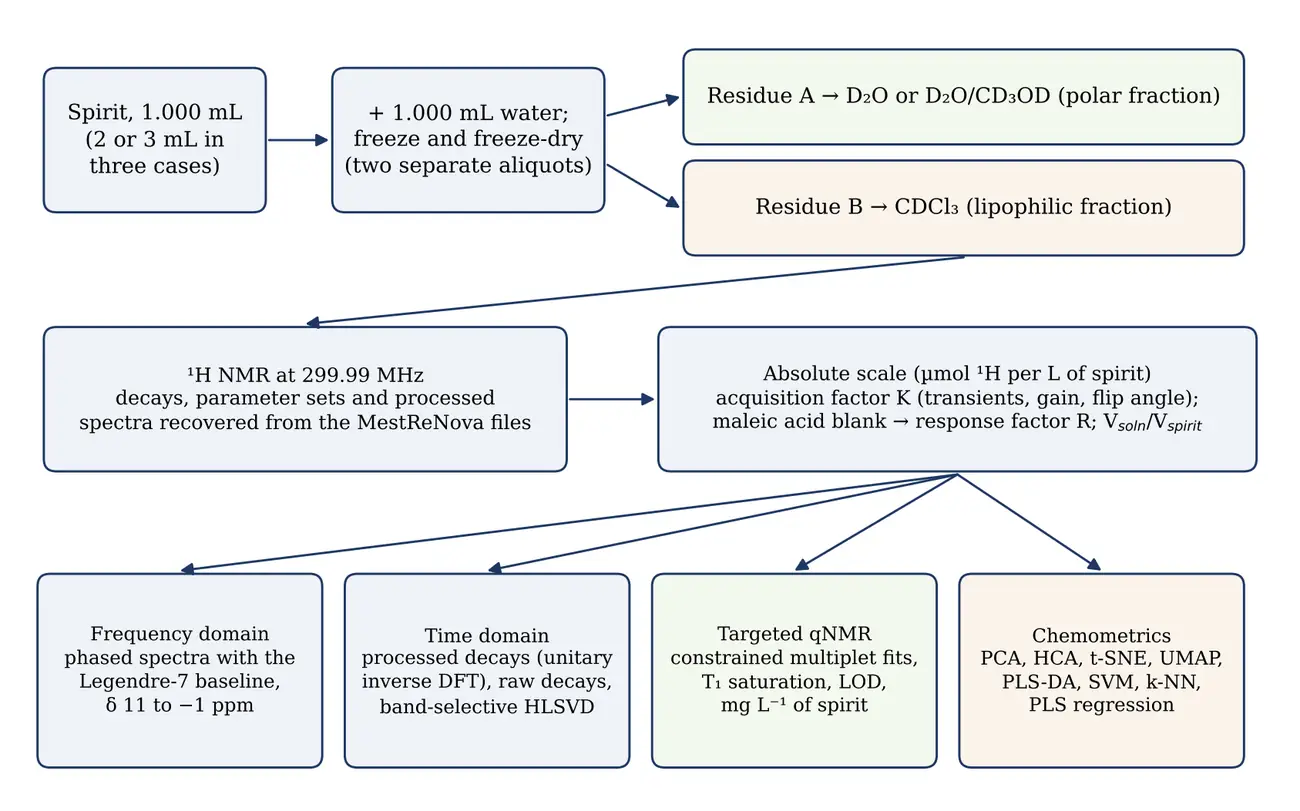
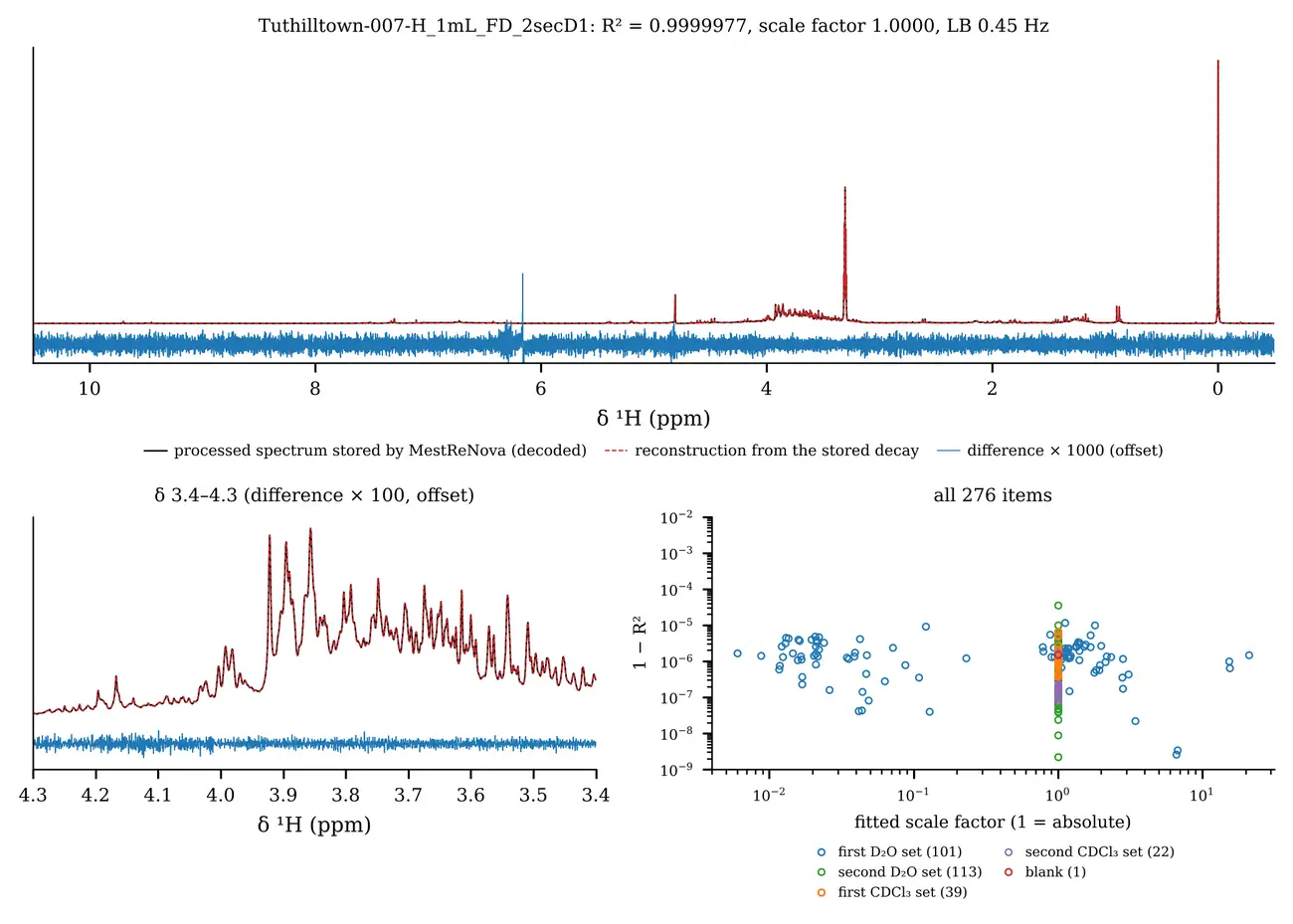
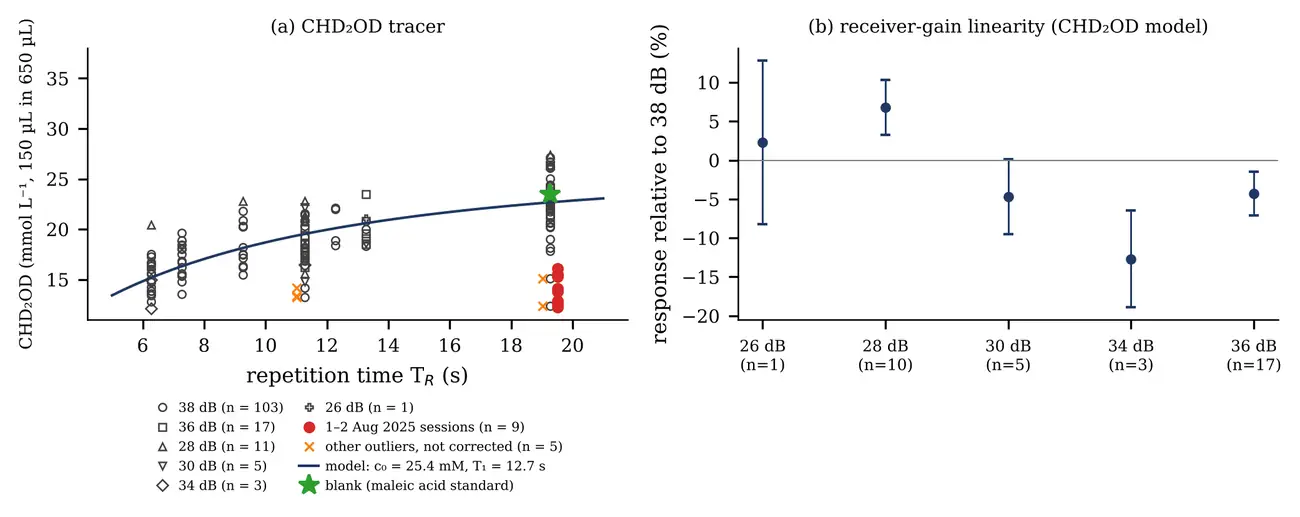
The non-volatile extract of an oak-aged spirit records its maturation, its cask history and any addition made after distillation, but in the native liquid that record lies beneath the ethanol and water signals that set the dynamic range of a ¹H NMR experiment. In this work the extract of 1.000 mL of spirit, diluted with 1.000 mL of water and freeze-dried, was redissolved in D₂O or D₂O/CD₃OD for the polar fraction and, from a separate aliquot, in CDCl₃ for the lipophilic fraction, and 197 D₂O and 61 CDCl₃ spectra of whiskeys, bourbons, rums, brandies and agave spirits were analyzed at 299.99 MHz. The complete acquired free-induction decays and parameter sets were recovered from the MestReNova documents, the processing was reproduced exactly from the decays, a silent normalization of the first data set was reversed, and every spectrum was placed on an absolute scale (micromoles of ¹H per liter of spirit) through an external maleic acid standard. The residual CHD₂OD of the CD₃OD, measured on that scale, agreed with the same signal in the standard within 3.4 %, validated the transient, gain and volume corrections, revealed that twenty solvent labels were wrong, and exposed two acquisition sessions in which nine spectra had lost 29–46 % of their sensitivity, which was corrected.
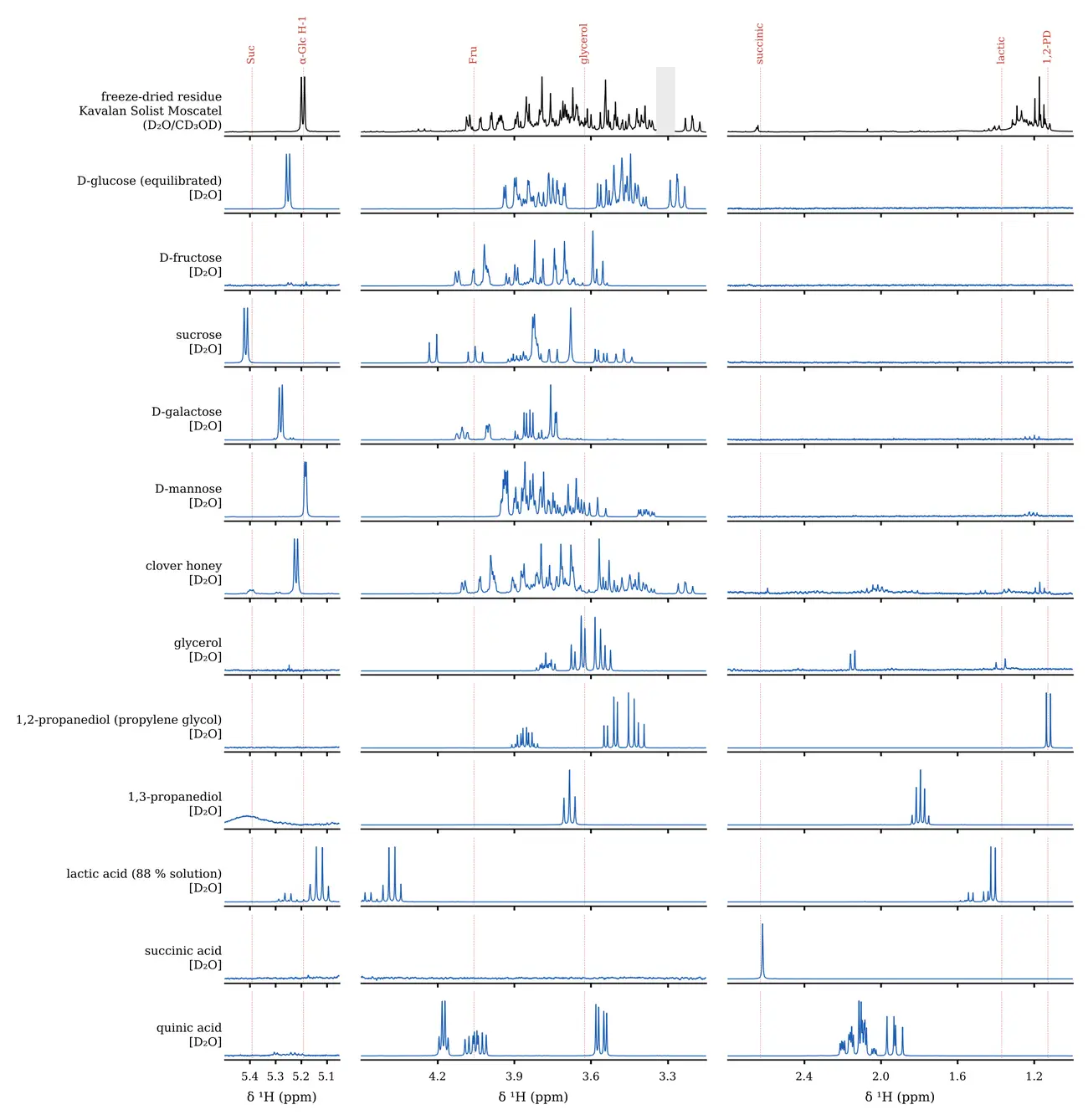
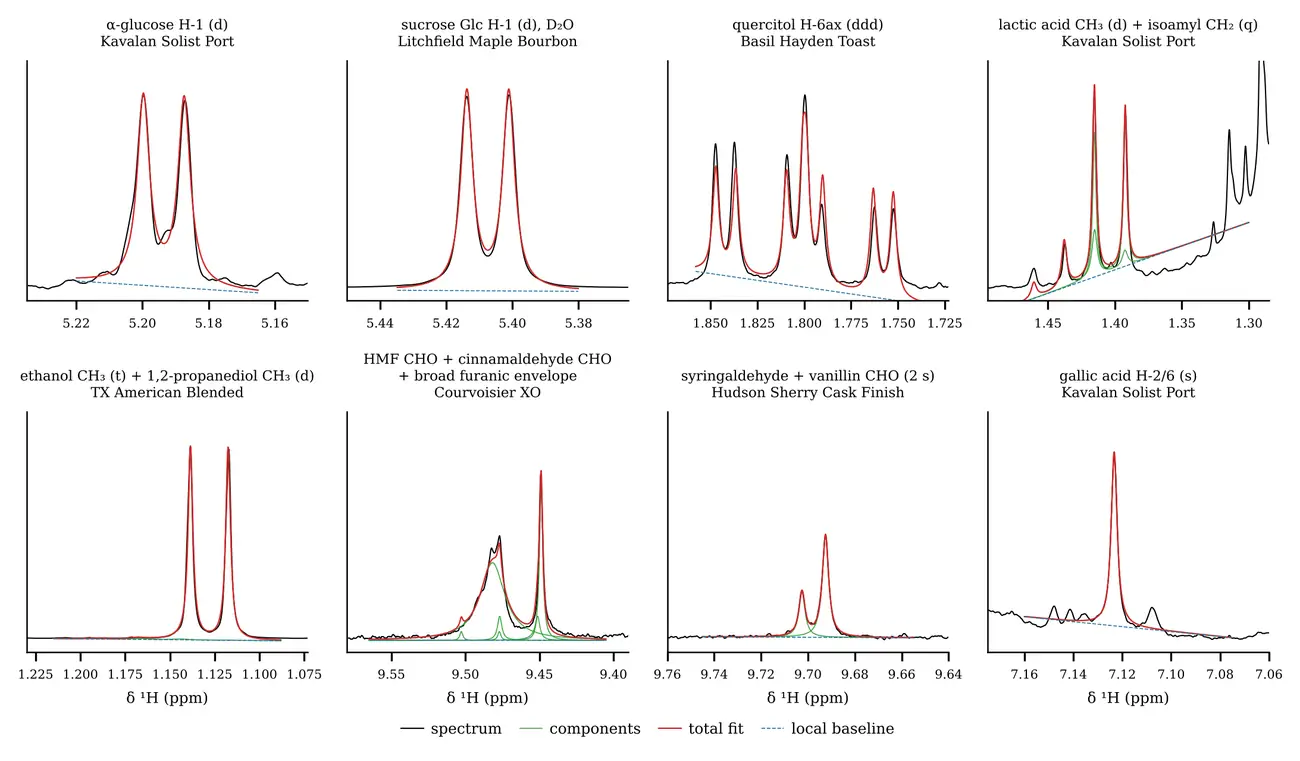
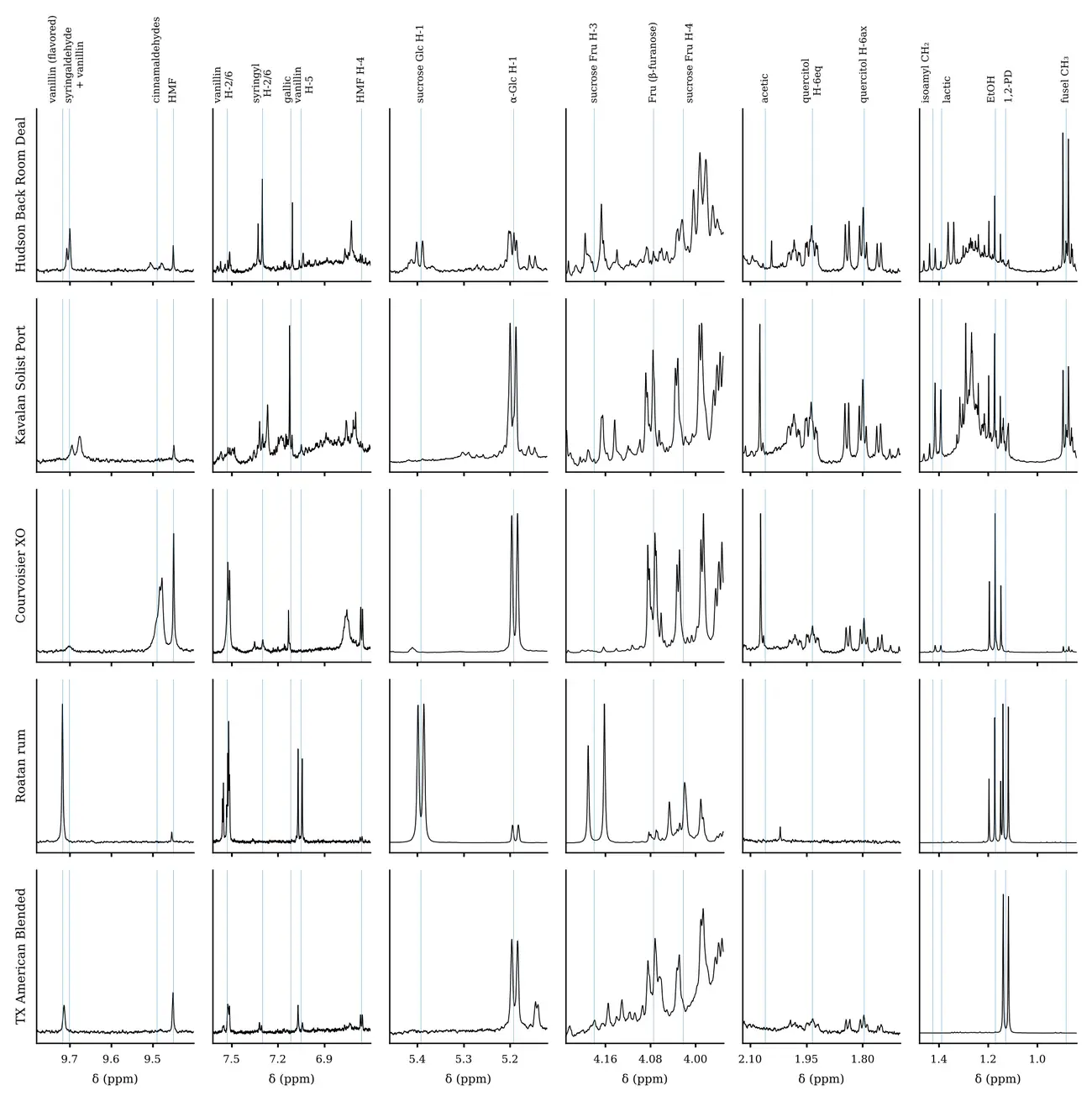
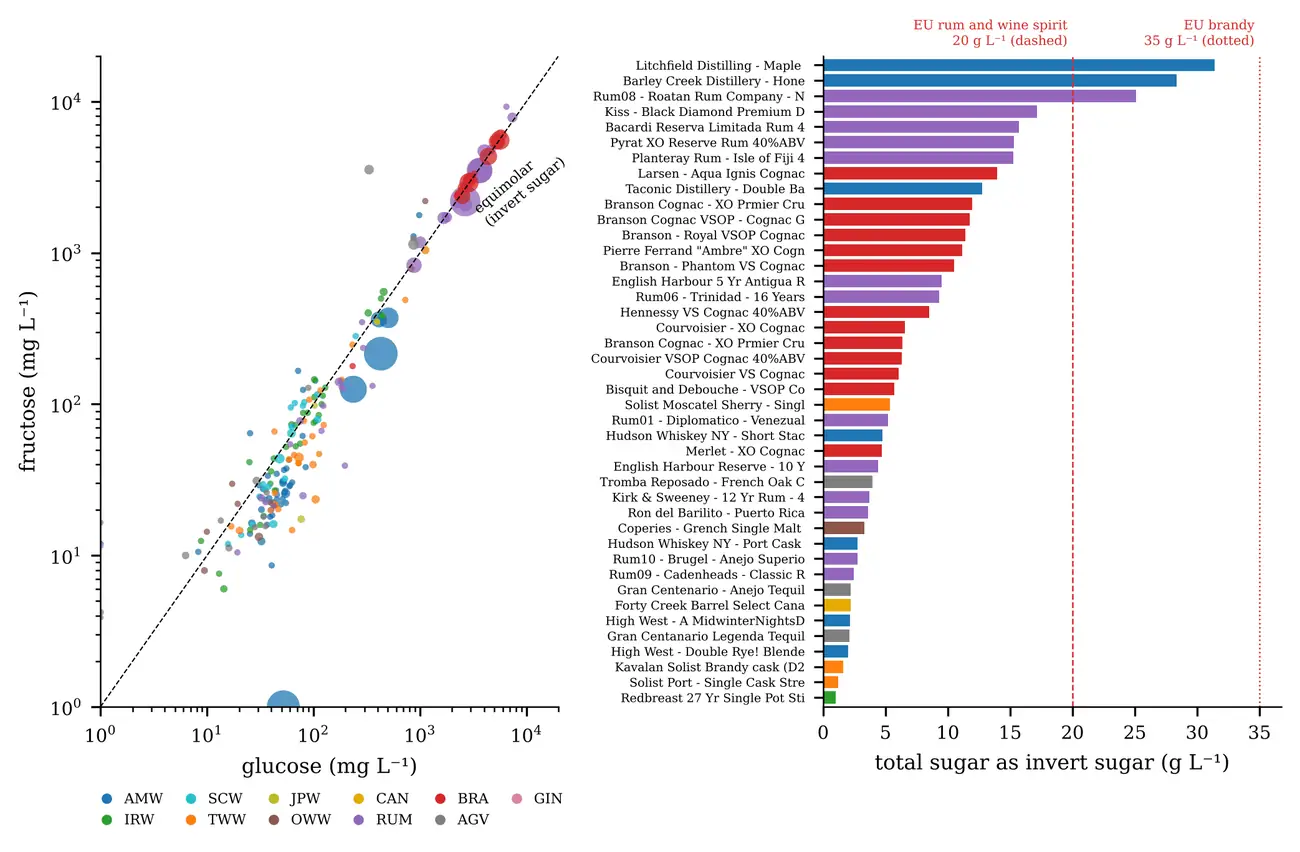
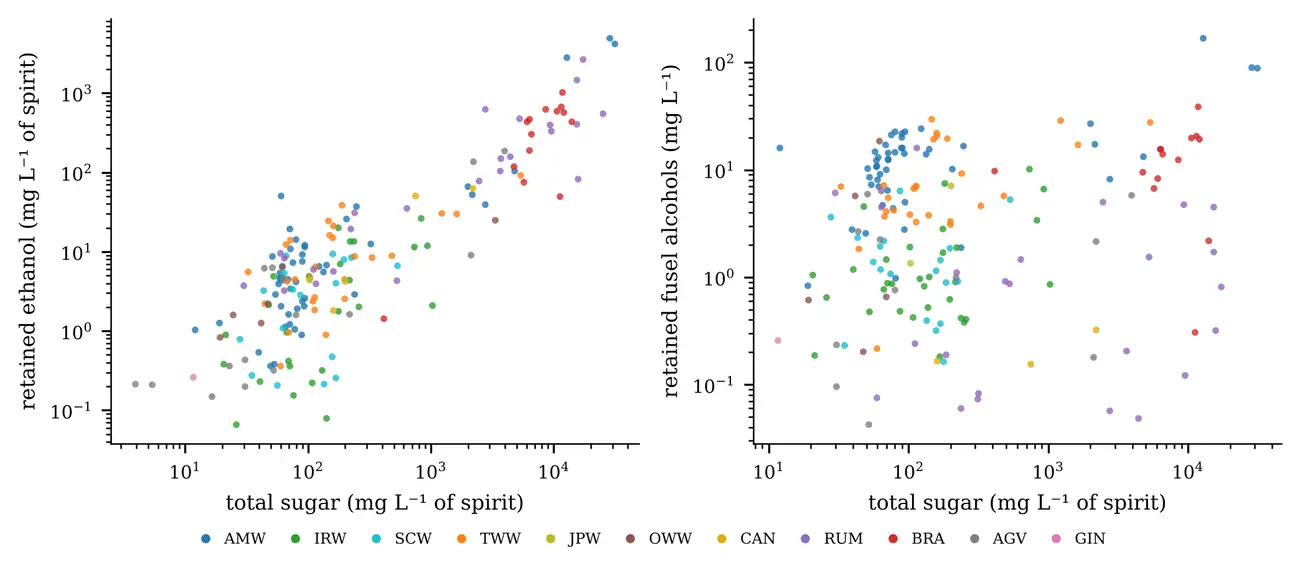
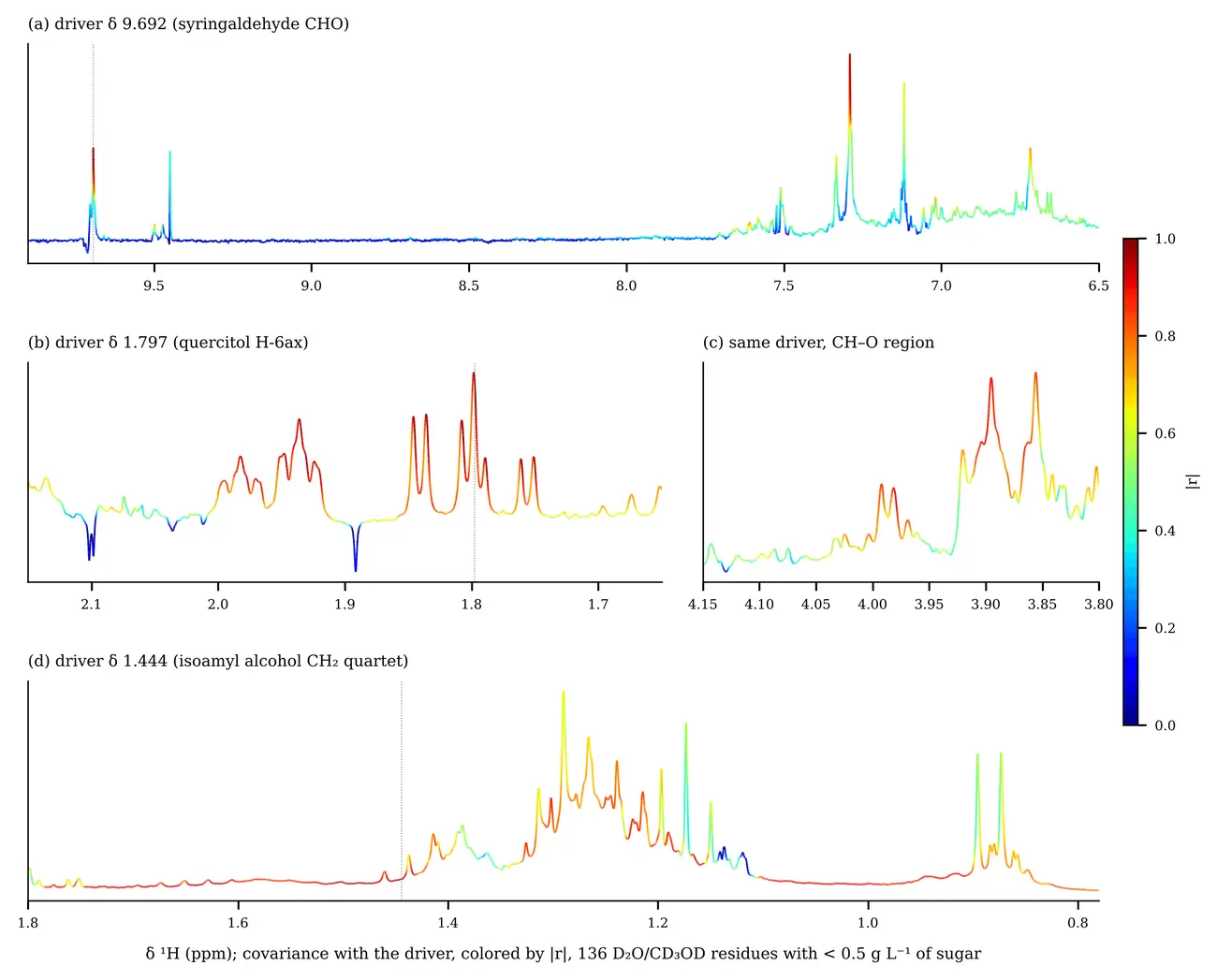
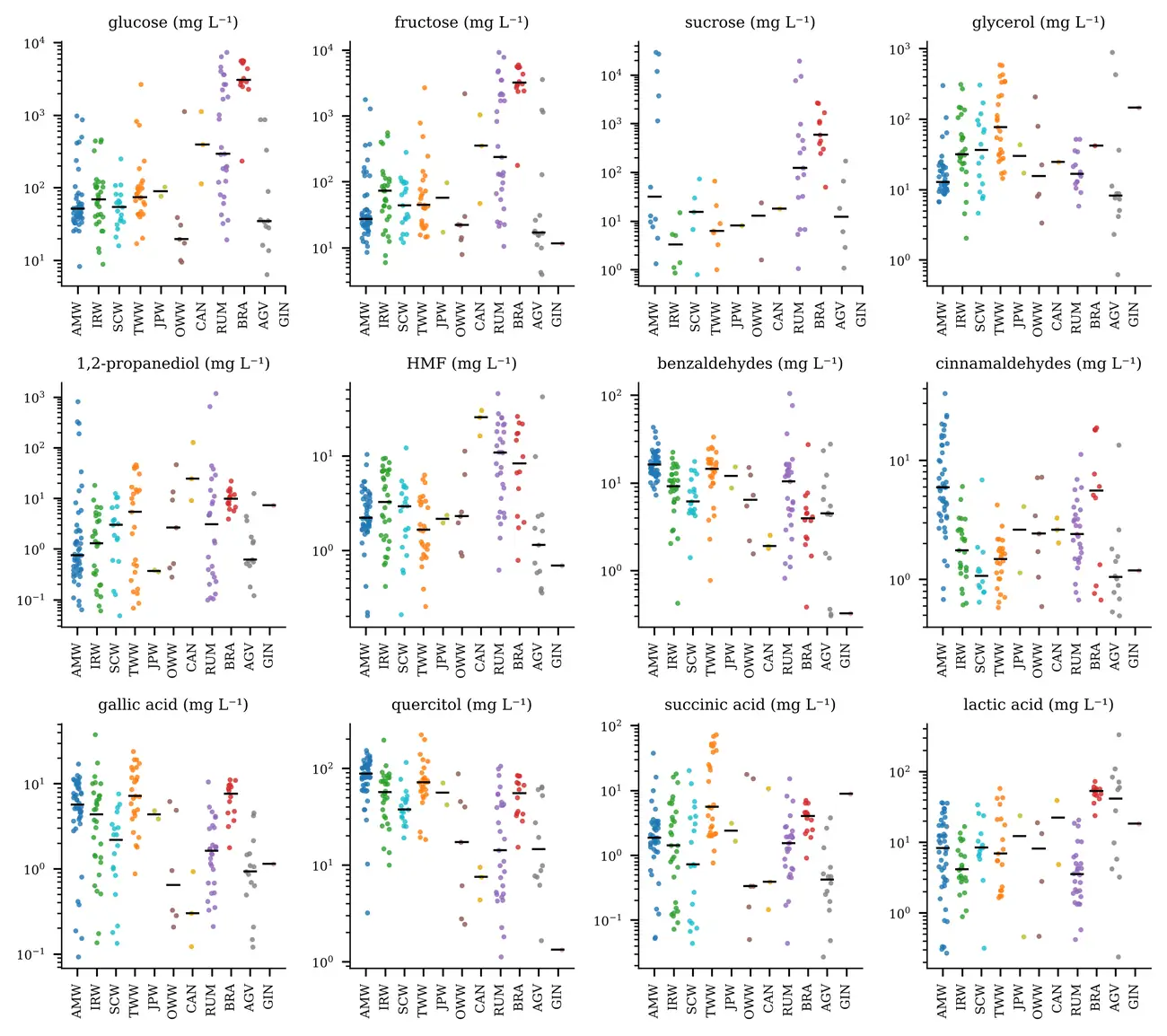
Constrained multiplet fitting with relaxation corrections and detection limits quantified 17 congeners or congener groups in the polar residues and 13 in the lipophilic residues. Cognacs contained 4.7–14.0 g L⁻¹ of sugar, mostly as equimolar glucose and fructose; eight of 29 rums contained 5–25.1 g L⁻¹ of sucrose or invert sugar; two maple bourbons and a honey whiskey contained 11.8–29.2 g L⁻¹ of sucrose; and unsweetened whiskeys contained only 0.04–0.21 g L⁻¹ (10th–90th percentiles) of the cell-wall sugars that oak releases. Vanillin without syringaldehyde, accompanied in two cases by 1,2-propanediol, identified flavor preparations in two rums and an American blended whiskey. Quercitol (median 88.2 mg L⁻¹ in American whiskeys), the benzaldehydes, gallic acid and the cinnamaldehydes traced oak contact; glycerol, succinic and lactic acid traced wine-cask seasoning; and a broad formyl envelope at δ 9.48 is proposed as a caramel index. A reposado tequila contained 3.54 g L⁻¹ of fructose with little glucose, the composition of a fructose-rich syrup of the kind permitted in an abocado tequila; the gram-per-liter glycerol that a single-multiplet fit had assigned to the same residue was shown, from the second glycerol multiplet, to be the β-pyranose H-1b doublet of fructose, and glycerol in sugar-rich residues is therefore reported only where both of its multiplets agree. Retained ethanol followed the sugar content of the residue (ρ = 0.77), as volatile trapping in a carbohydrate glass predicts. Residues of the same product prepared under different sample numbers differed by up to a factor of 3.1 in non-volatile content, whereas the one true replicate preparation of a single bottle agreed within 9 %, which identifies bottle-to-bottle variation and recovery through freeze-drying as the dominant unvalidated steps.
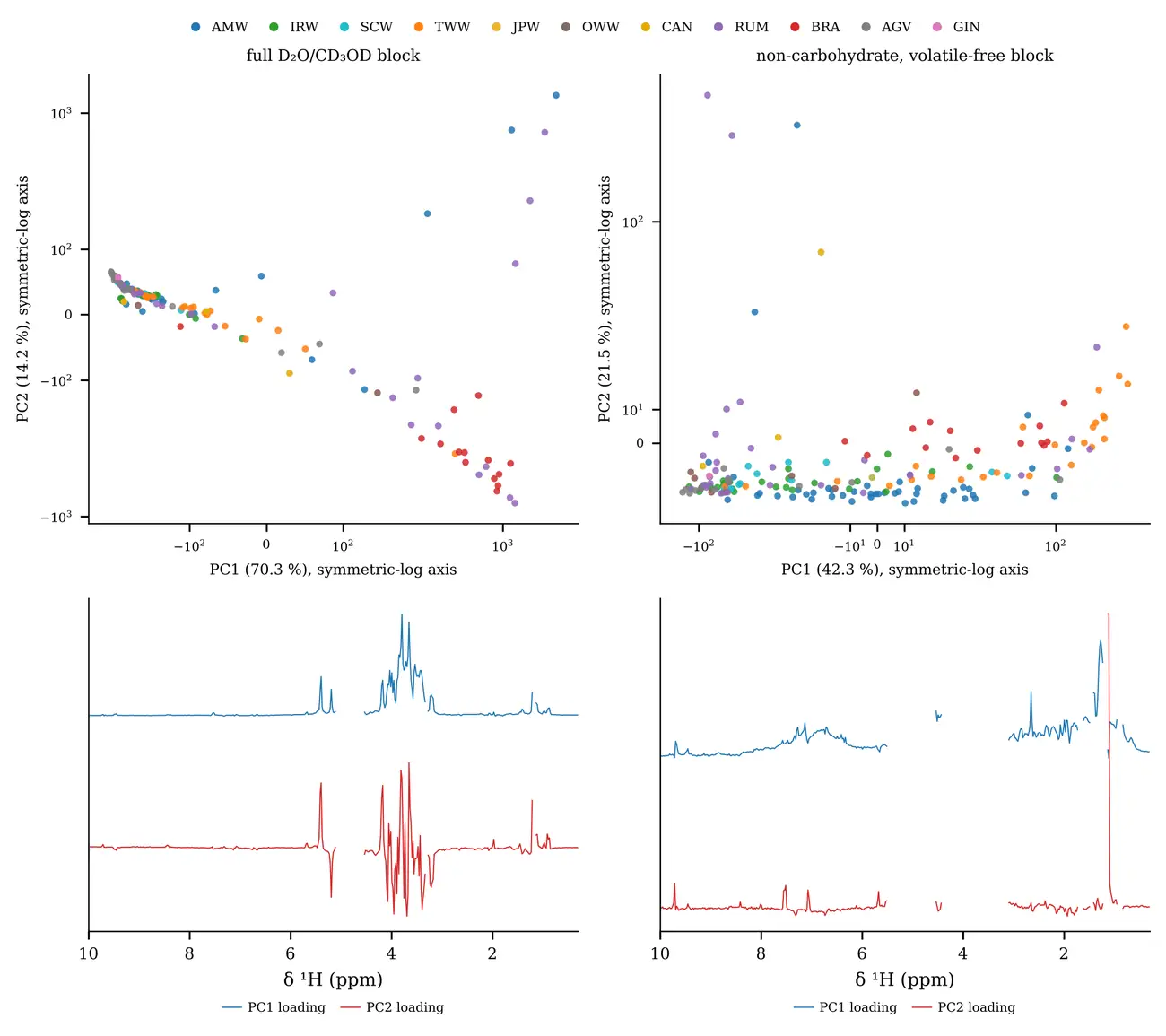
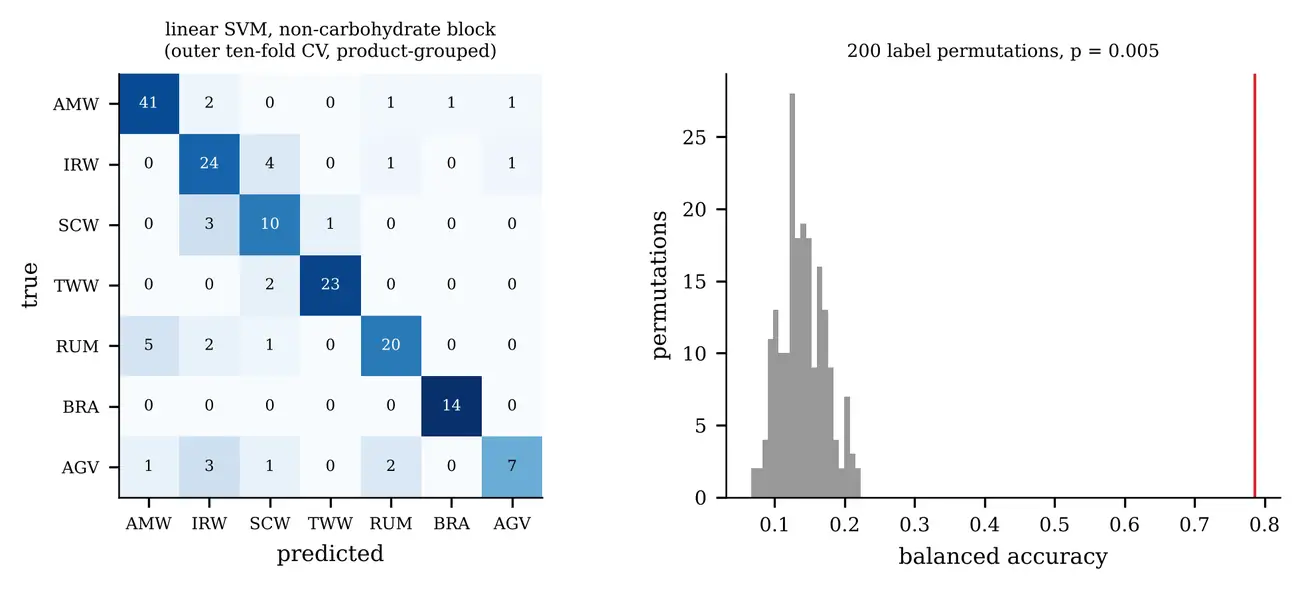
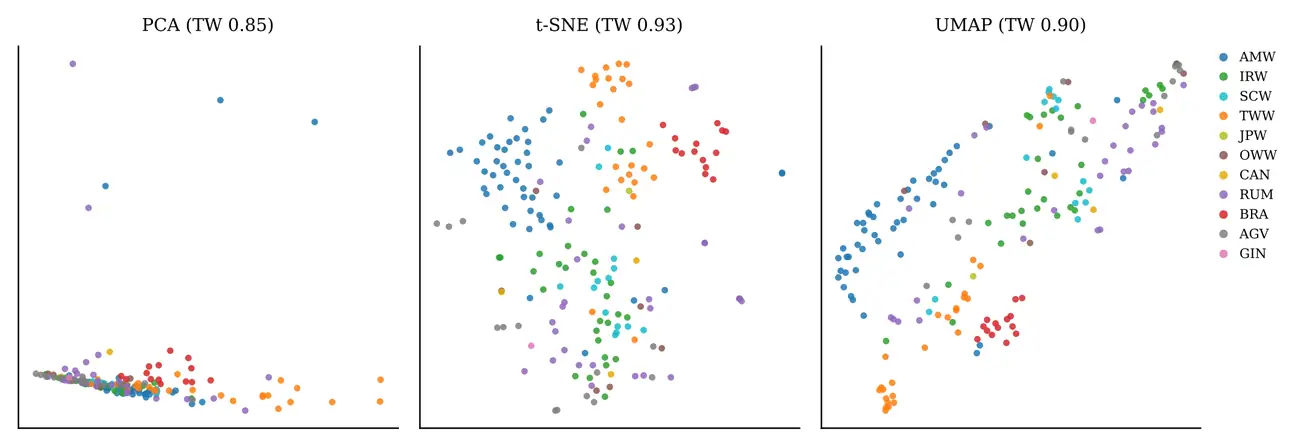
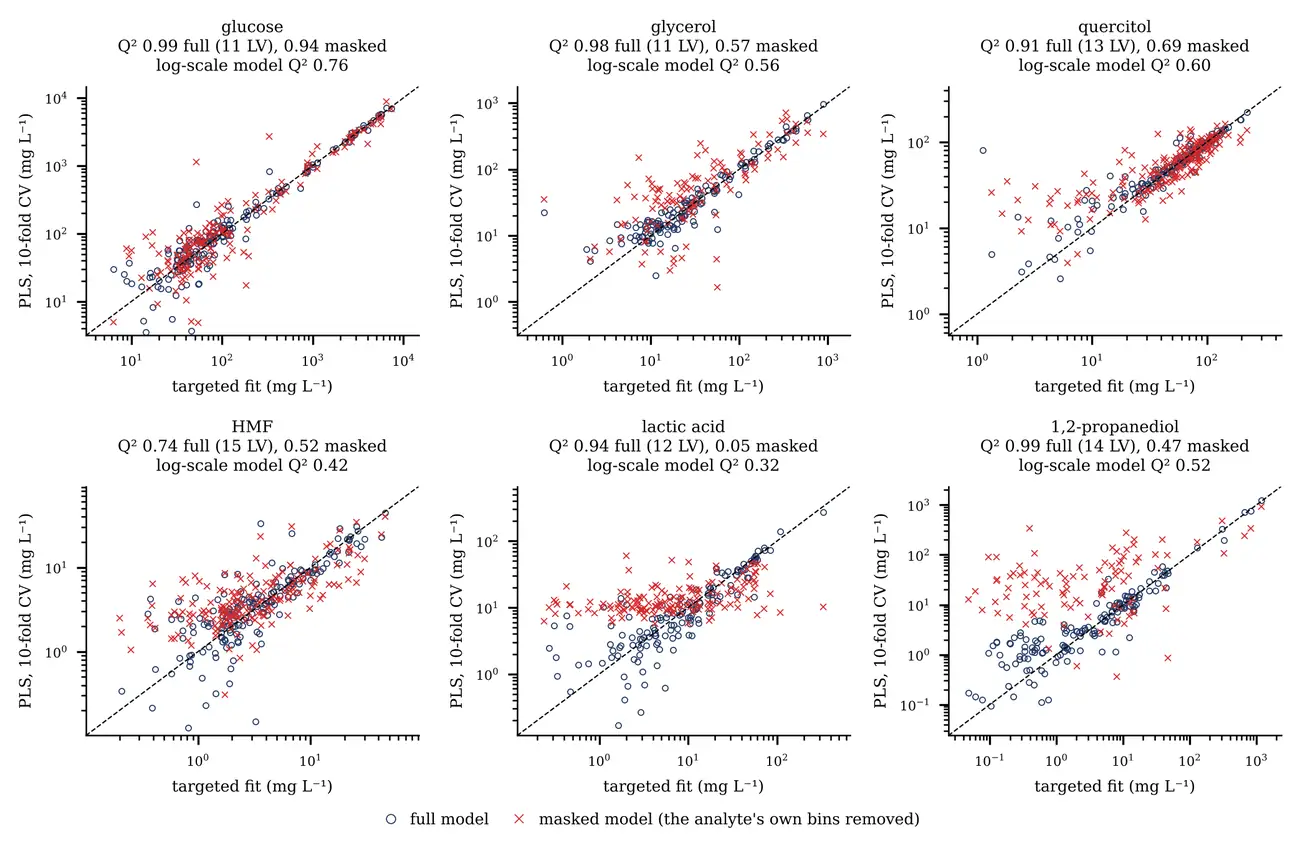
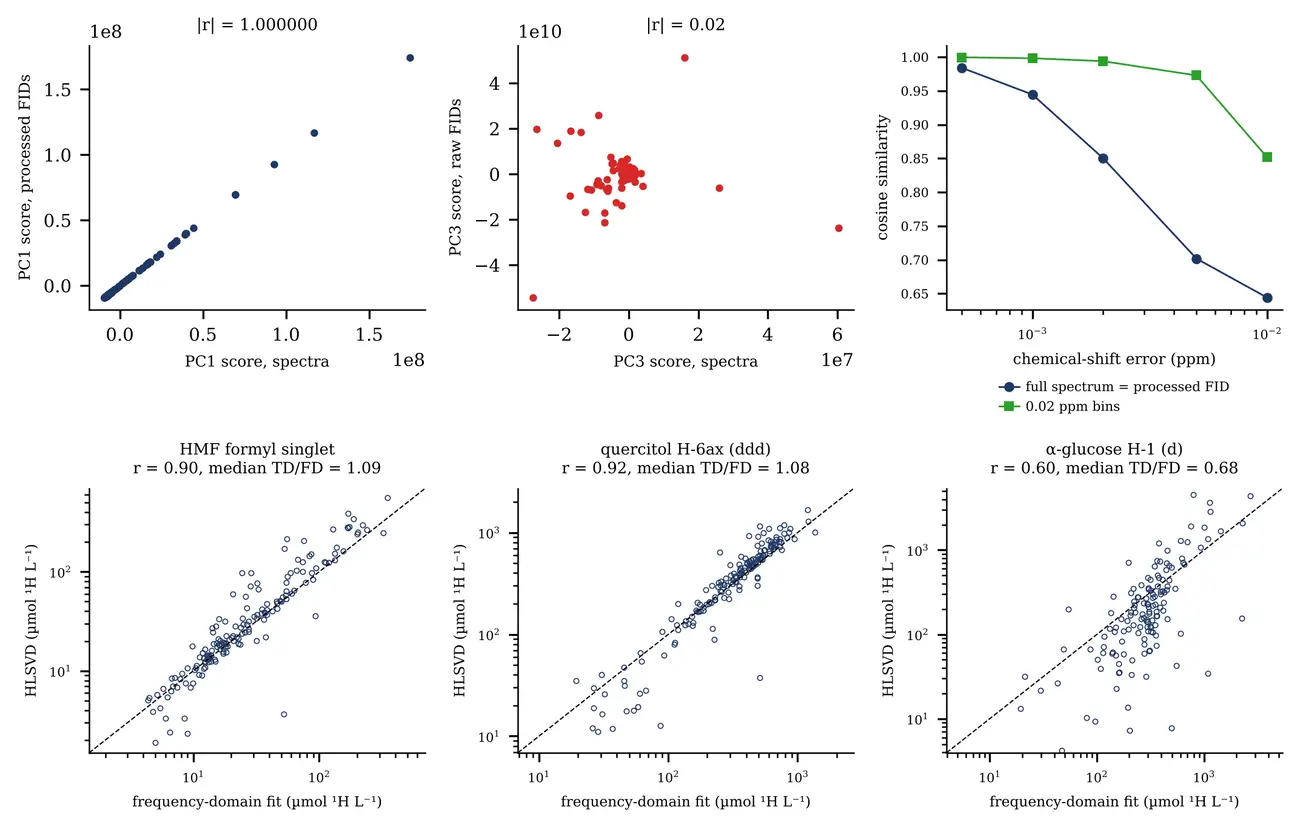
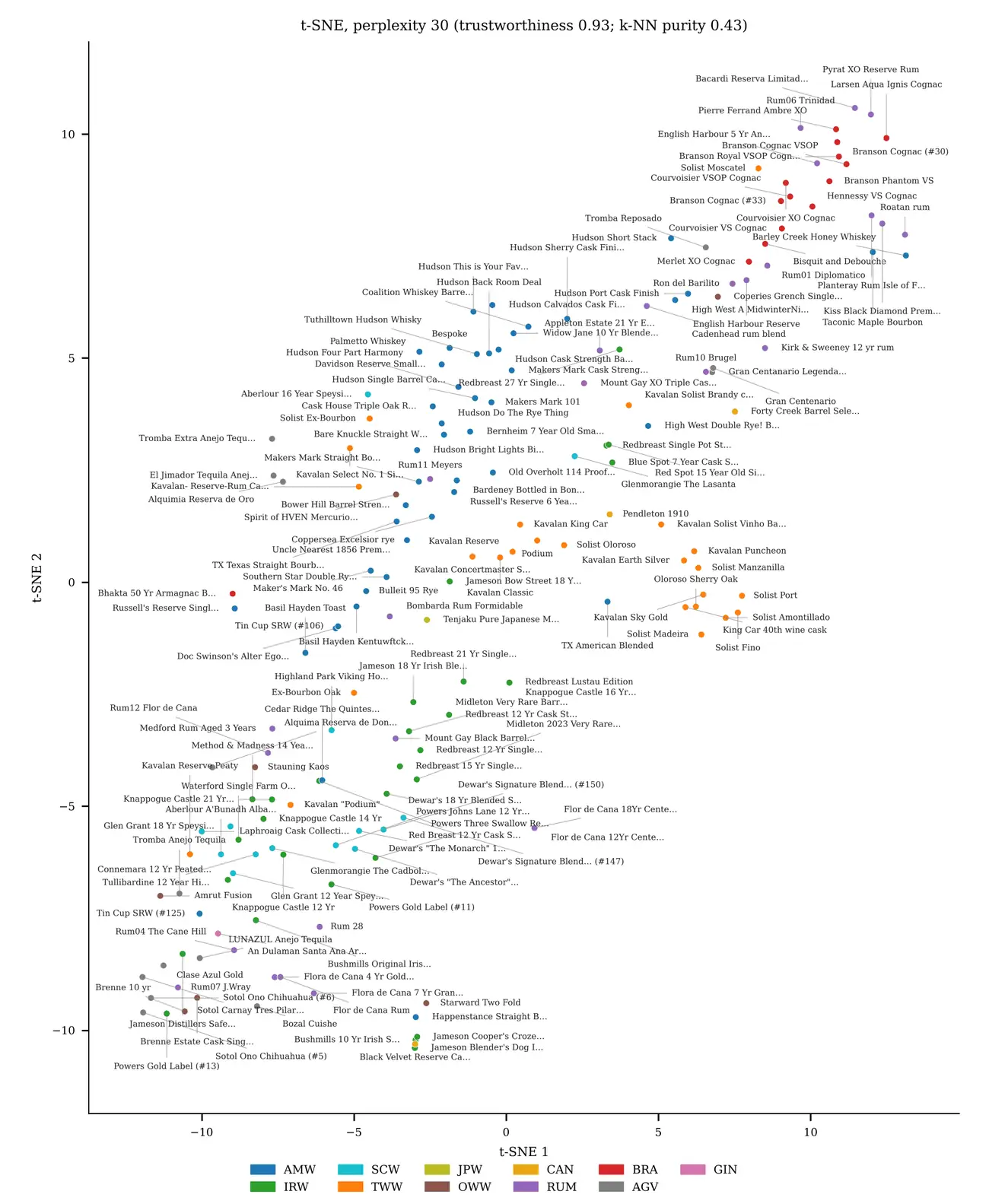
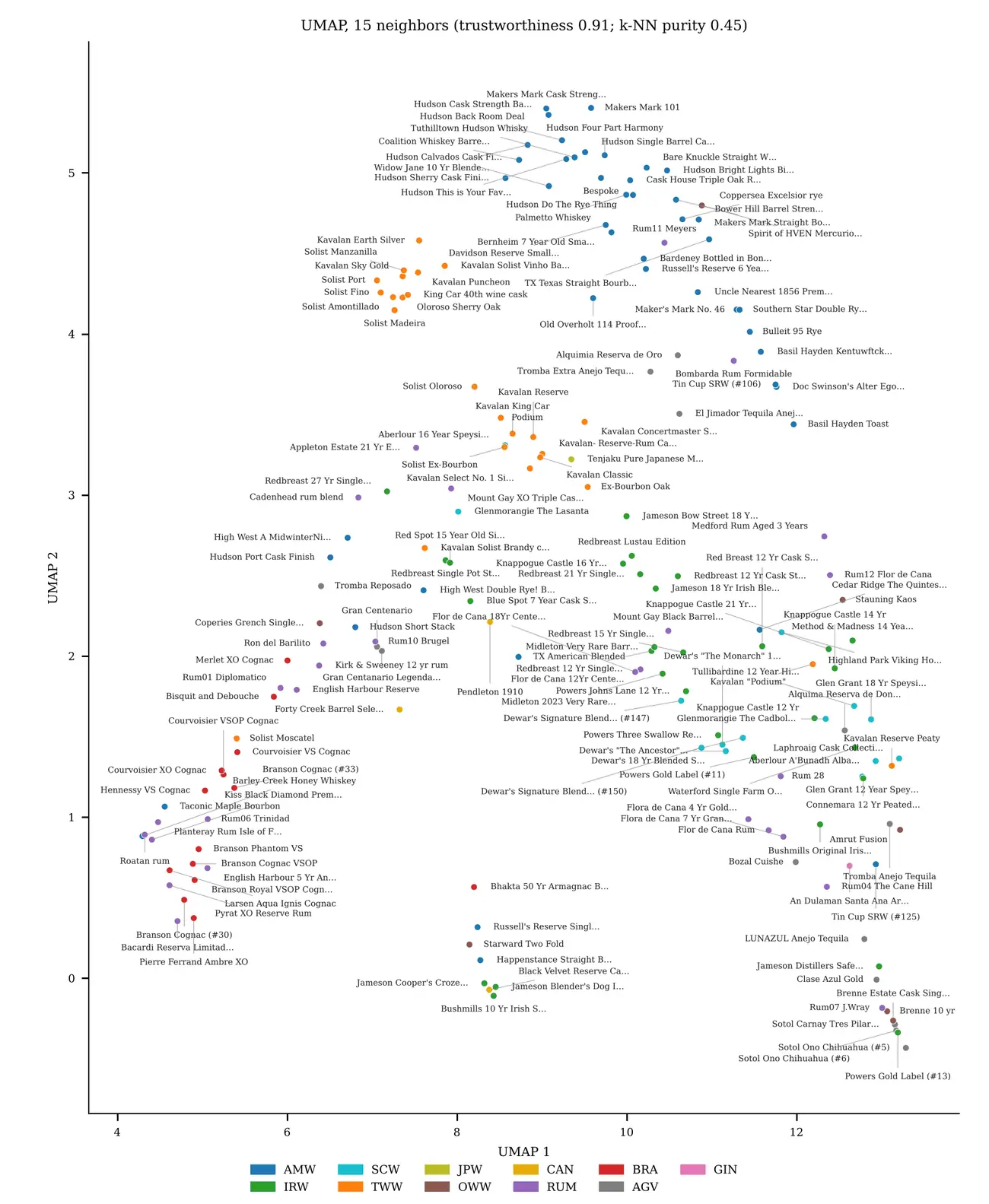
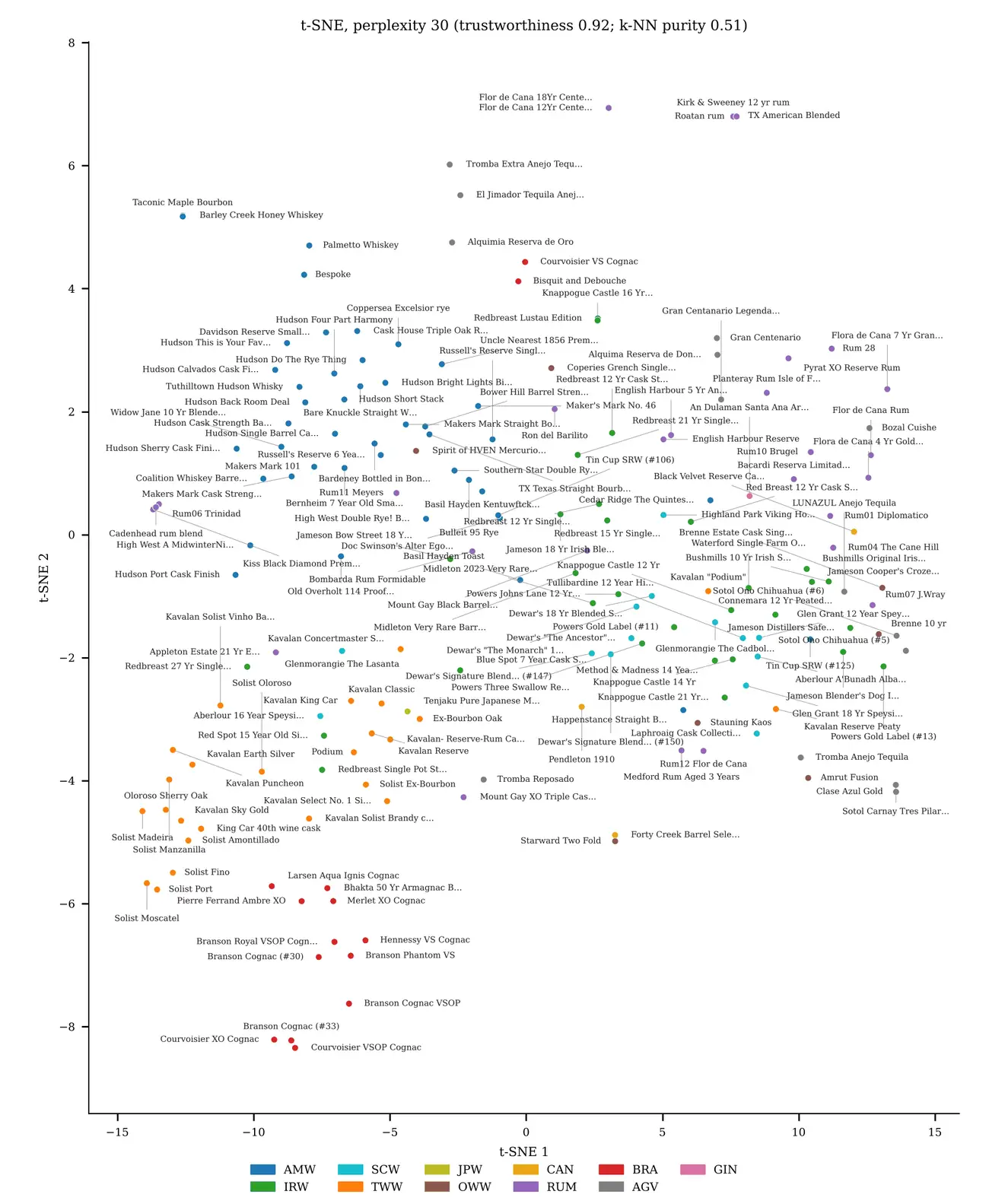
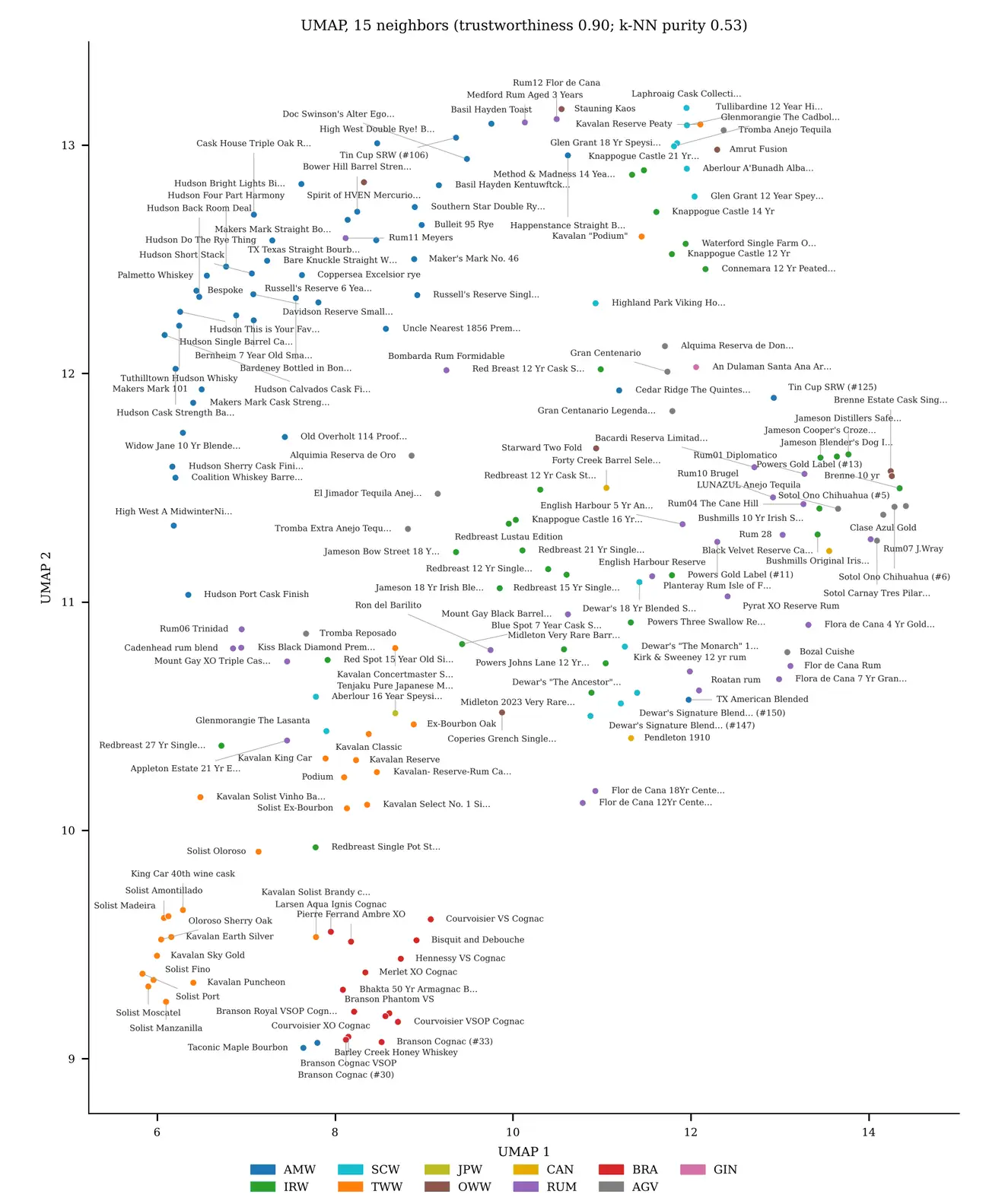
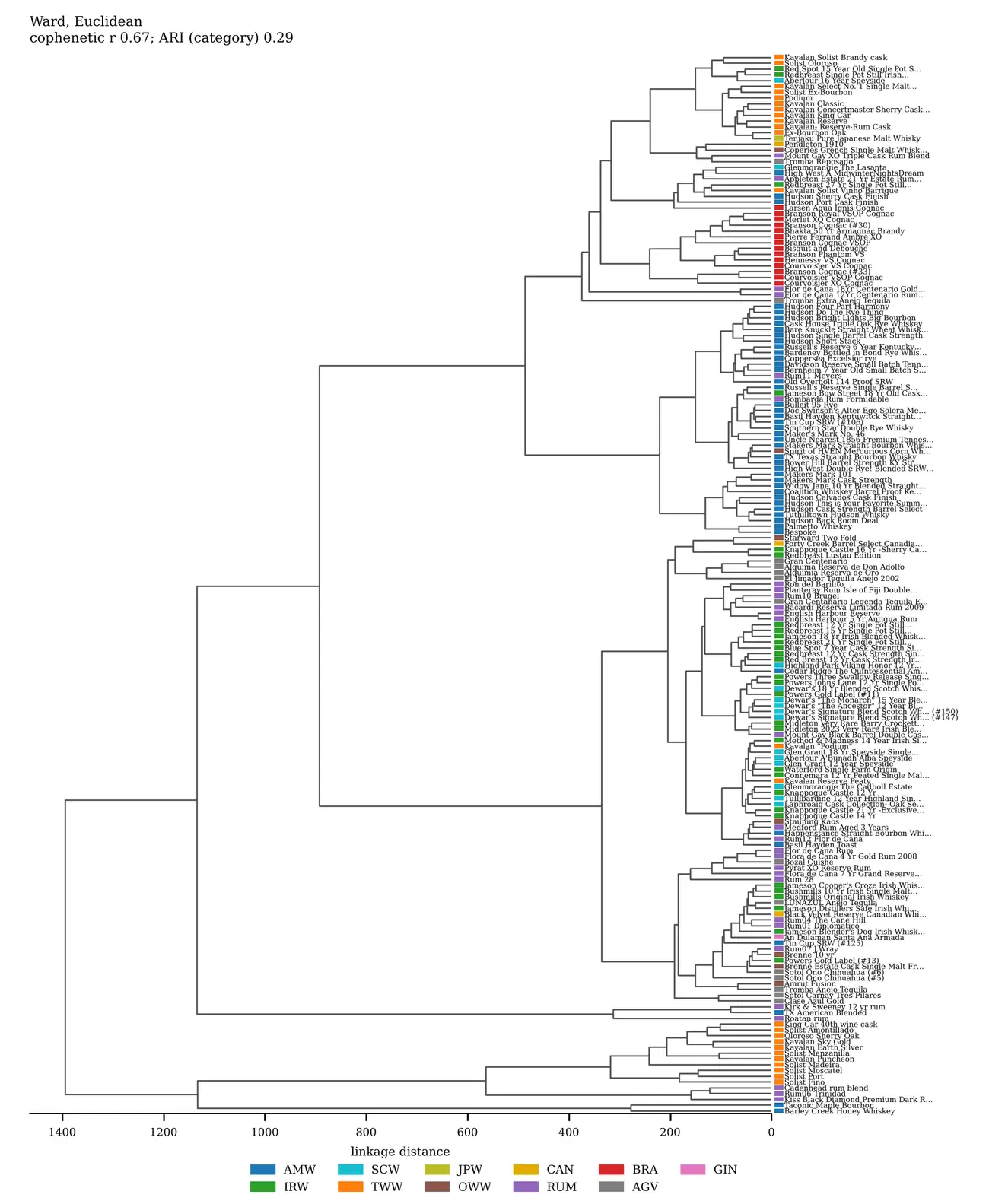
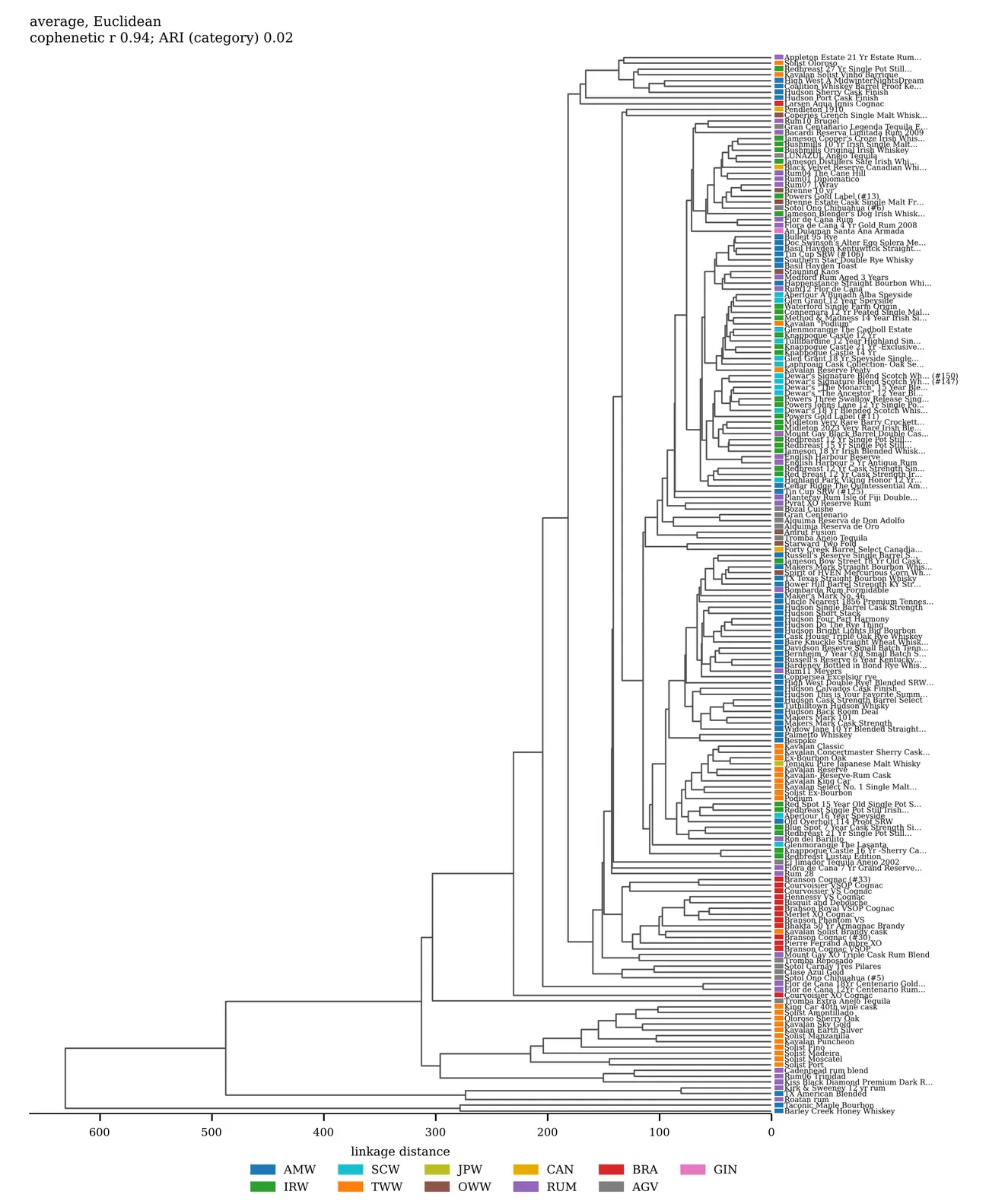
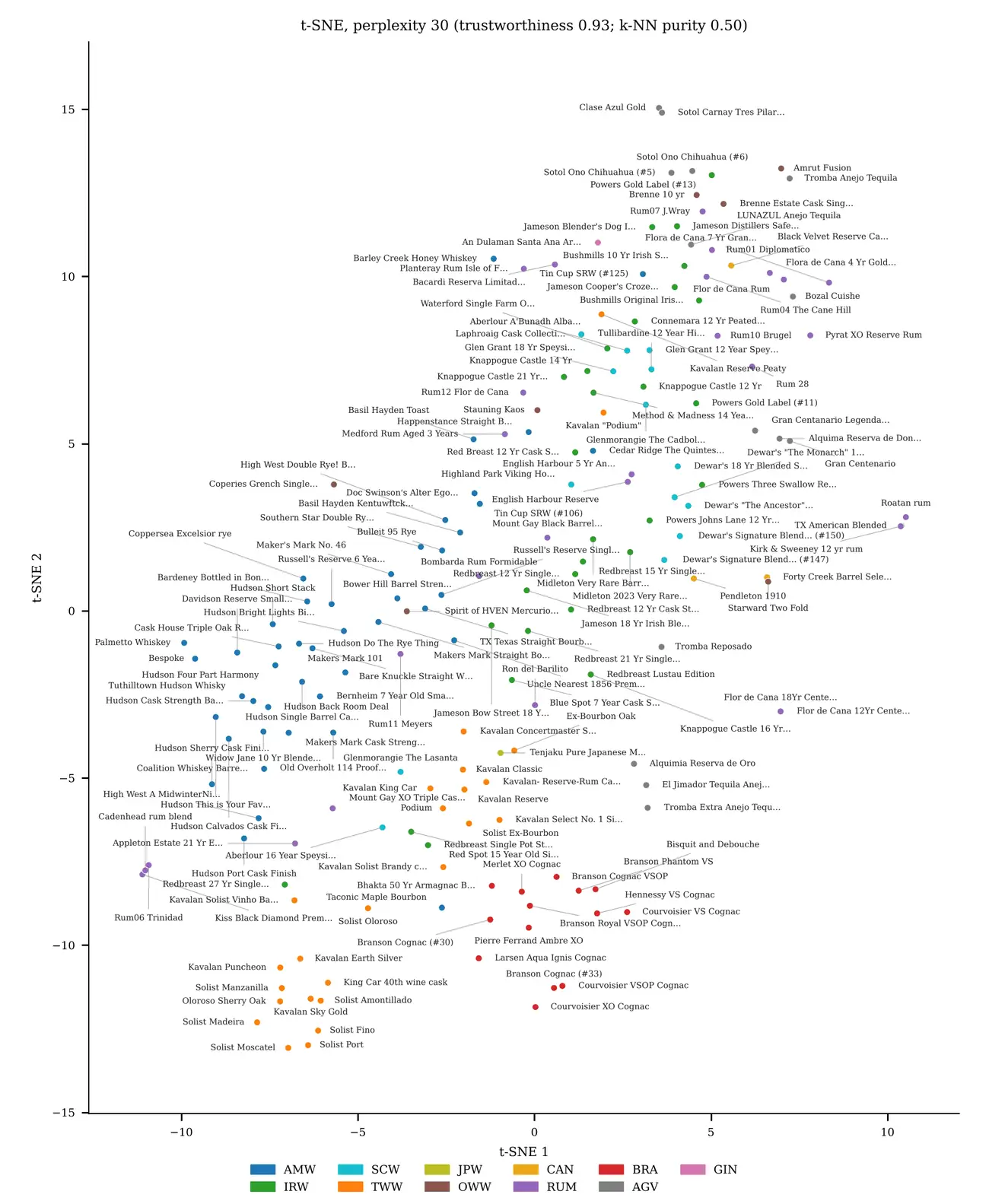
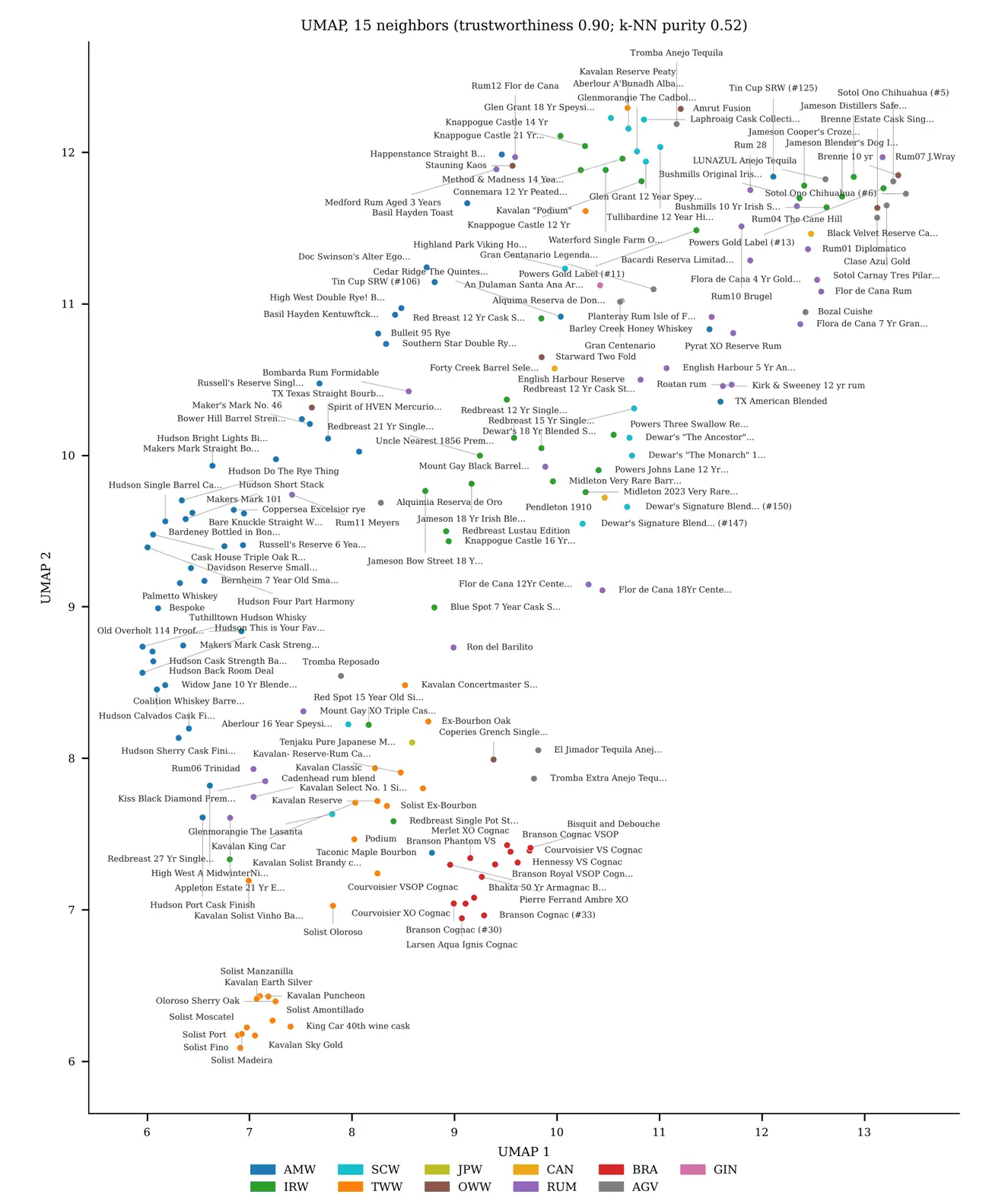
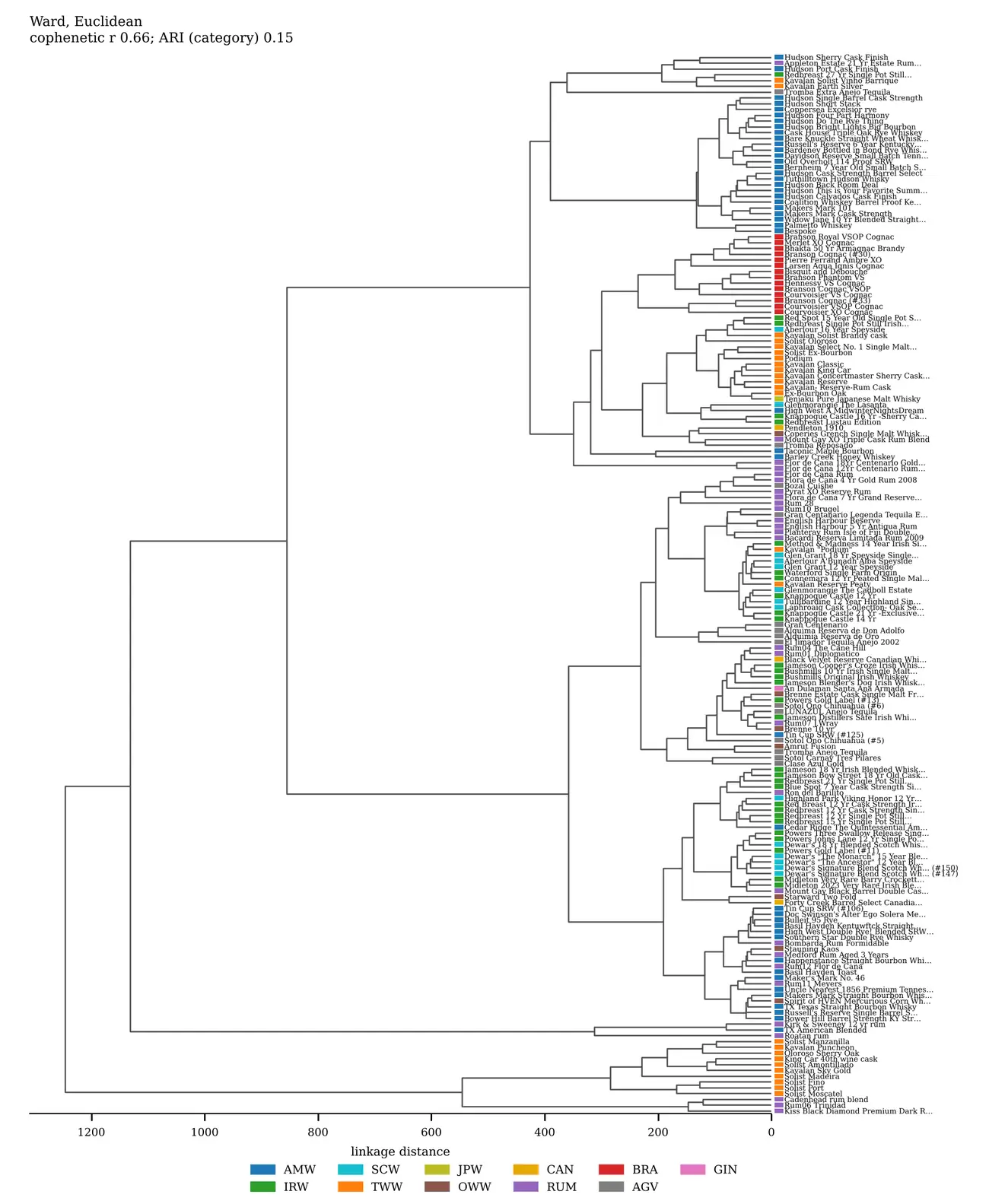
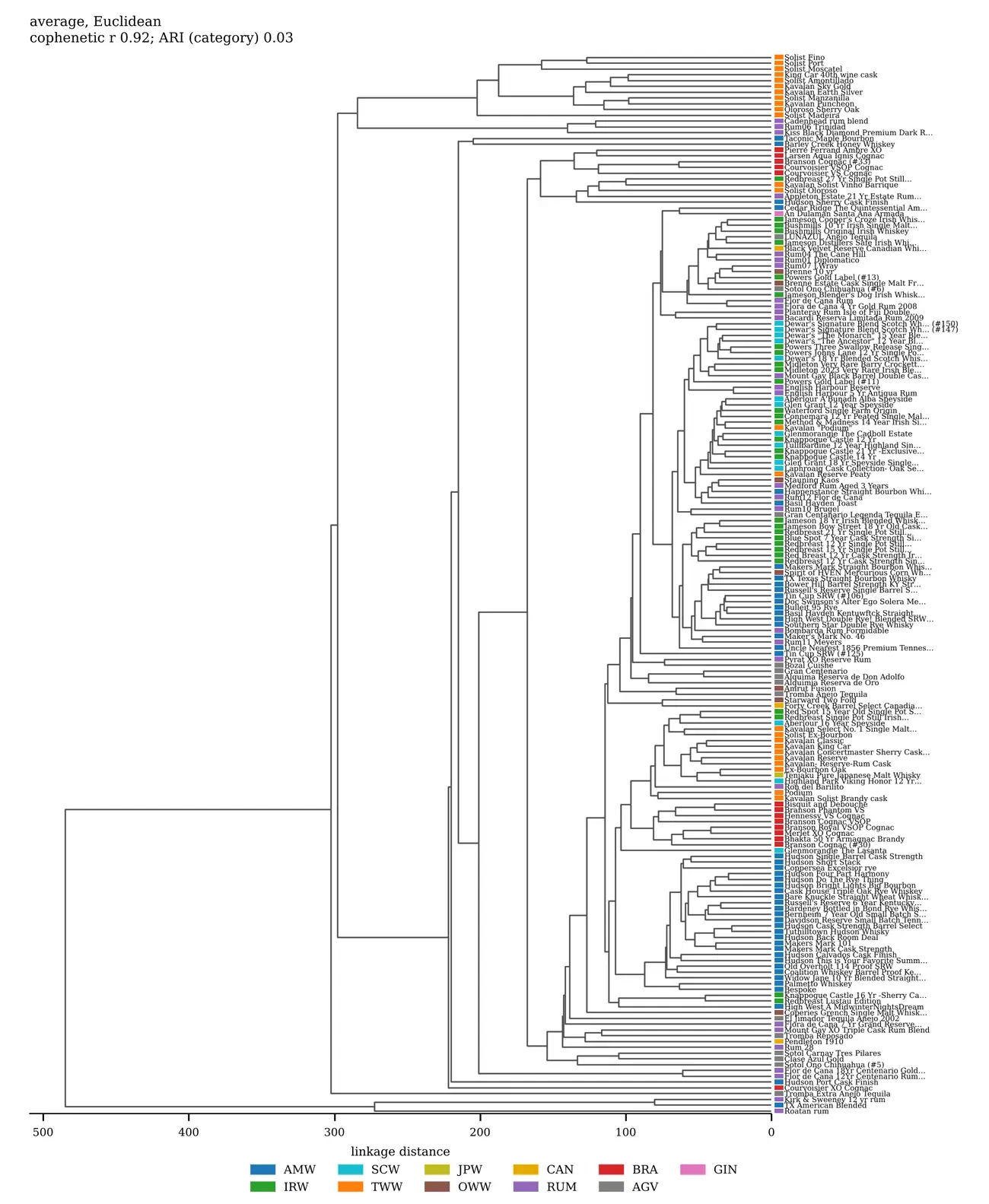
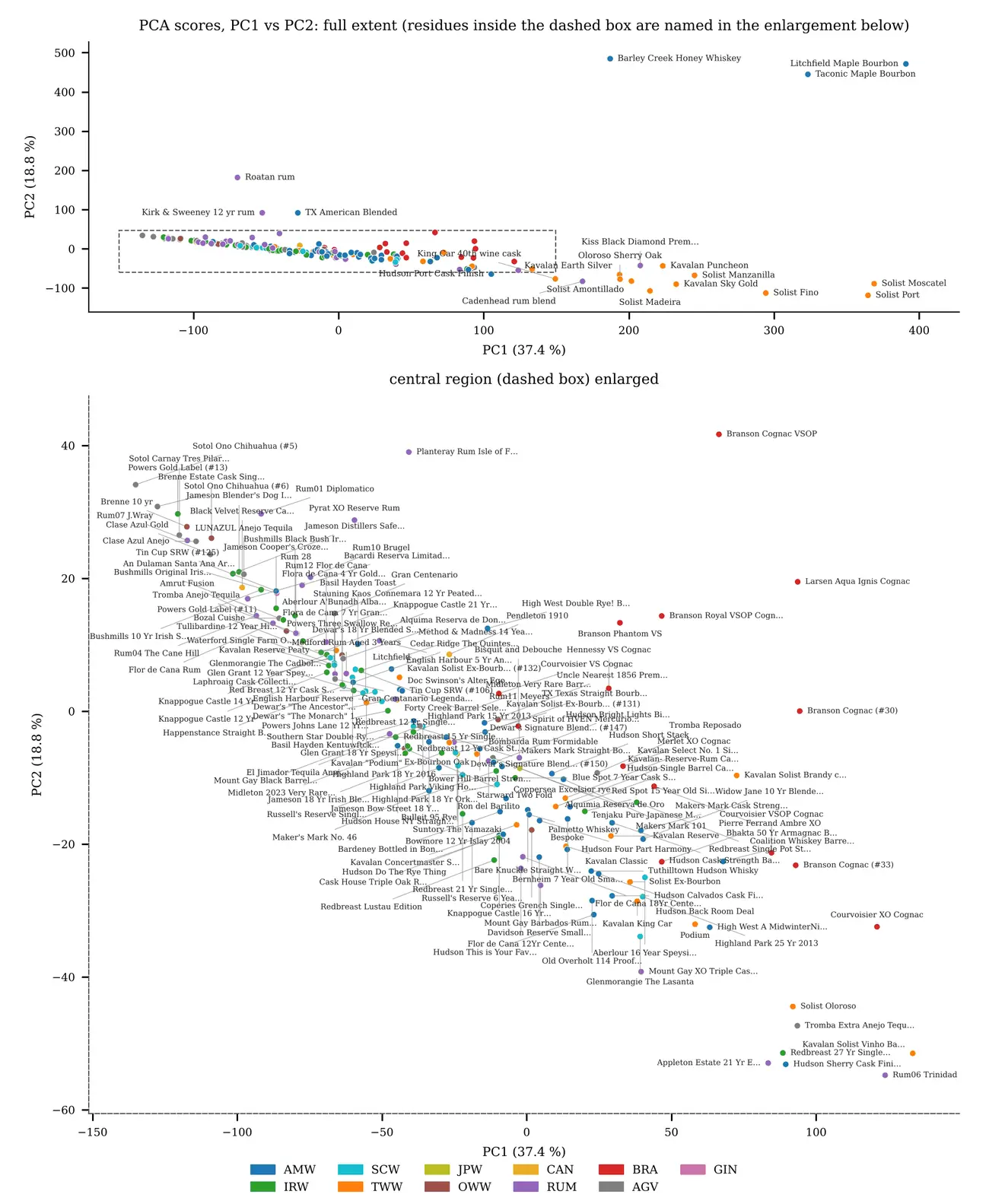
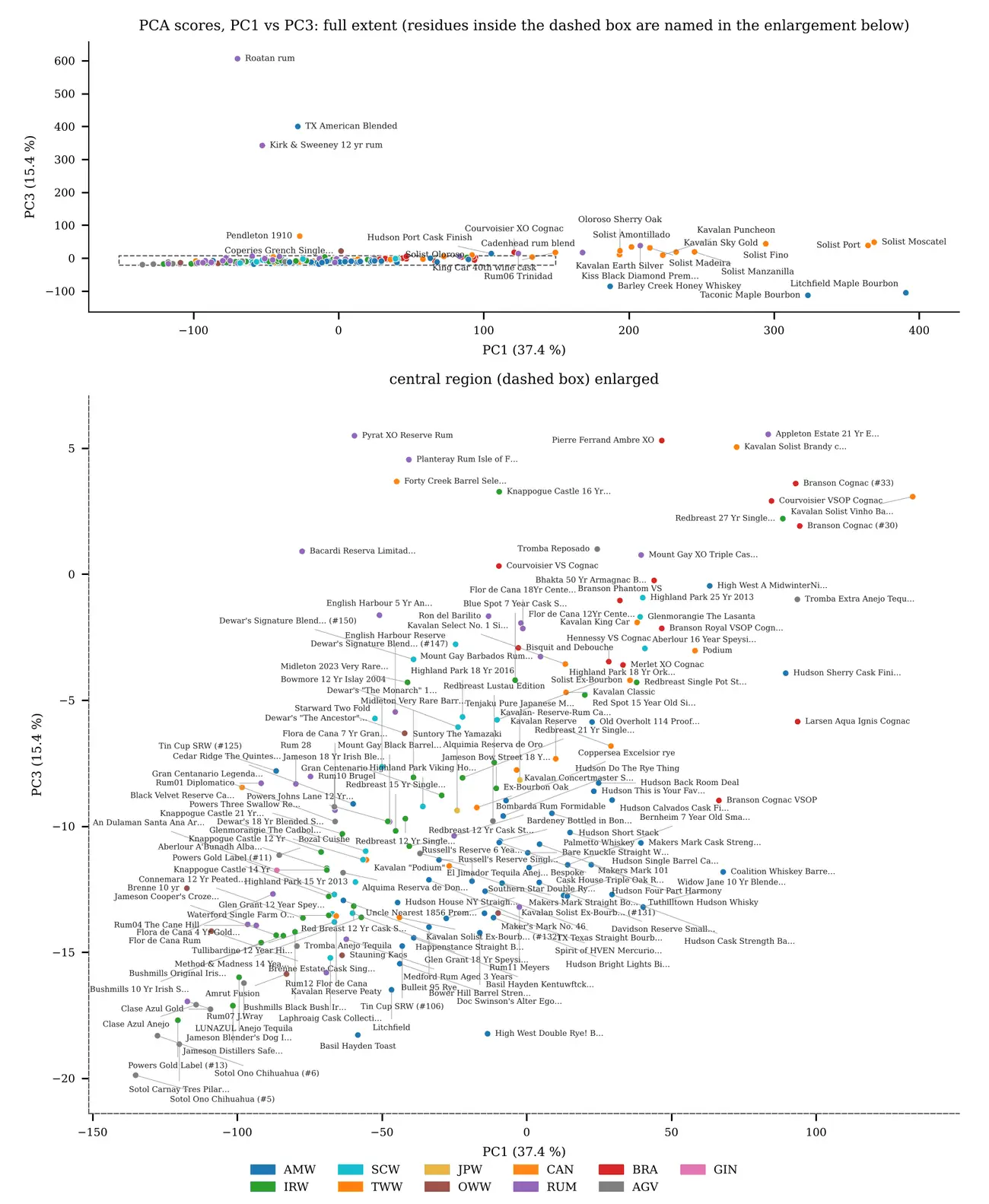
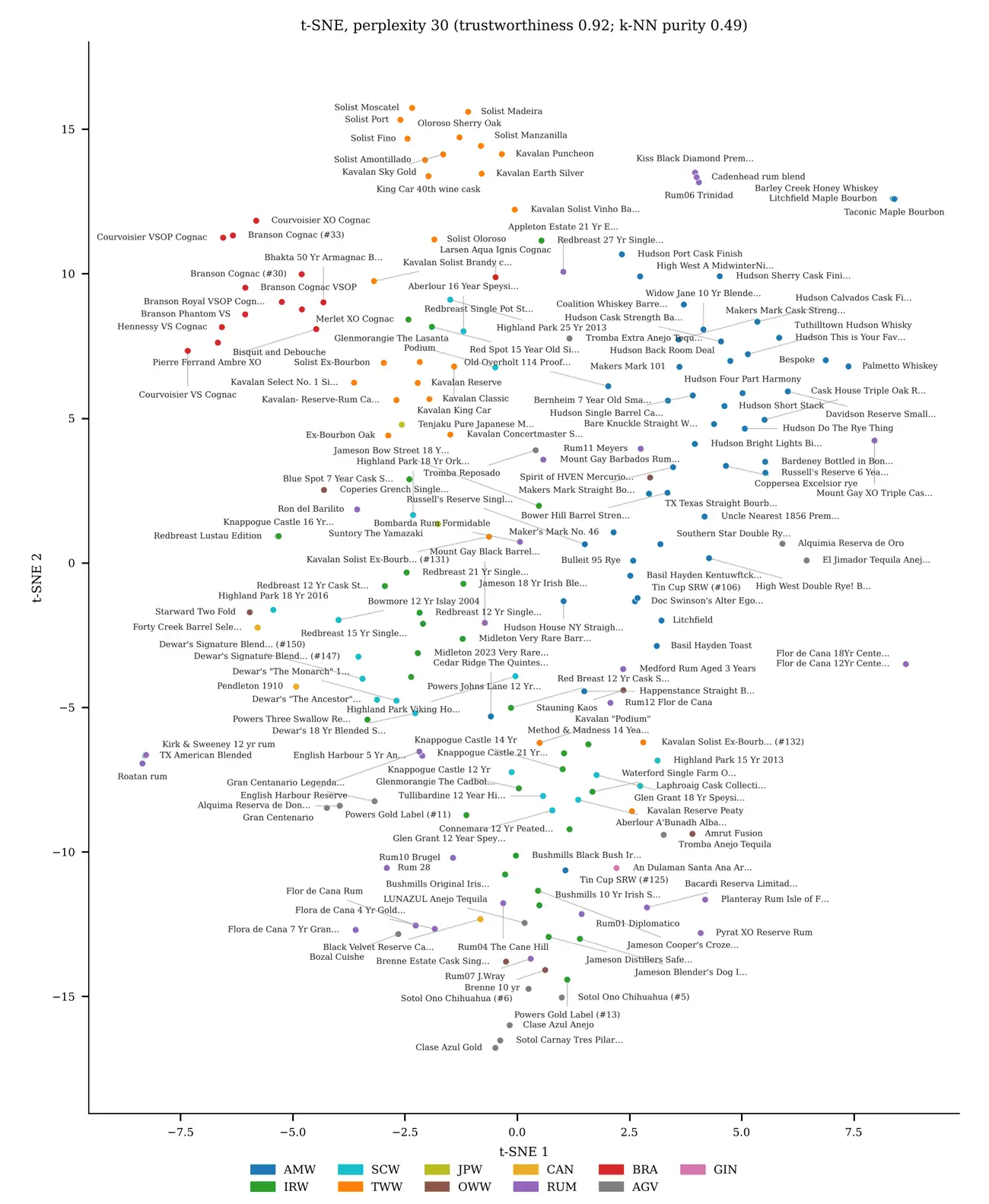
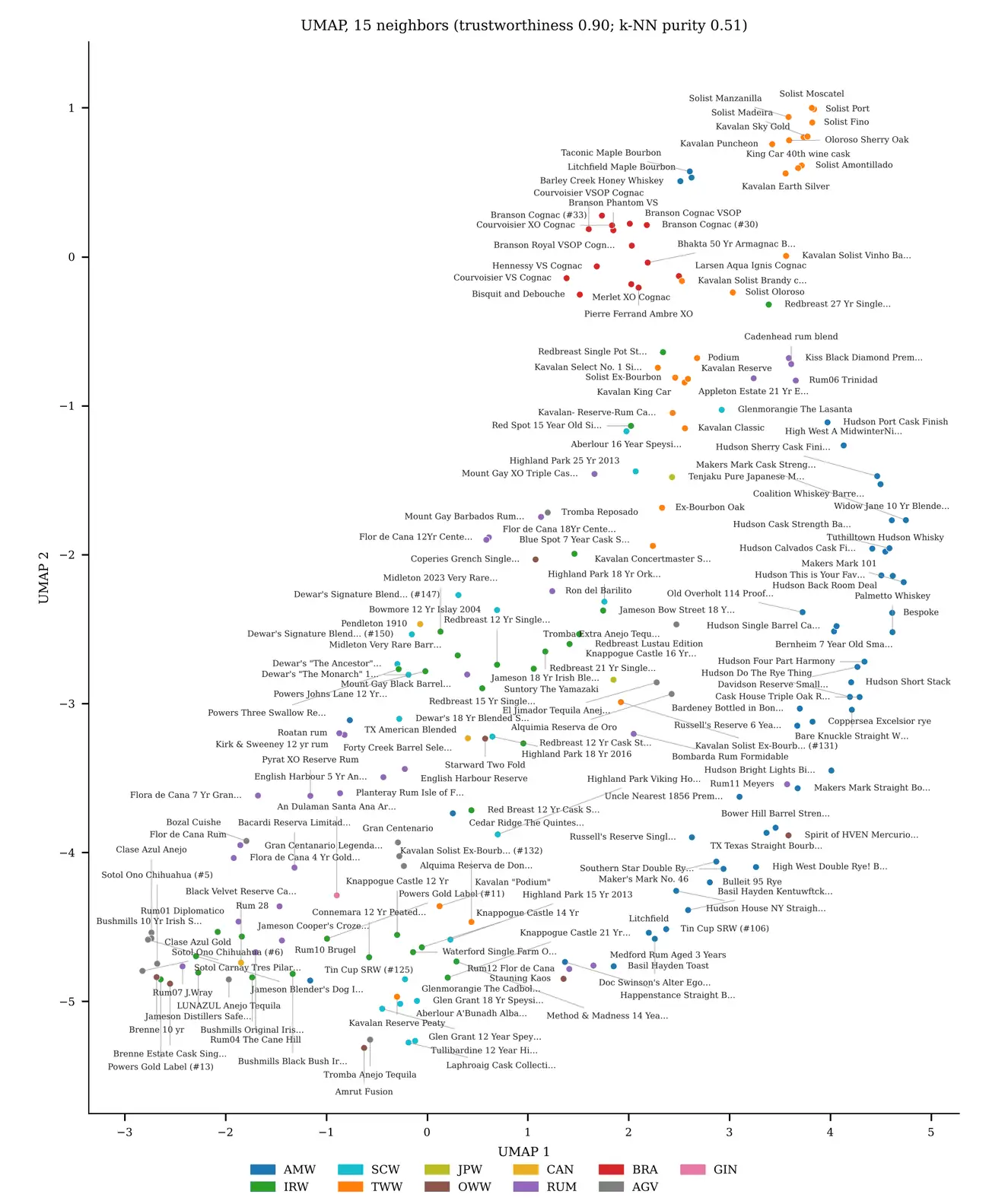
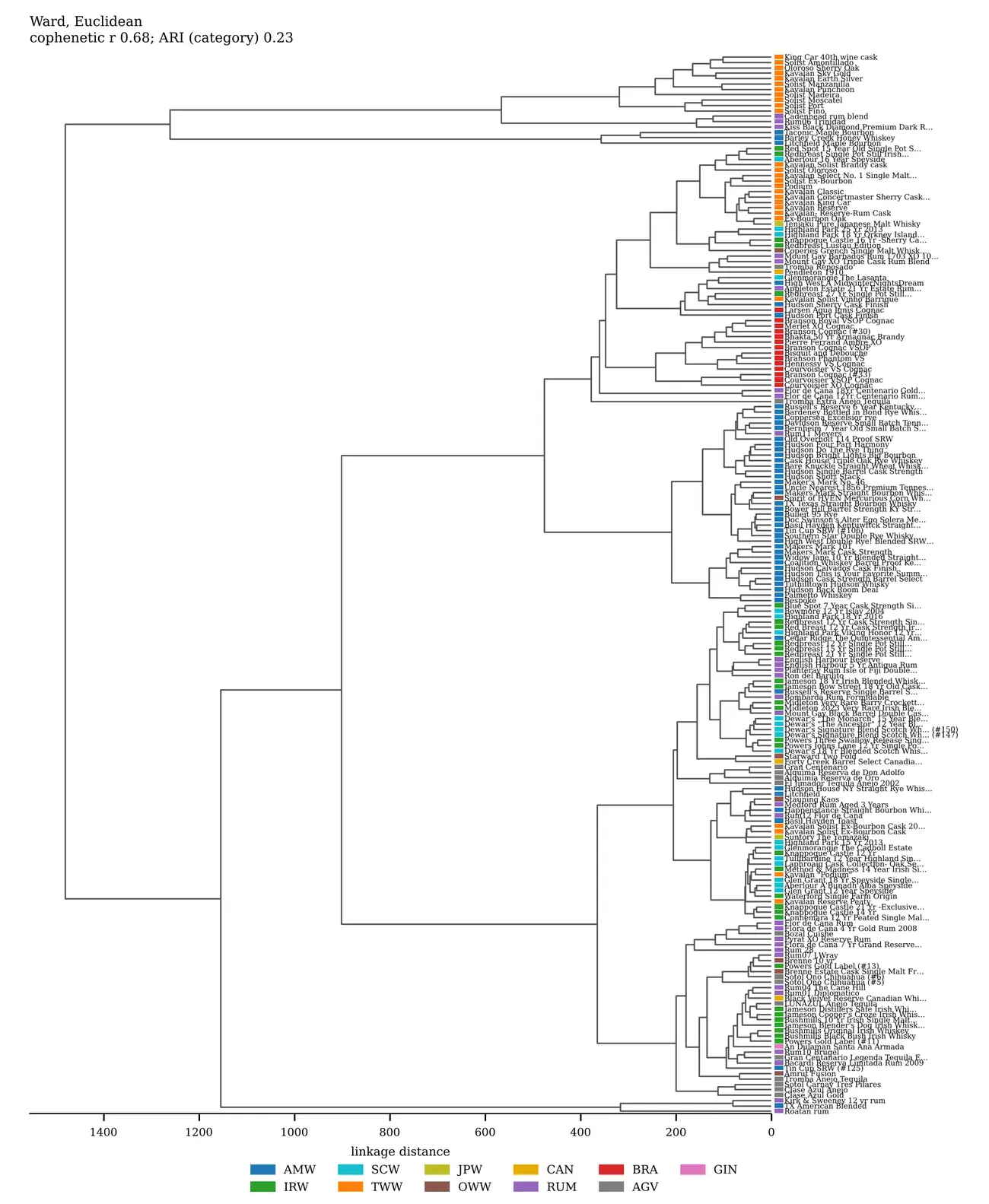
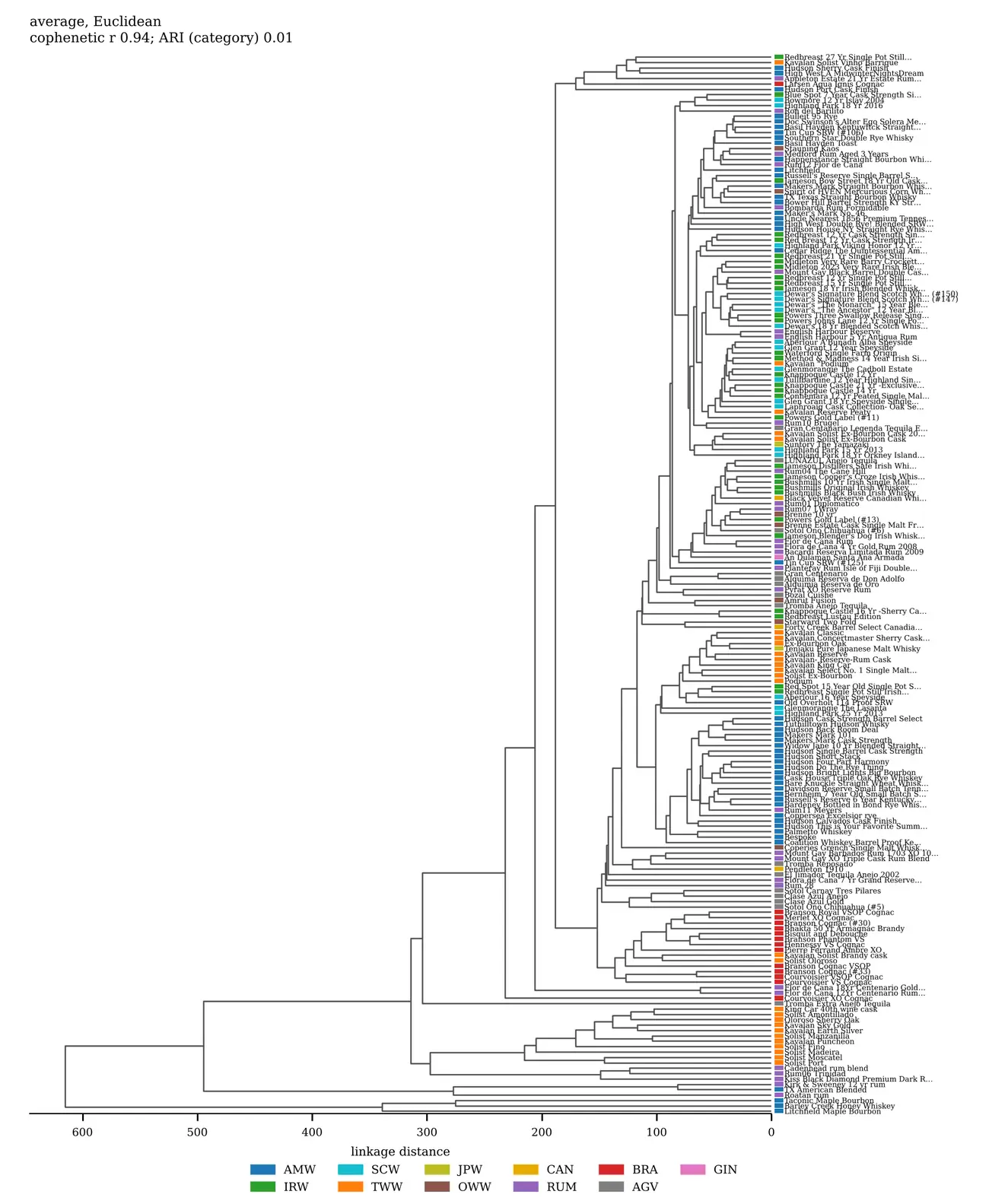
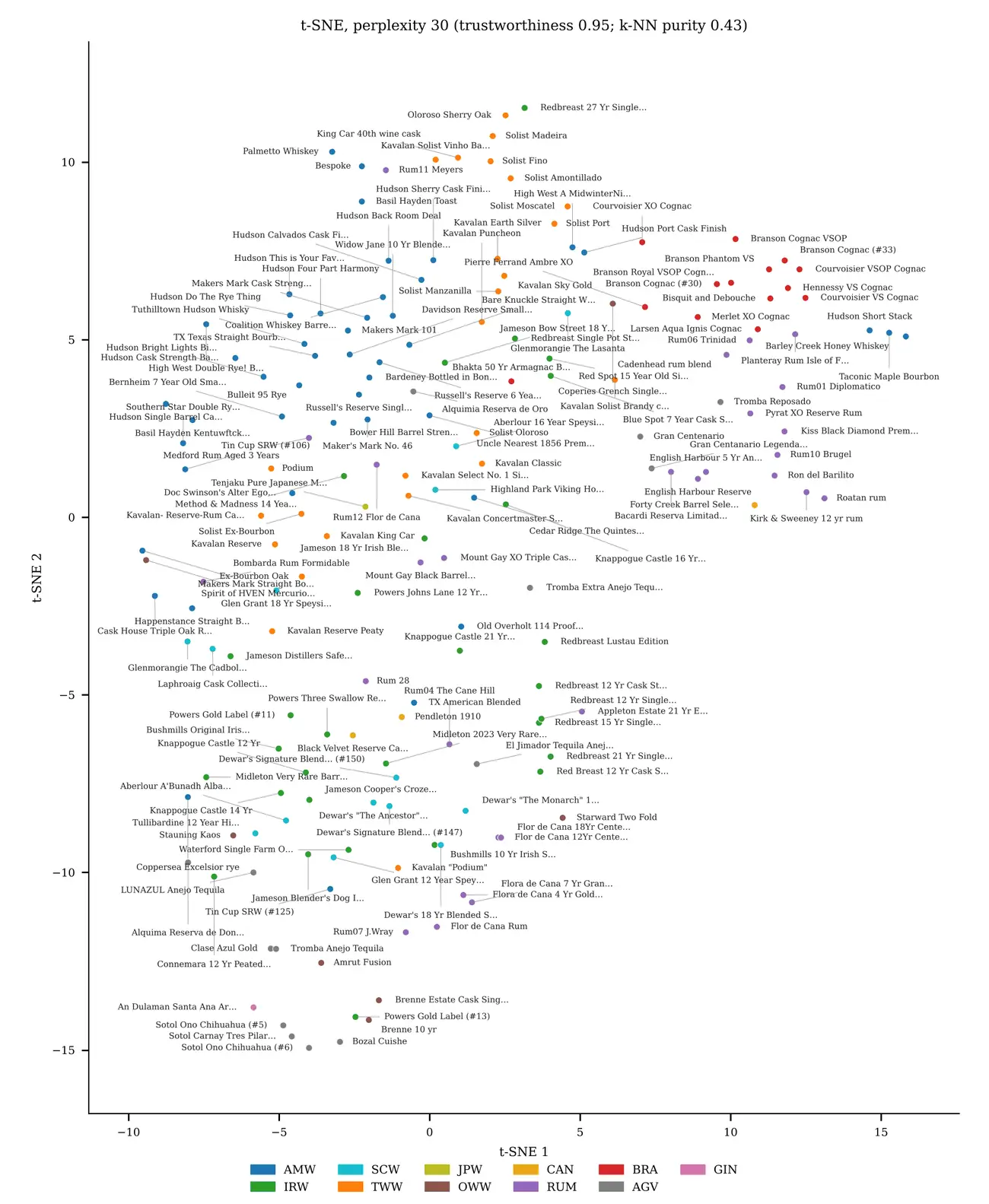
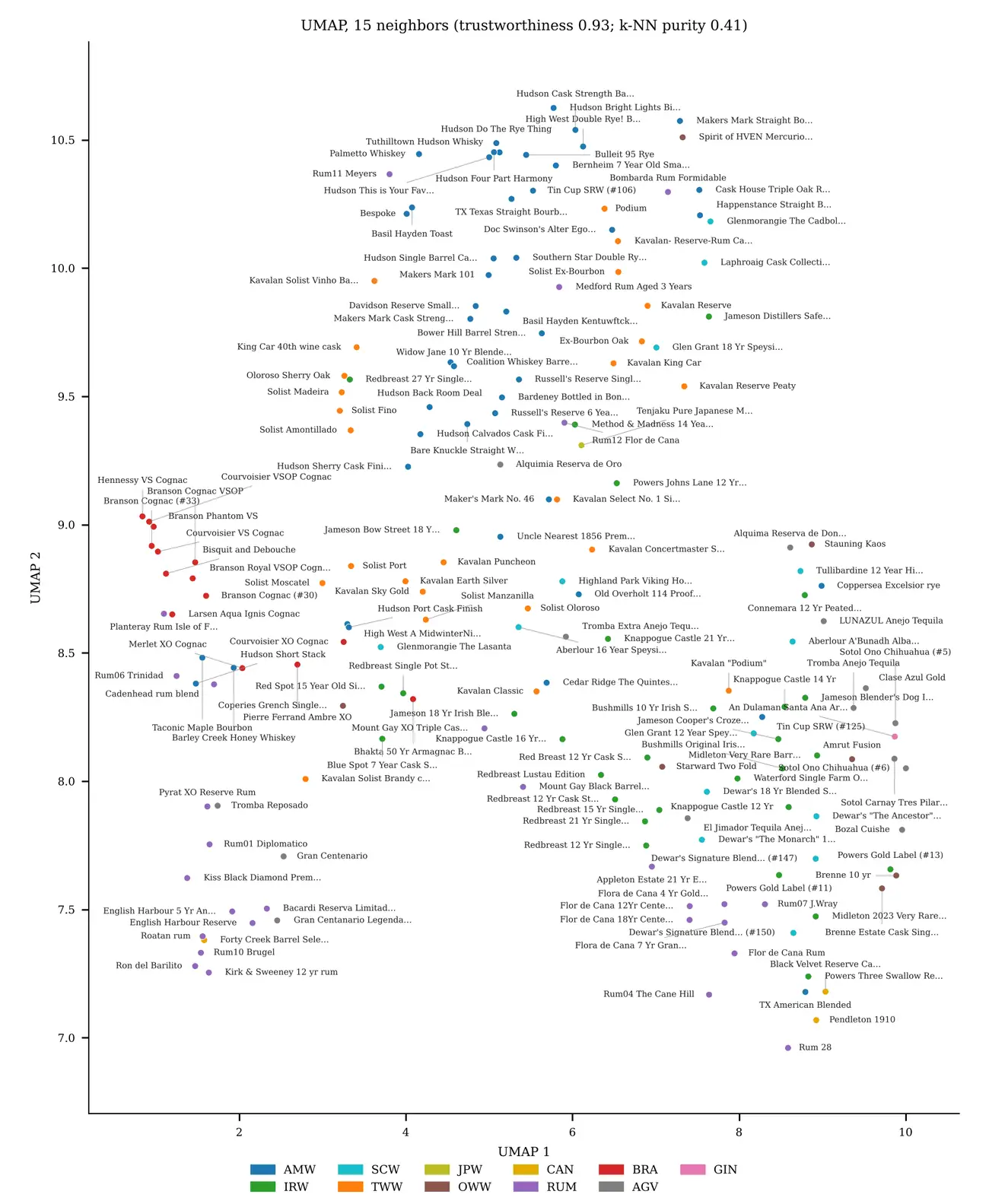
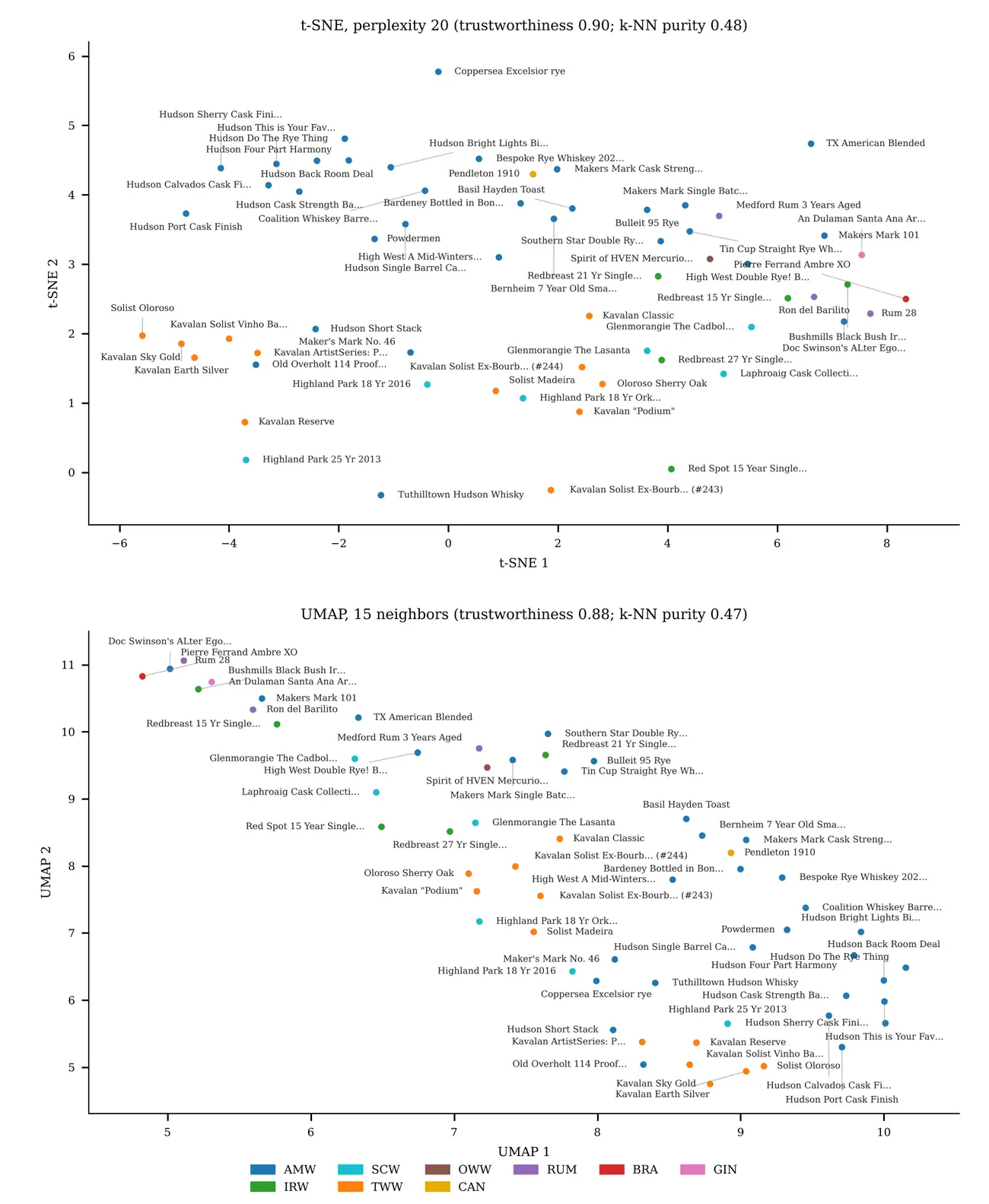
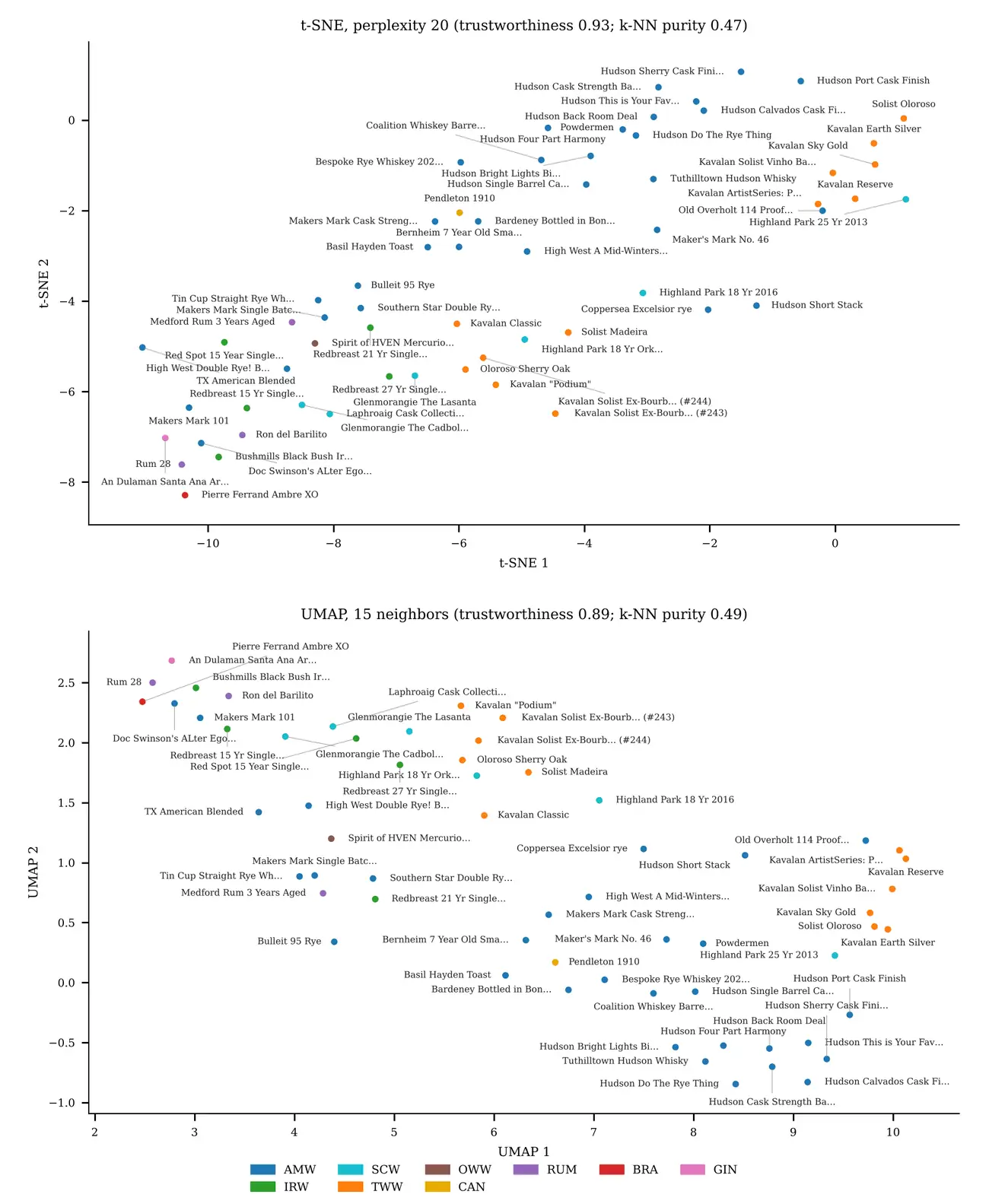
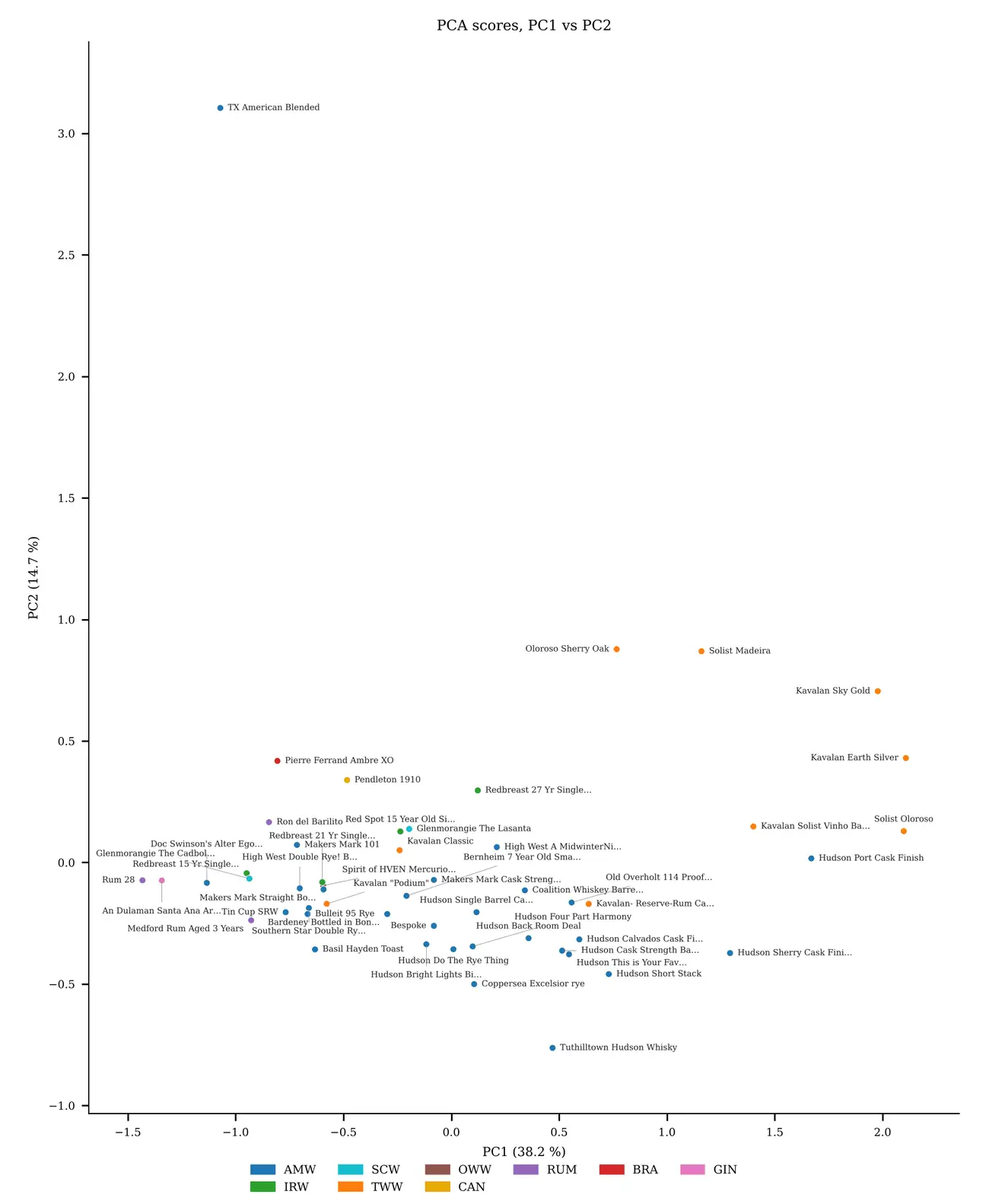
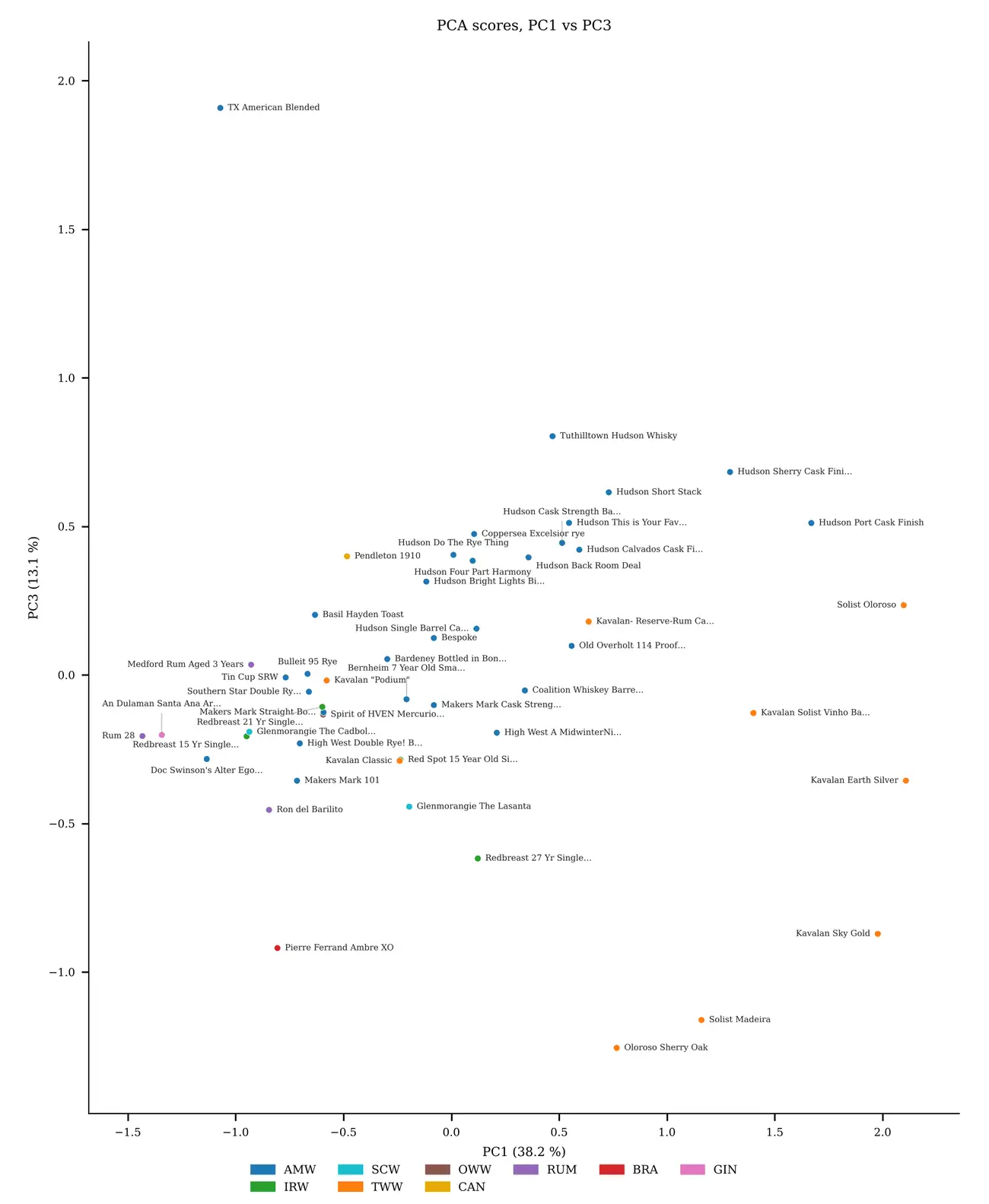
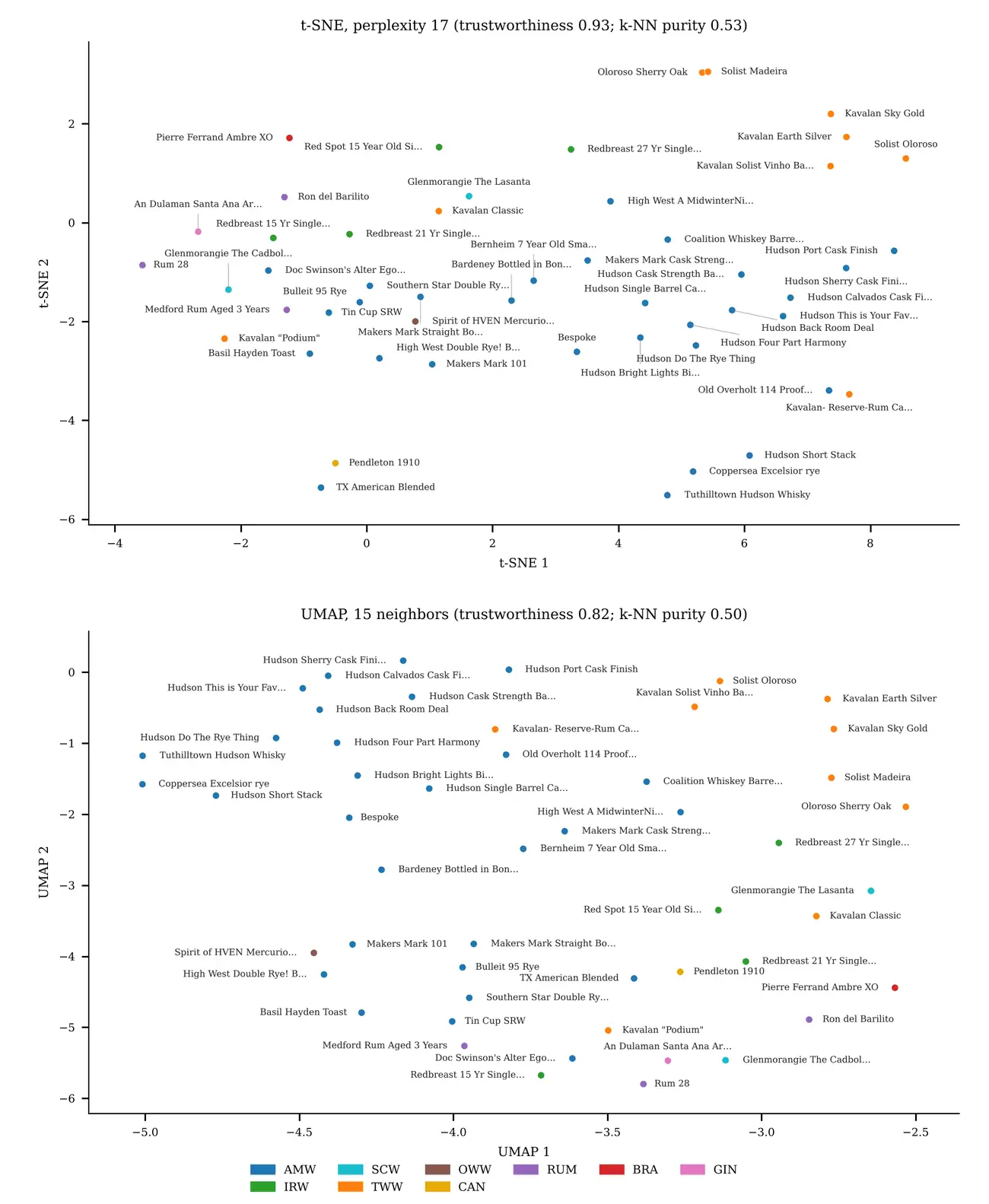
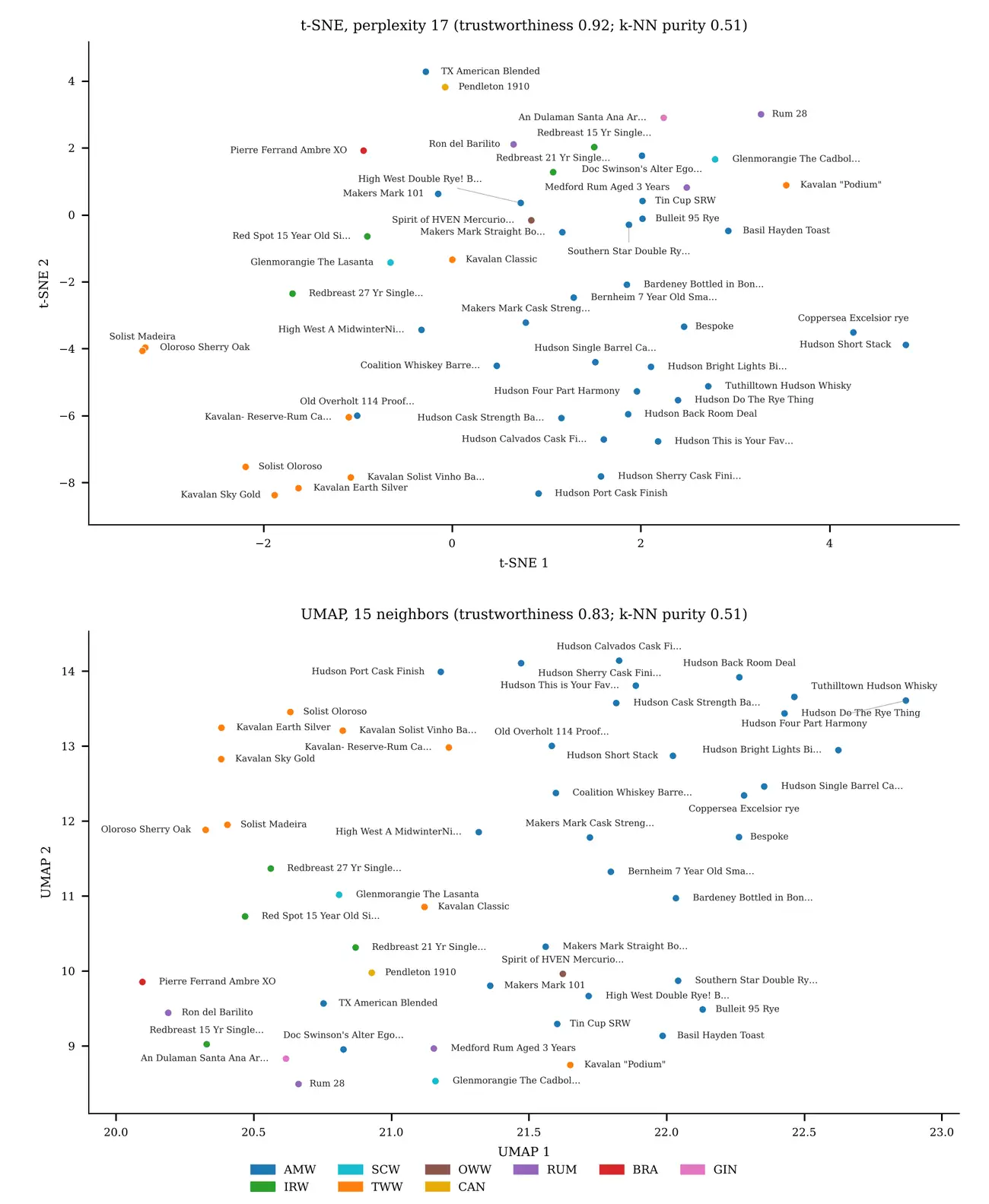
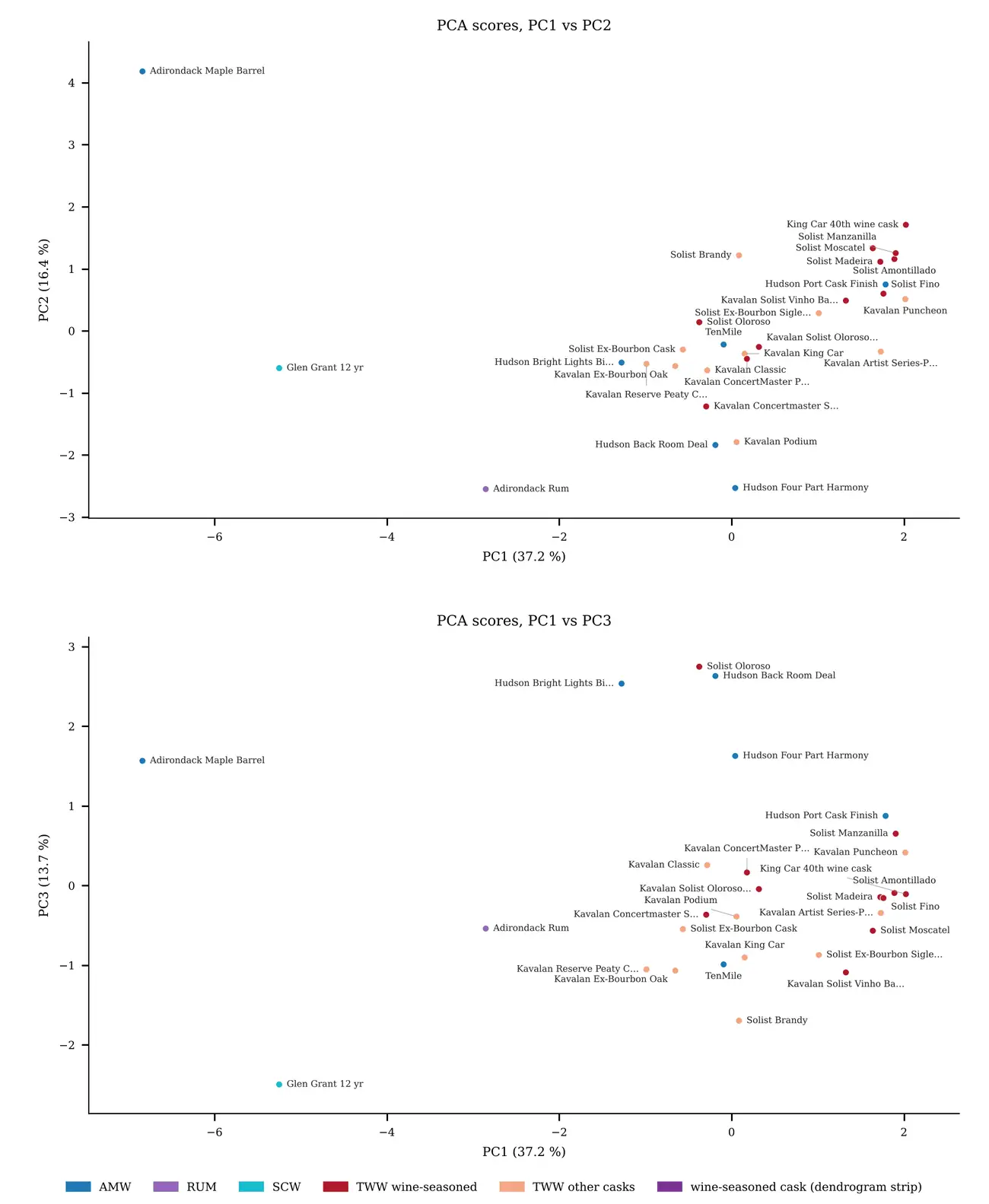
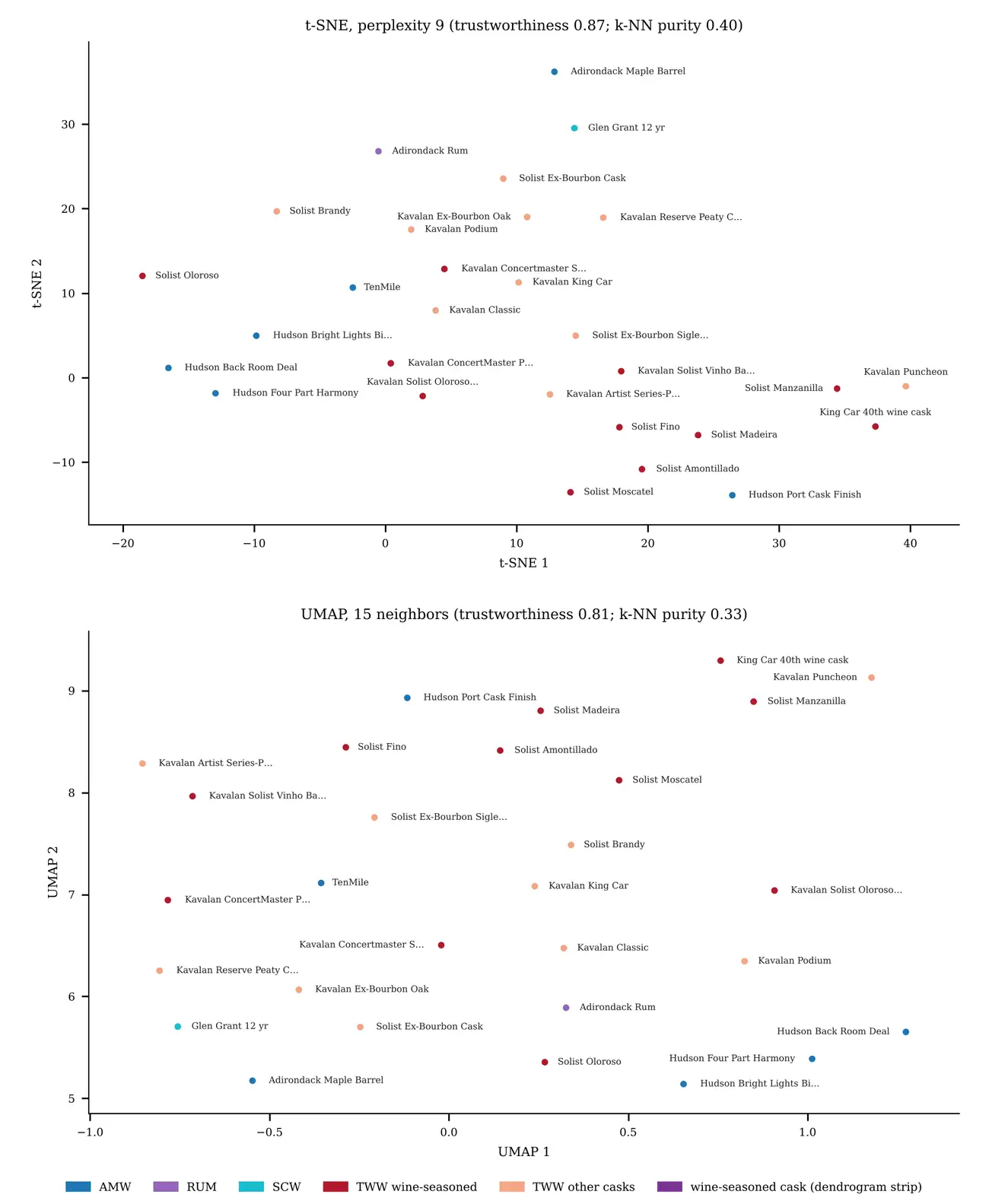
Pareto-scaled absolute spectra were analyzed by PCA, HCA, t-SNE, UMAP, PLS-DA, SVM and k-nearest neighbors with nested, product-grouped cross-validation. Seven spirit categories were classified with a balanced accuracy of 0.78 (linear SVM; permutation p = 0.005), falling to 0.67 when whole producers were held out; the embeddings were faithful (trustworthiness ≥ 0.88) but added no class information. PLS calibrations with leave-10 %-out cross-validation gave Q² of 0.32–0.76 on a logarithmic scale; masked models showed which calibrations rest on the analyte's own signals, and a first-pass glycerol calibration with Q² = 0.95 proved to have learned the sugar signals that had contaminated its reference values. Every linear analysis was shown to be identical in the time domain, and band-selective HLSVD on the decays reproduced the frequency-domain quantitation of isolated resonances. The limitations that an expert reviewer would raise, and the procedures that would remove them, are set out explicitly.
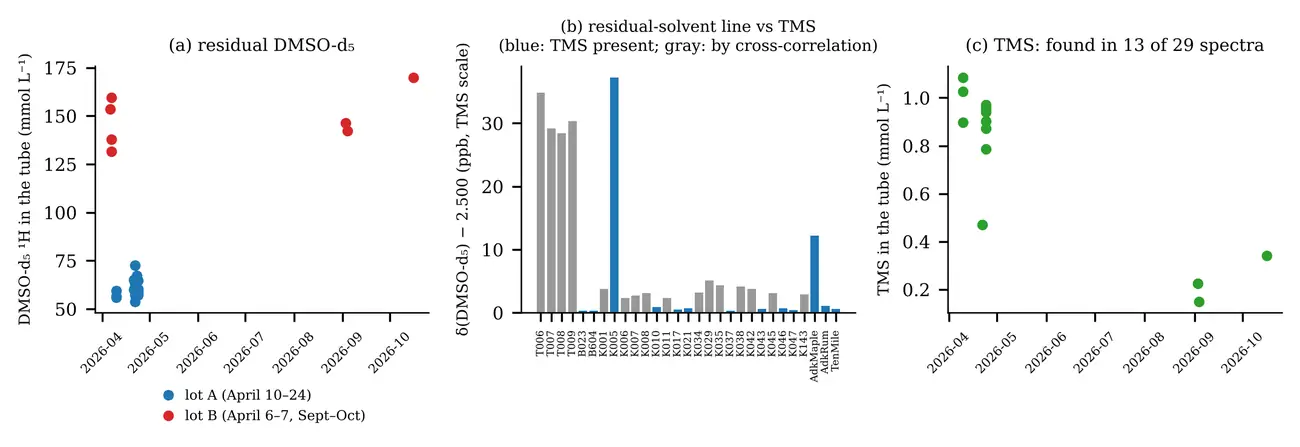
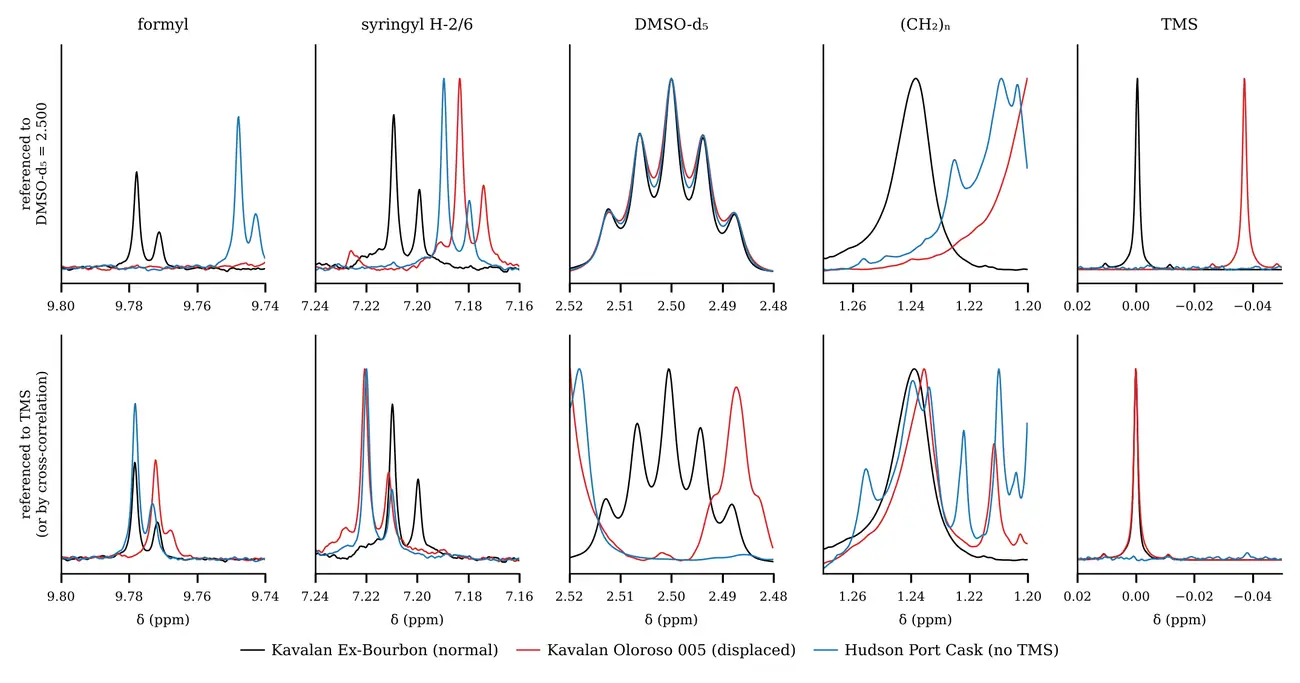
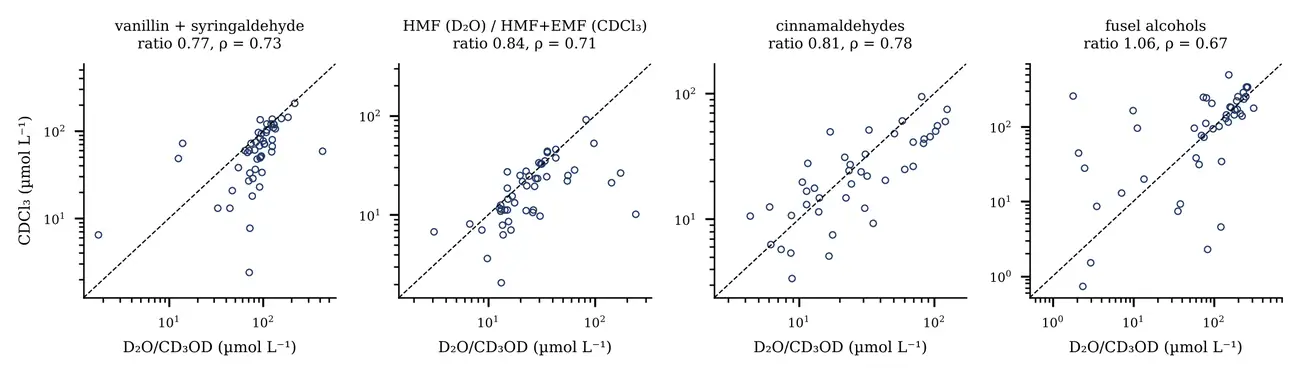
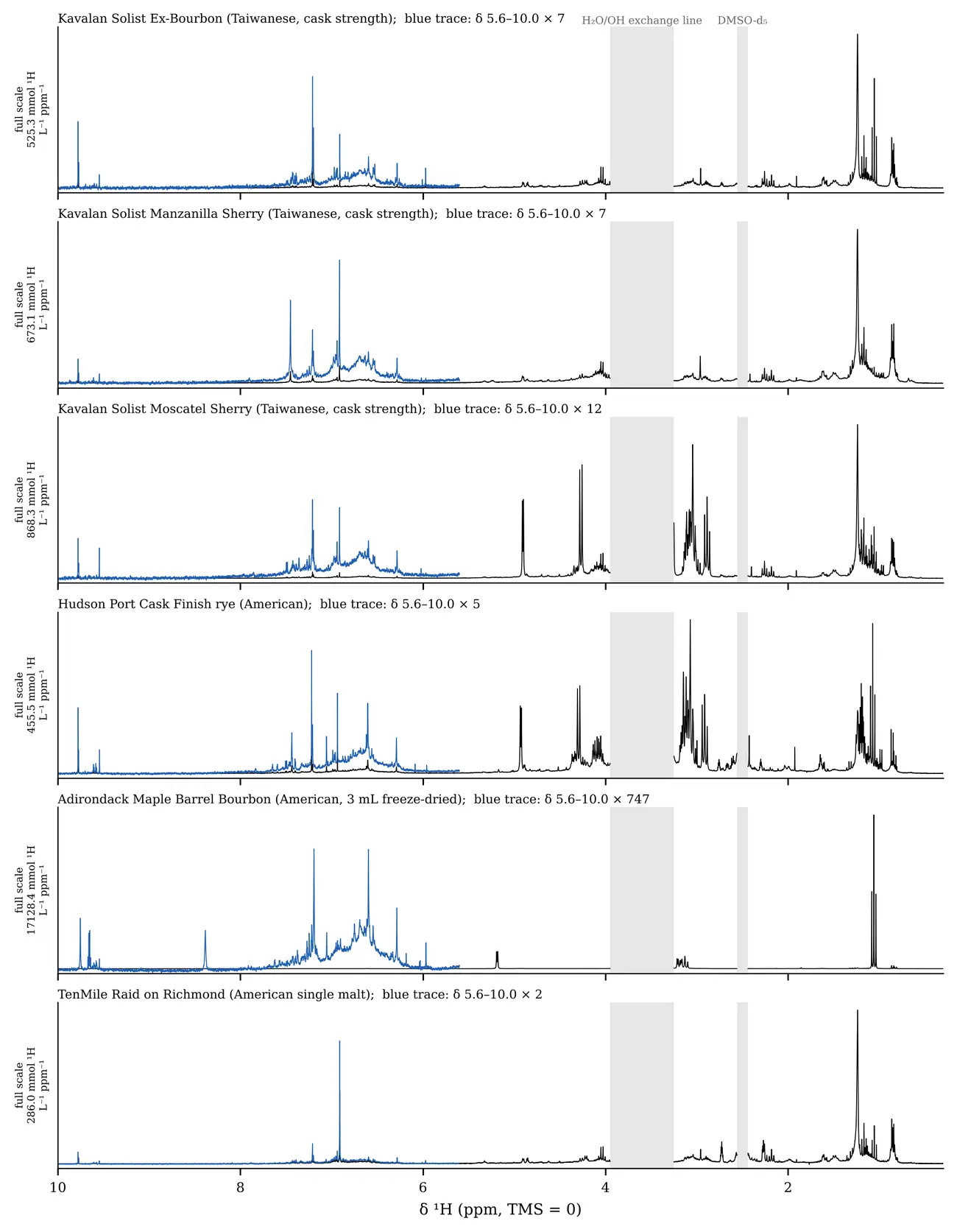
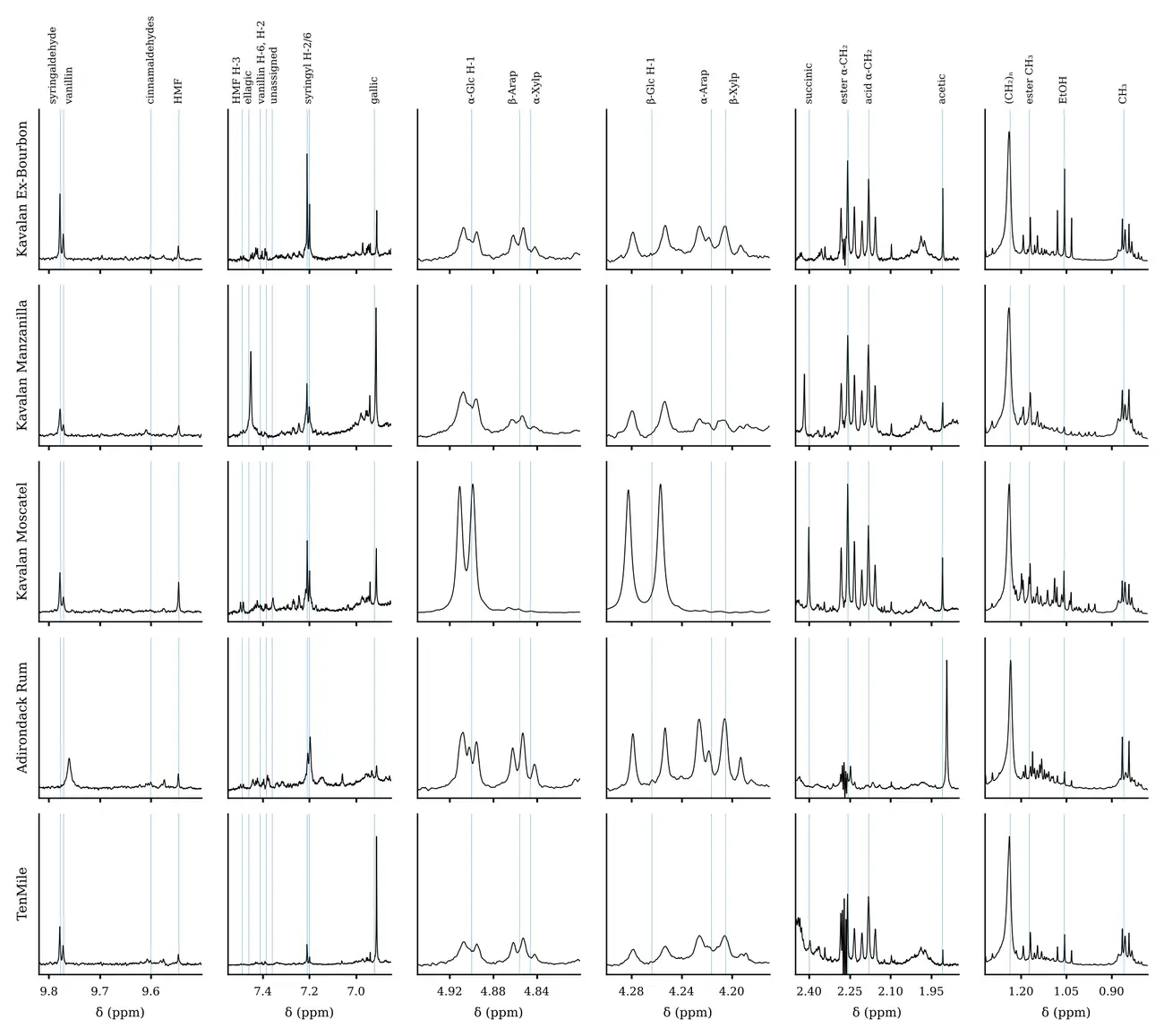
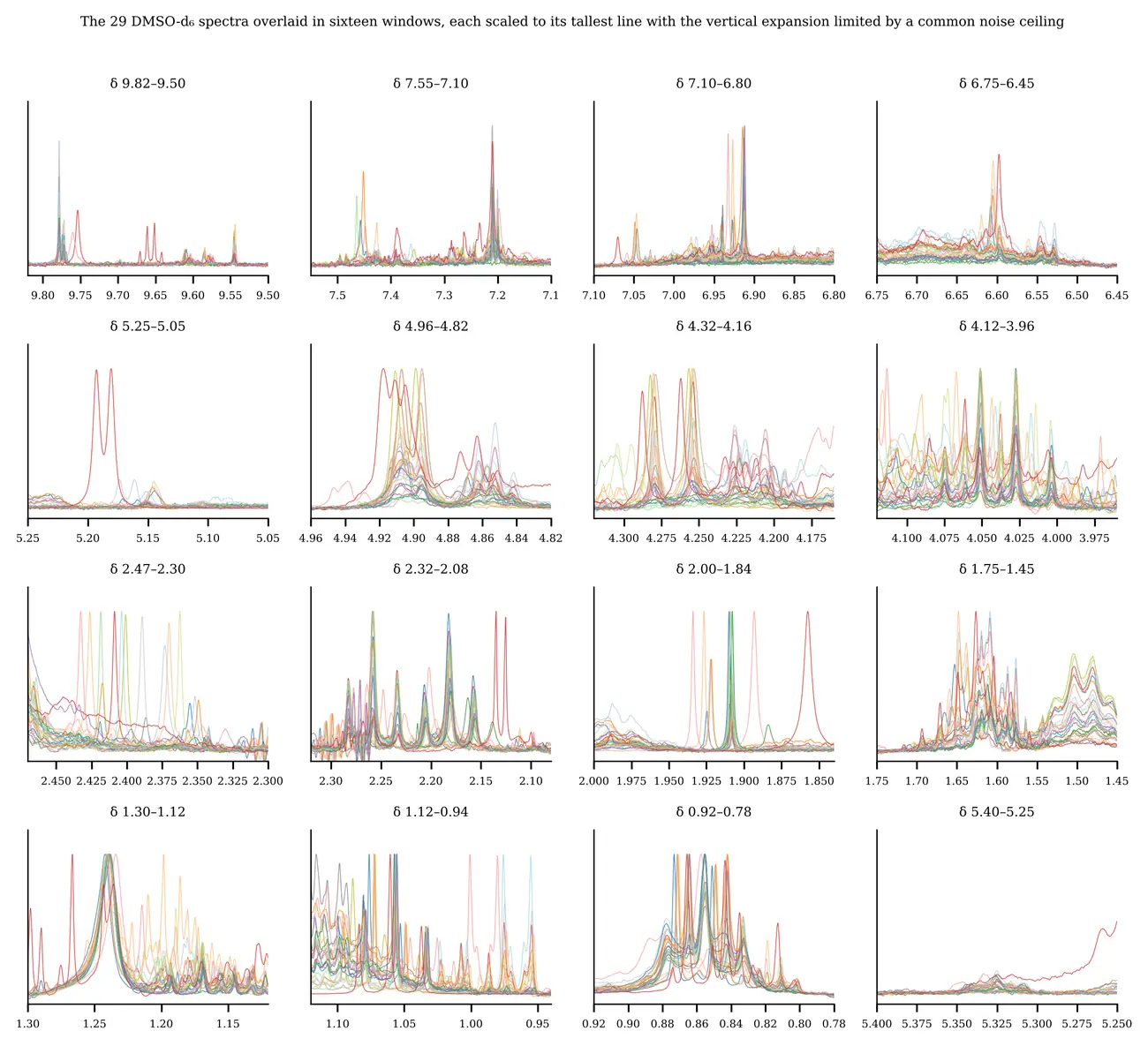
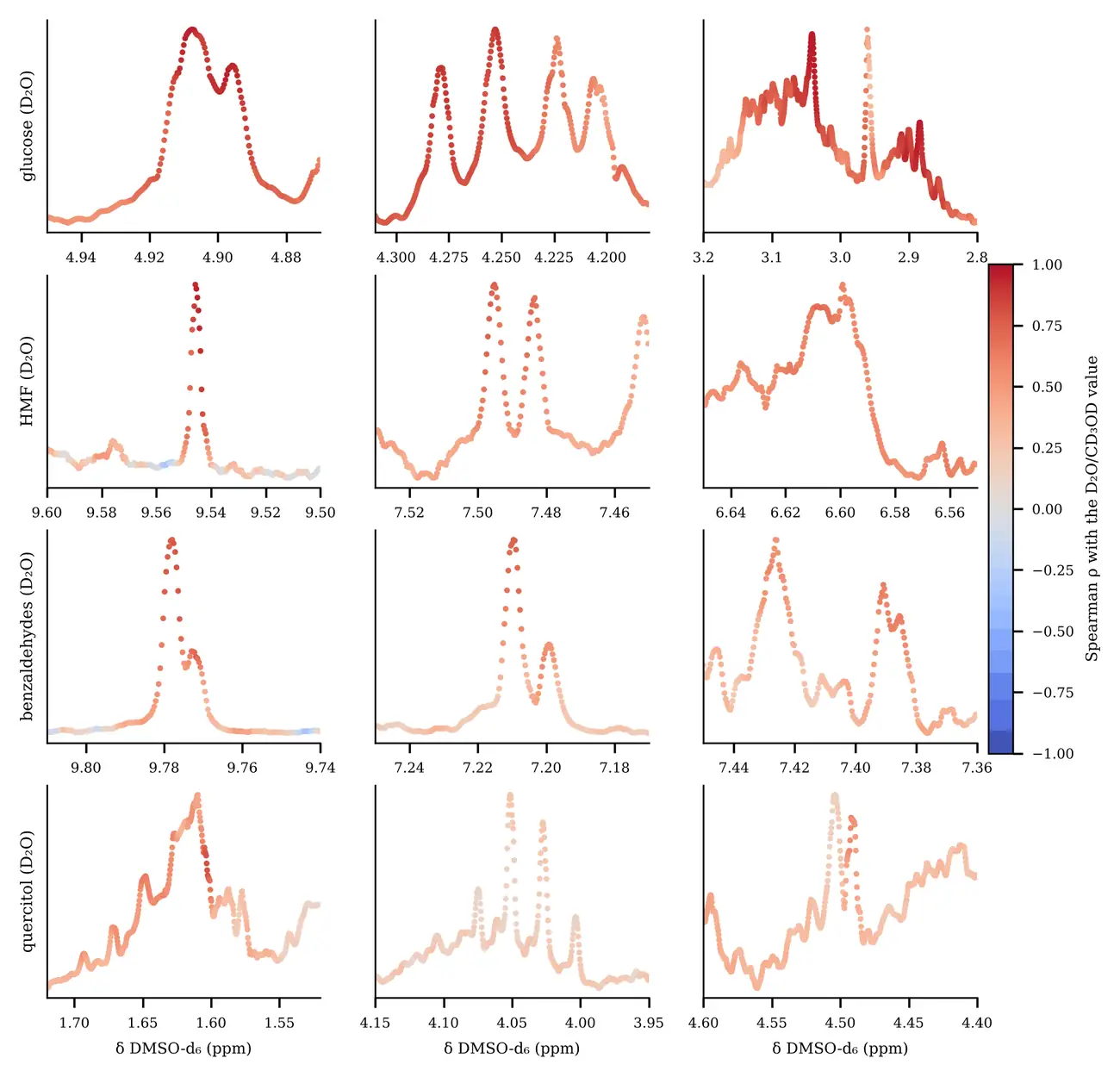
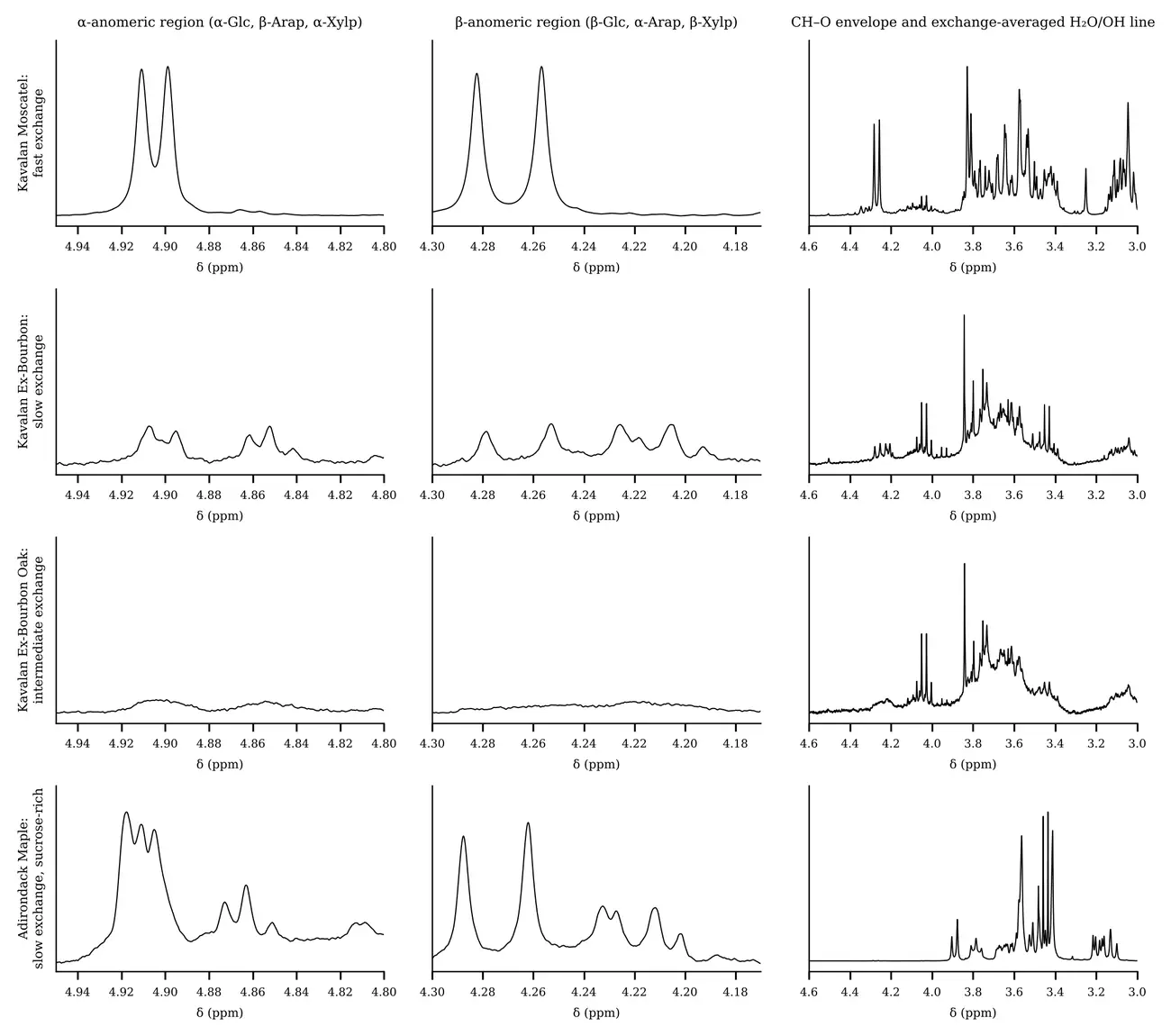
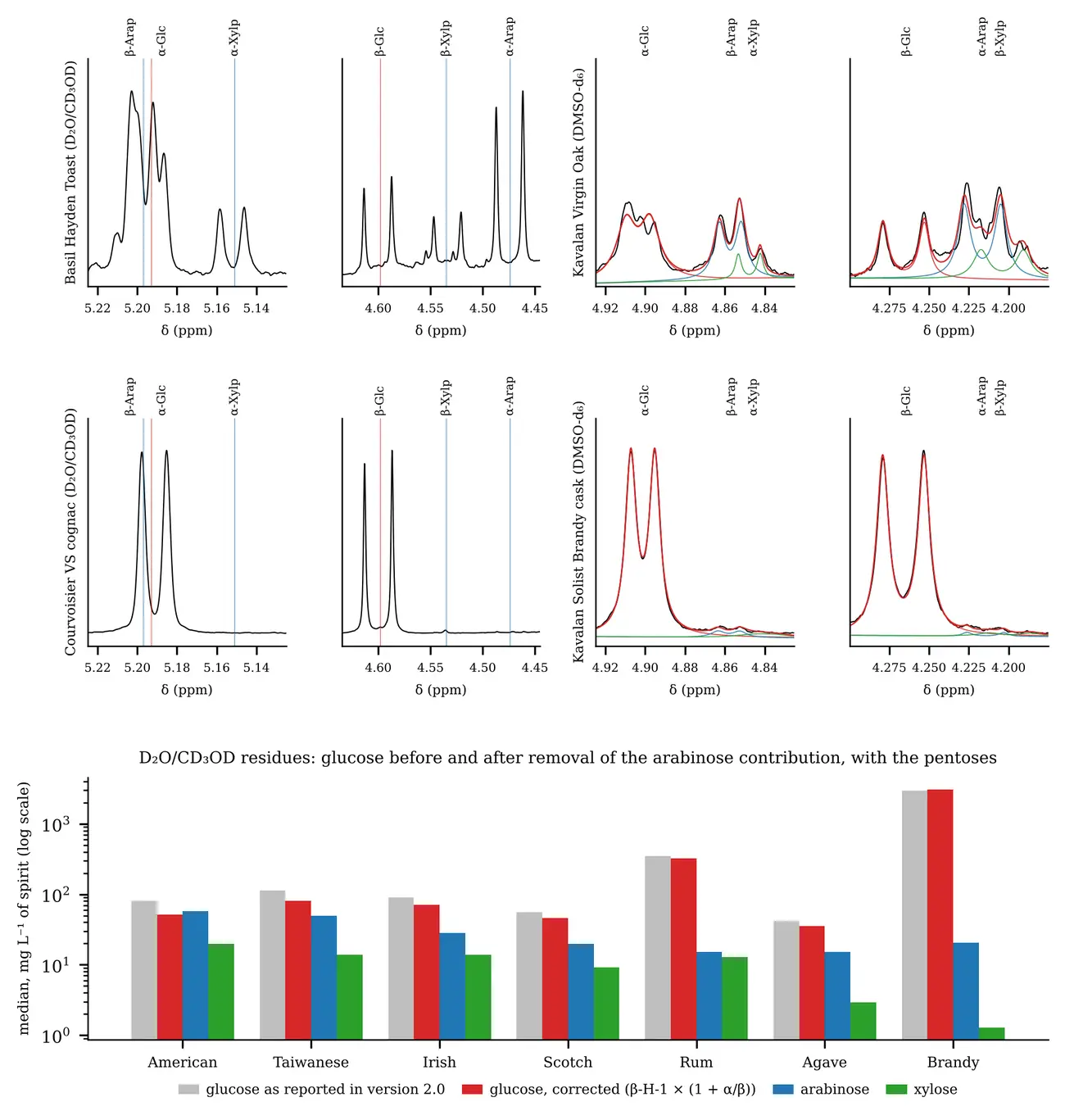
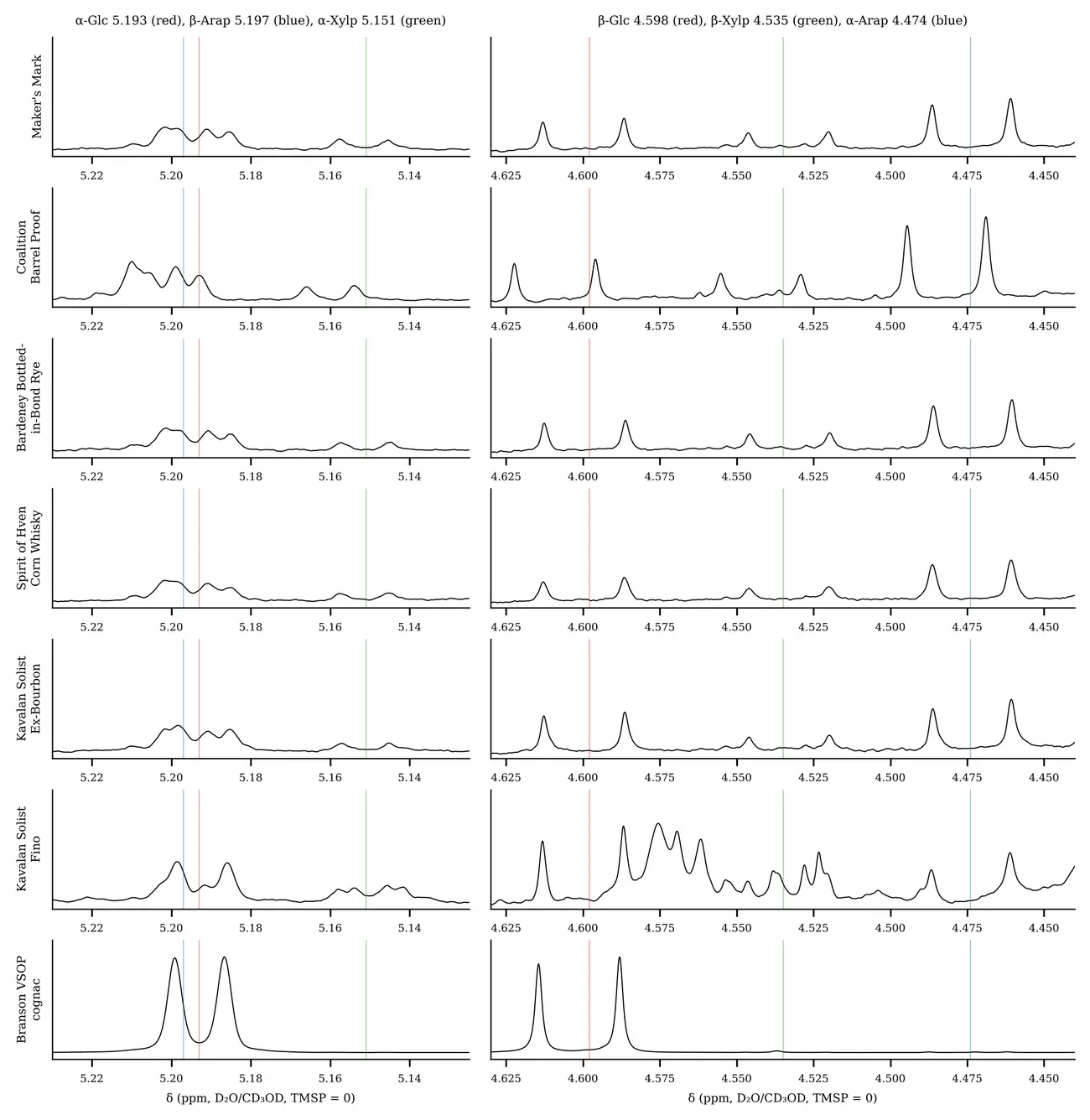
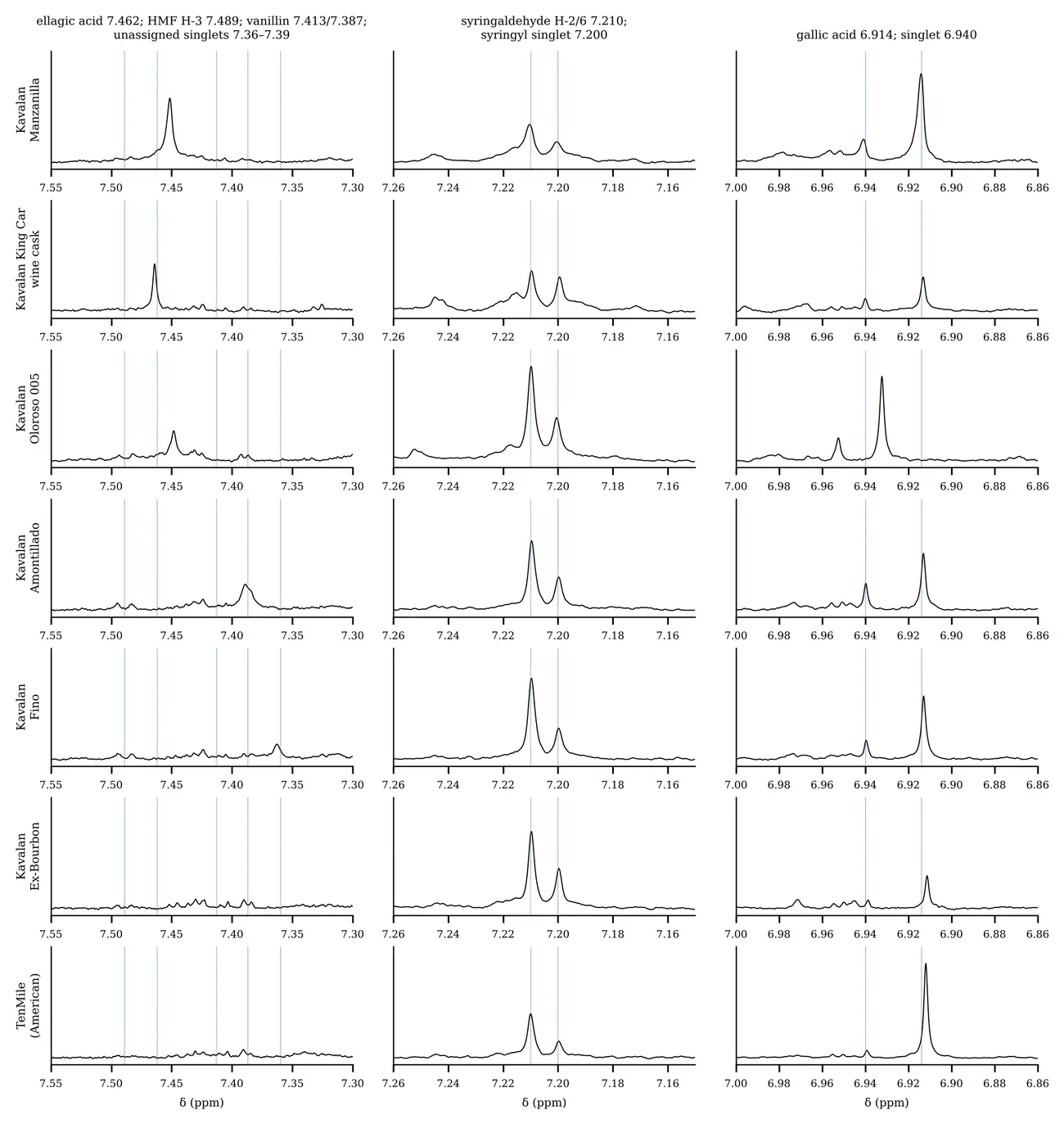
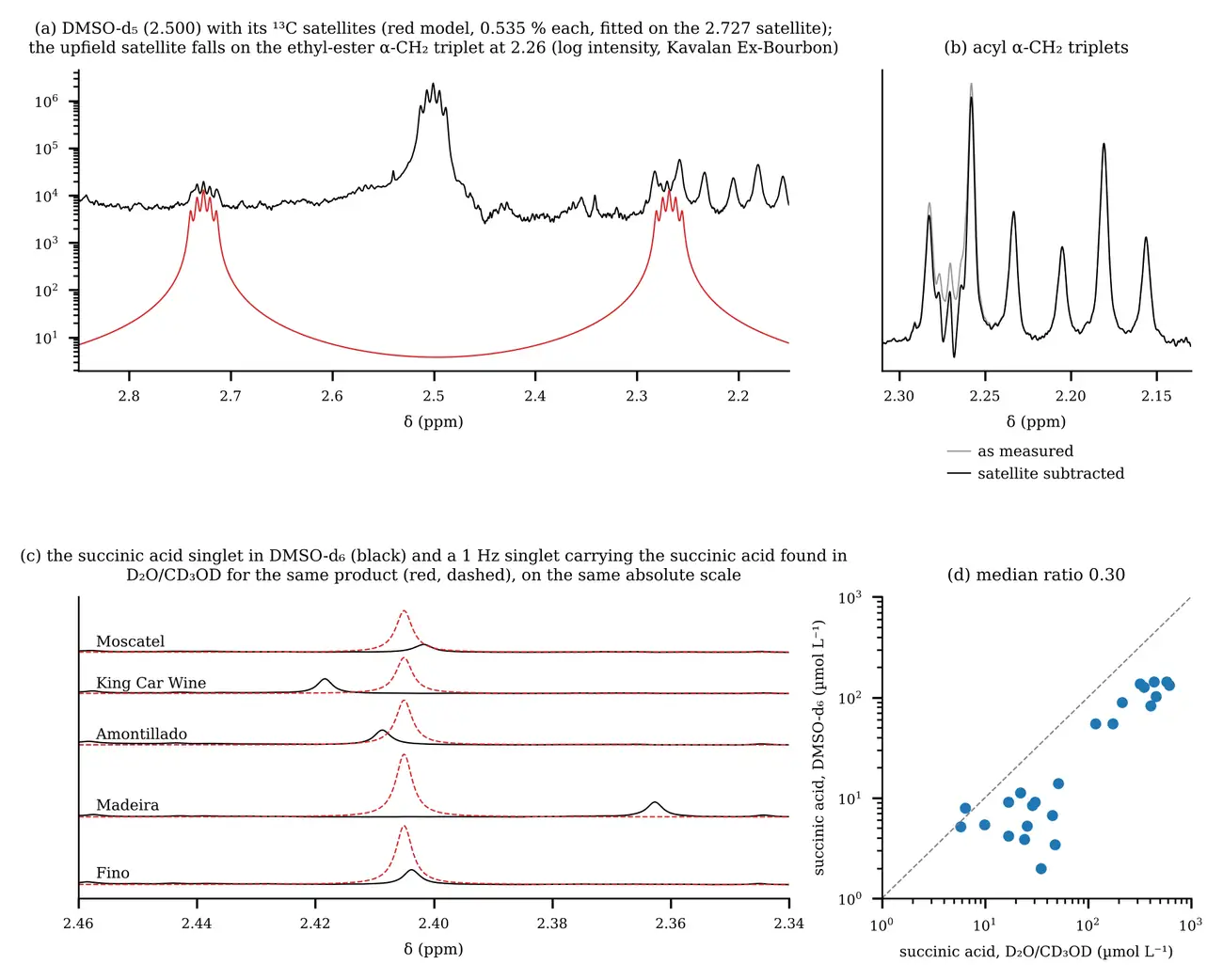
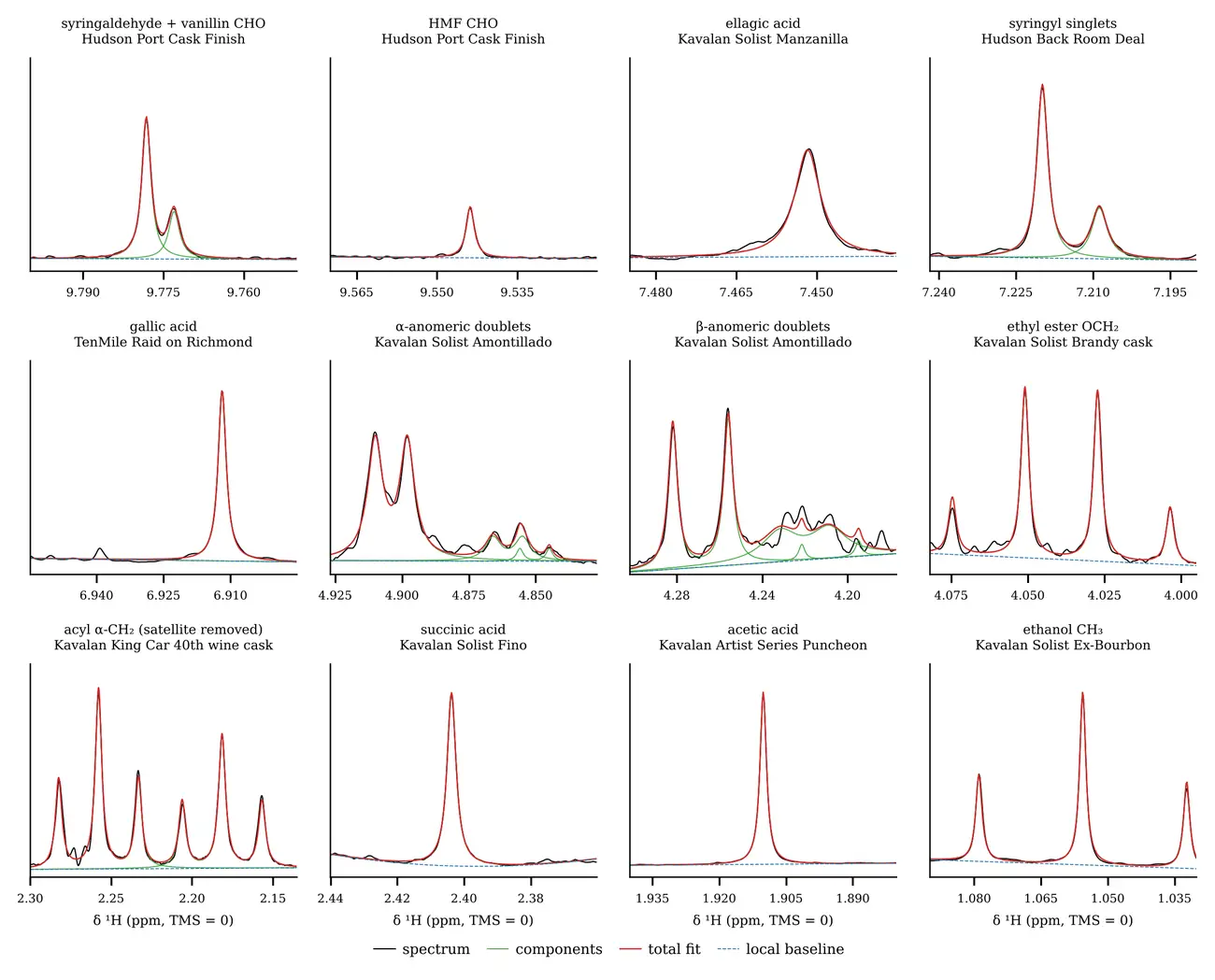
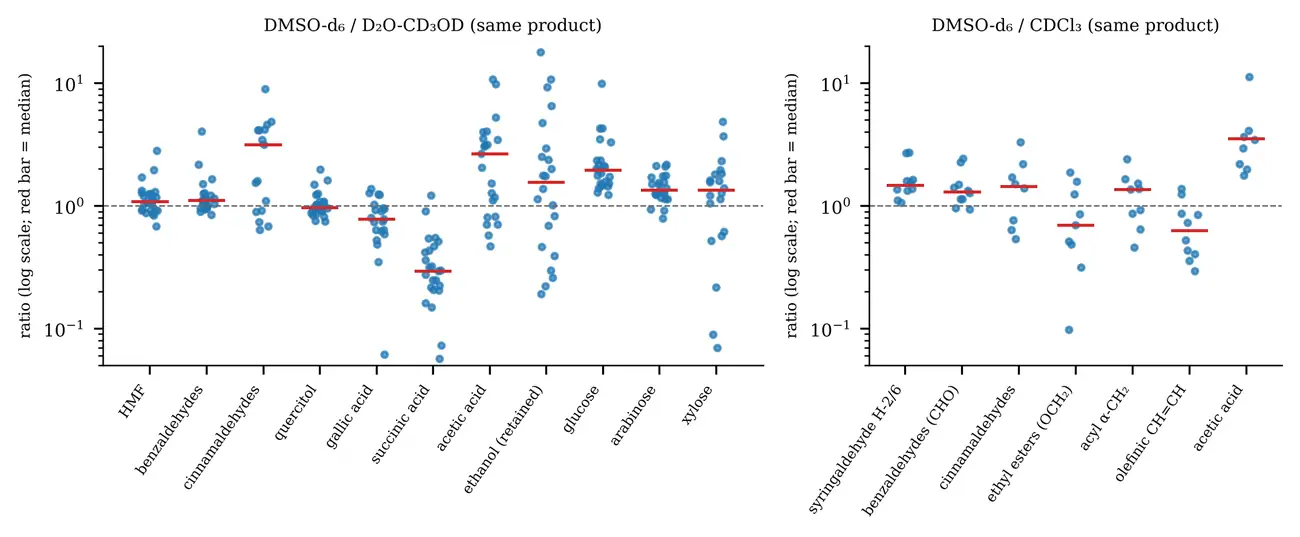
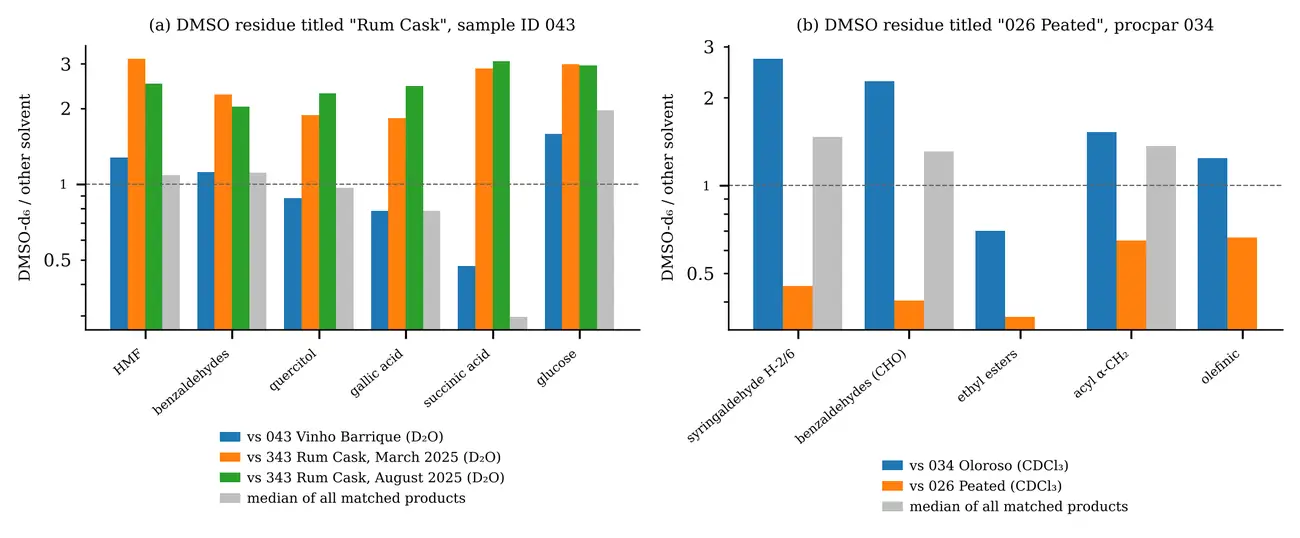
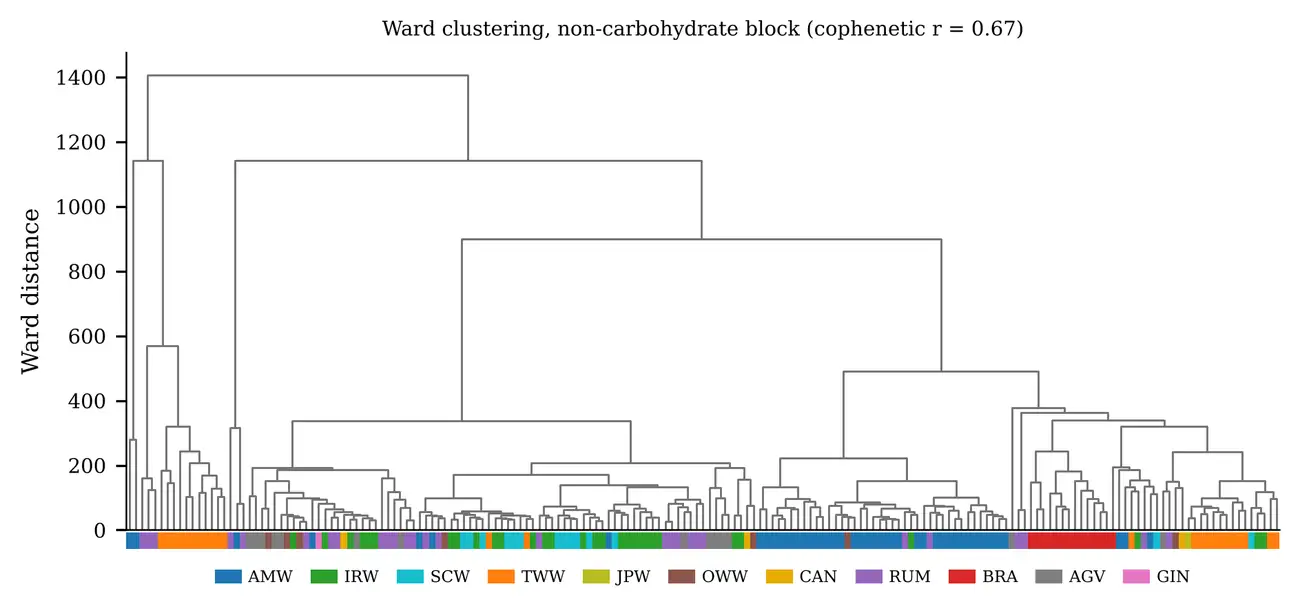
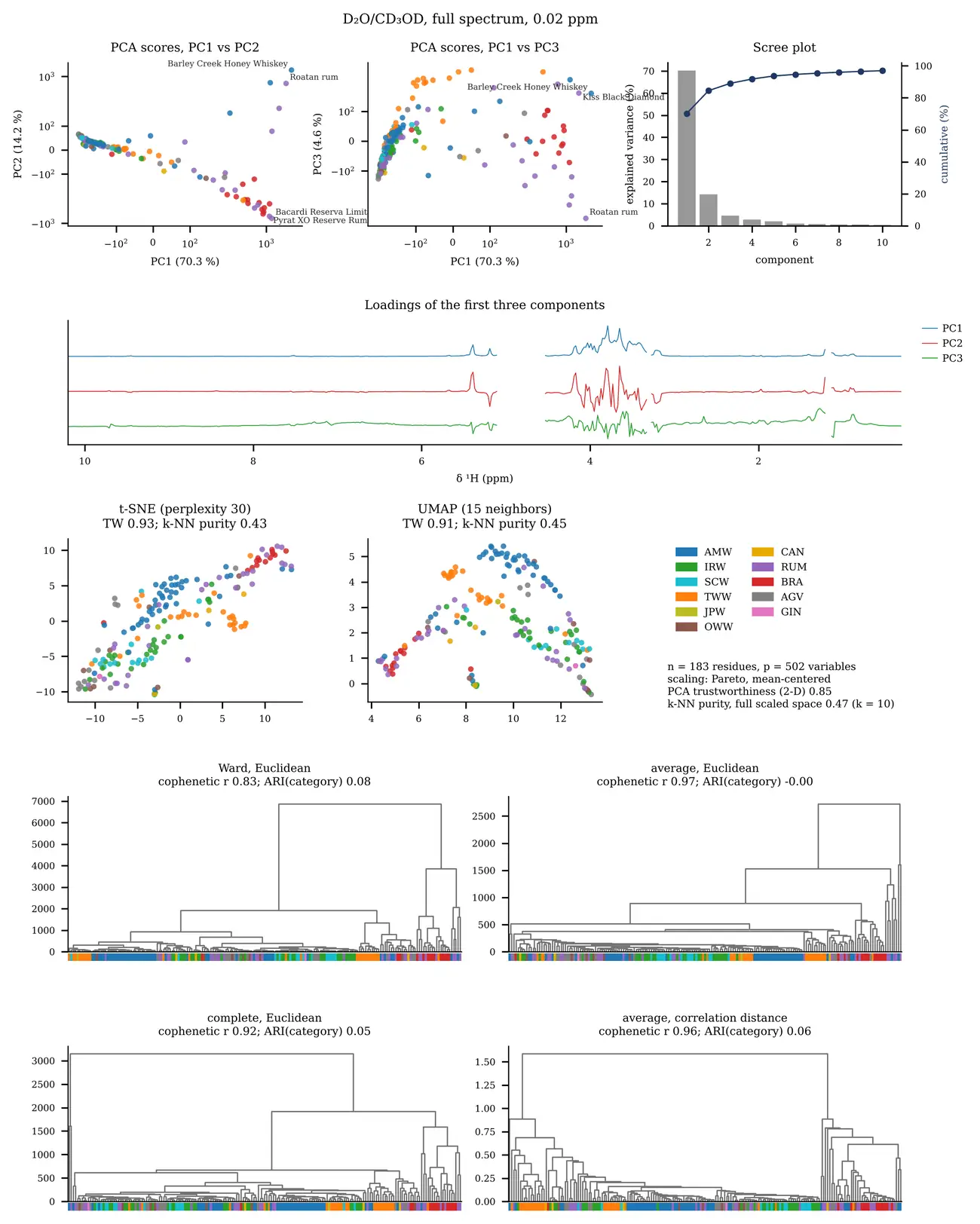
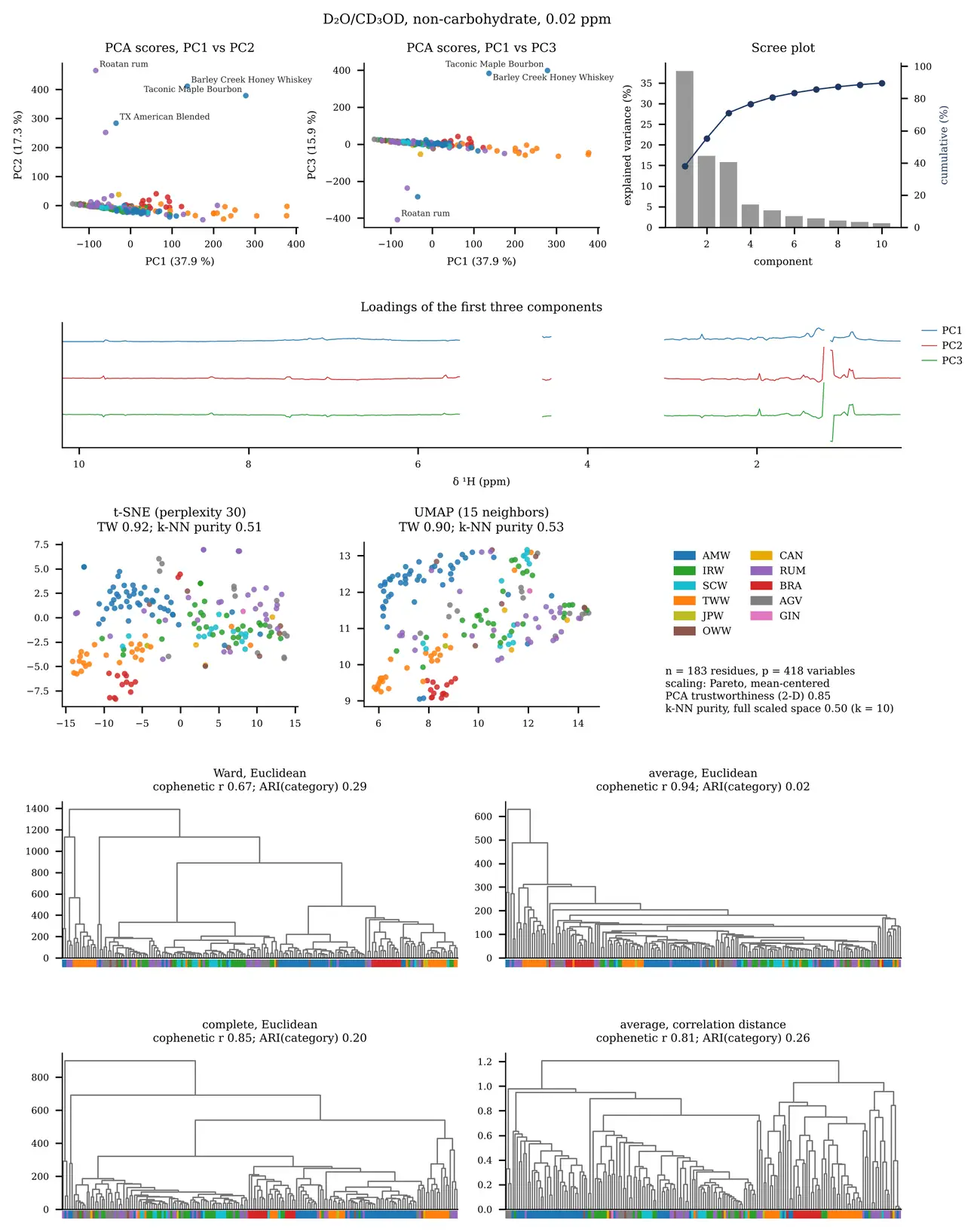
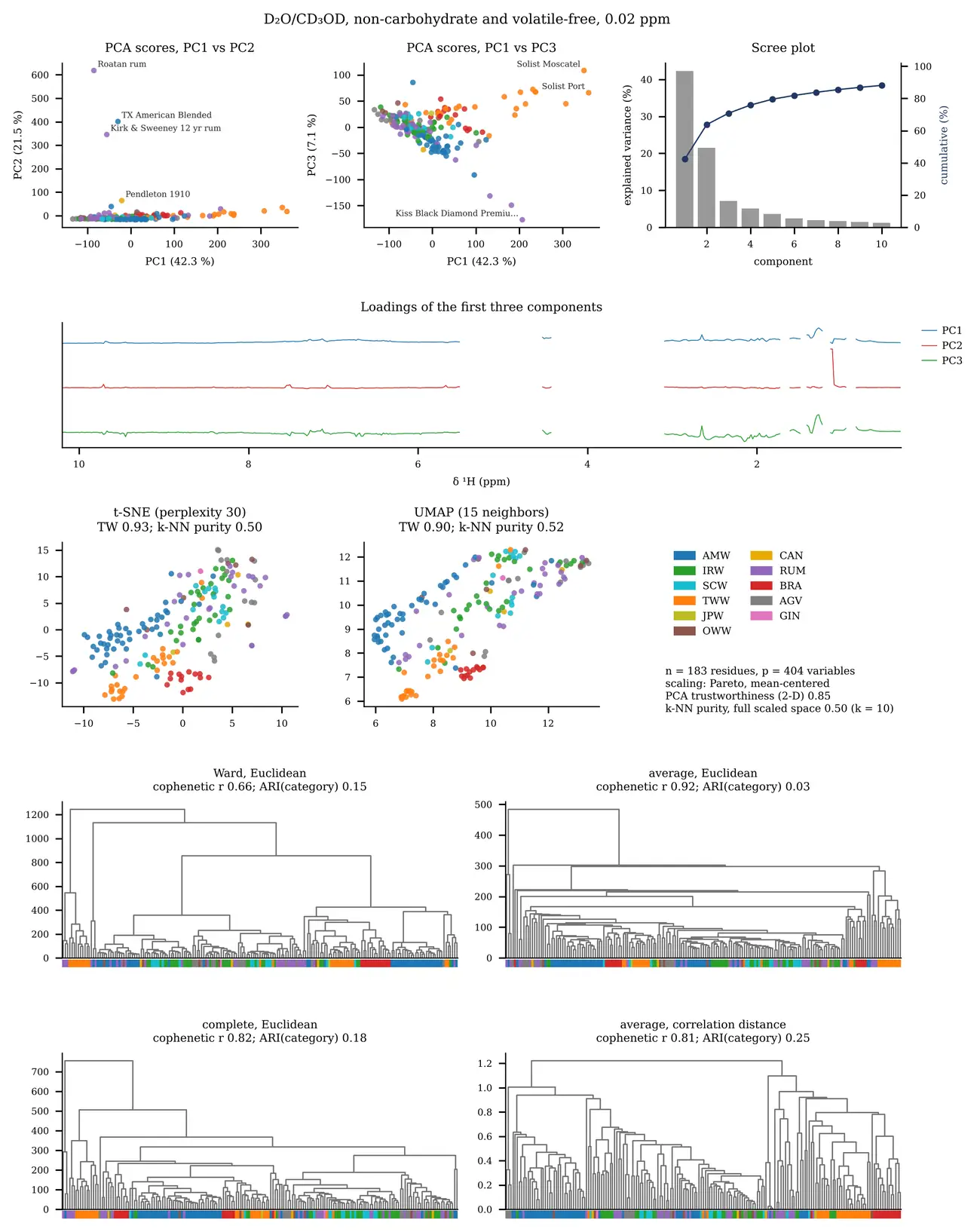
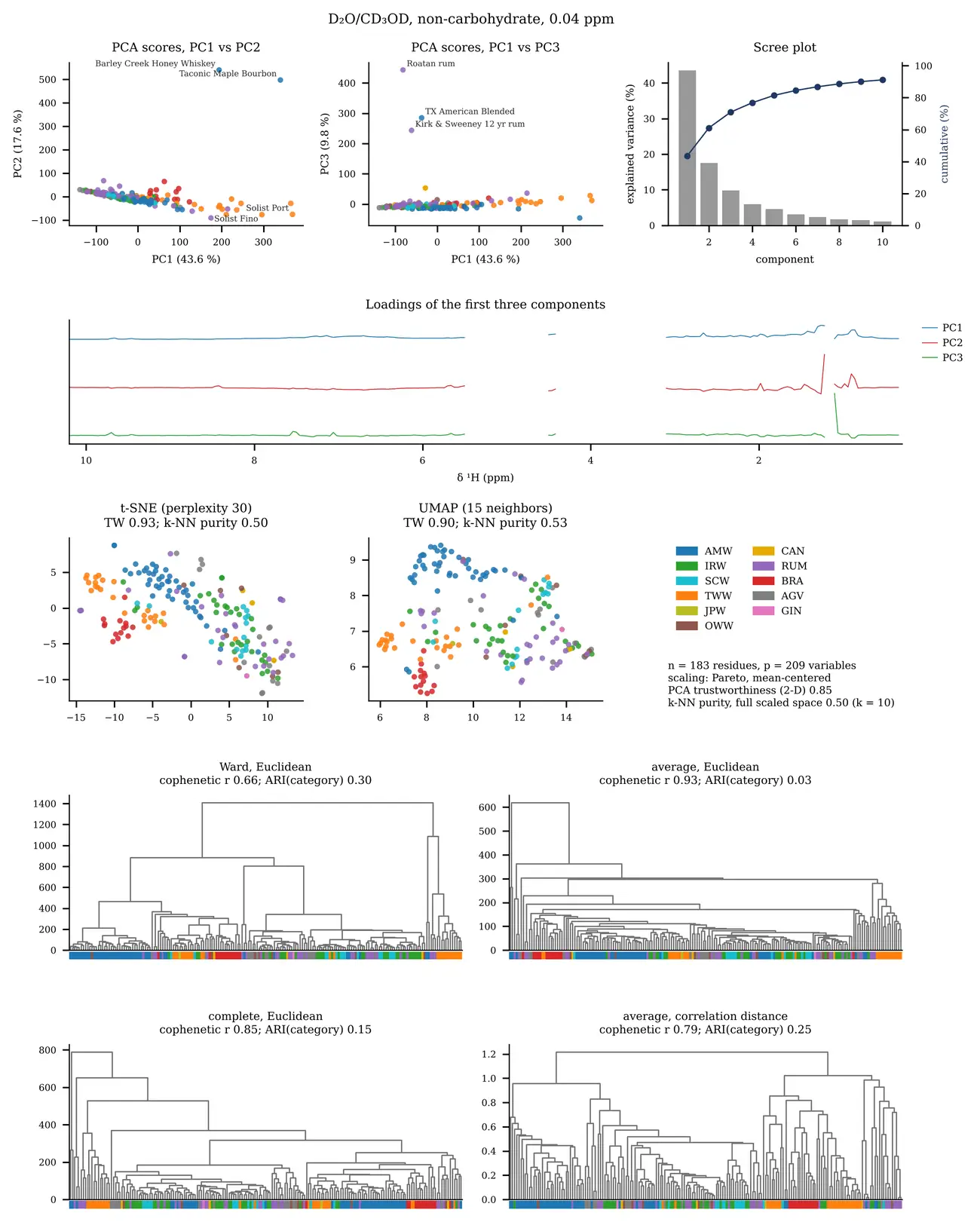
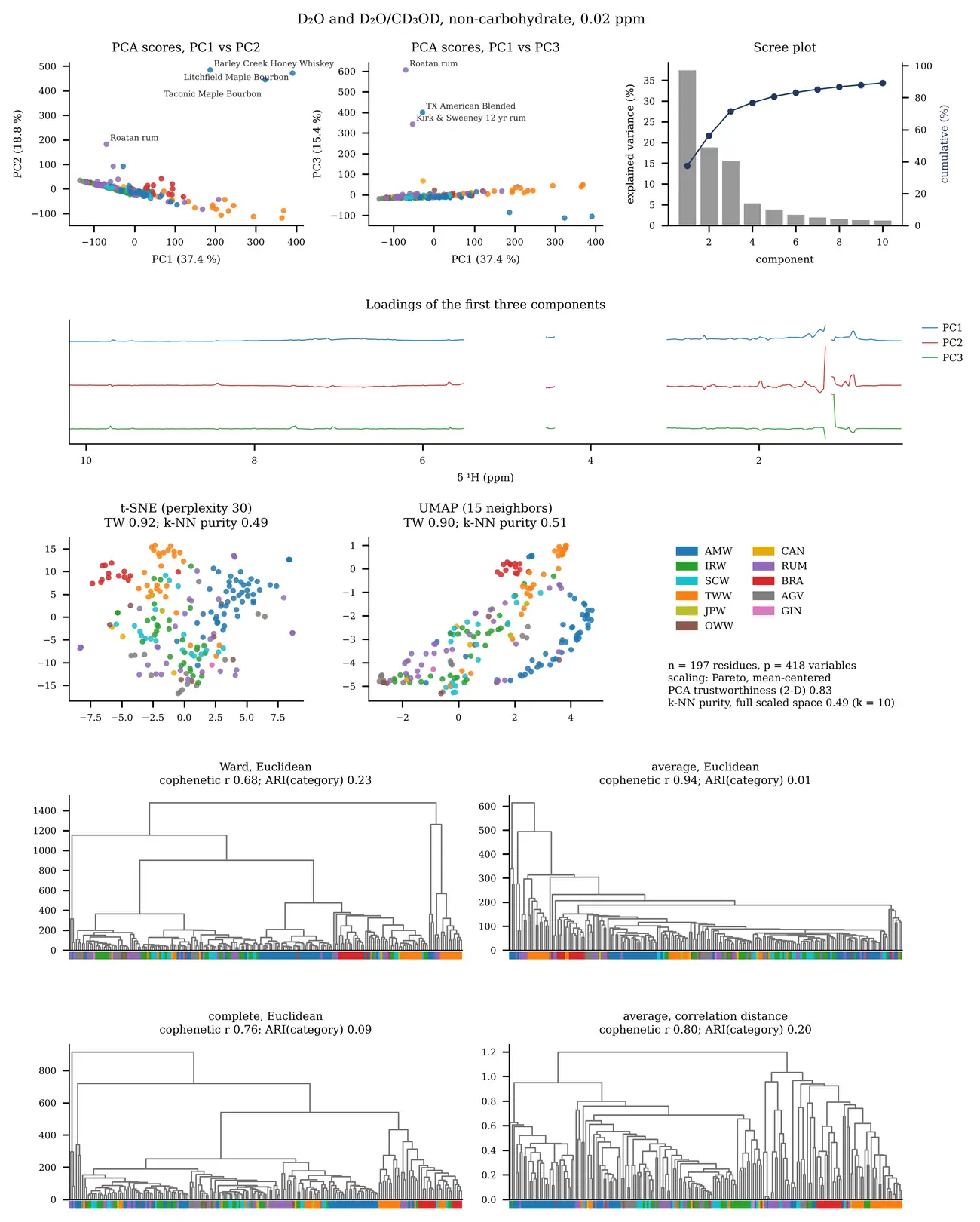
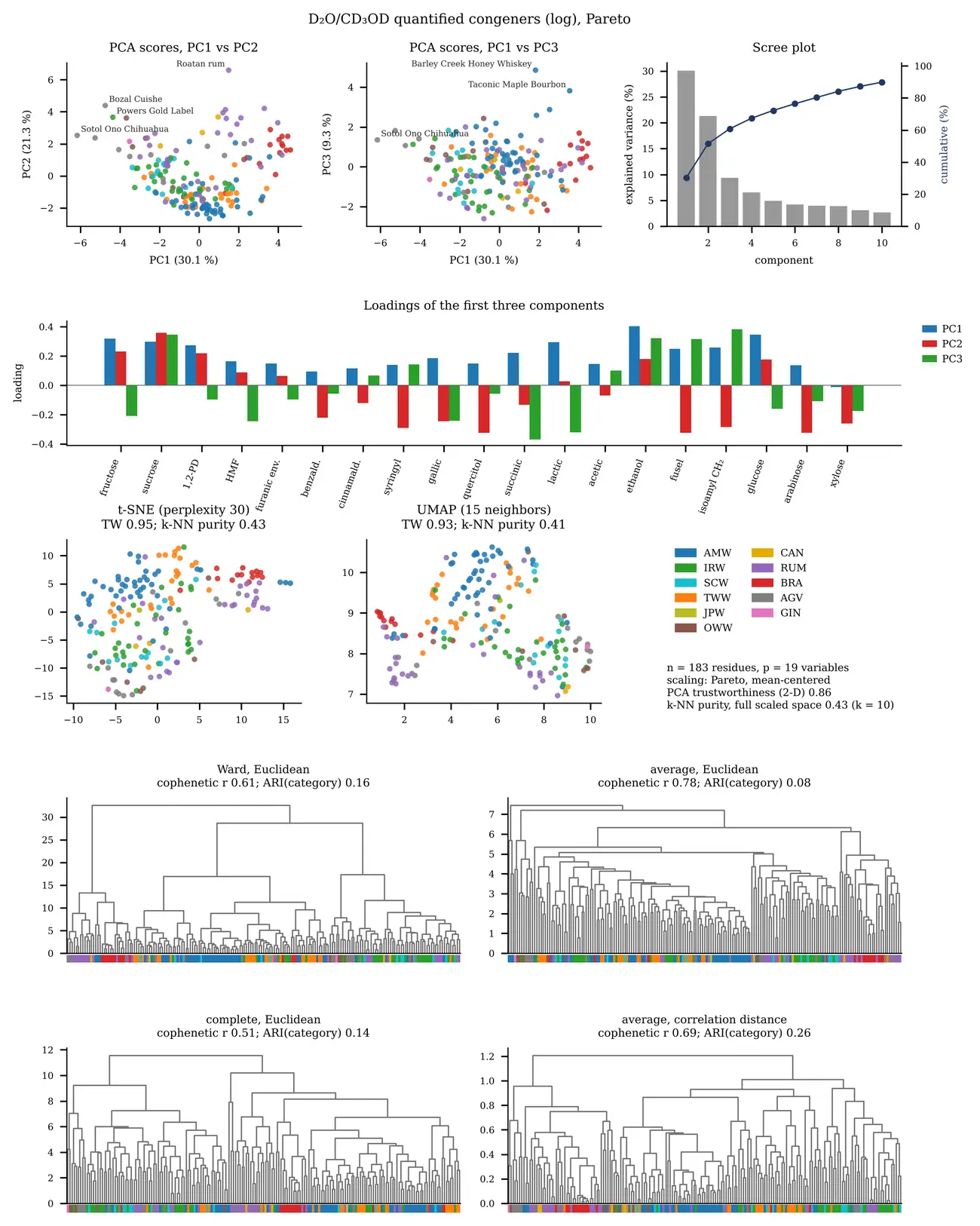
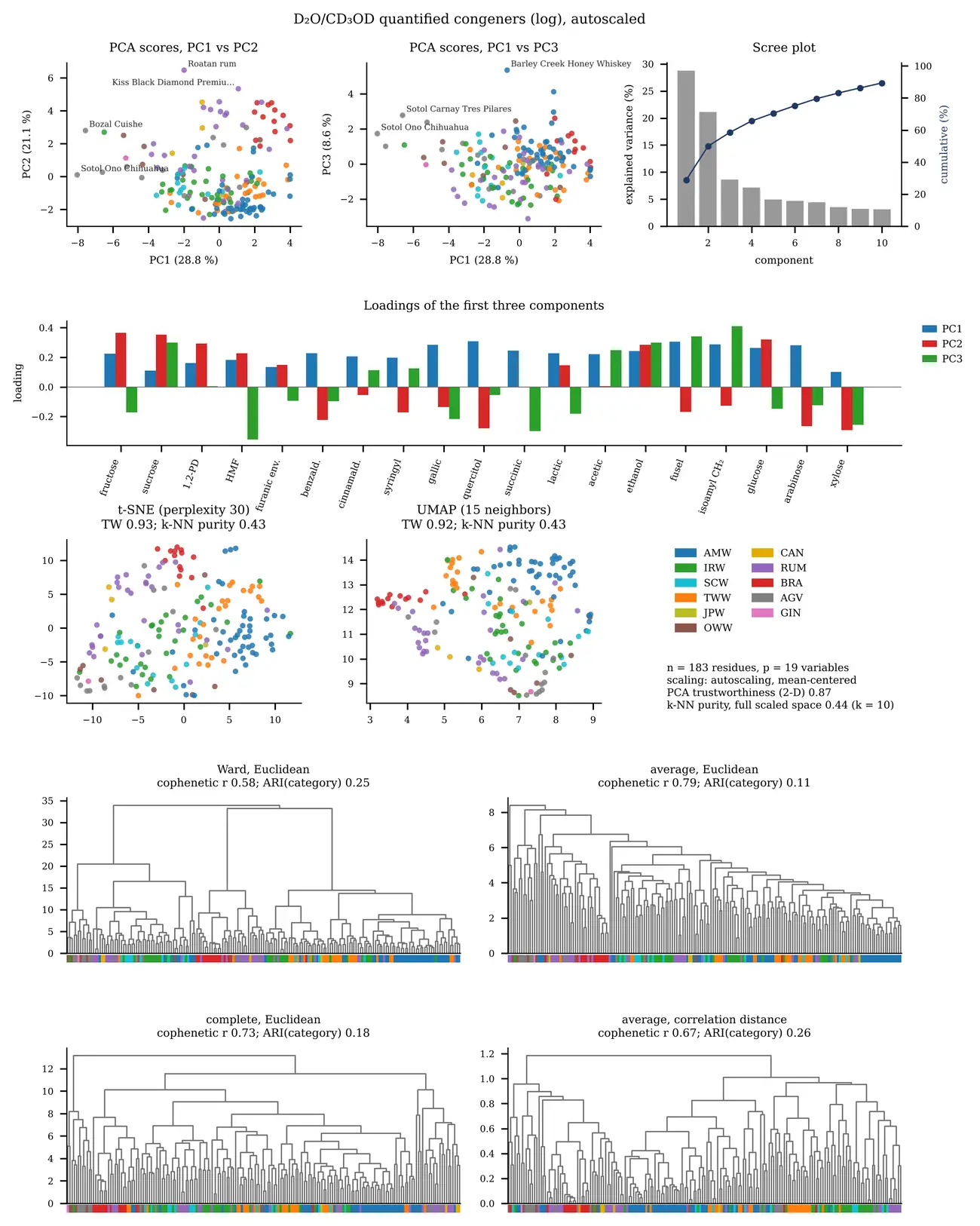
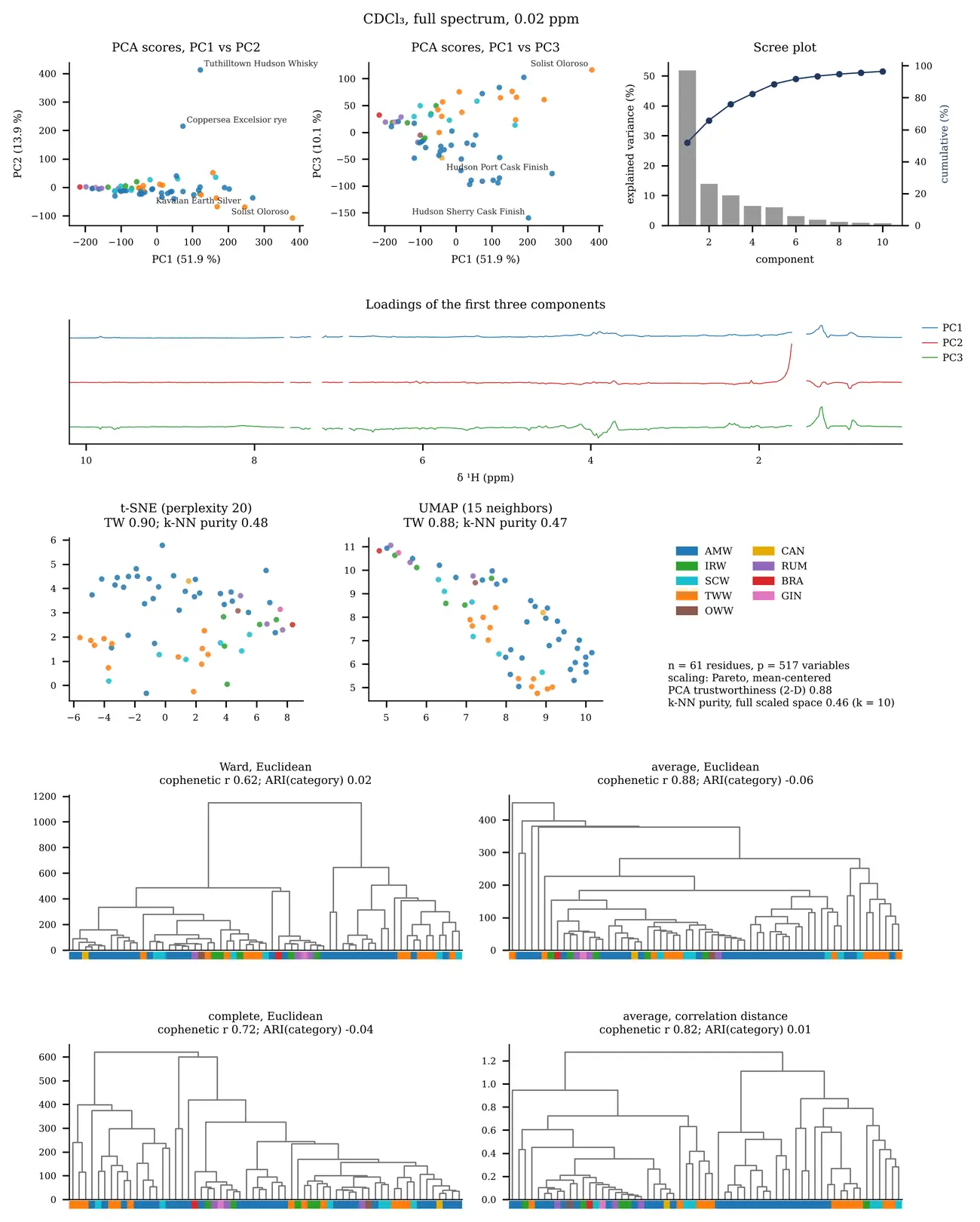
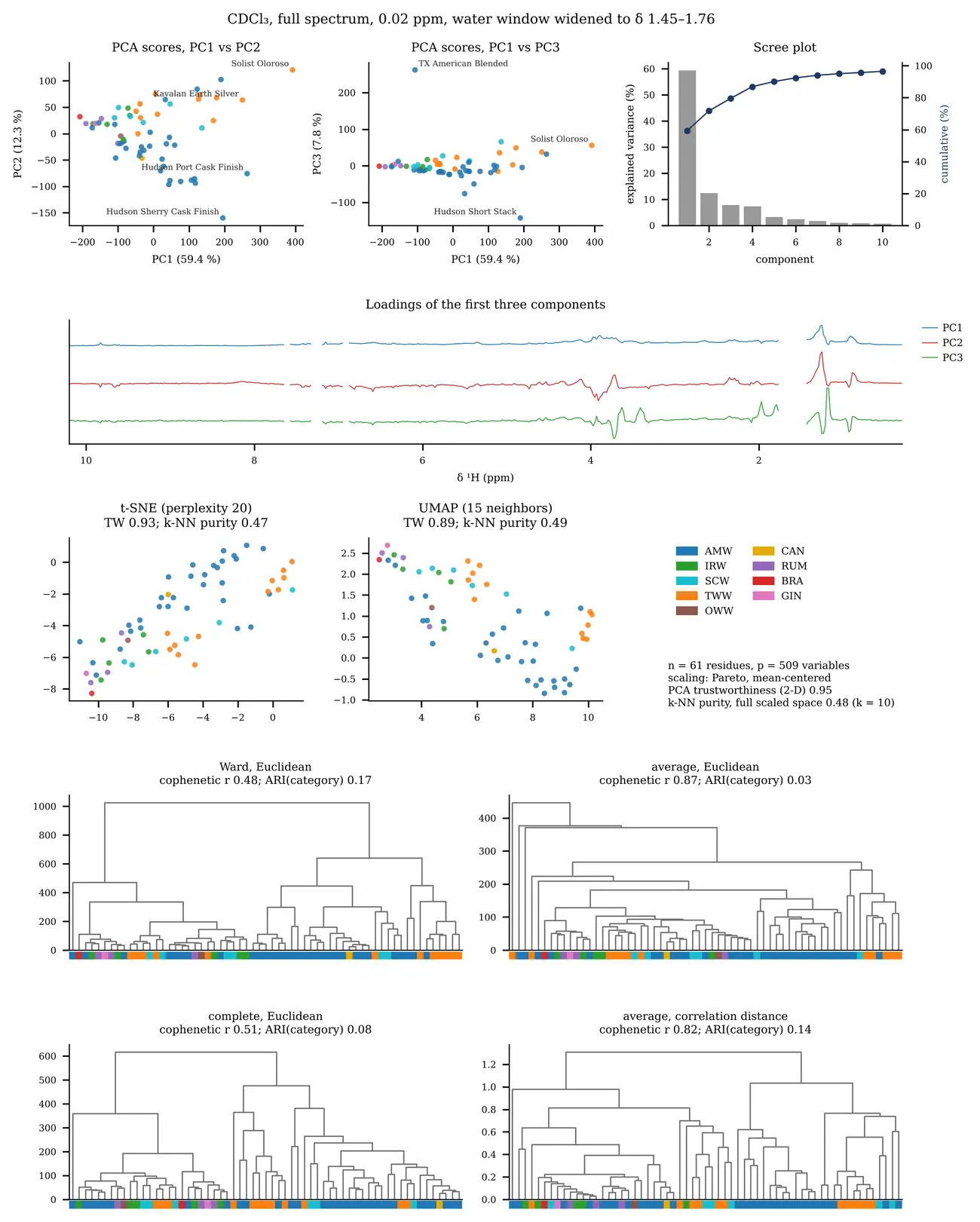
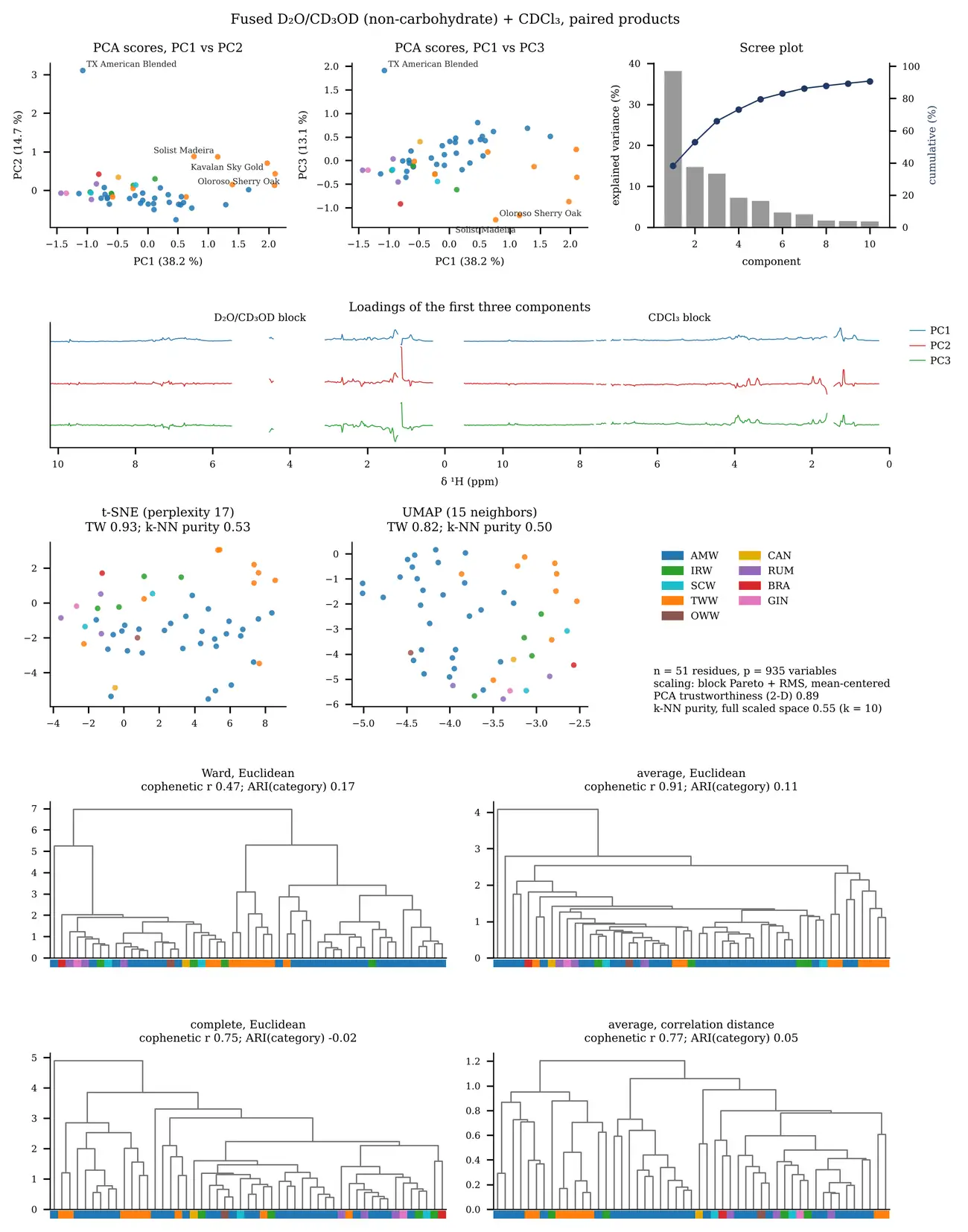
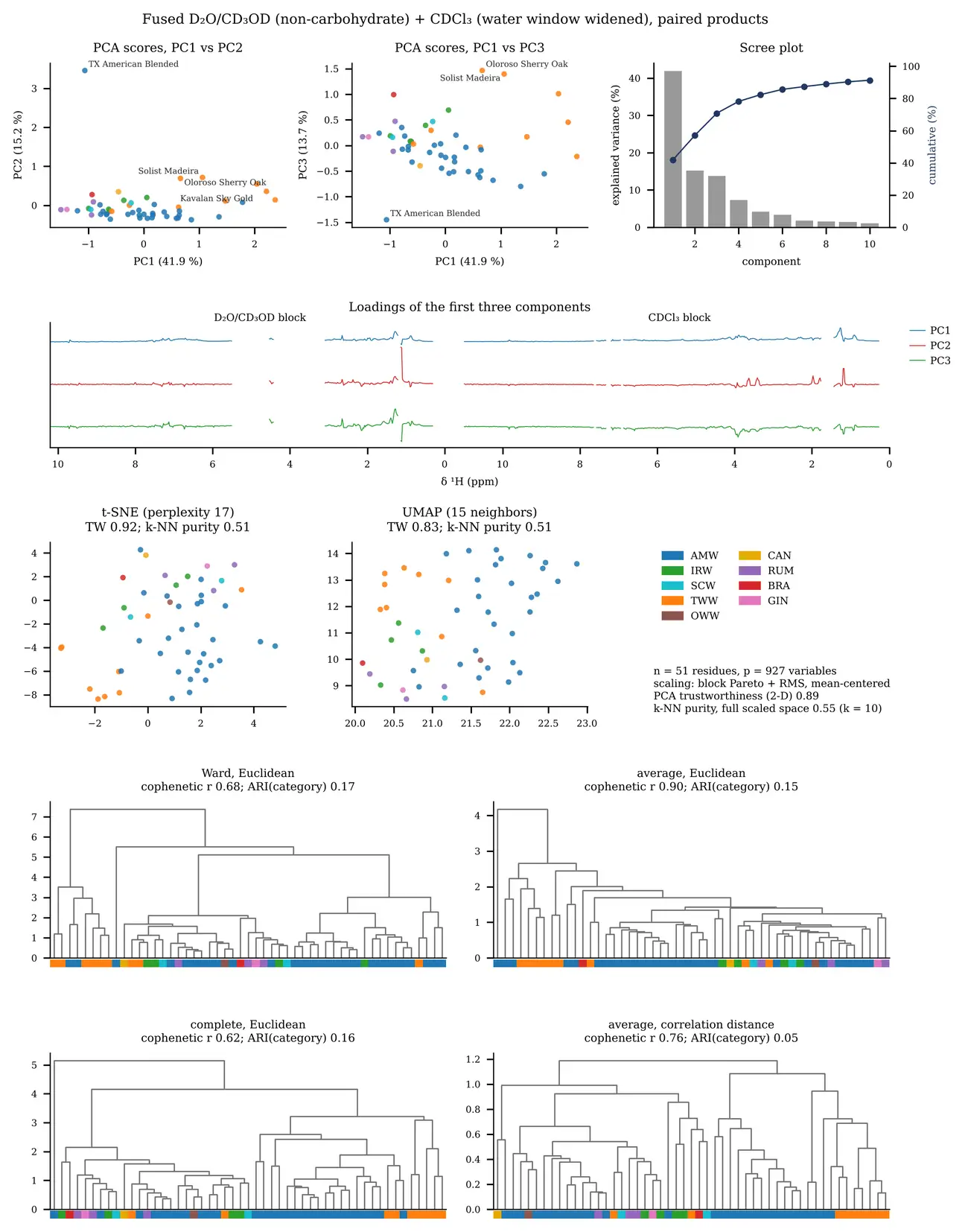
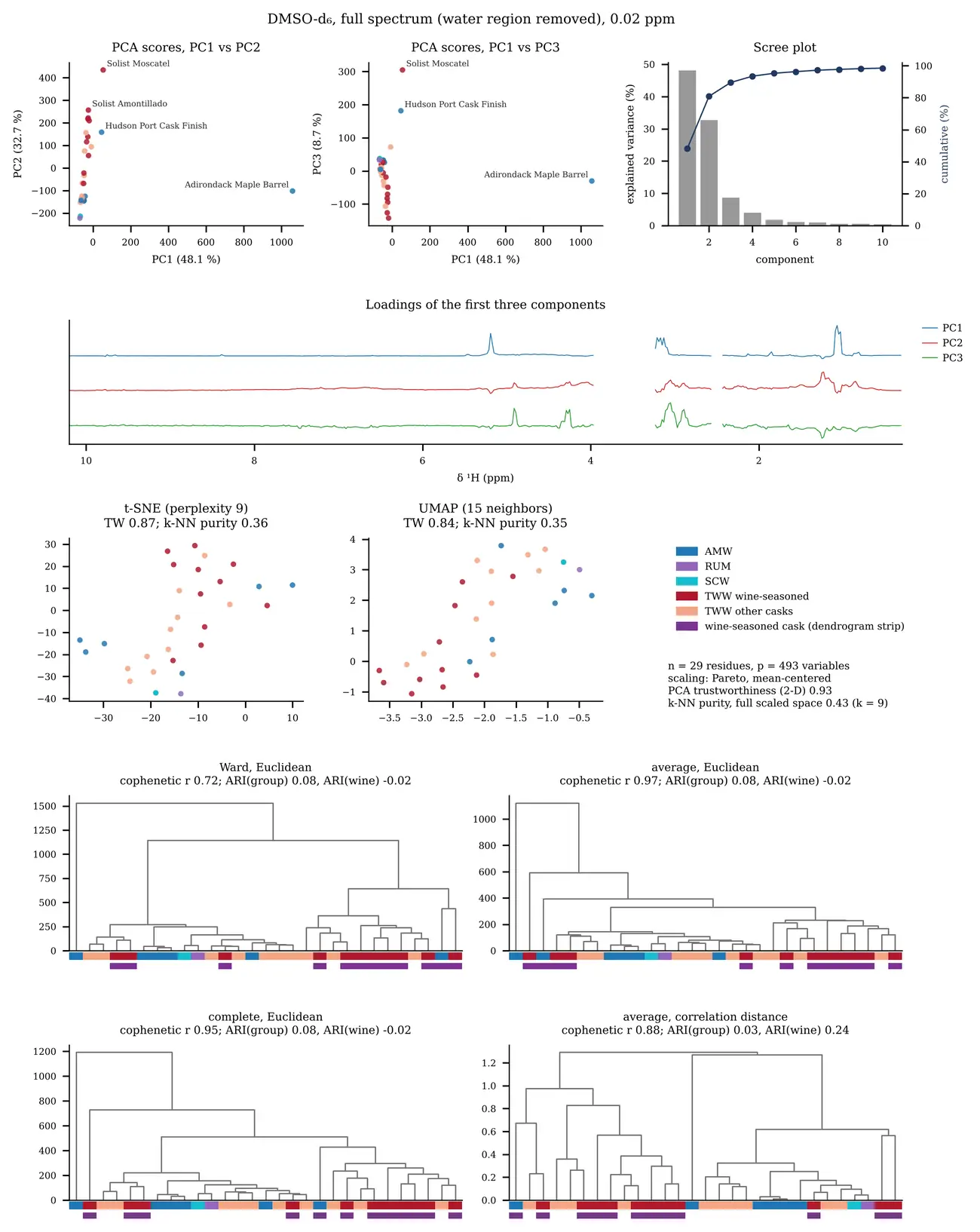
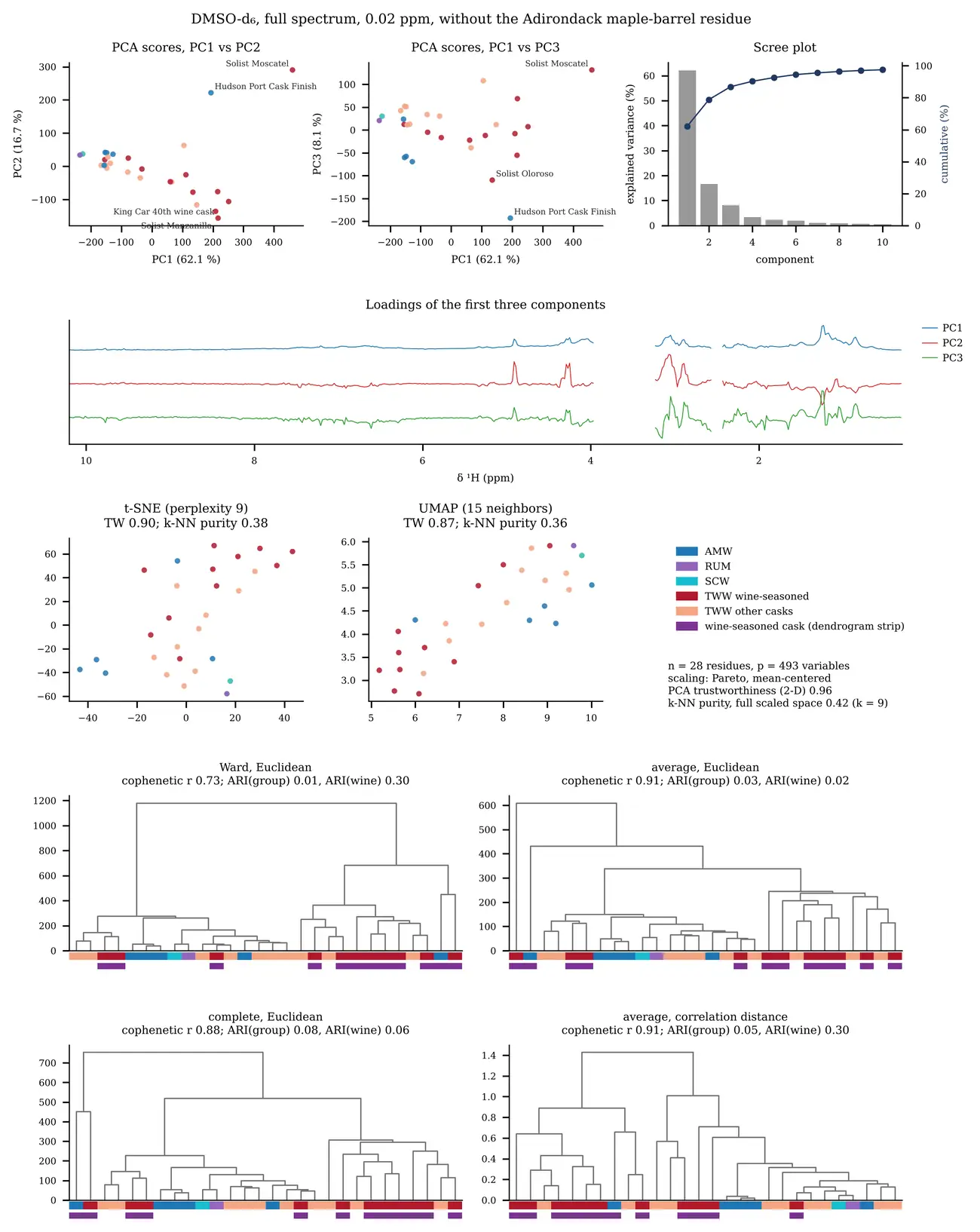
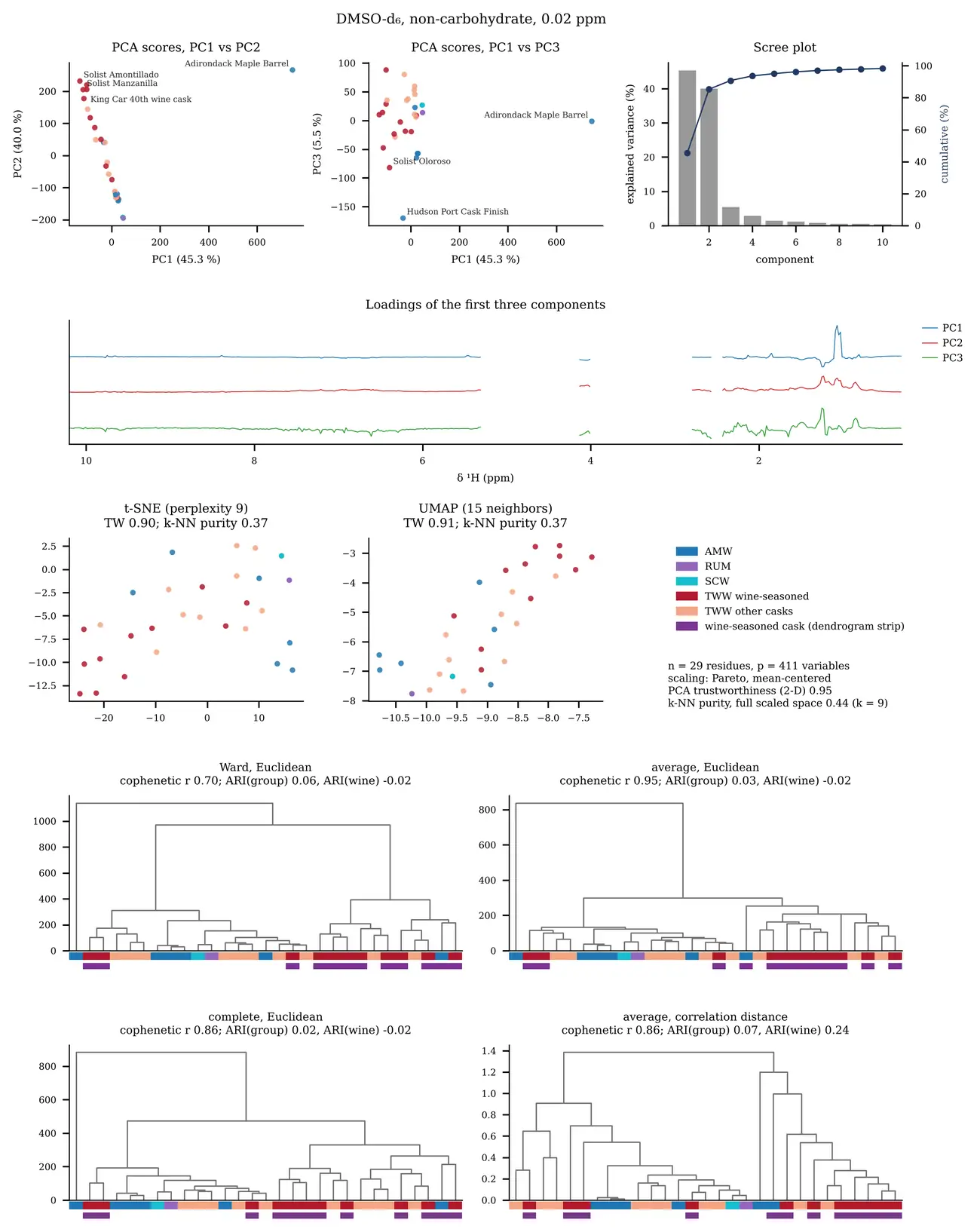
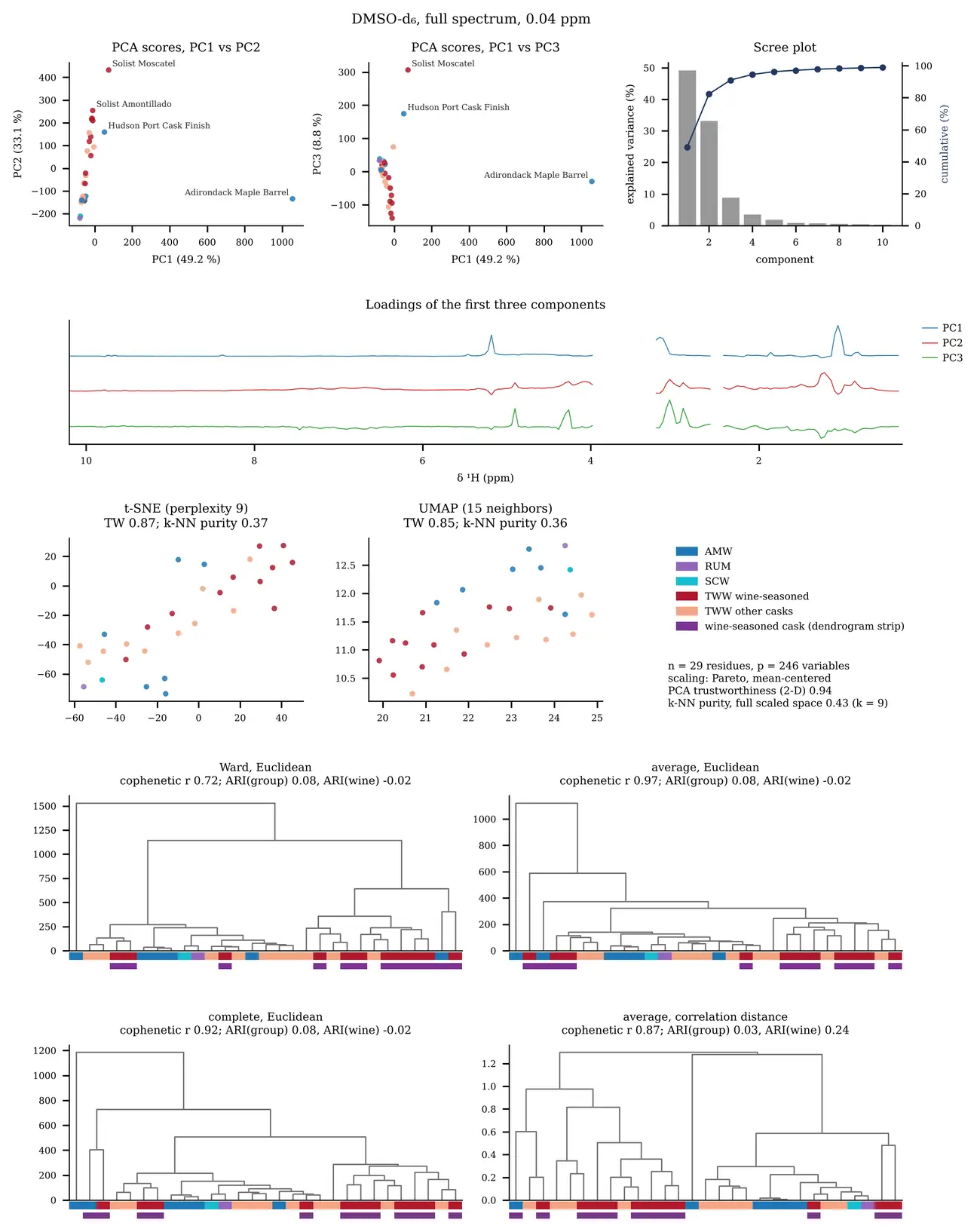
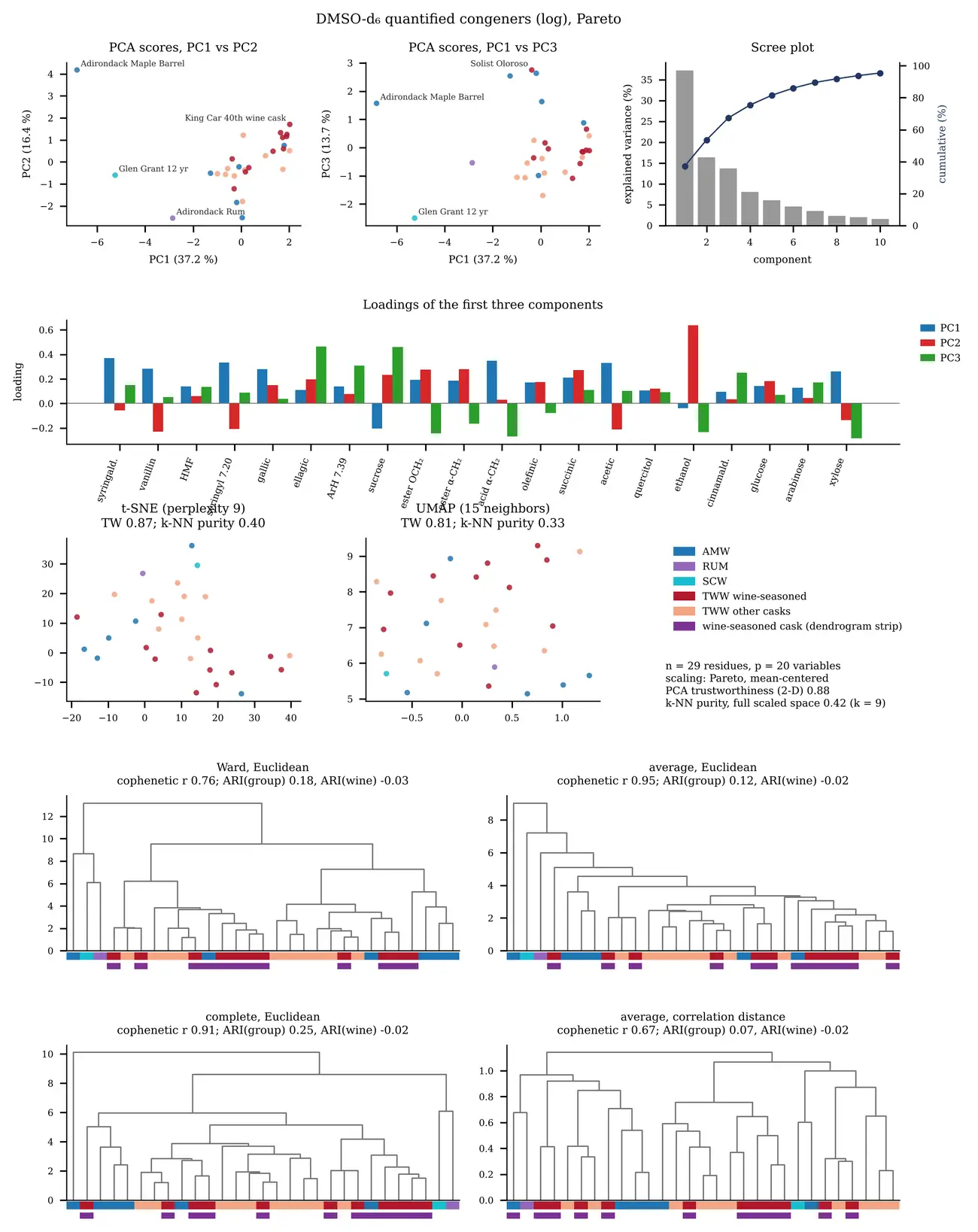
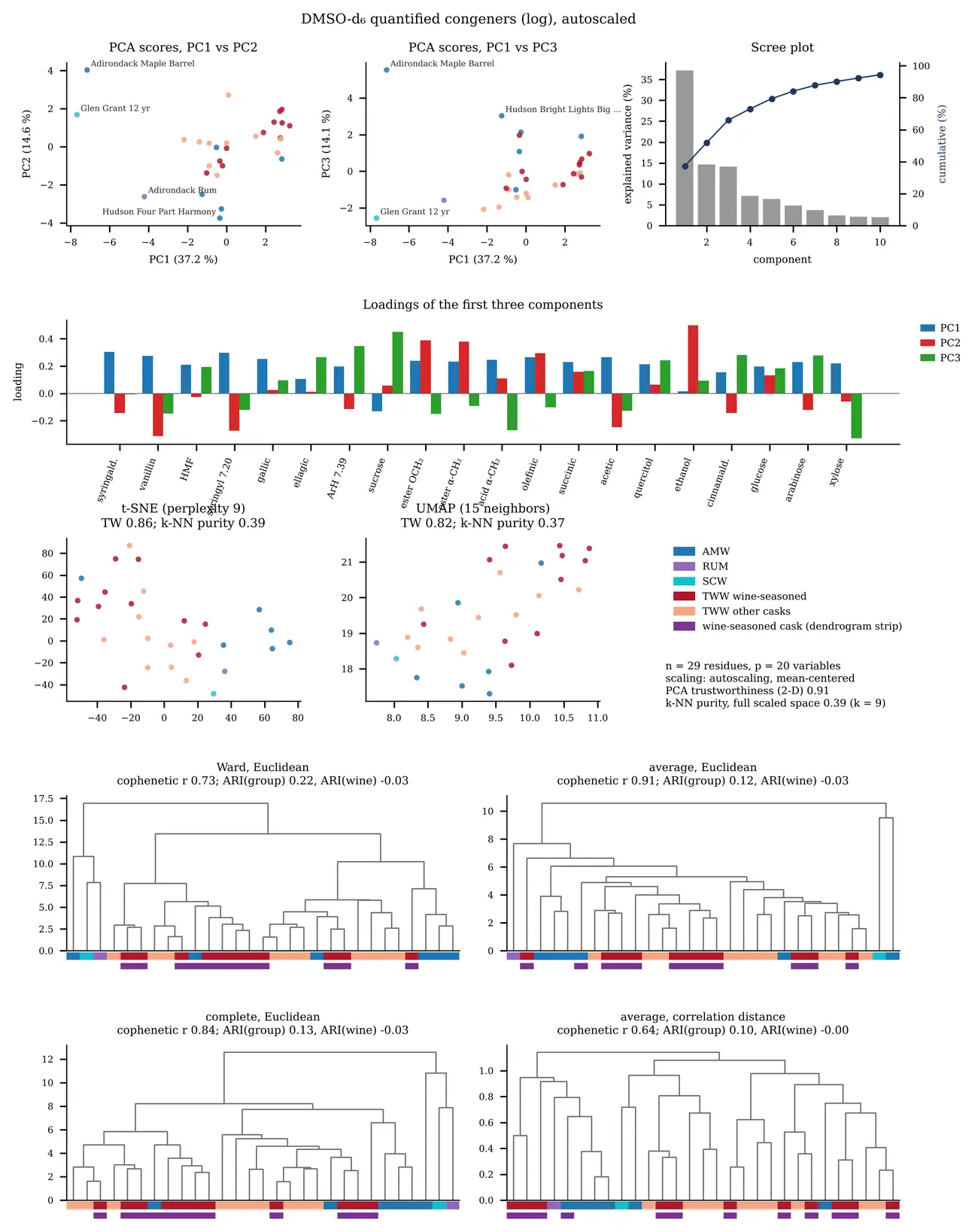
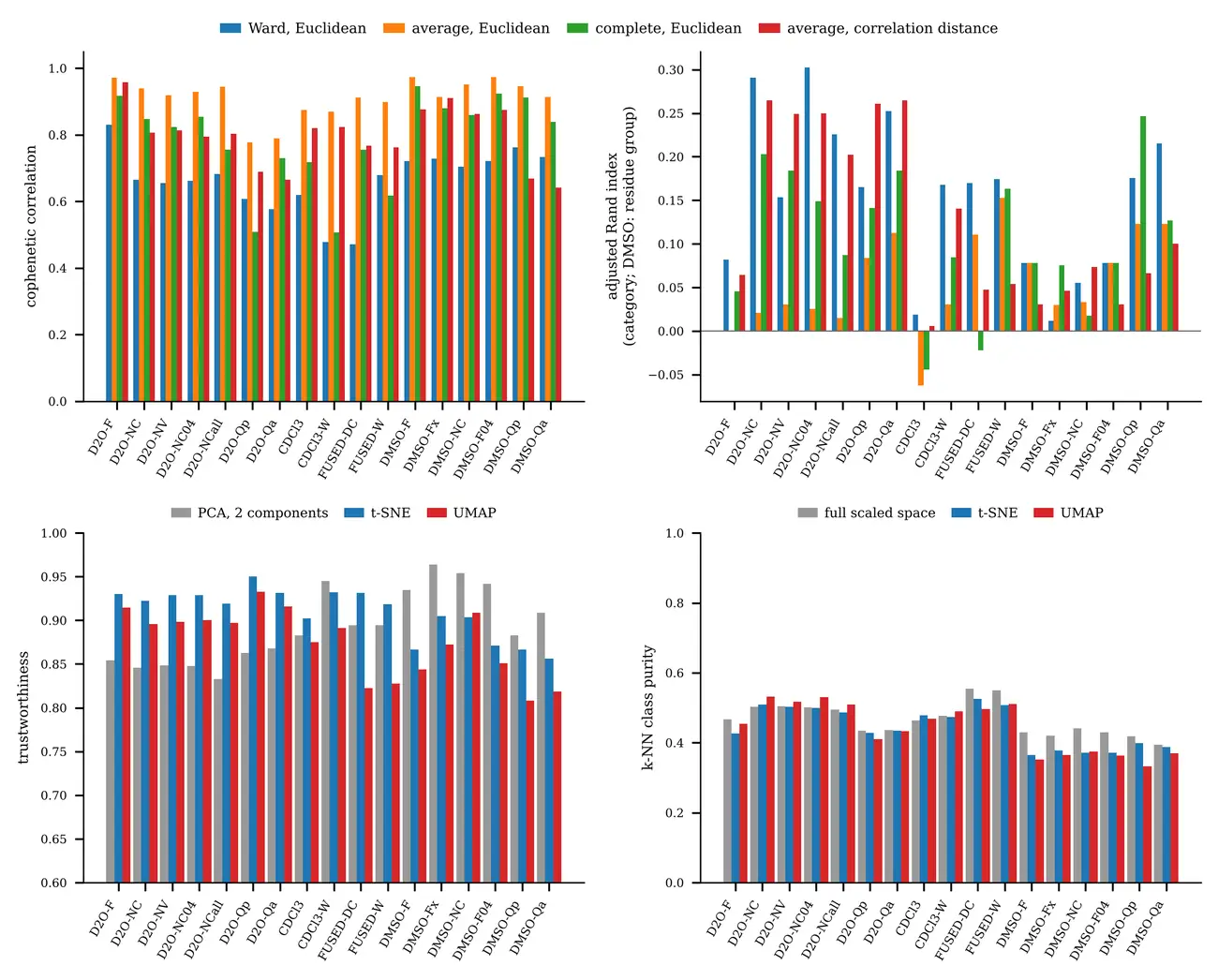
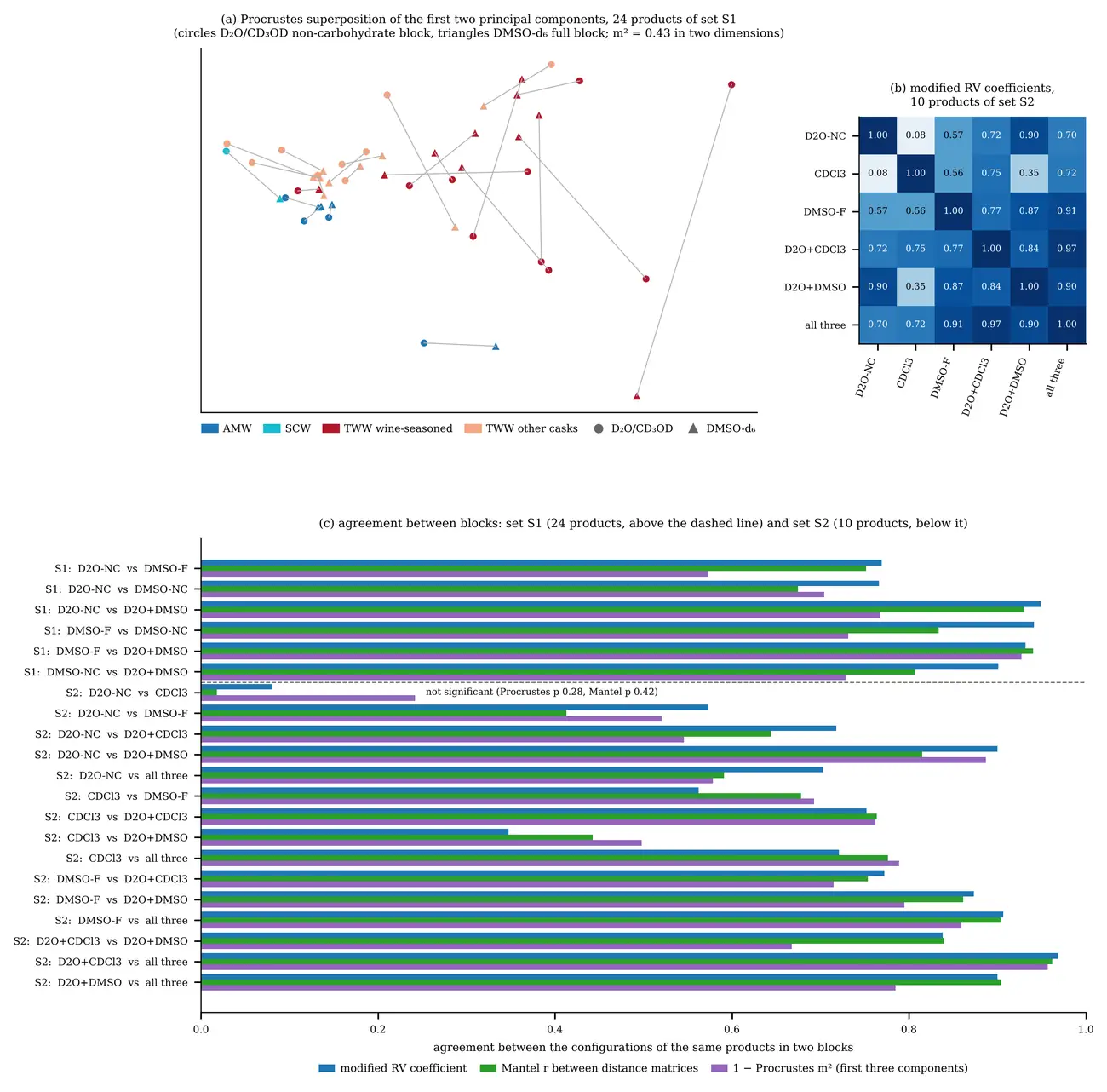
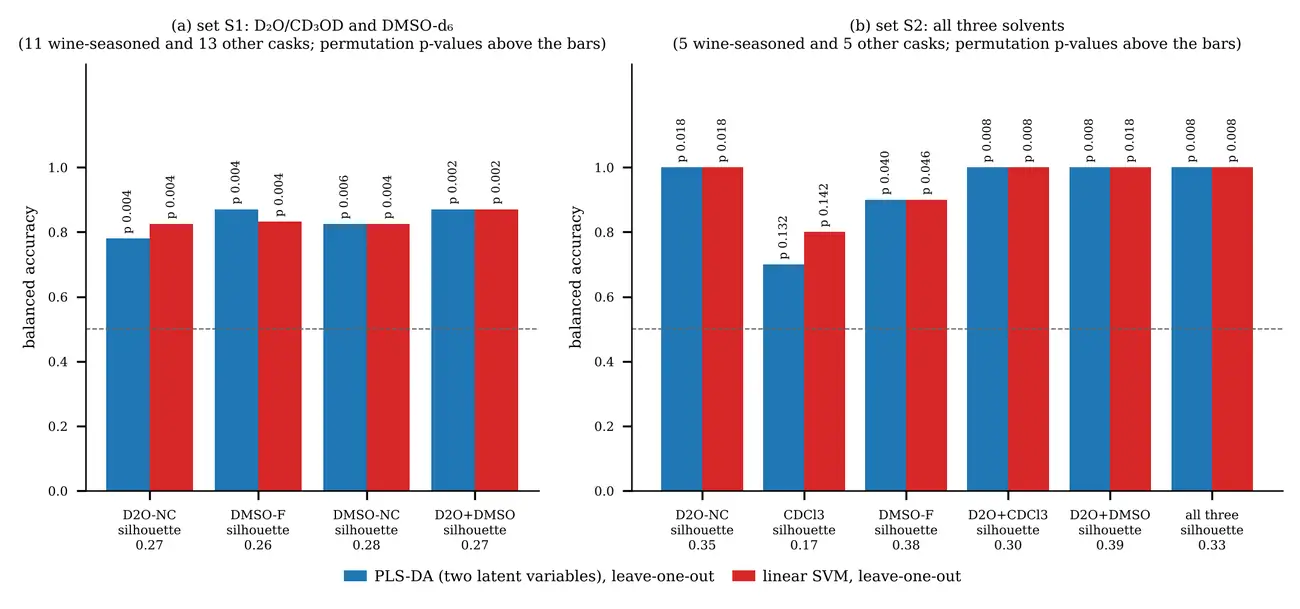
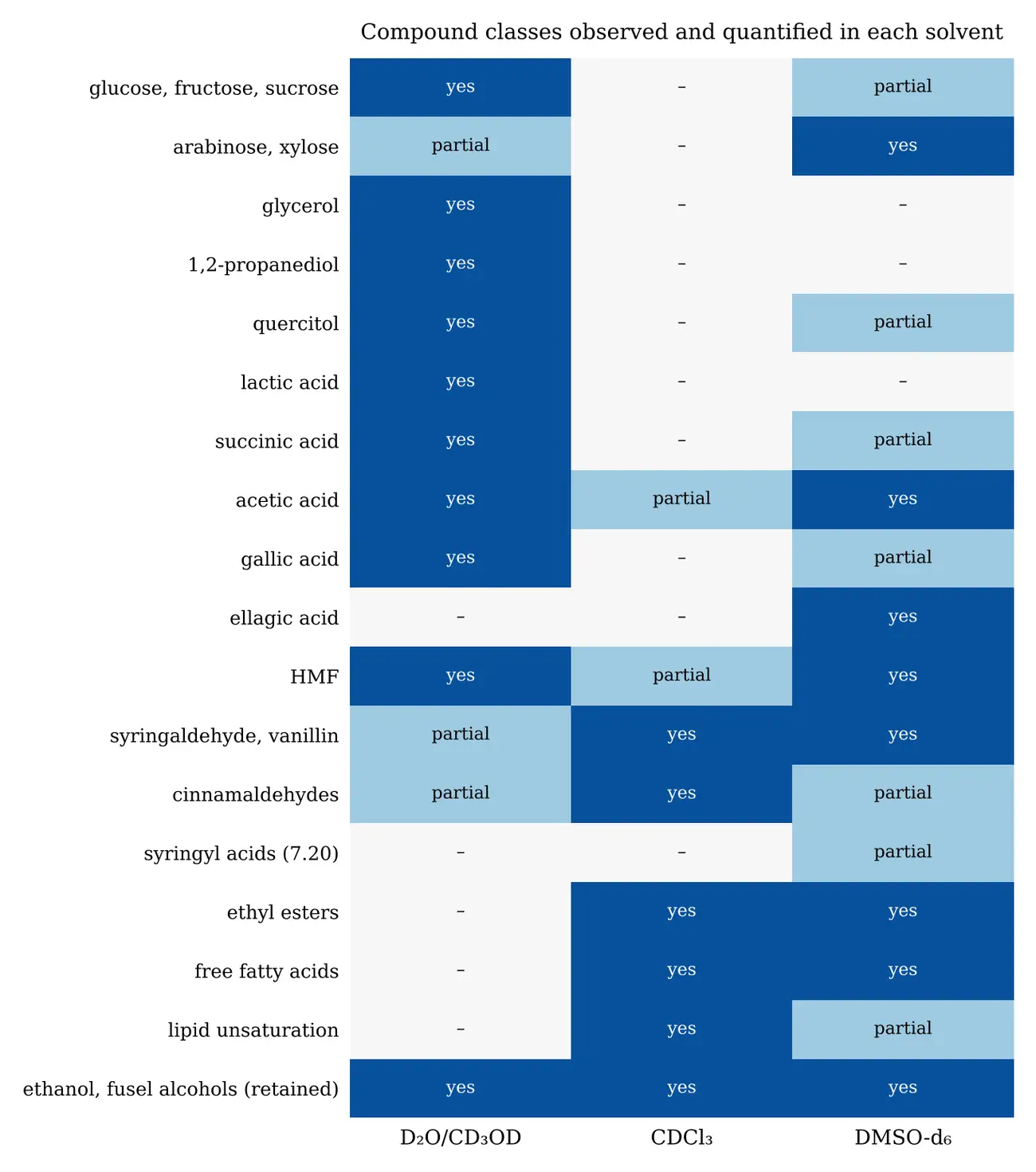
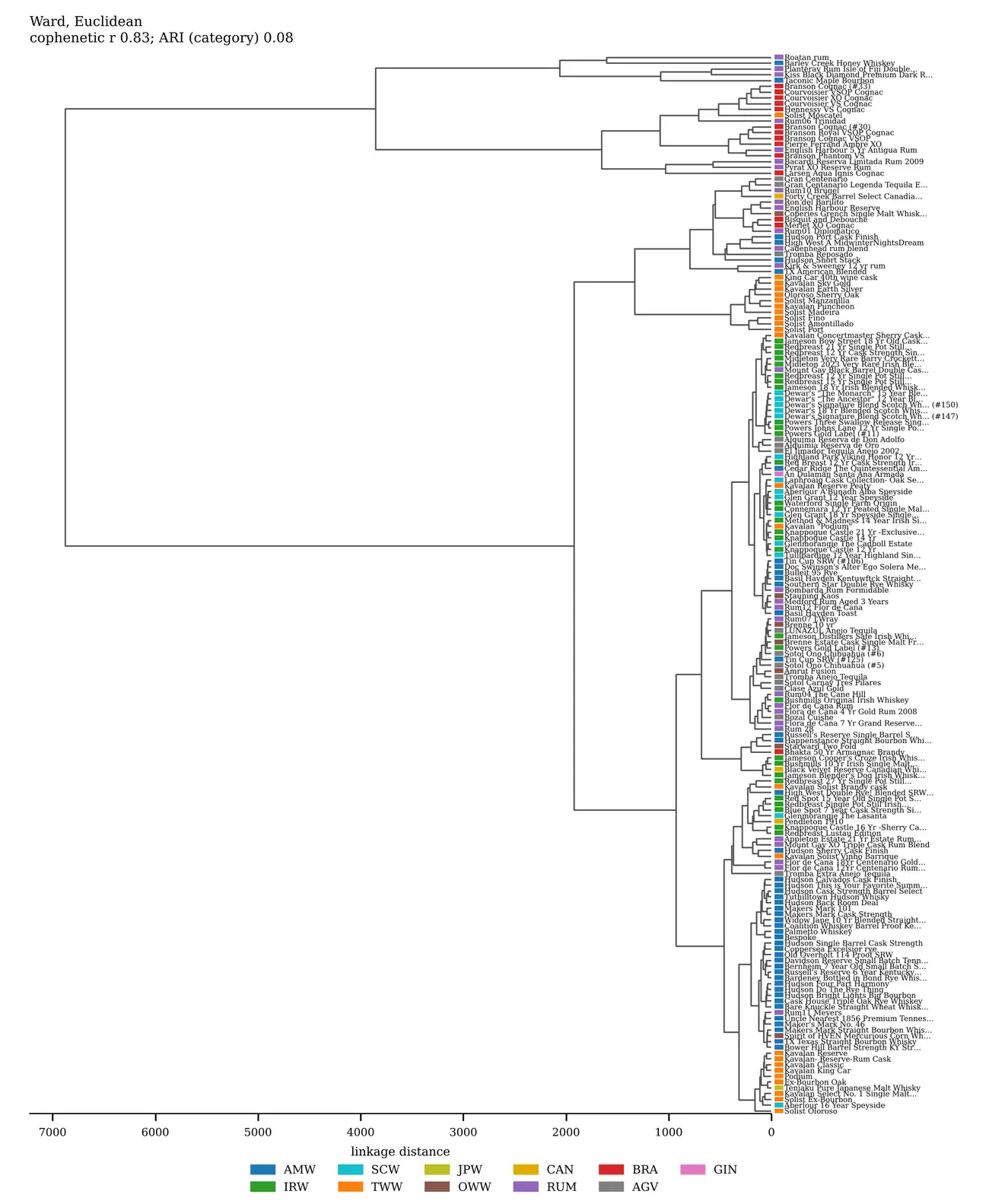
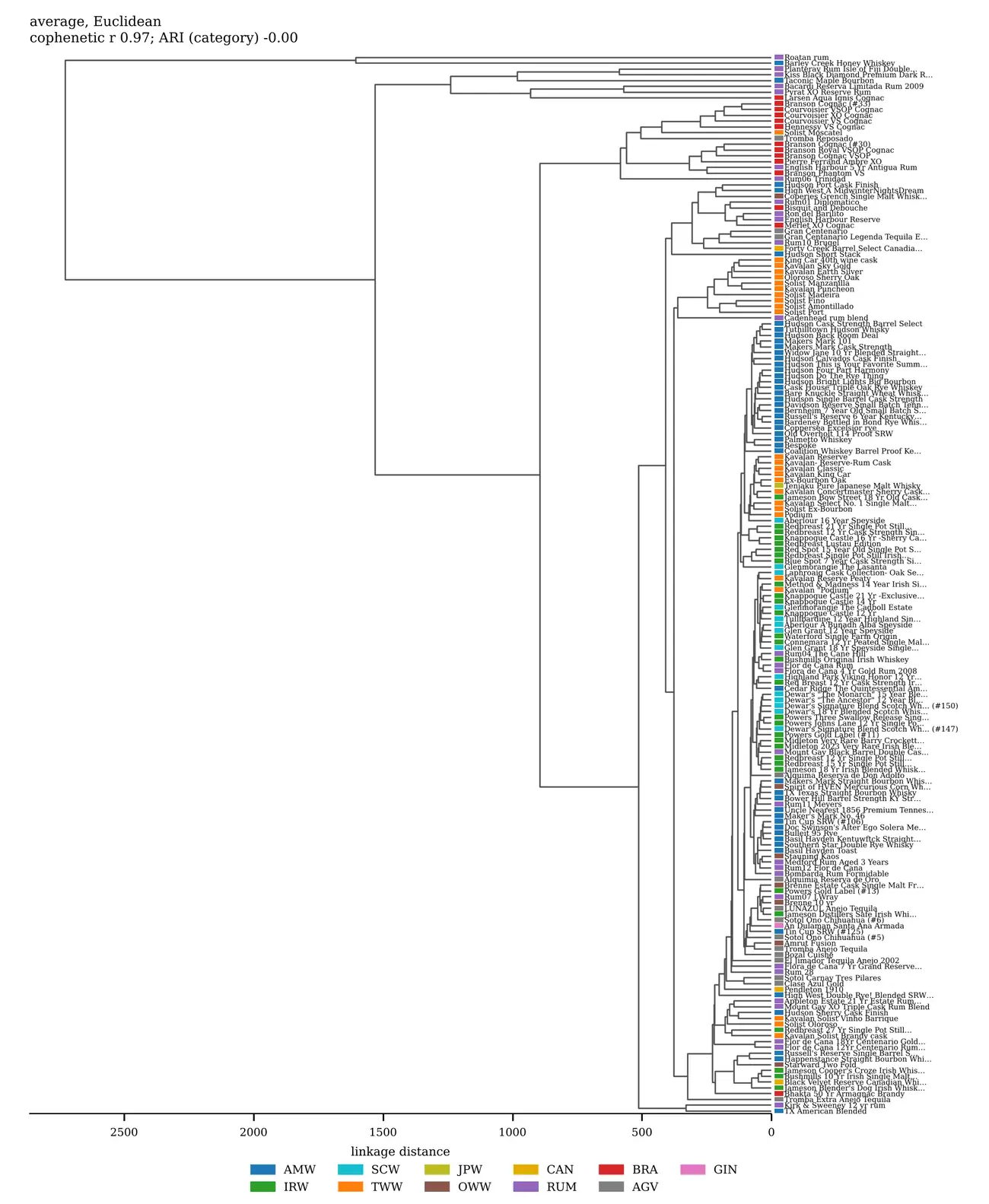
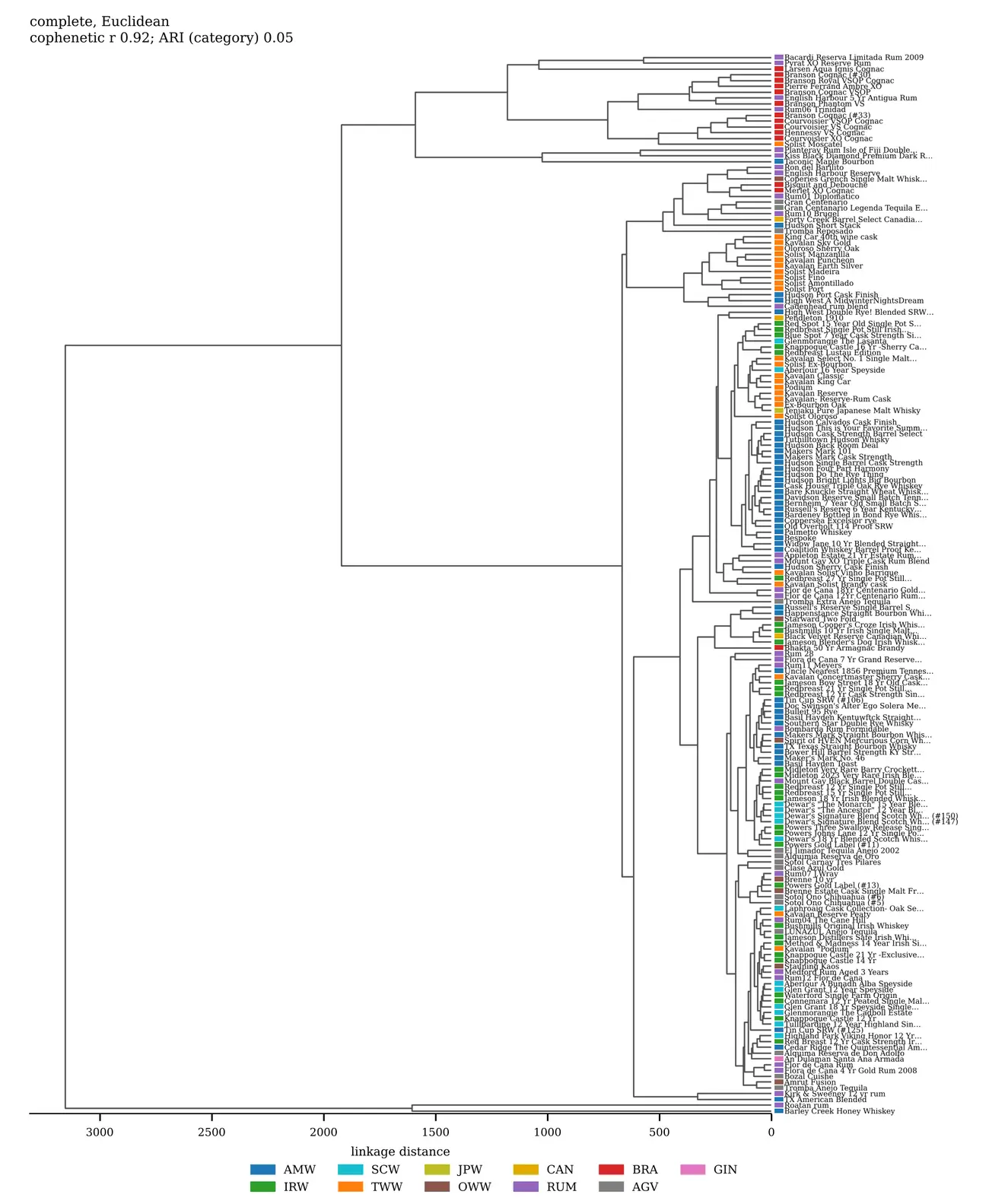
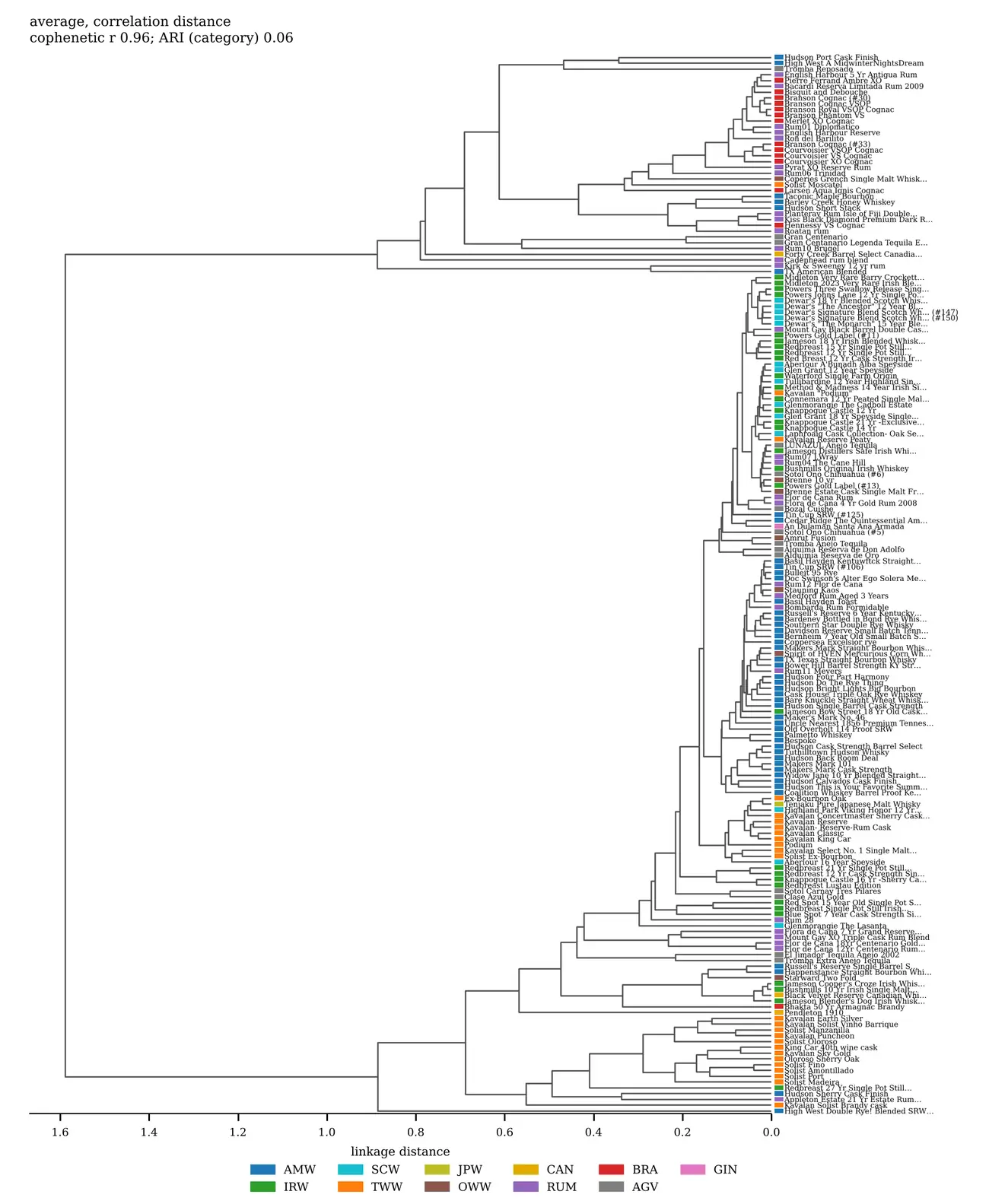
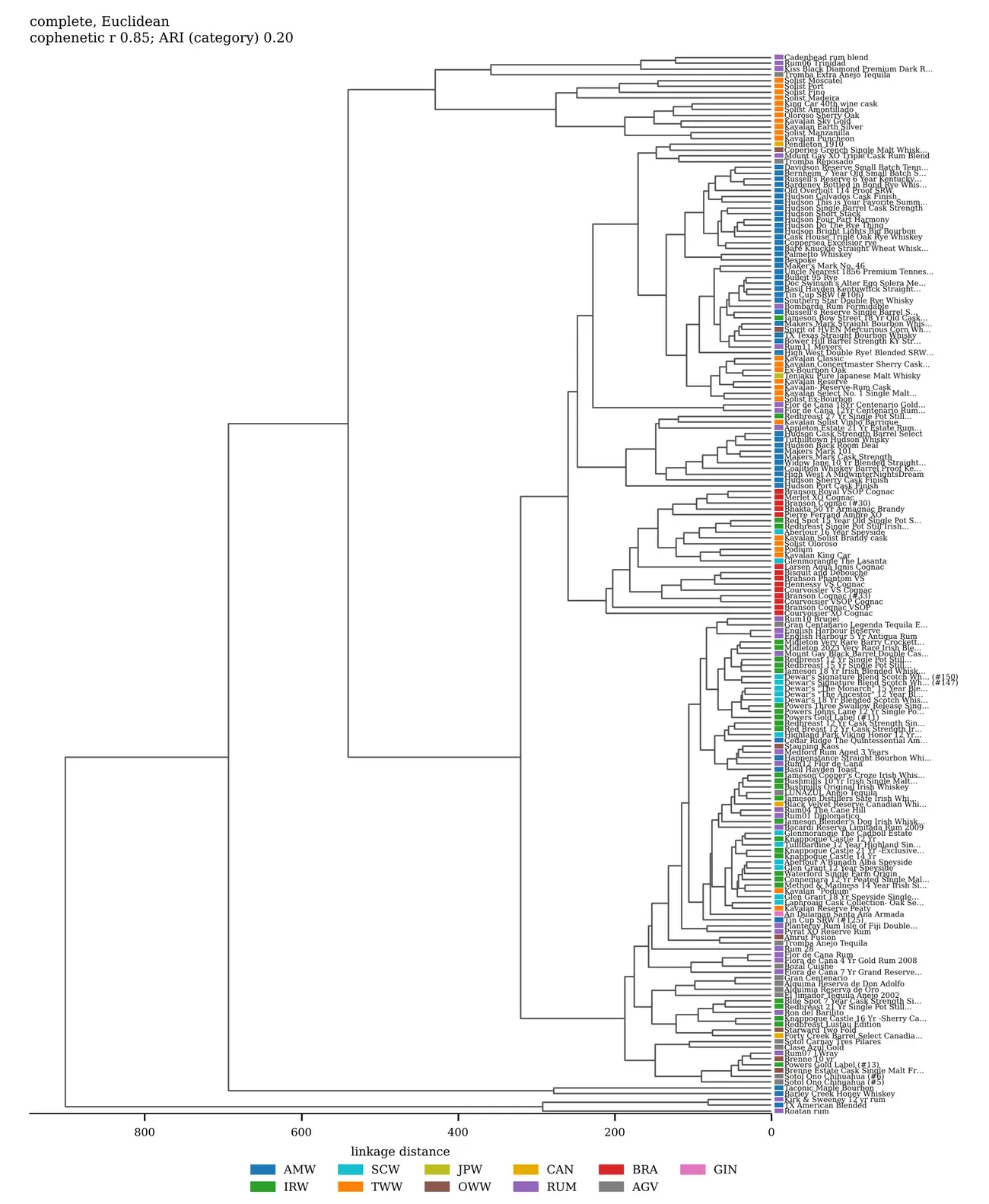
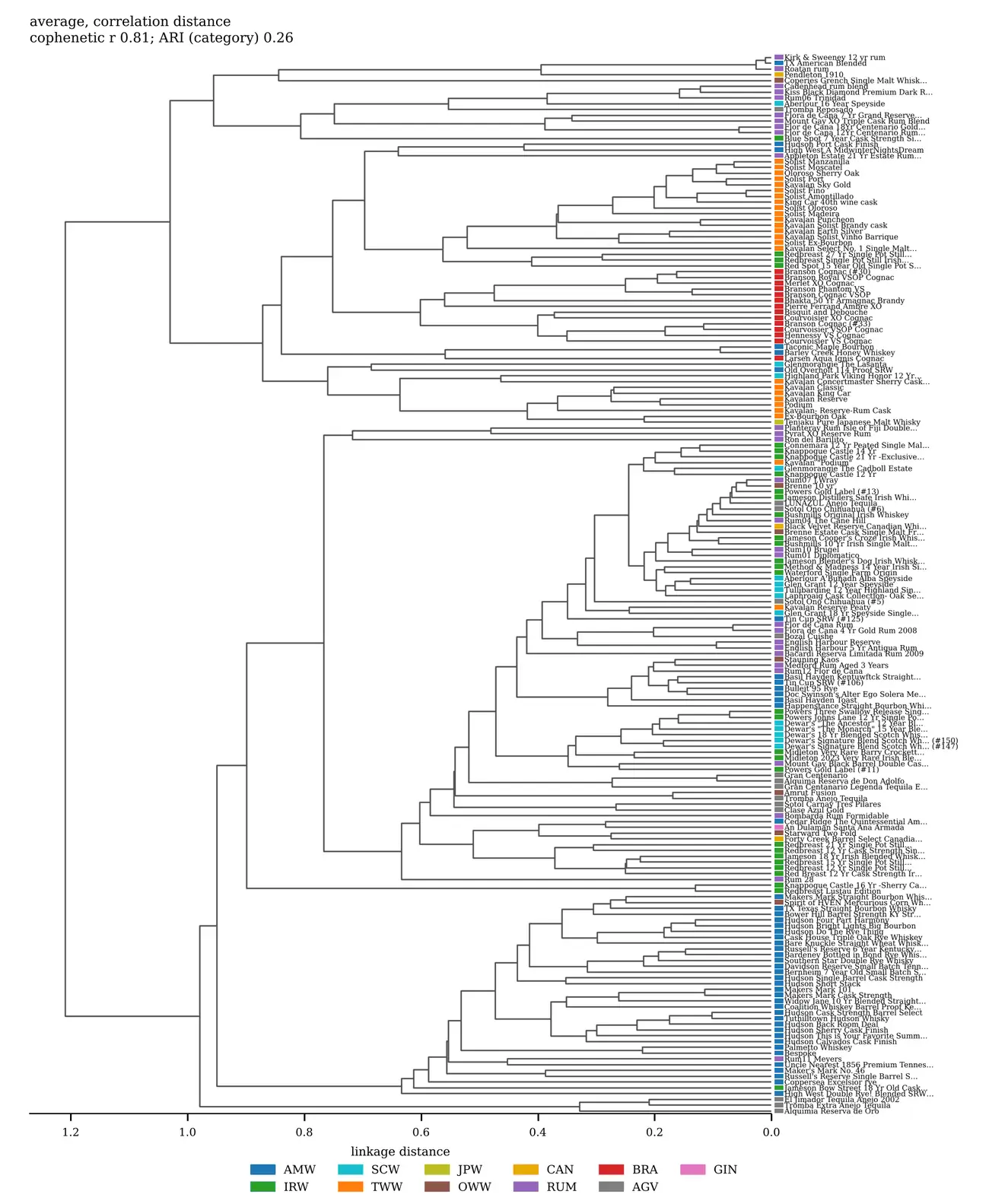
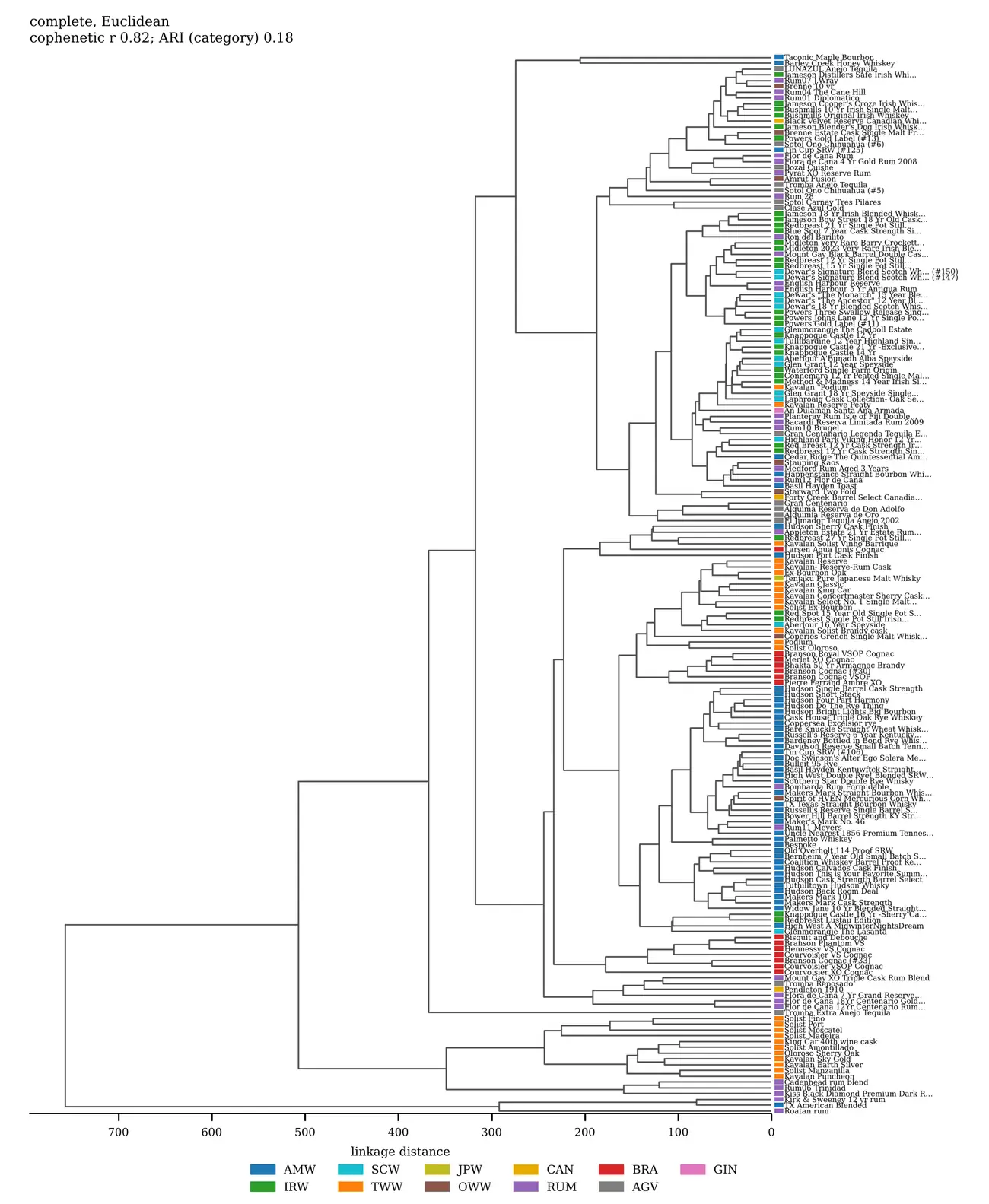
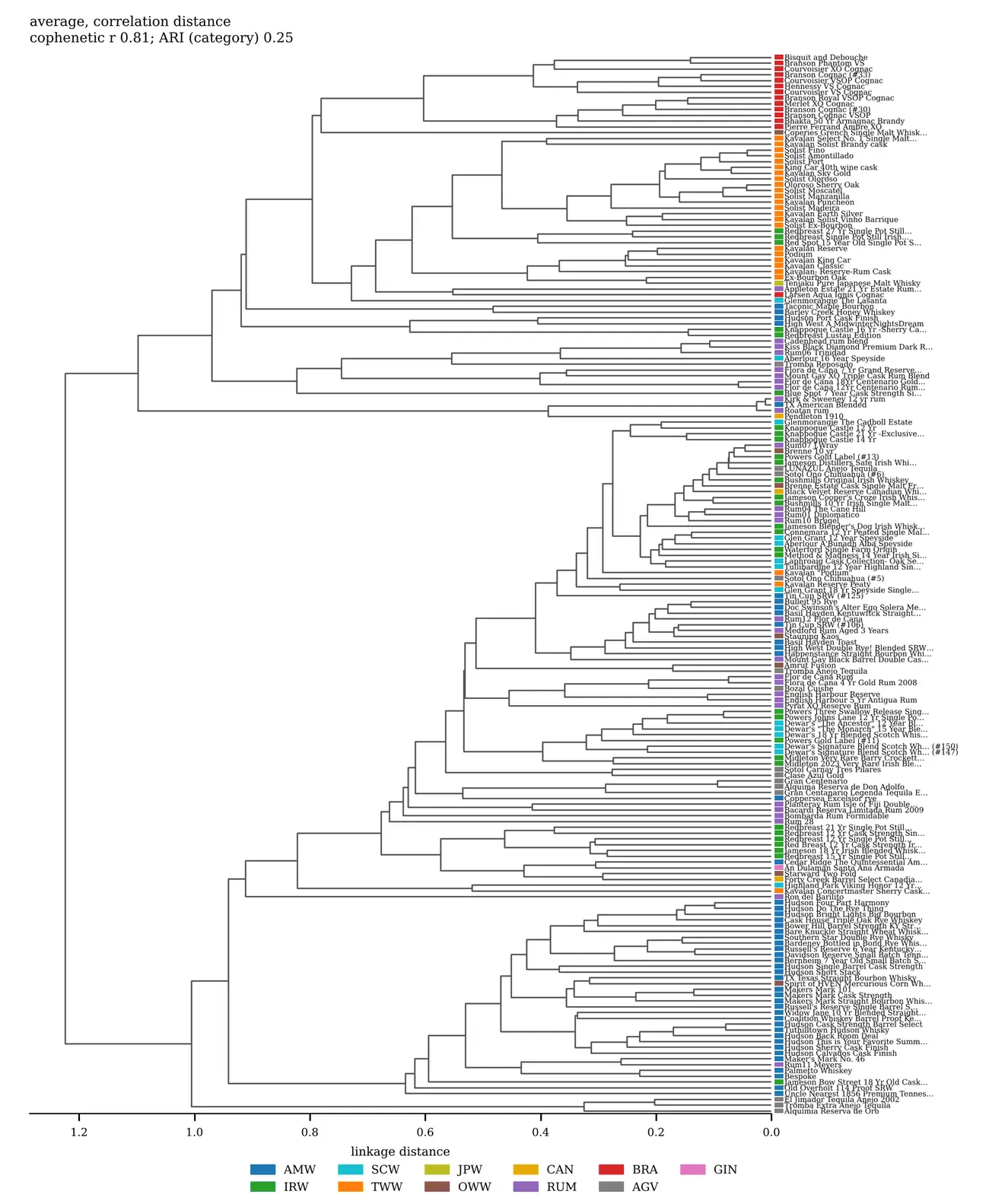
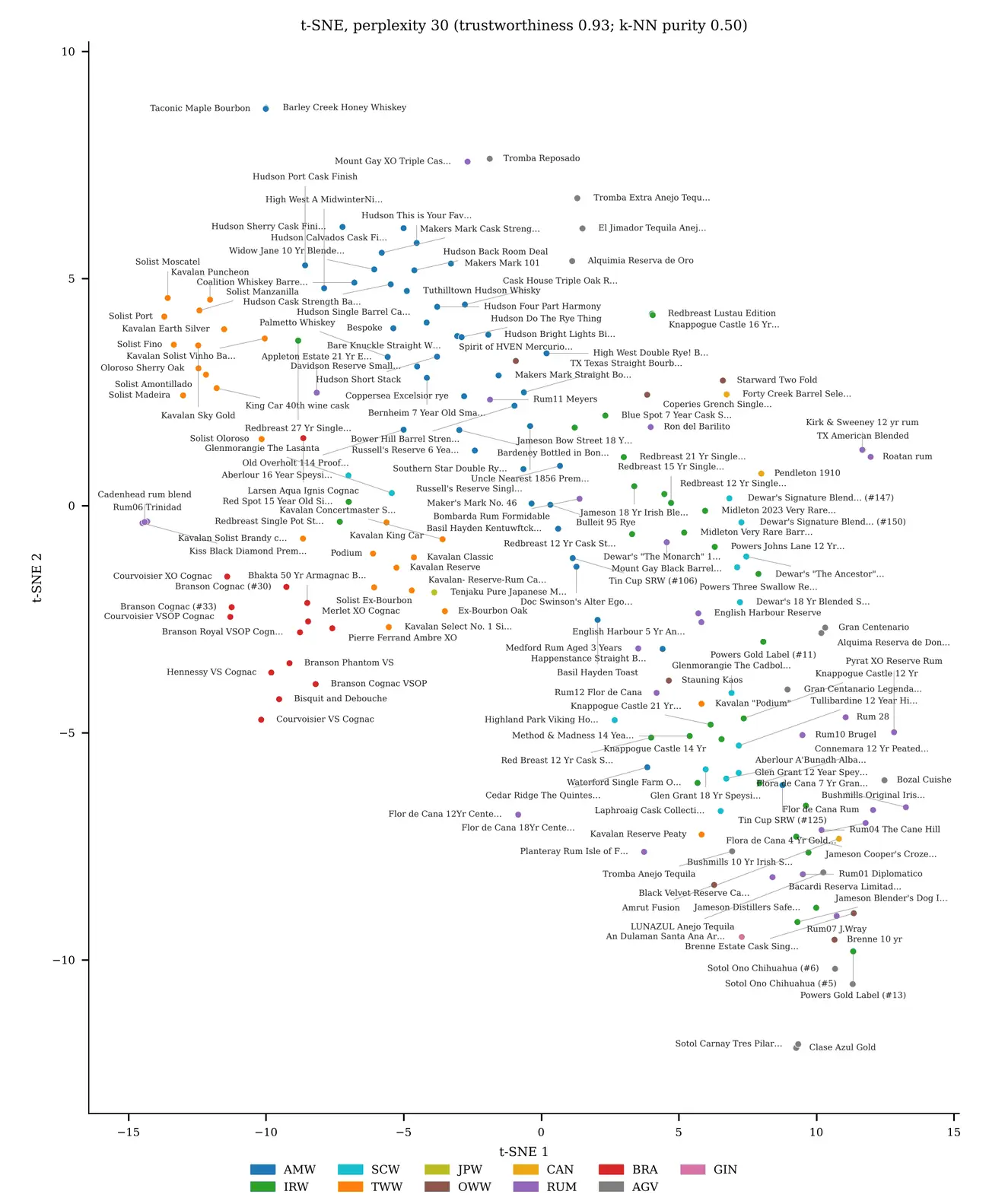
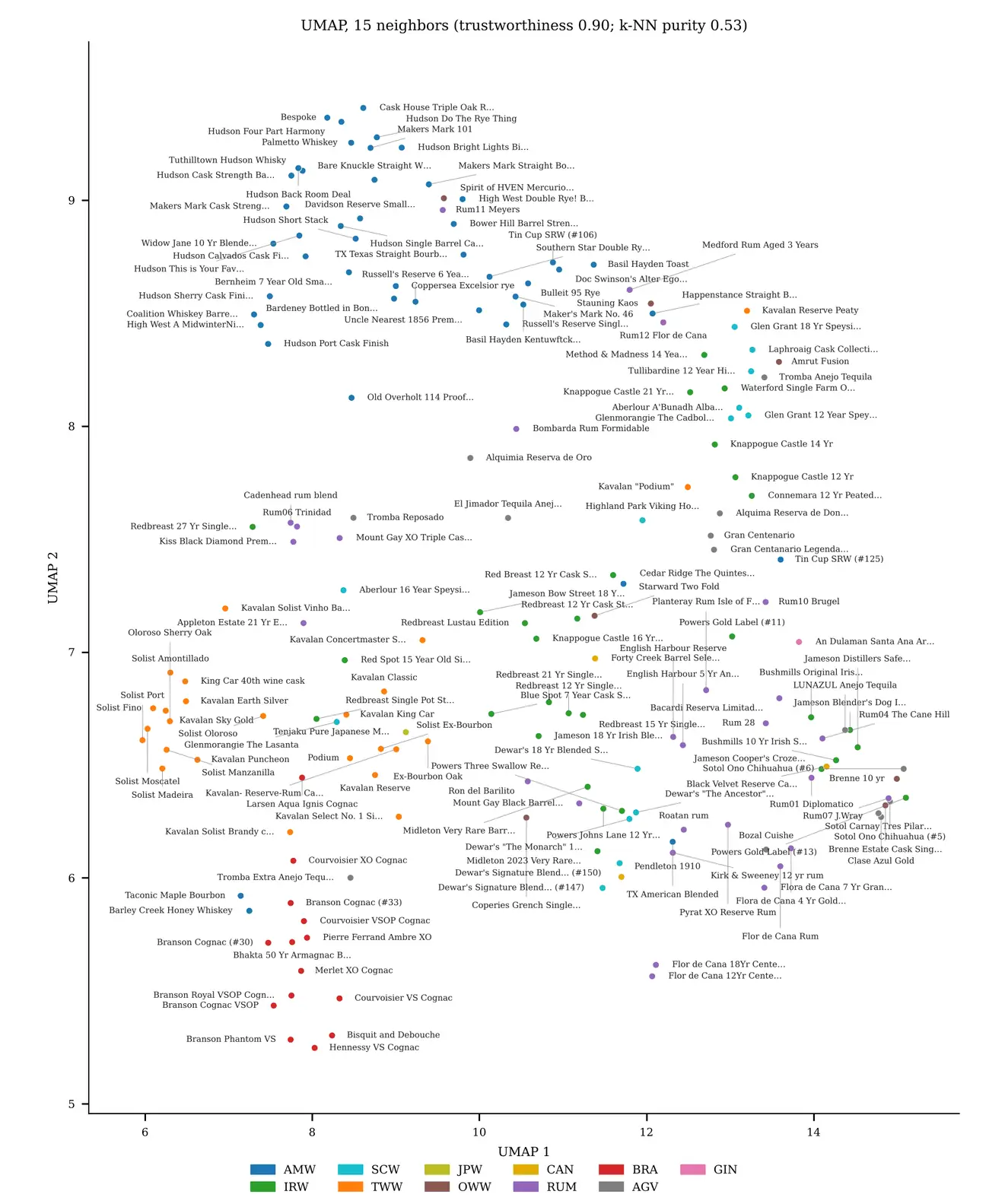
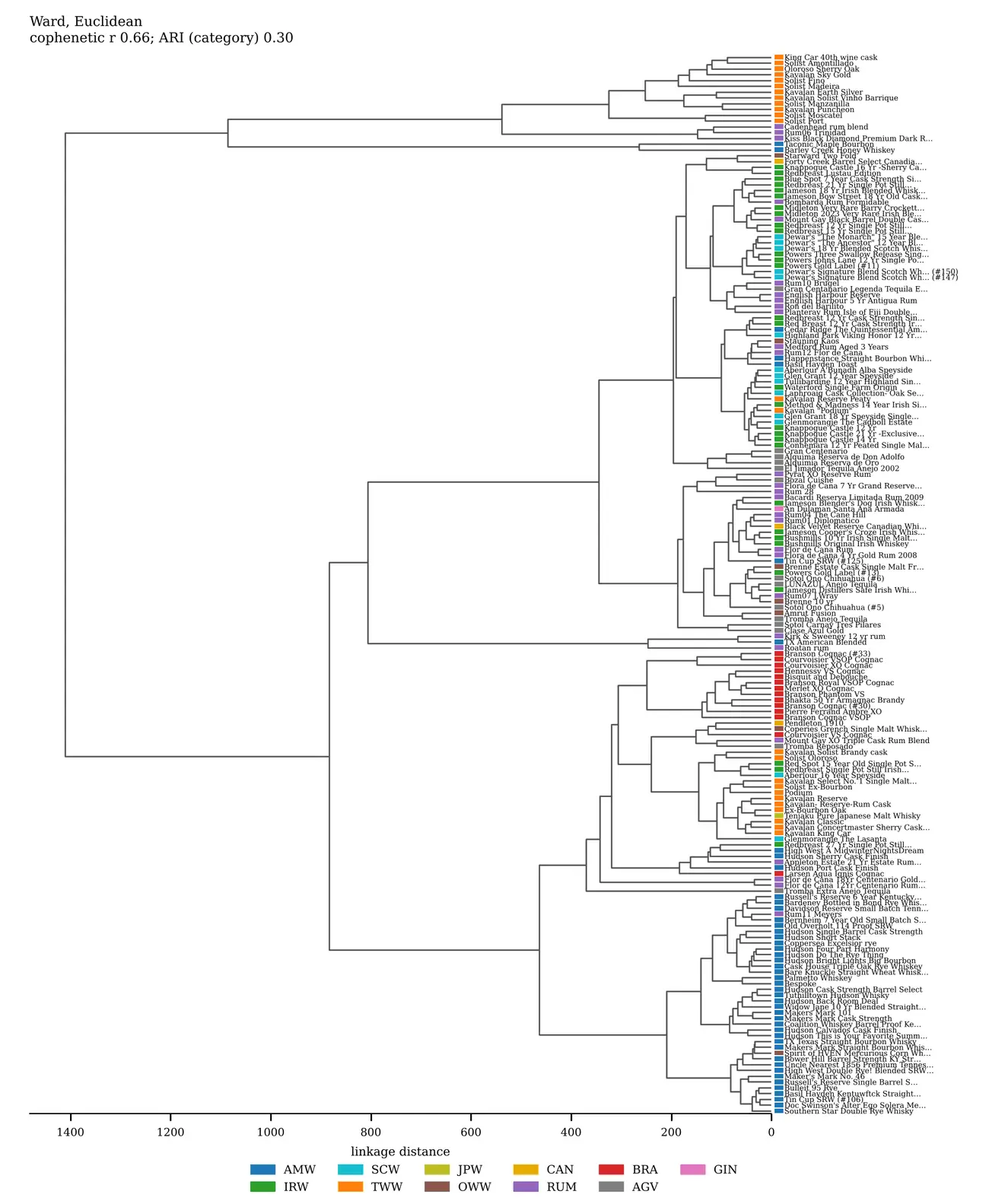
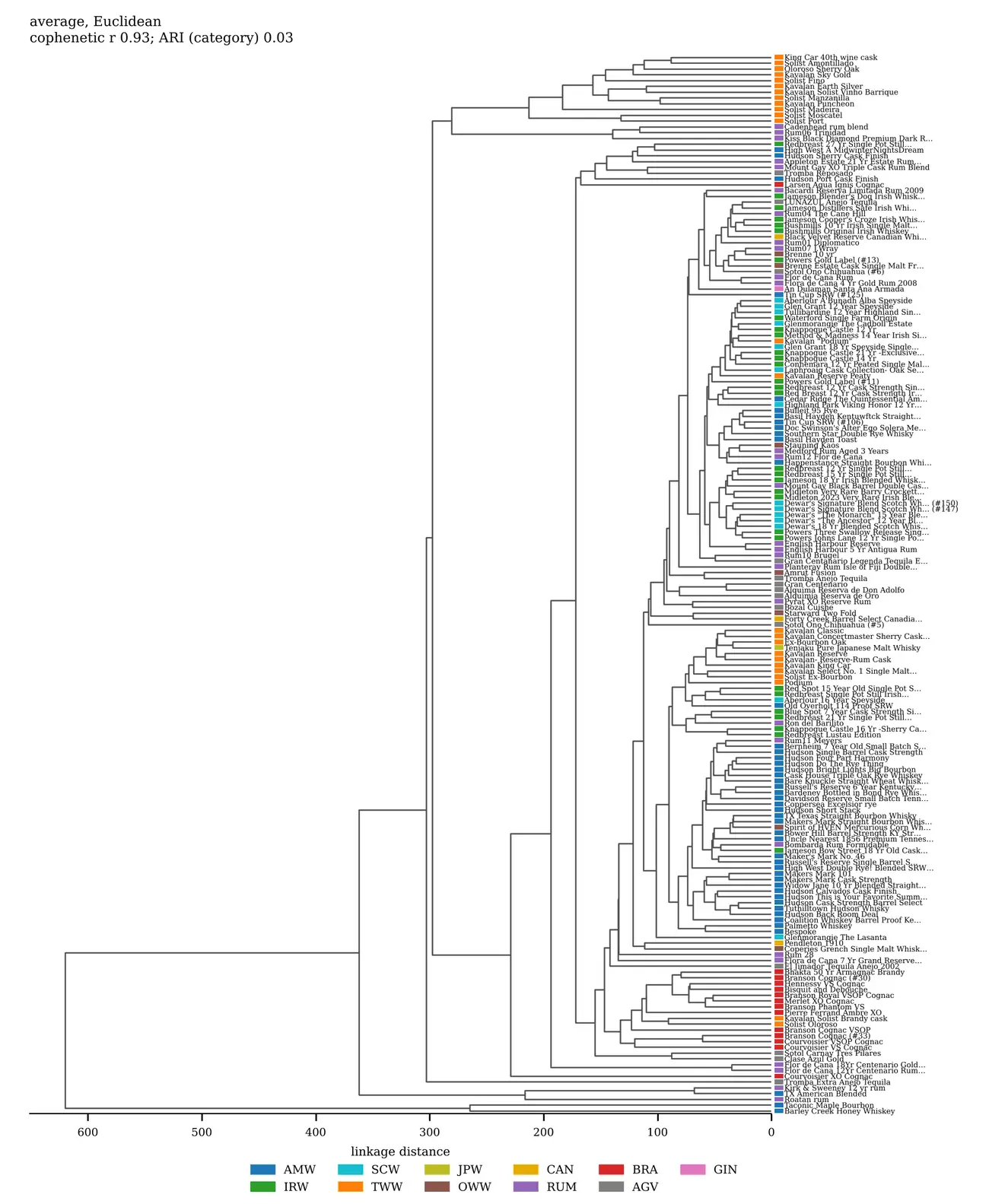
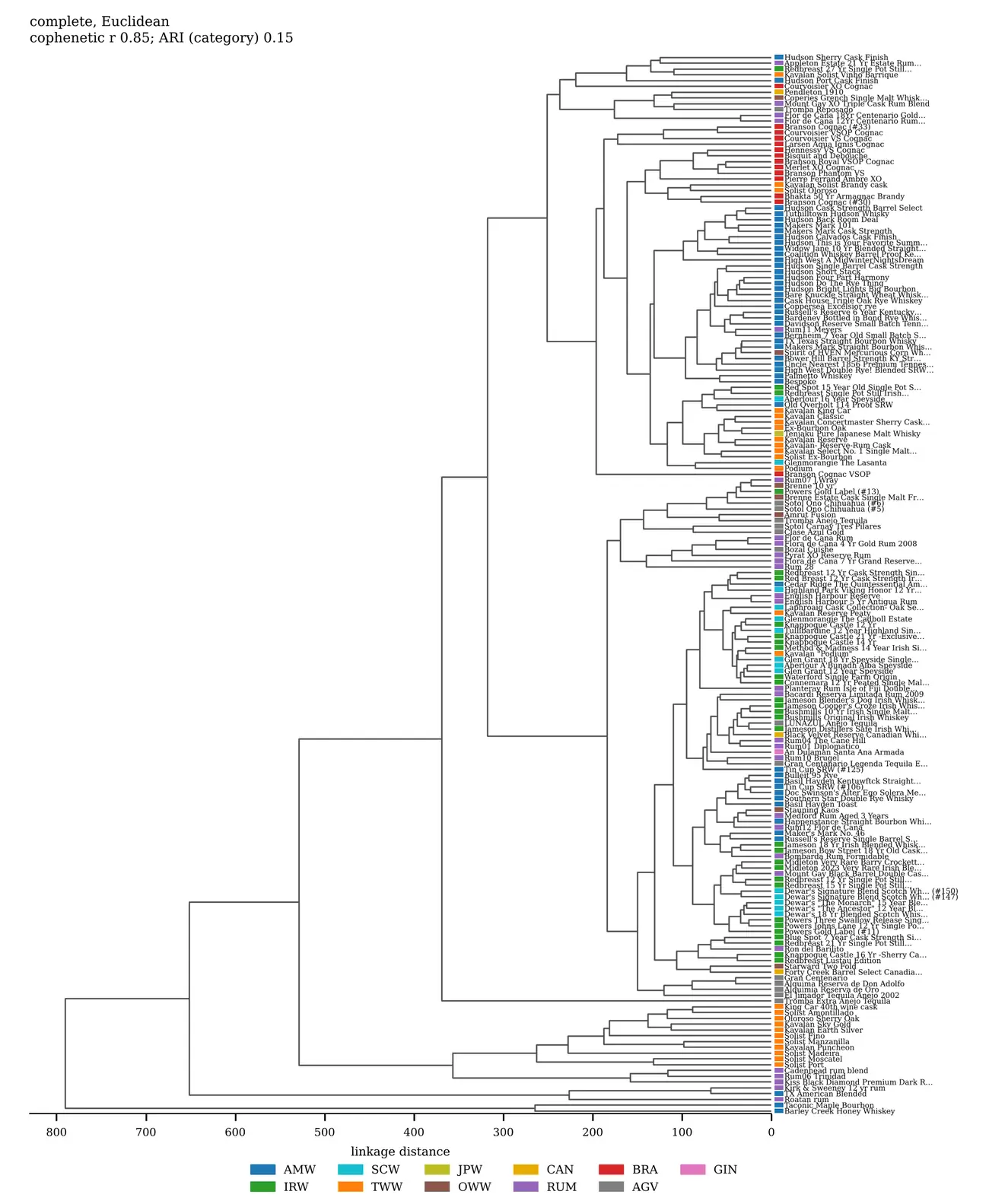
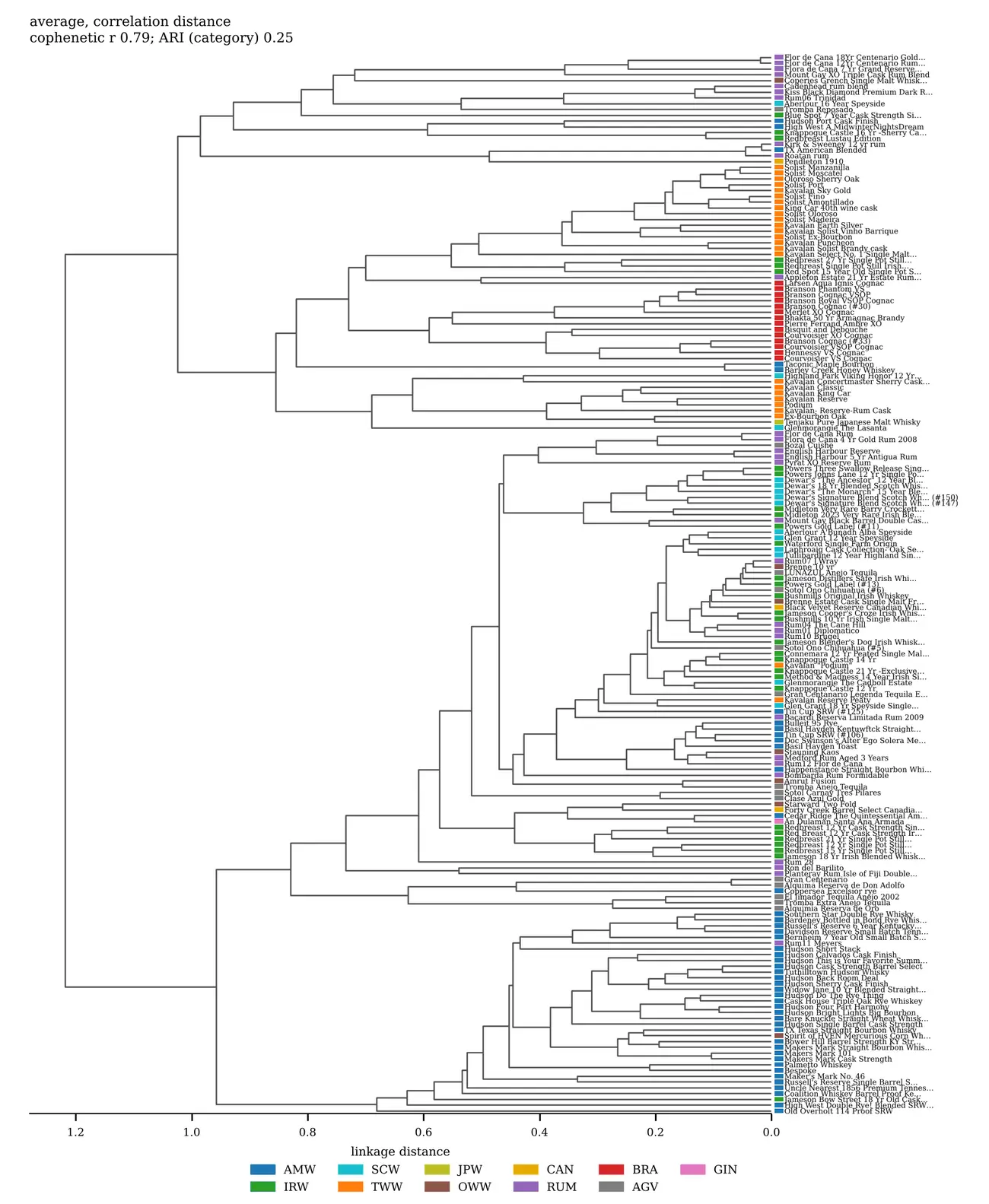
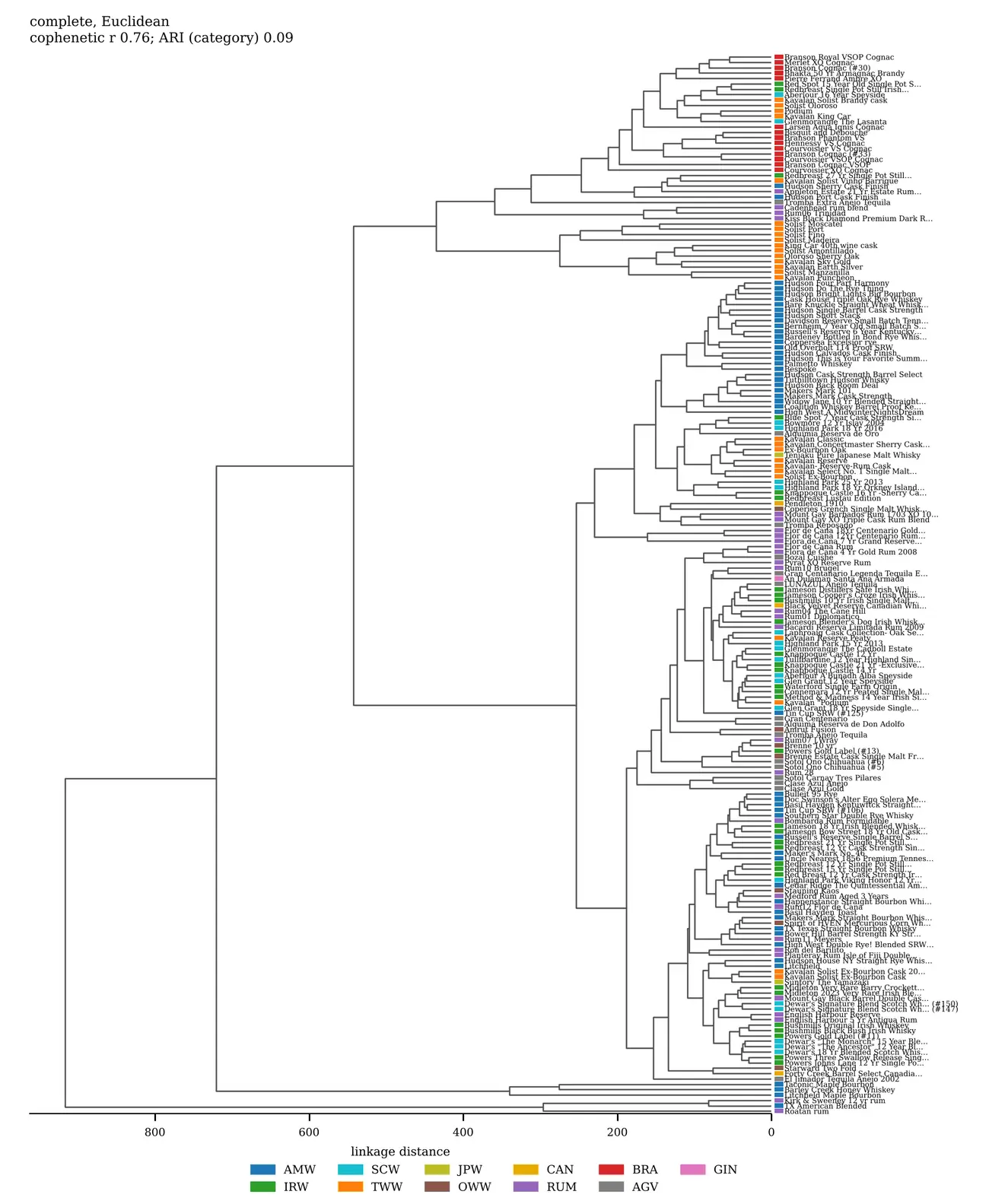
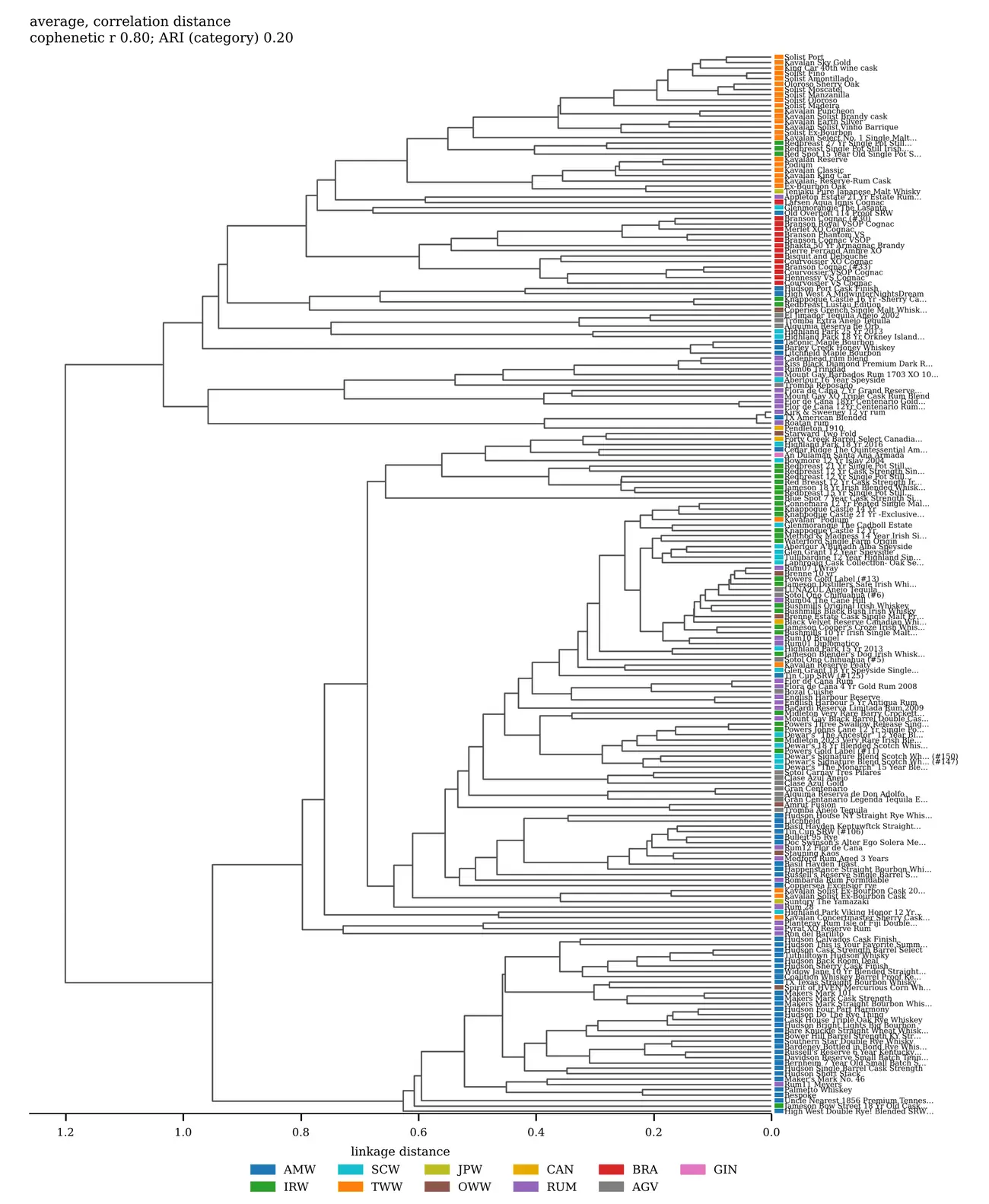
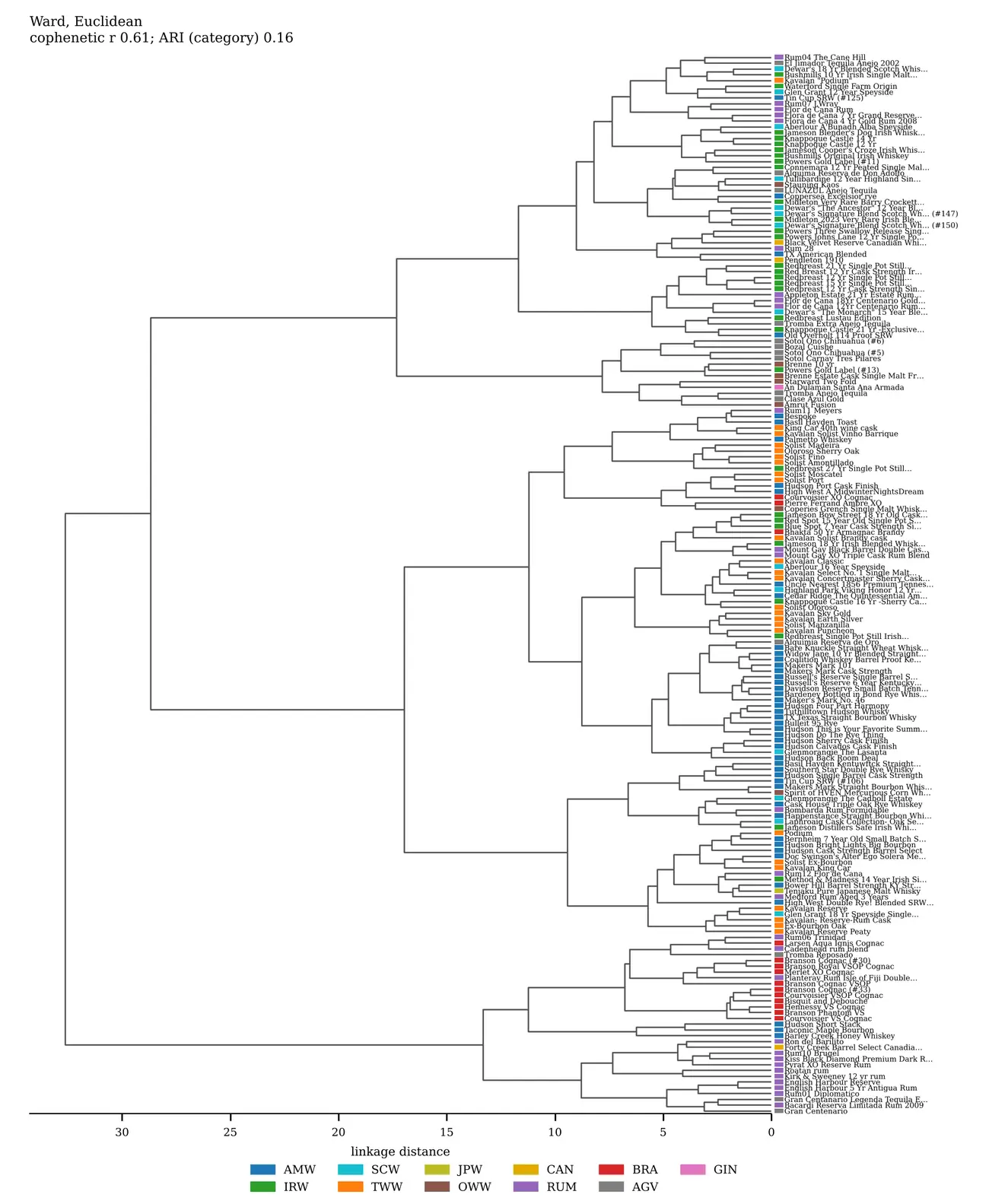
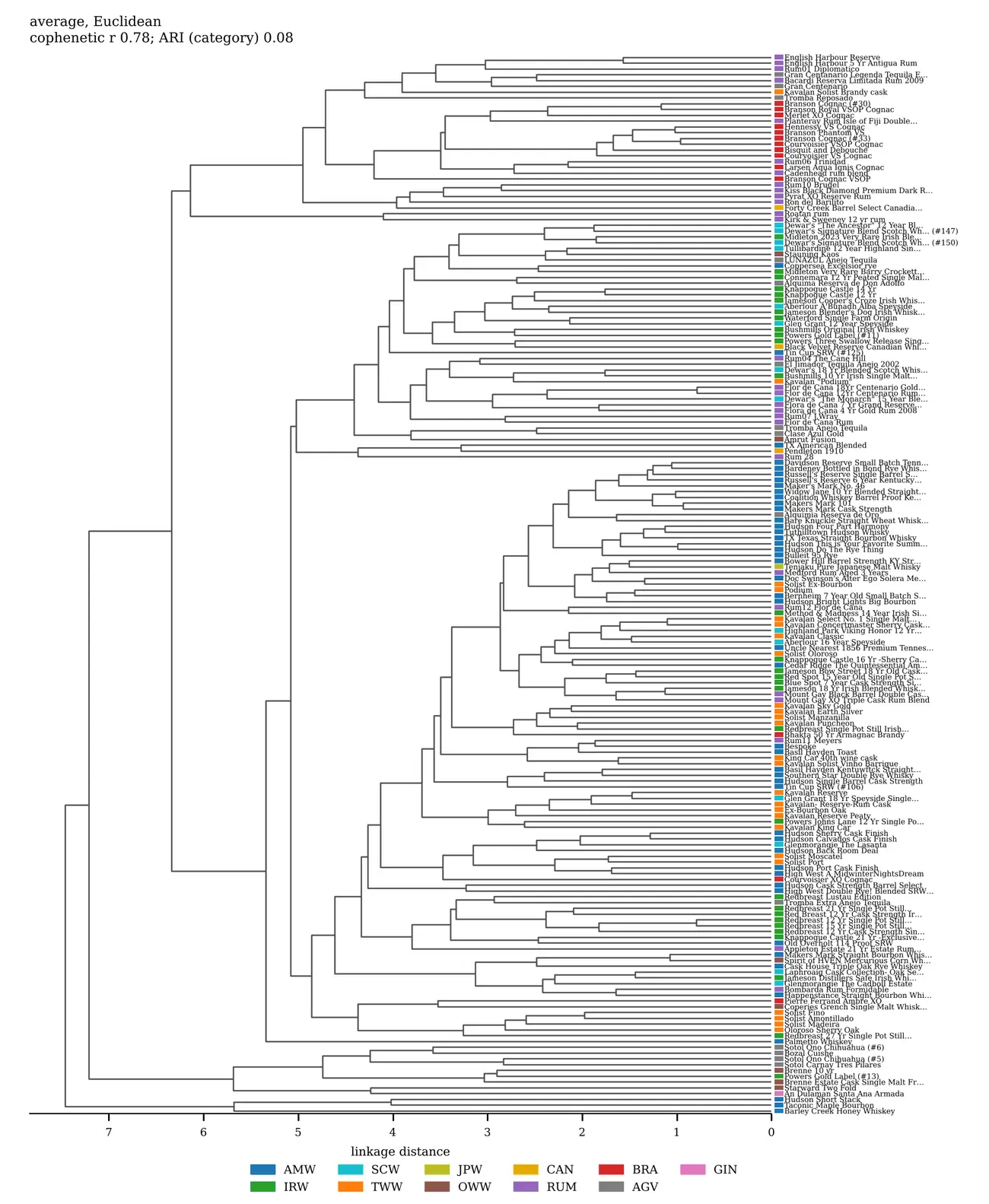
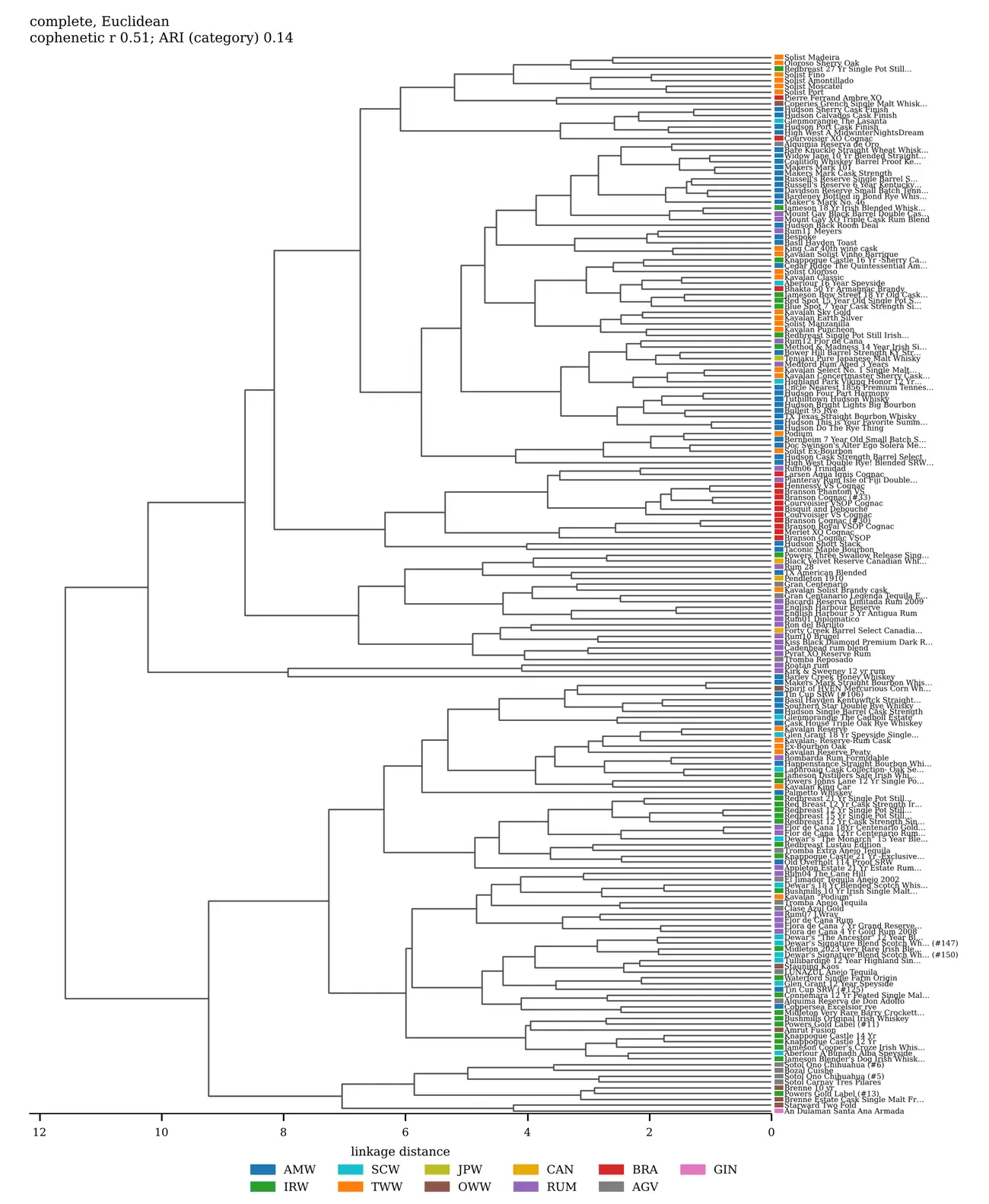
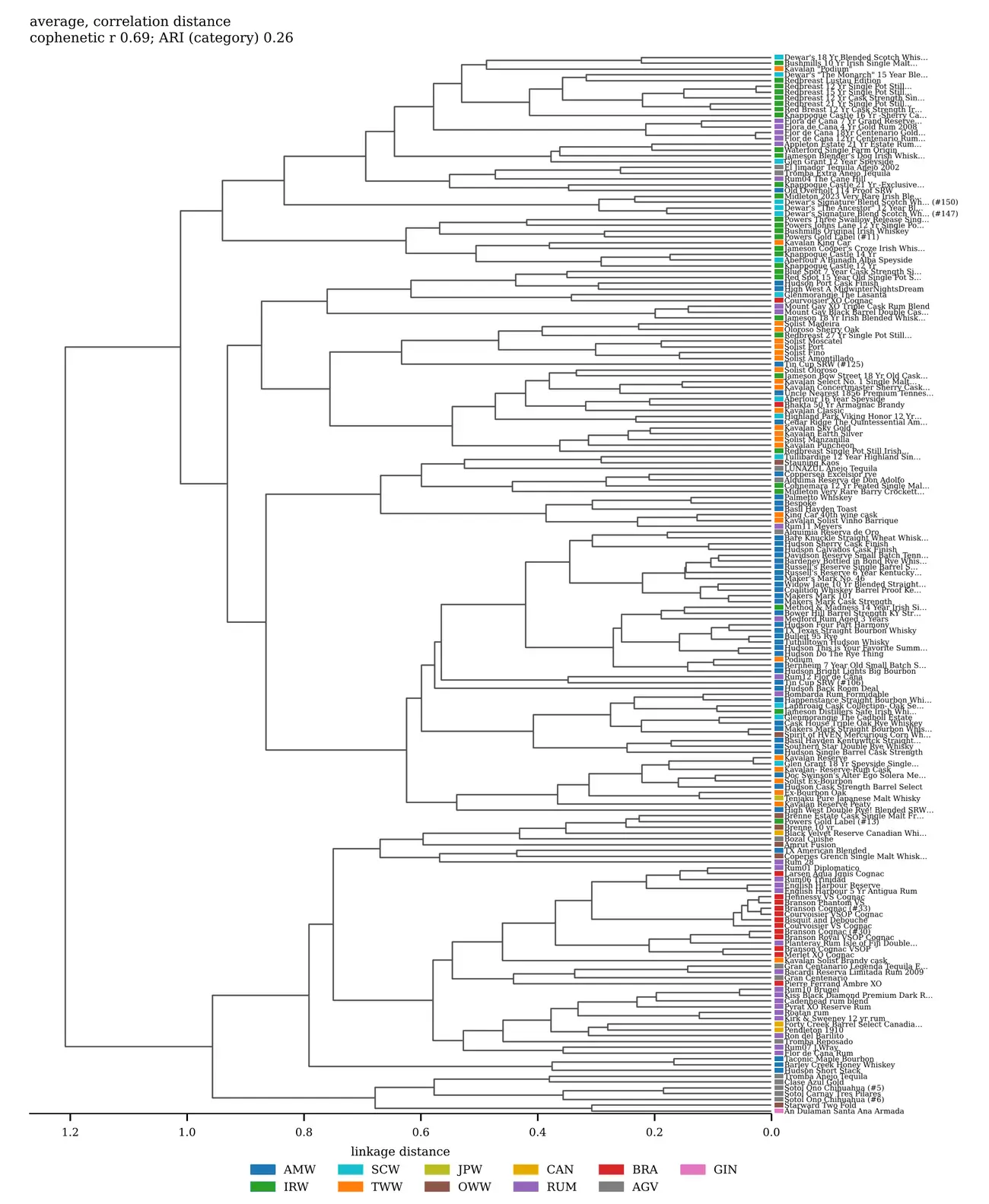
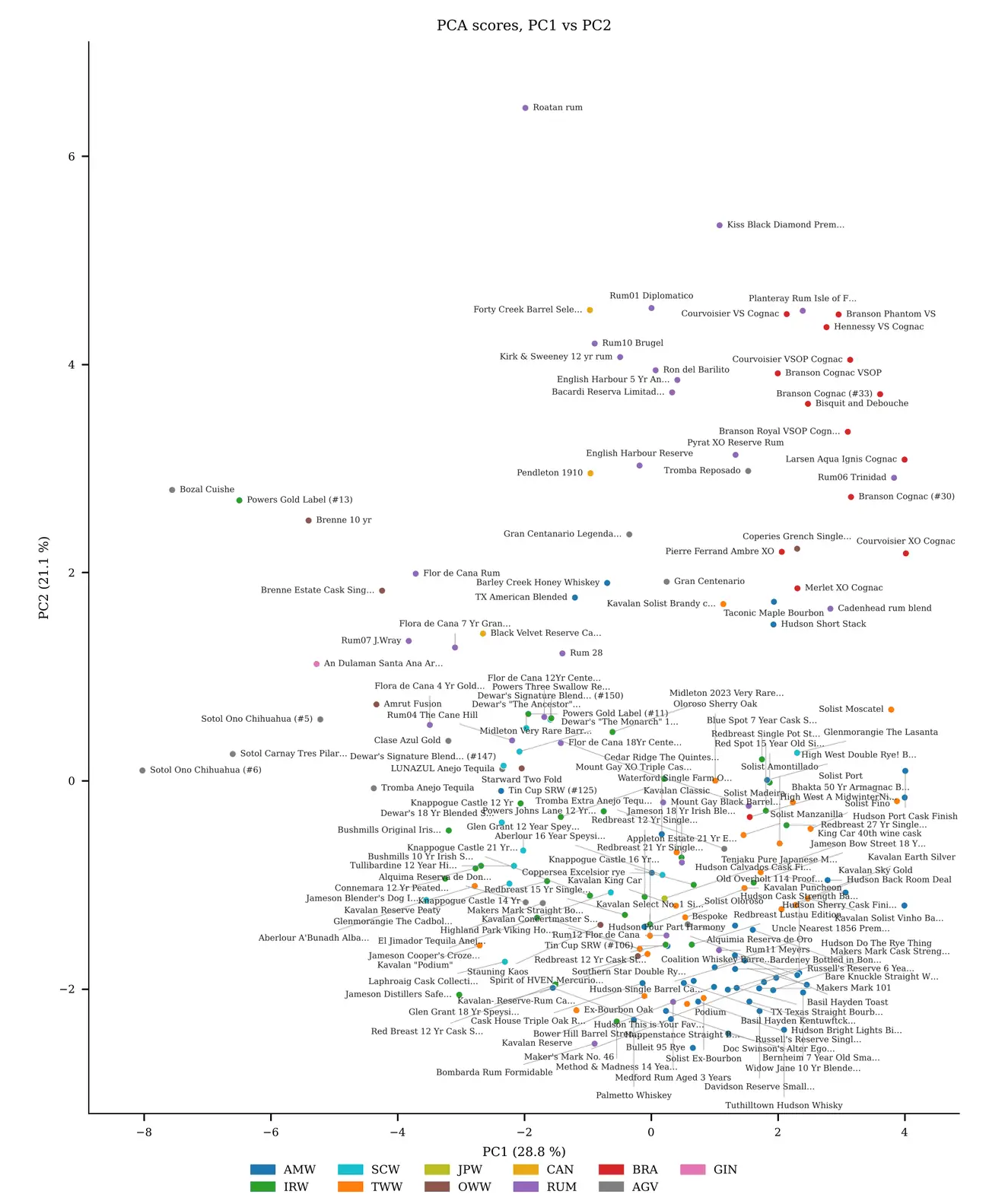
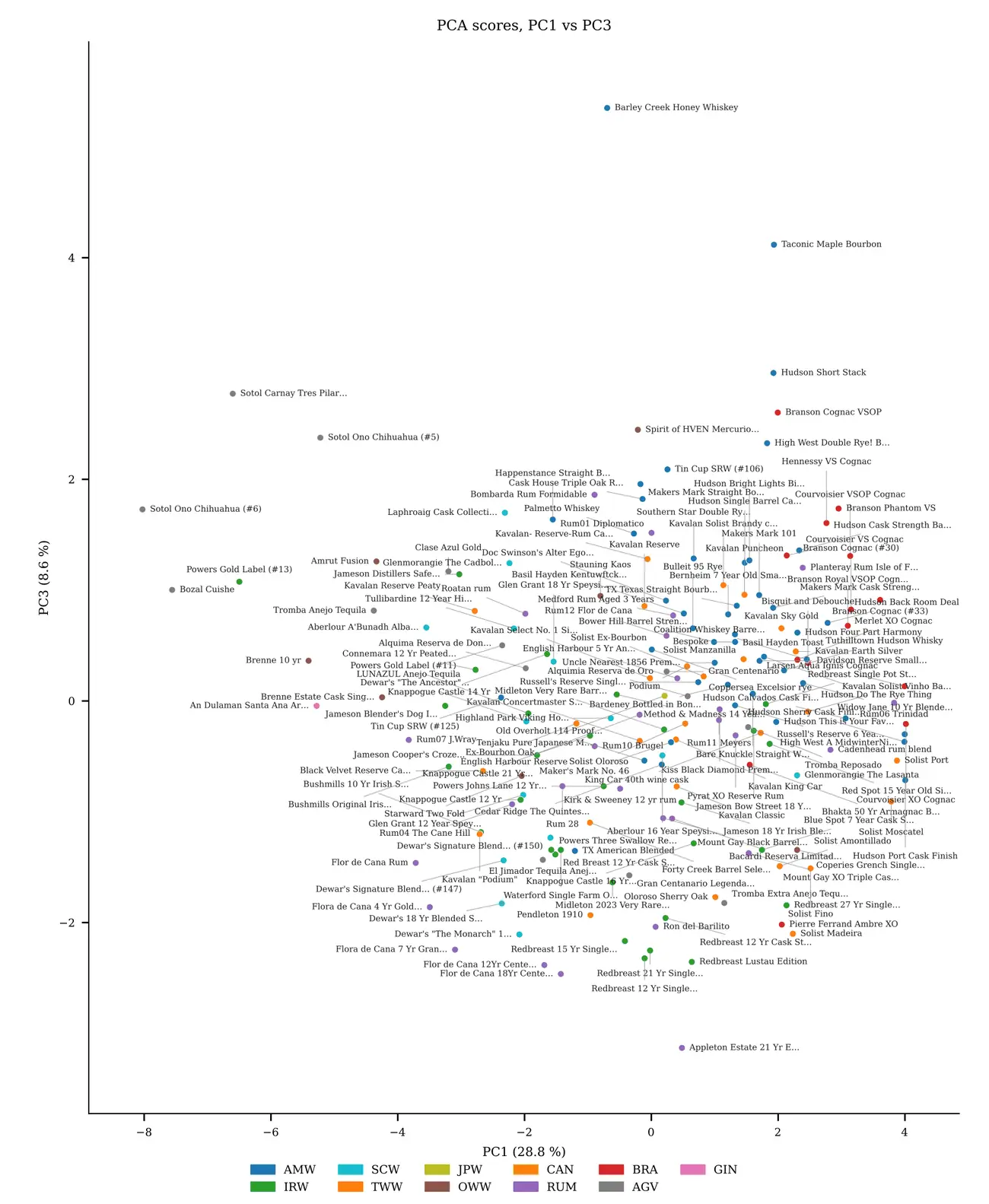
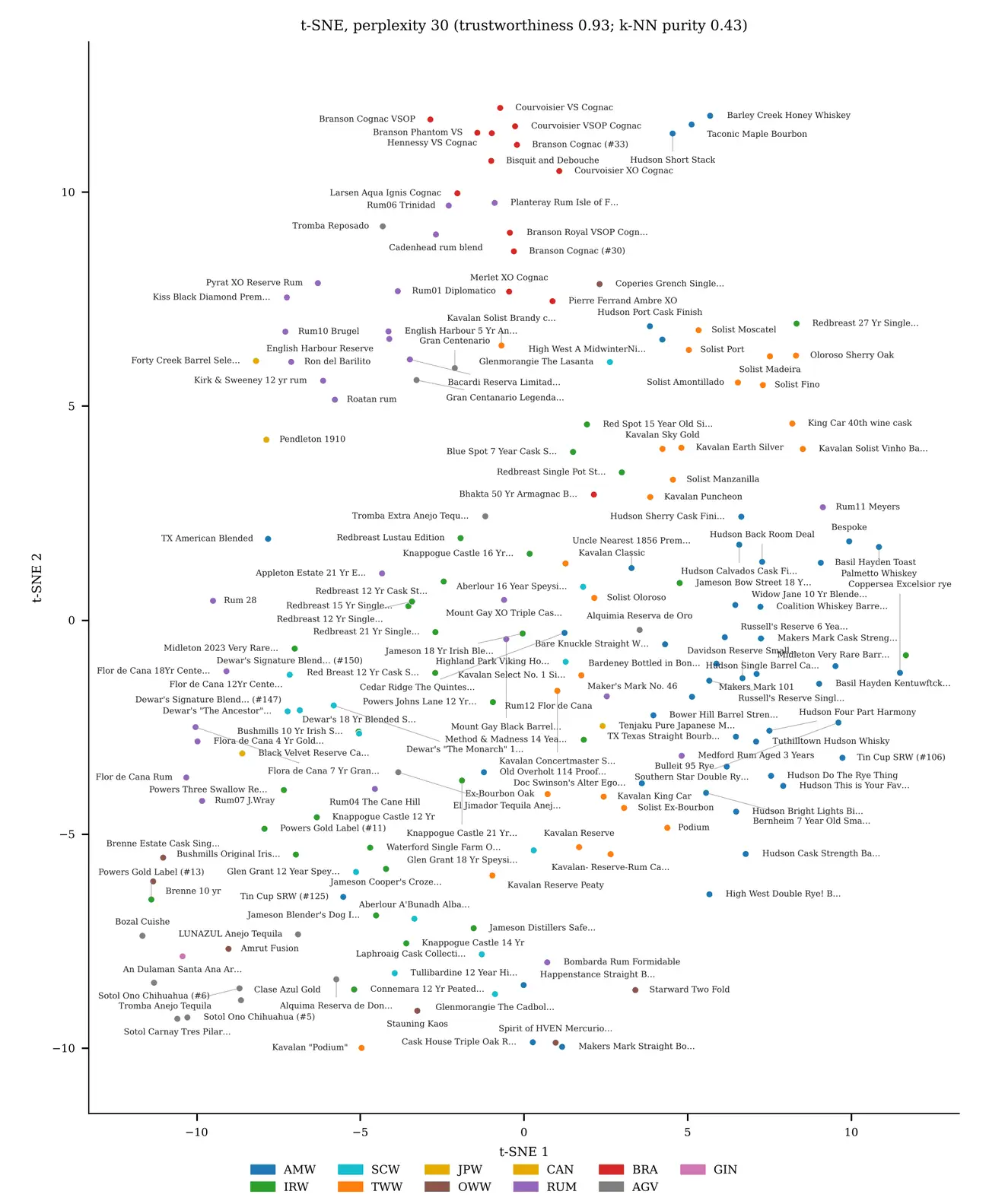
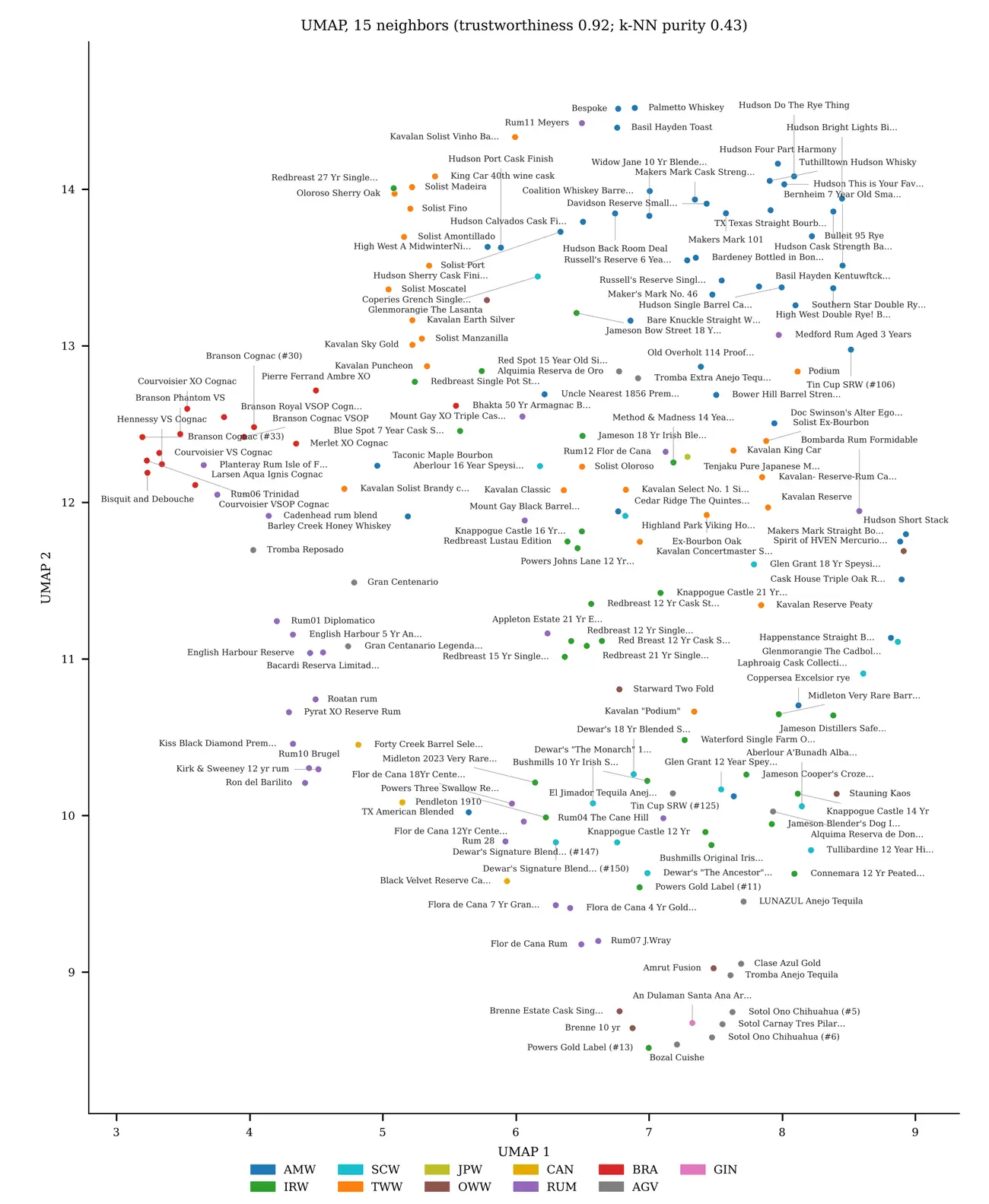
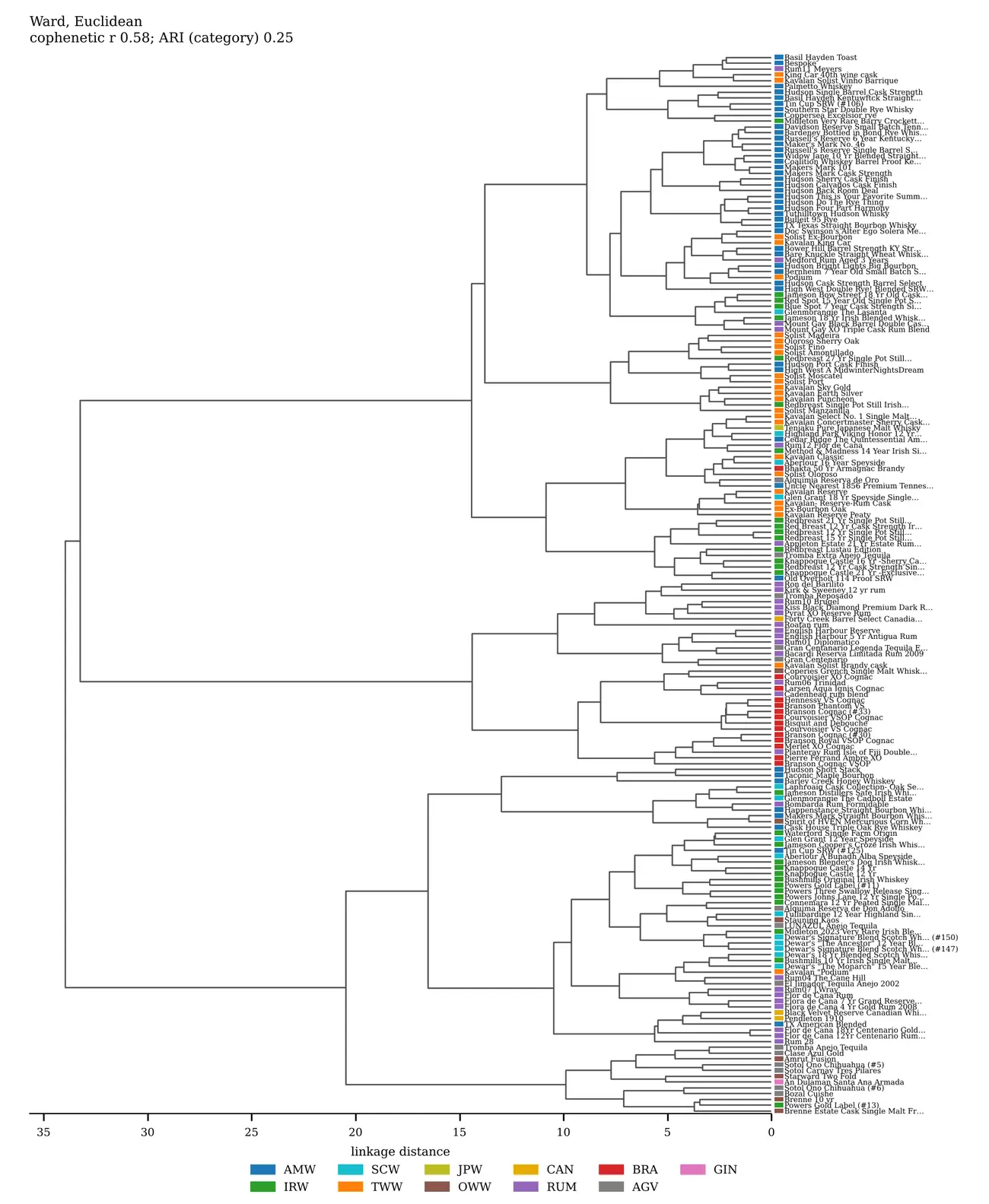
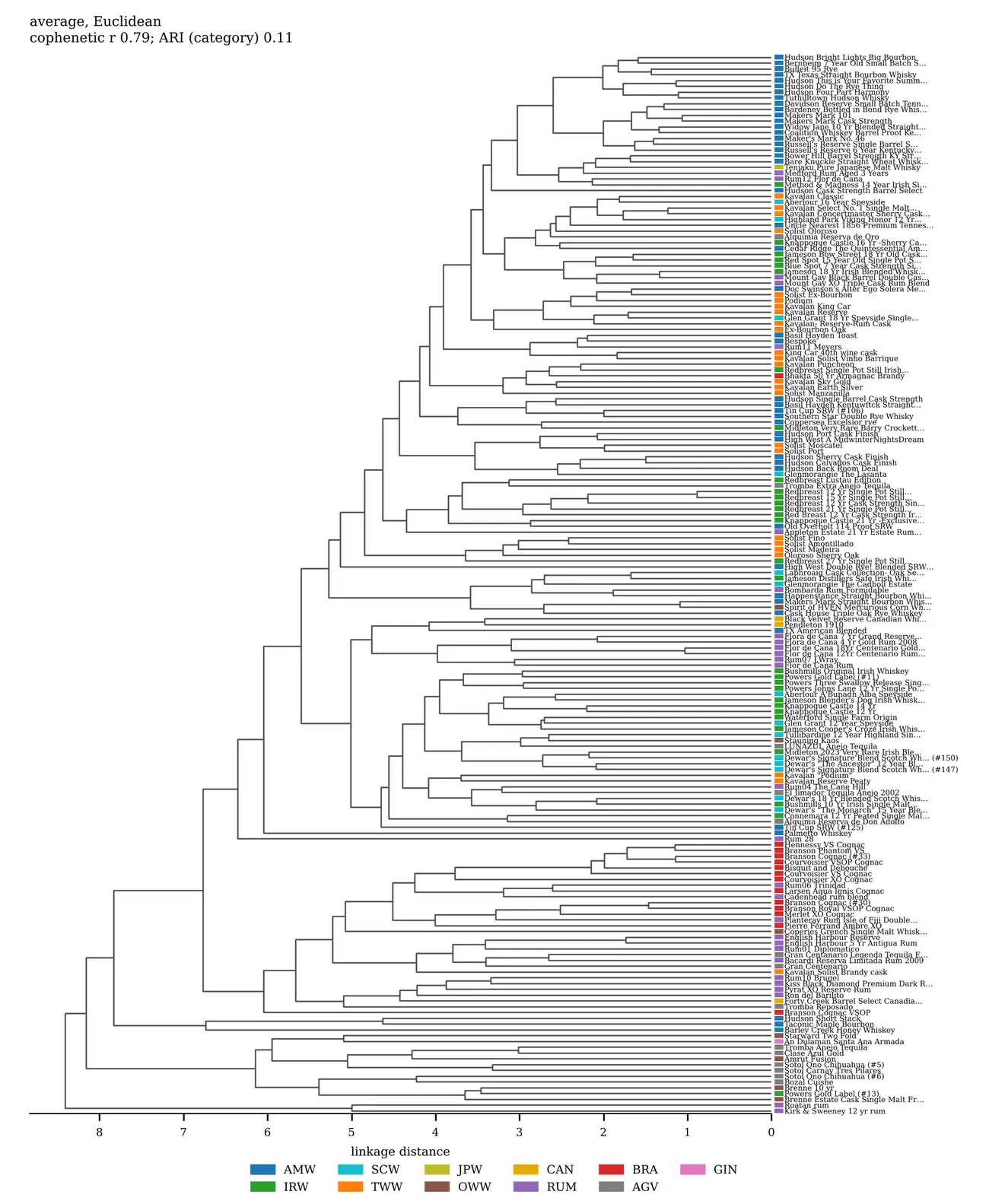
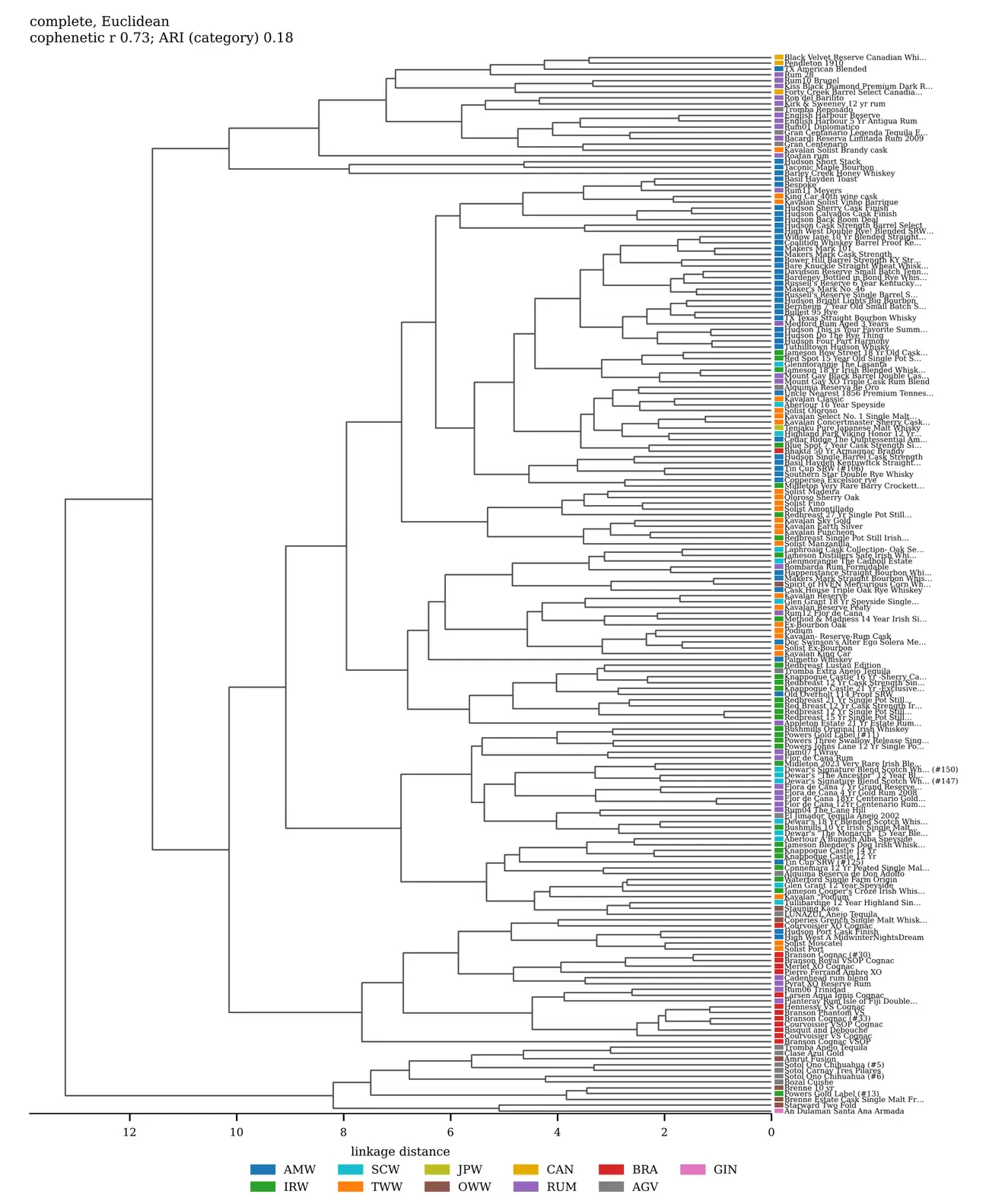
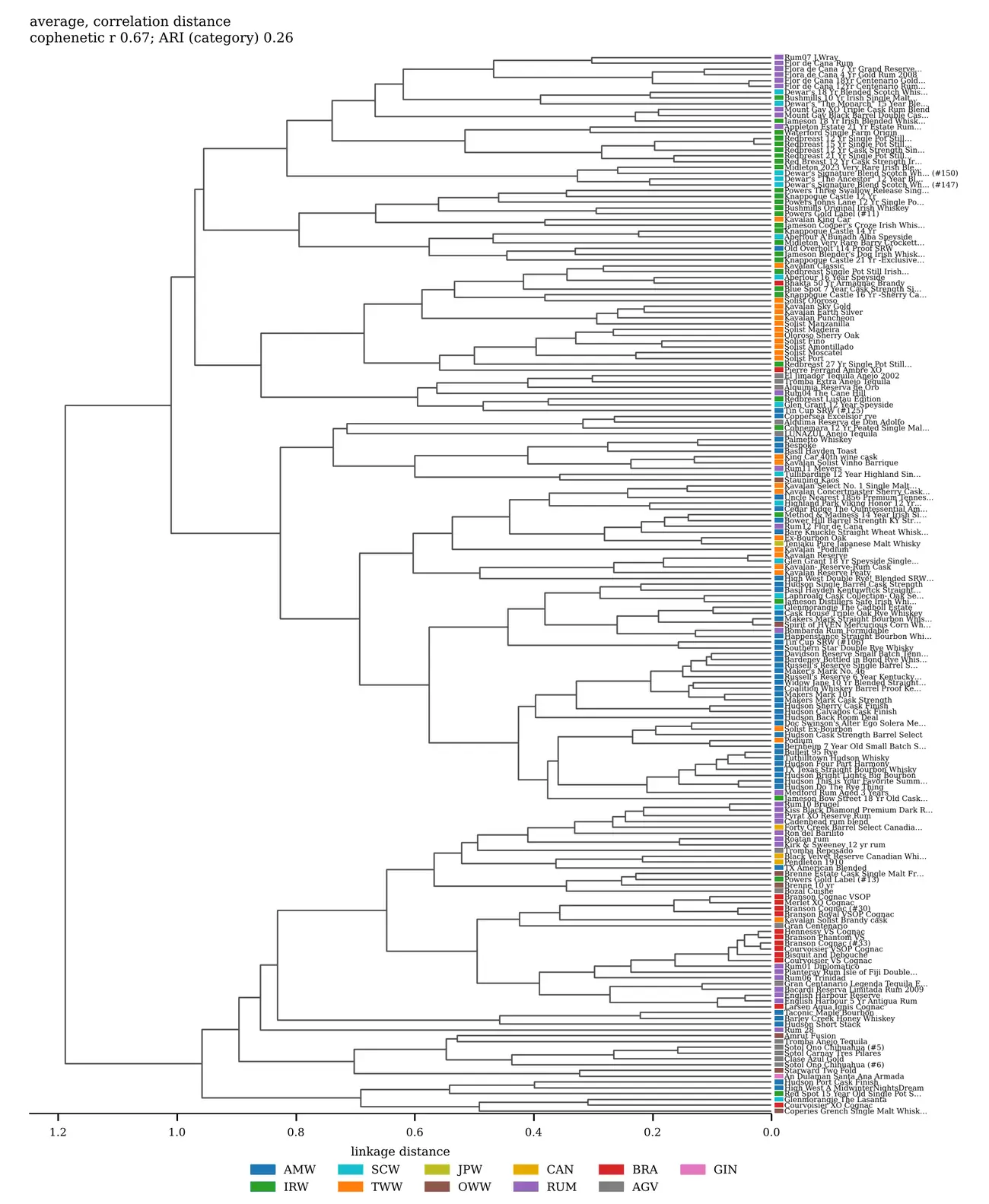
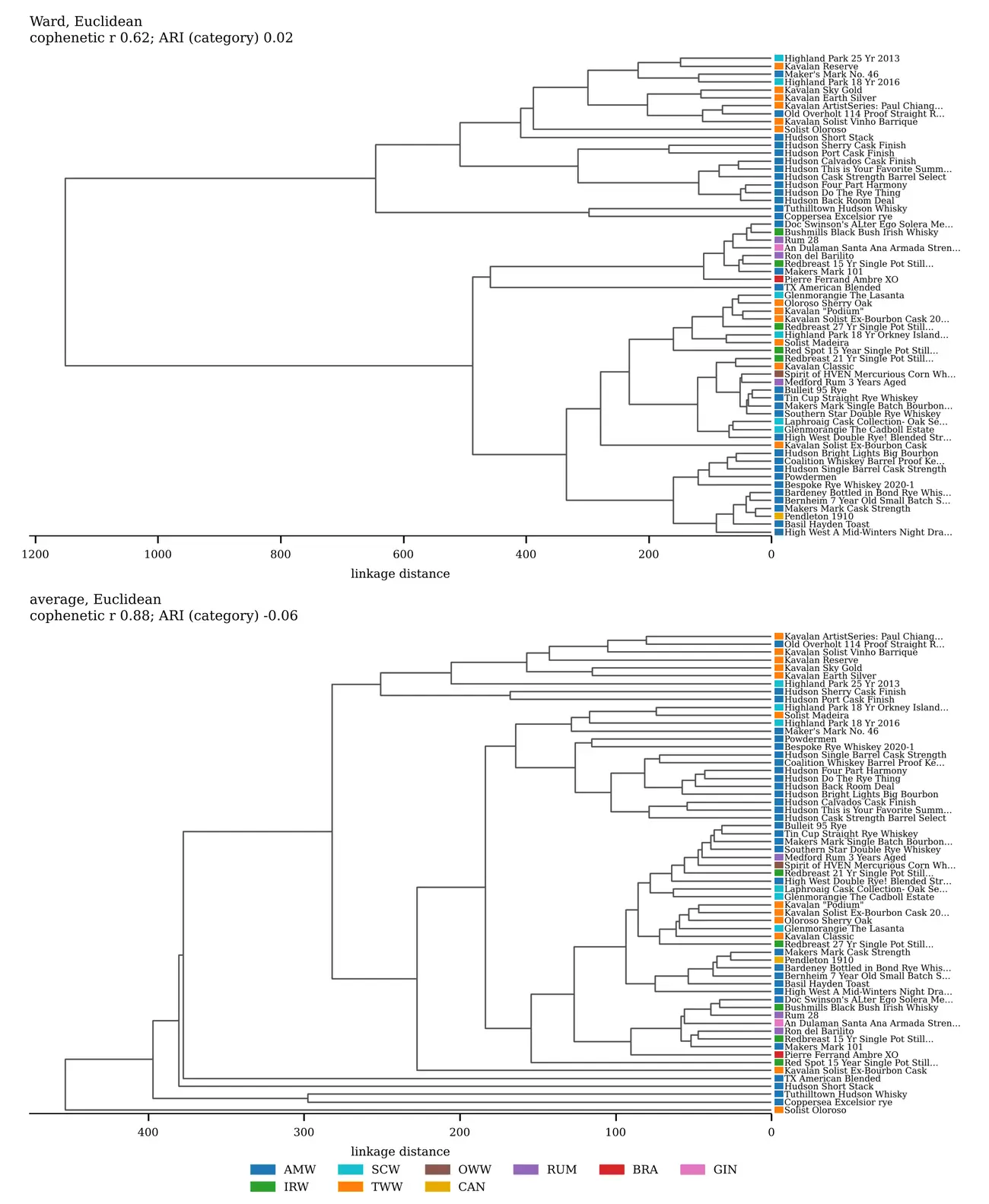
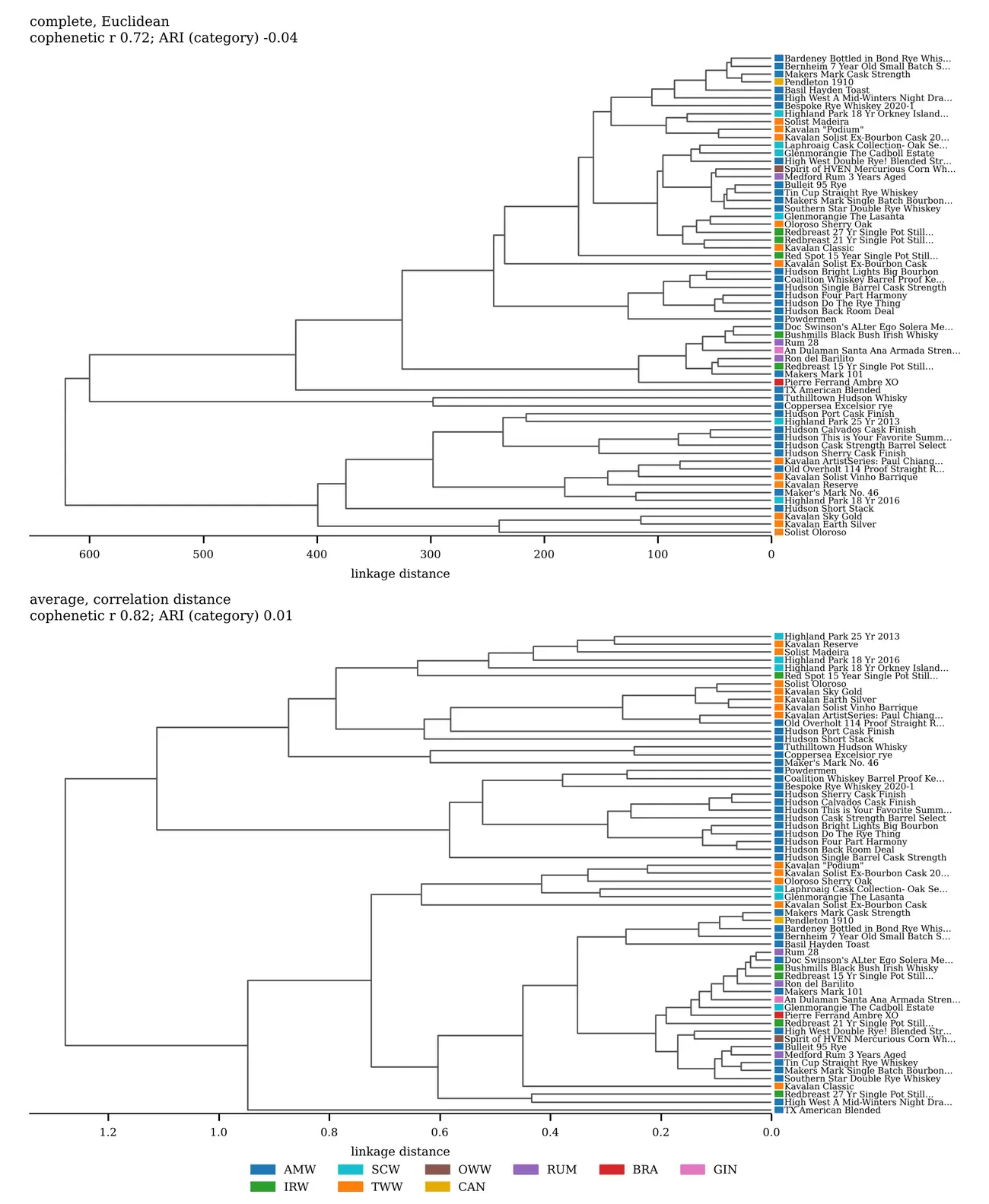
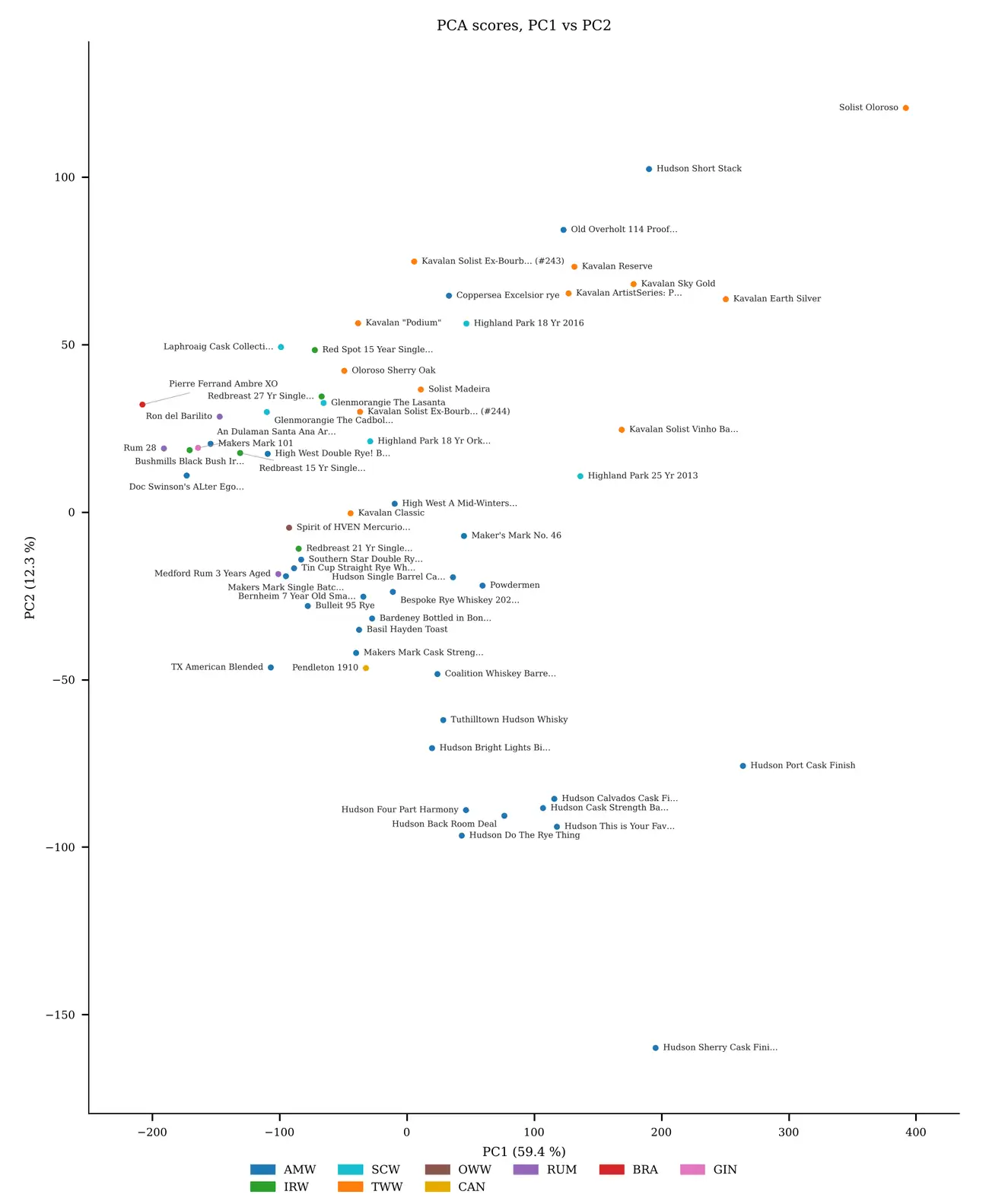
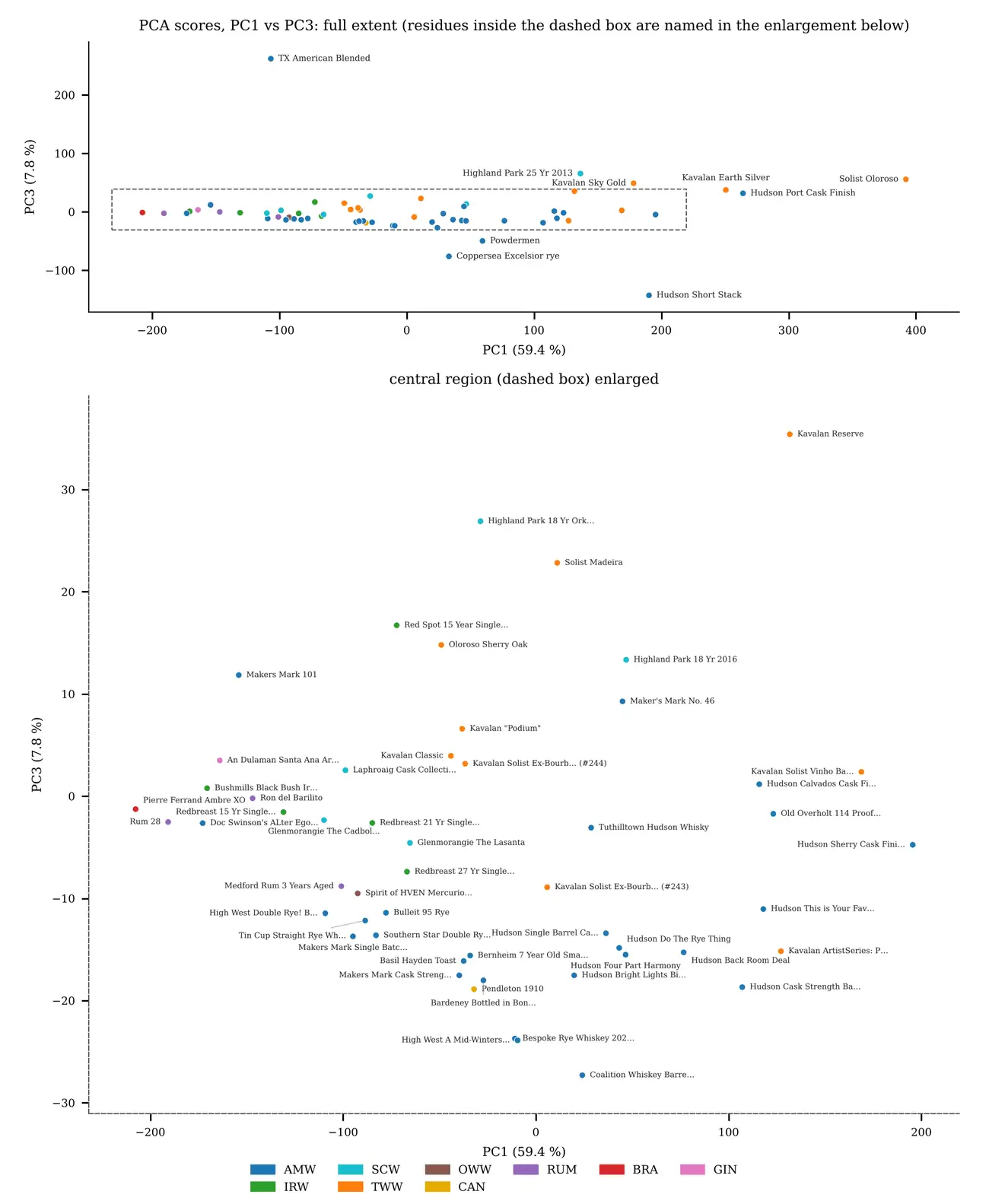
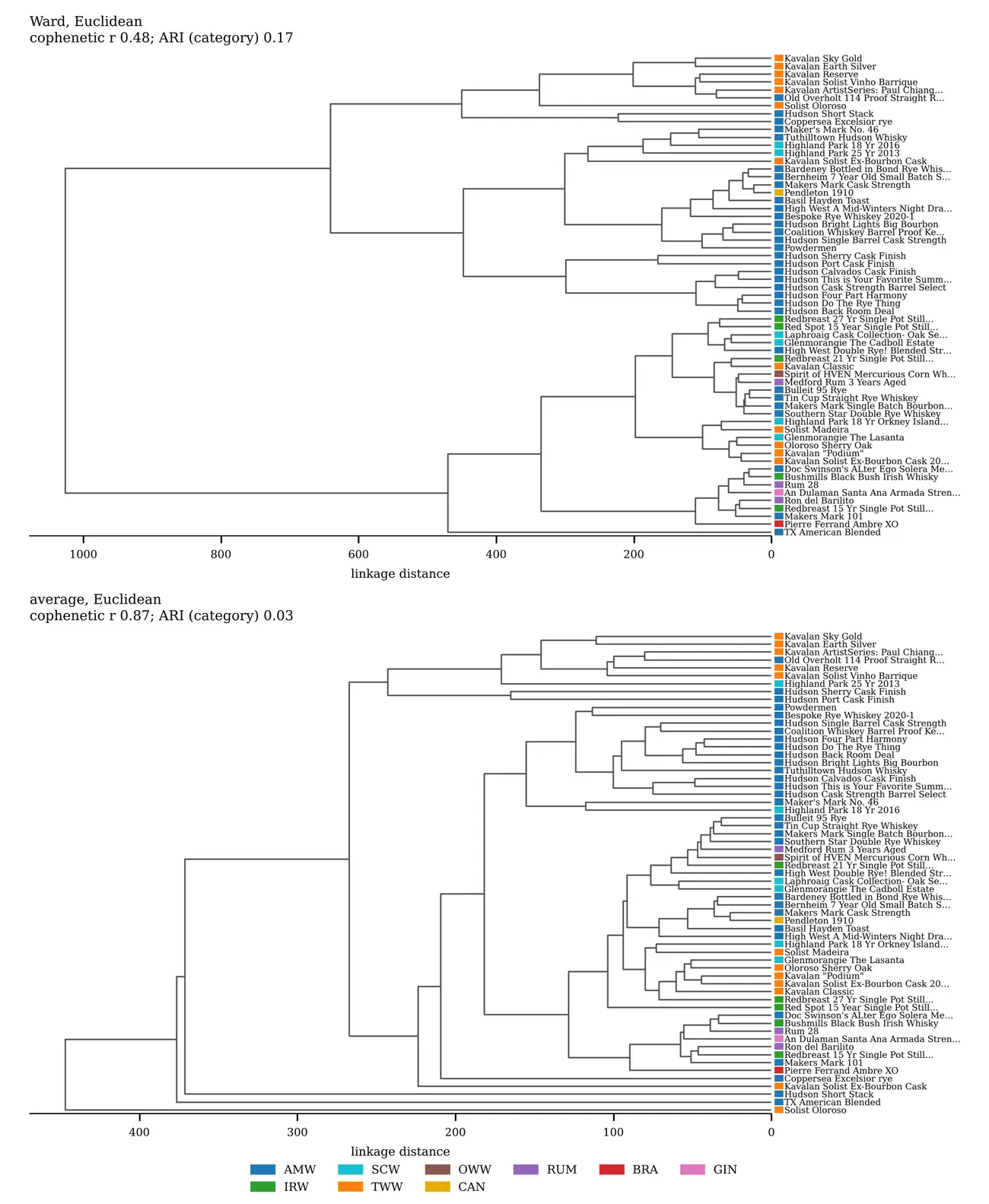
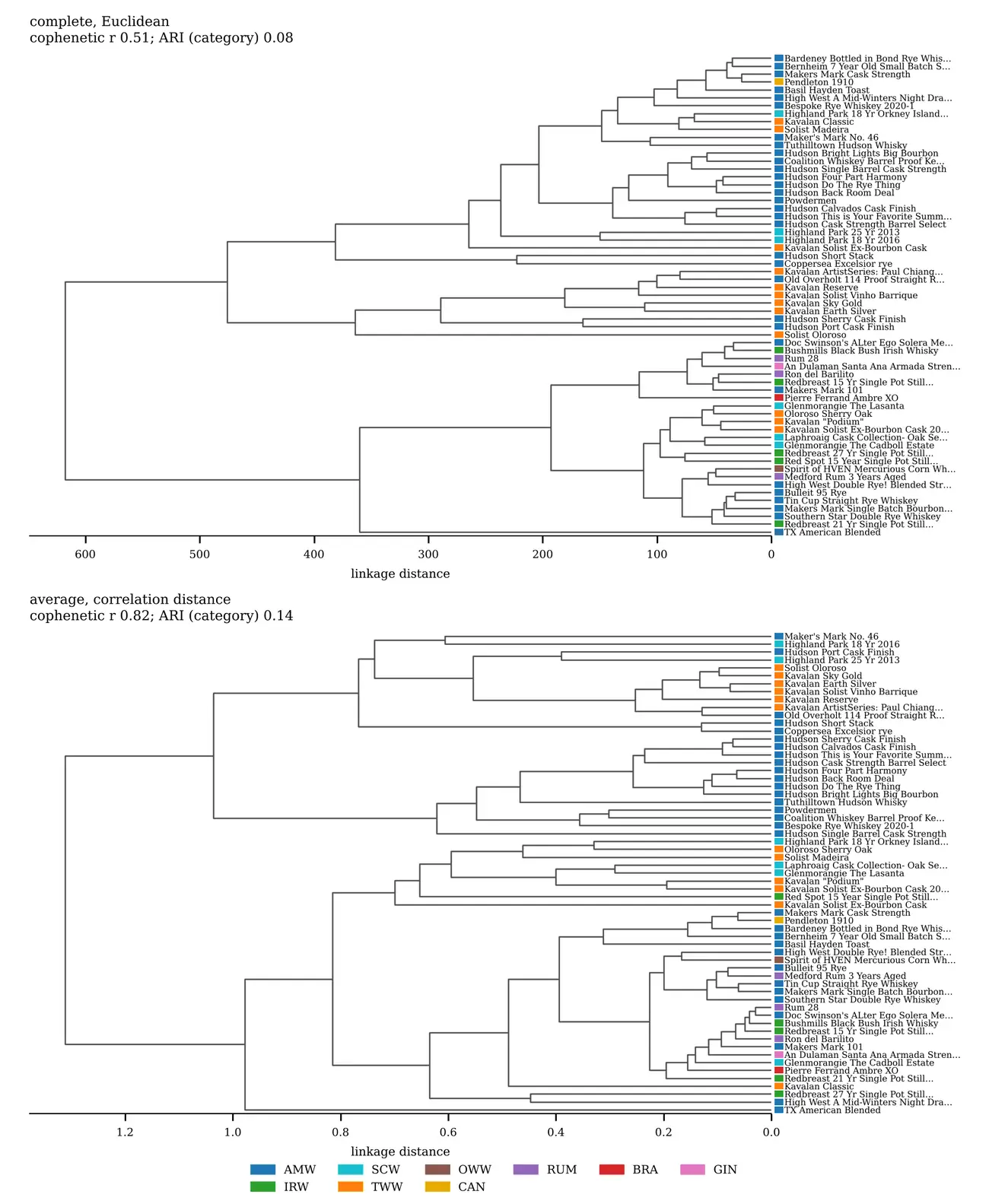
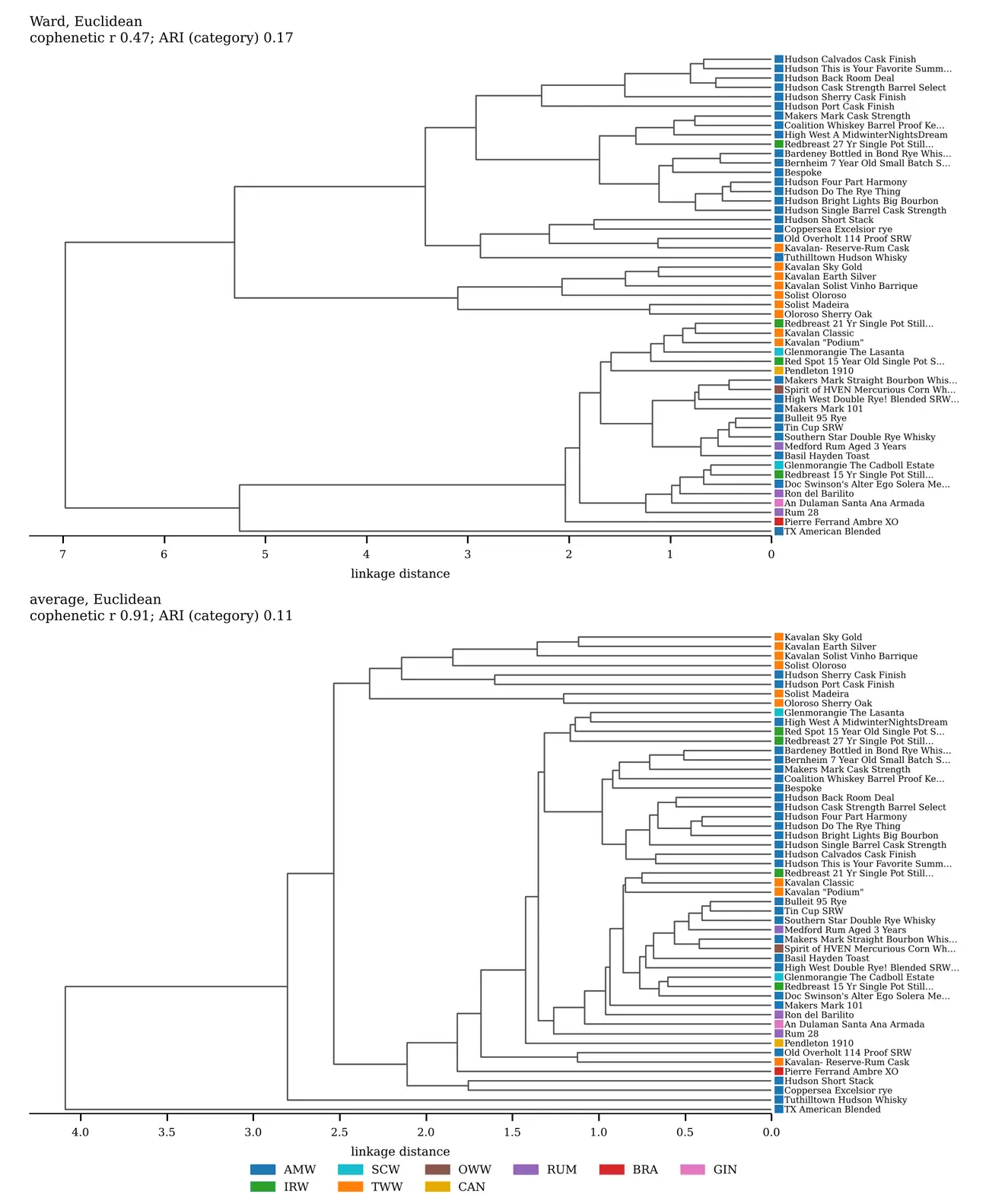
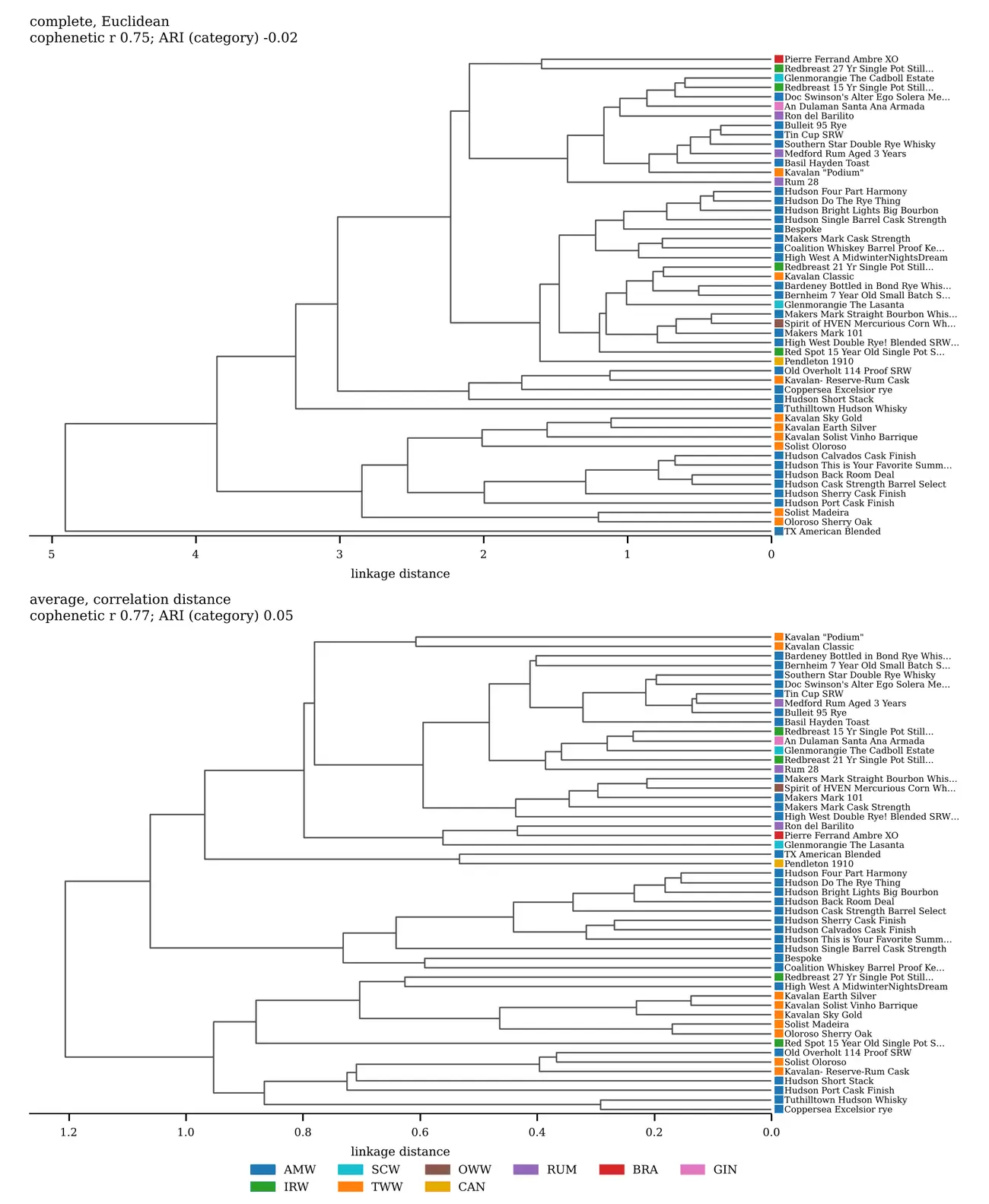
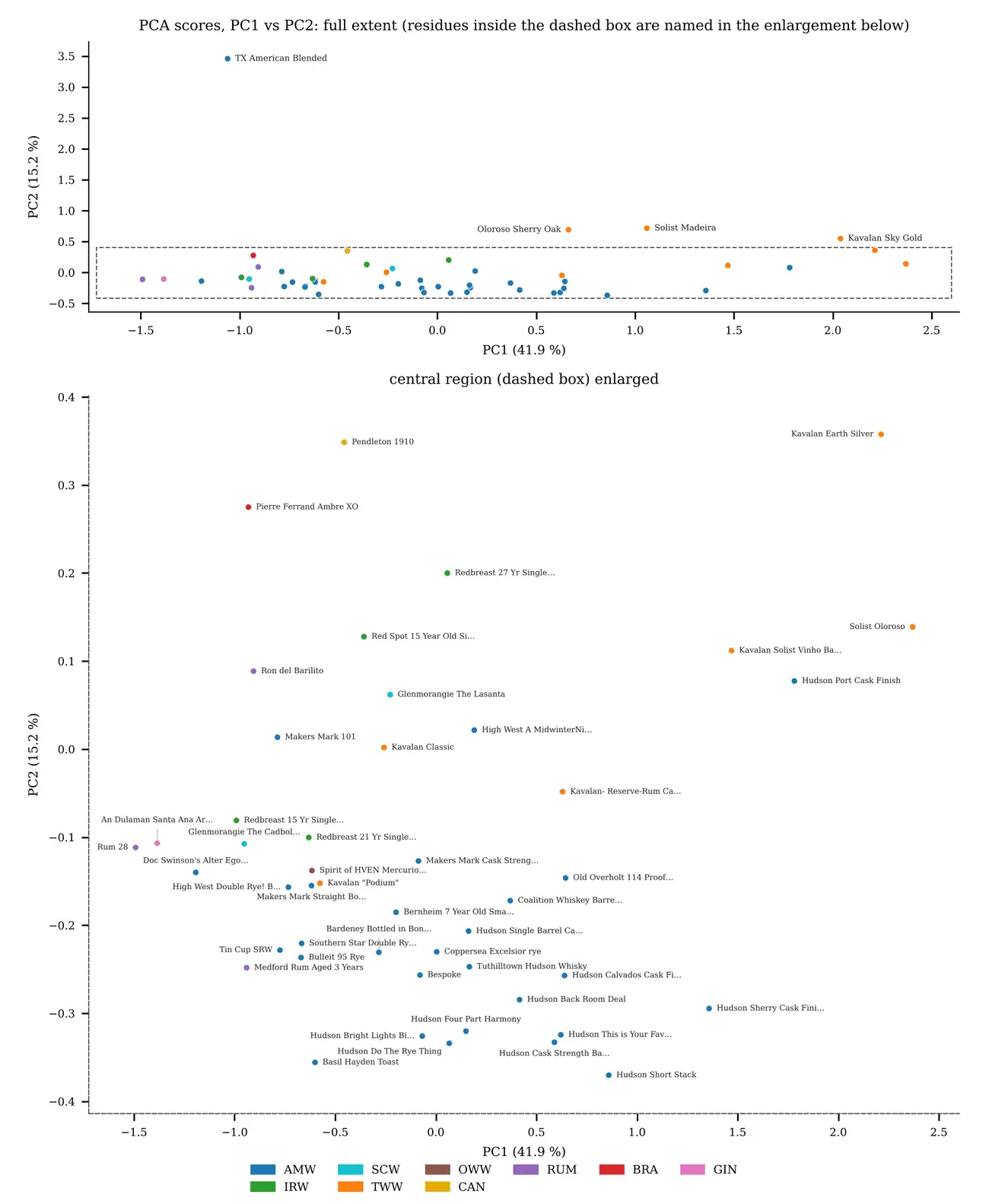
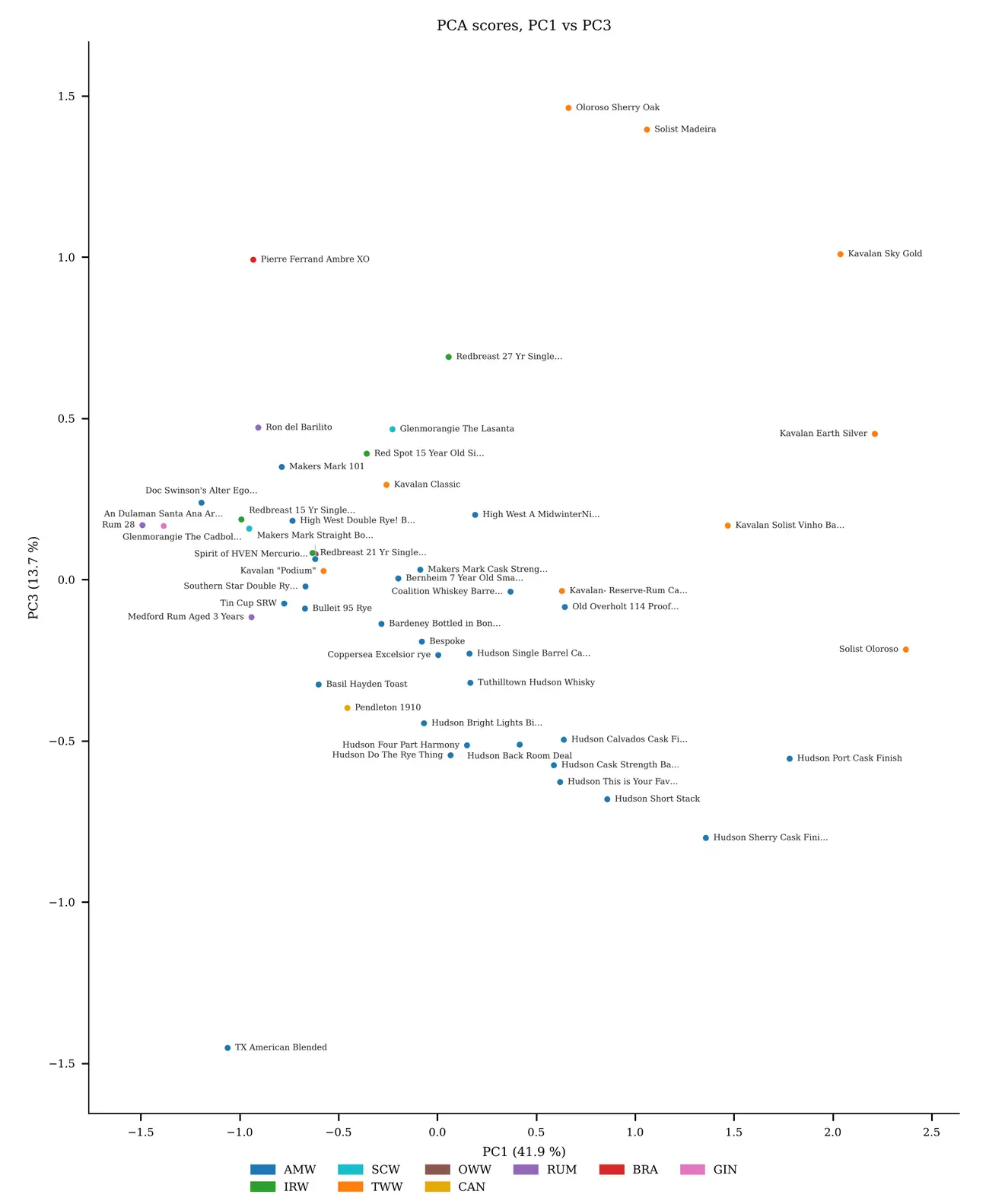
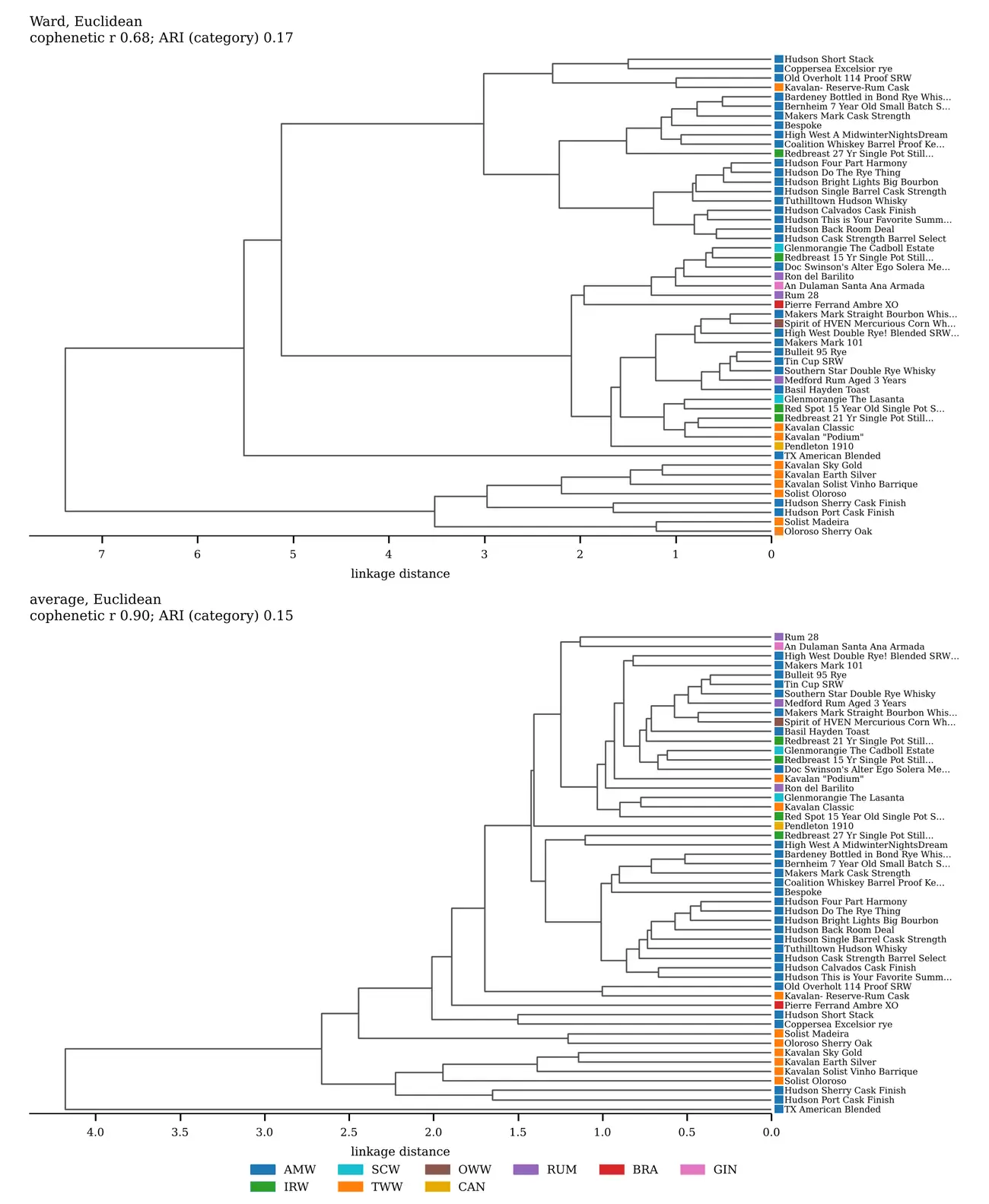
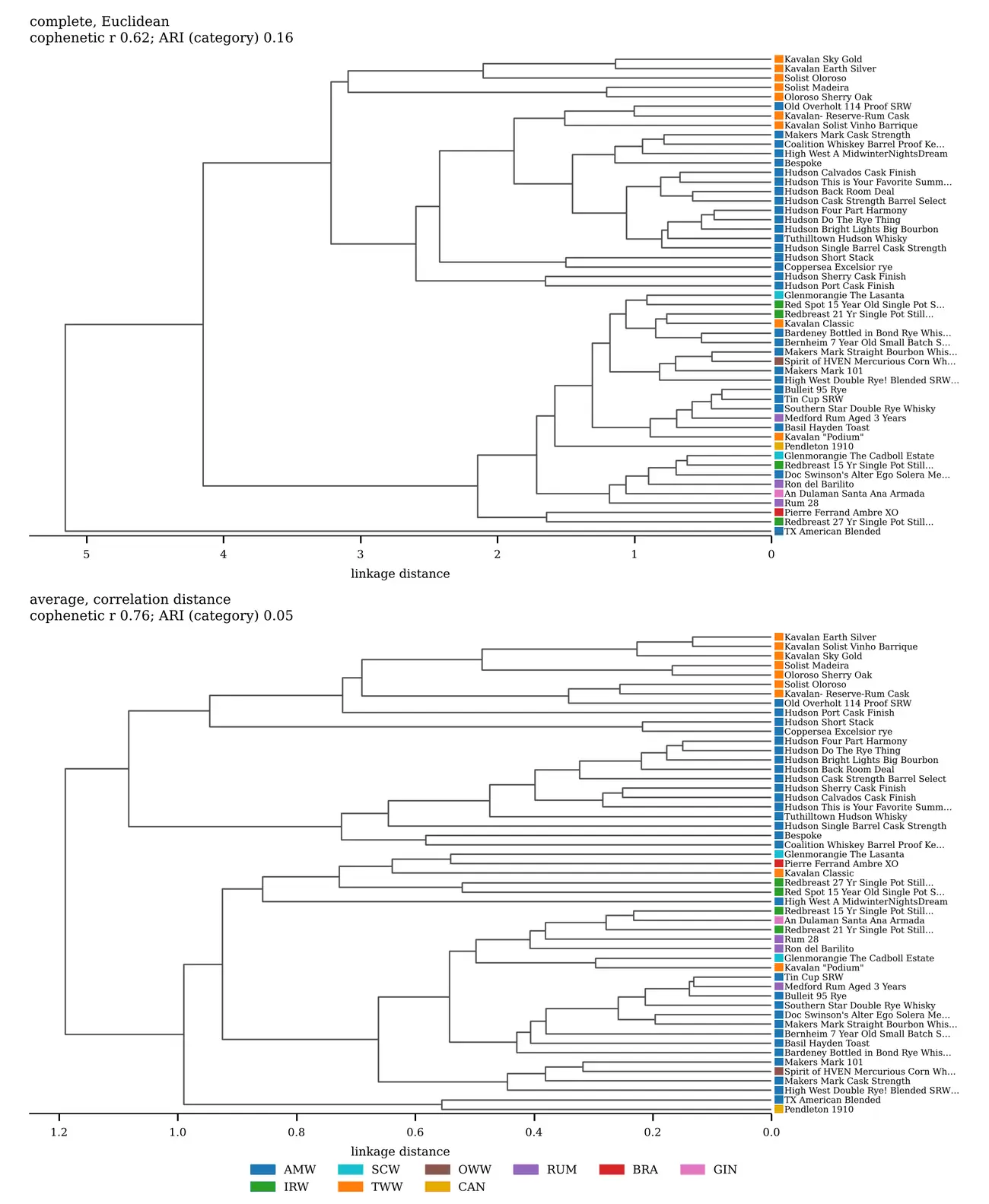
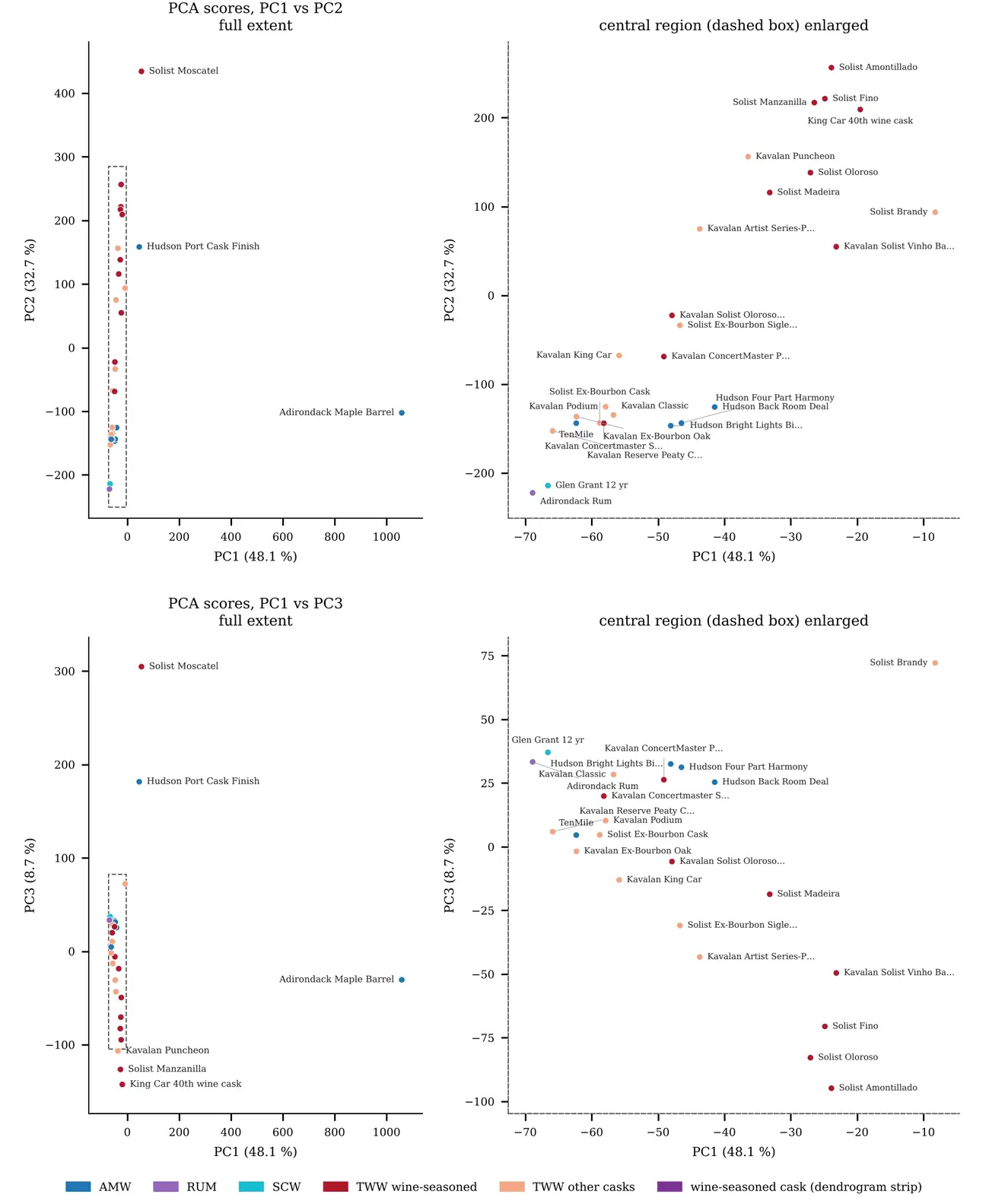
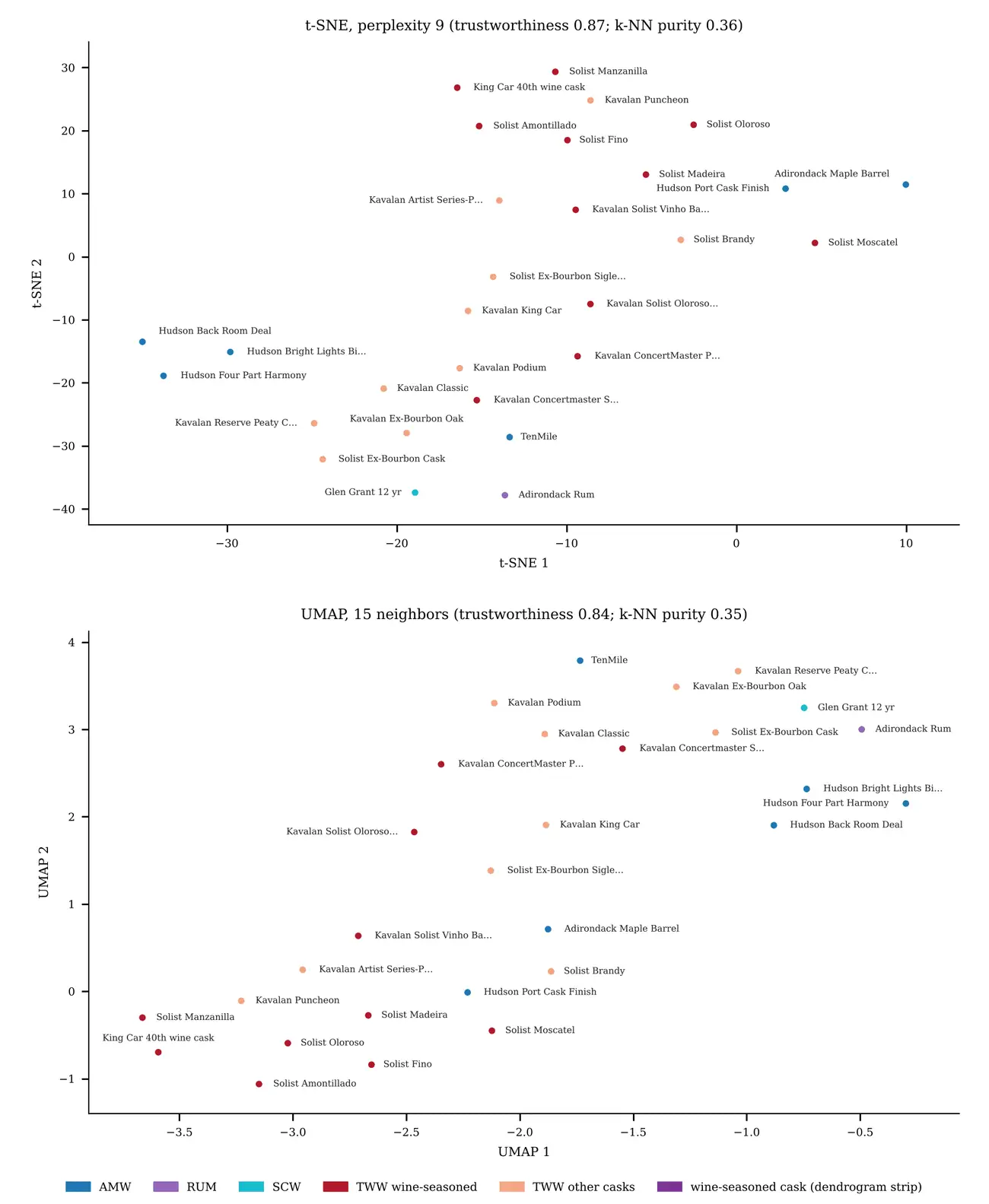
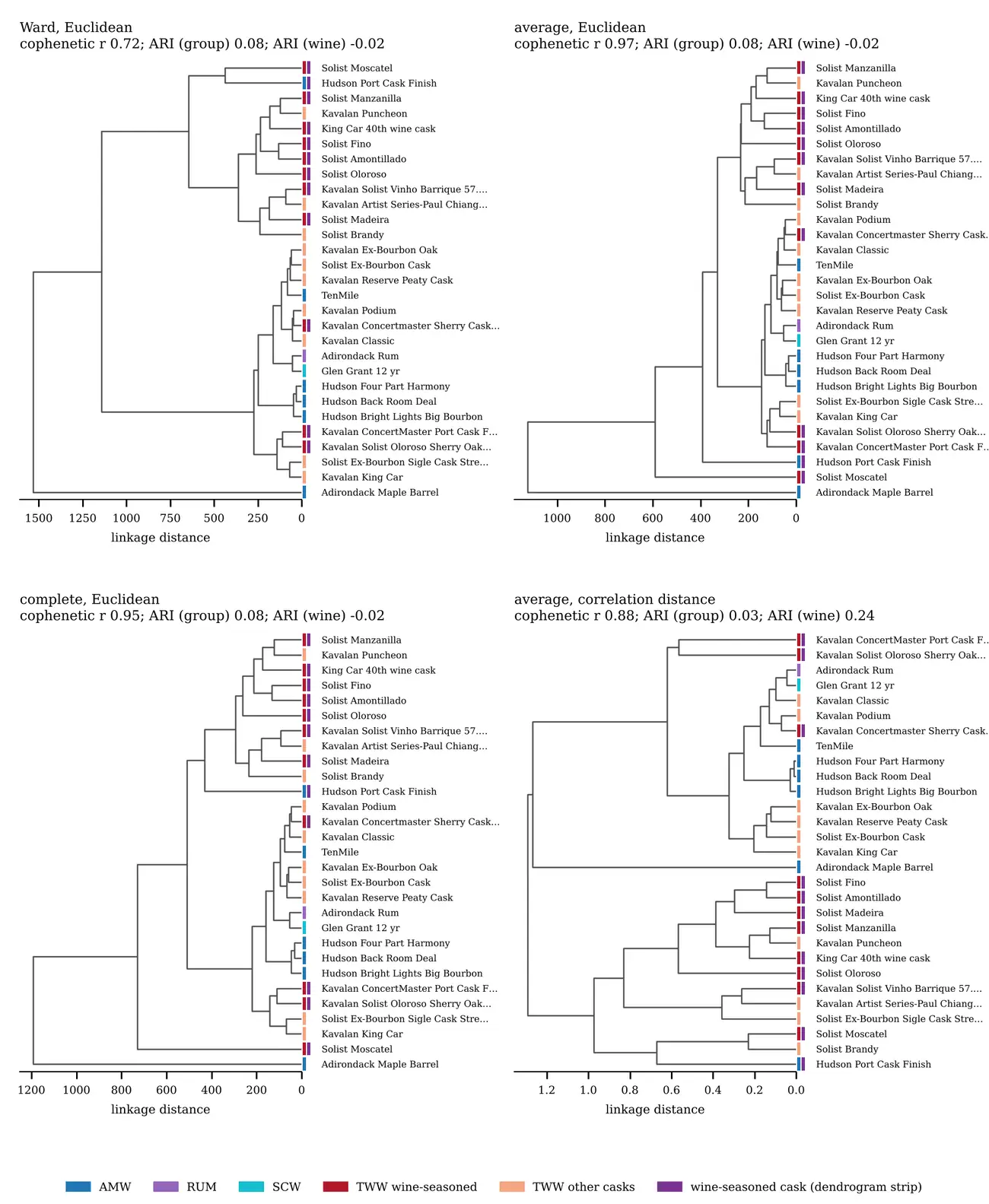
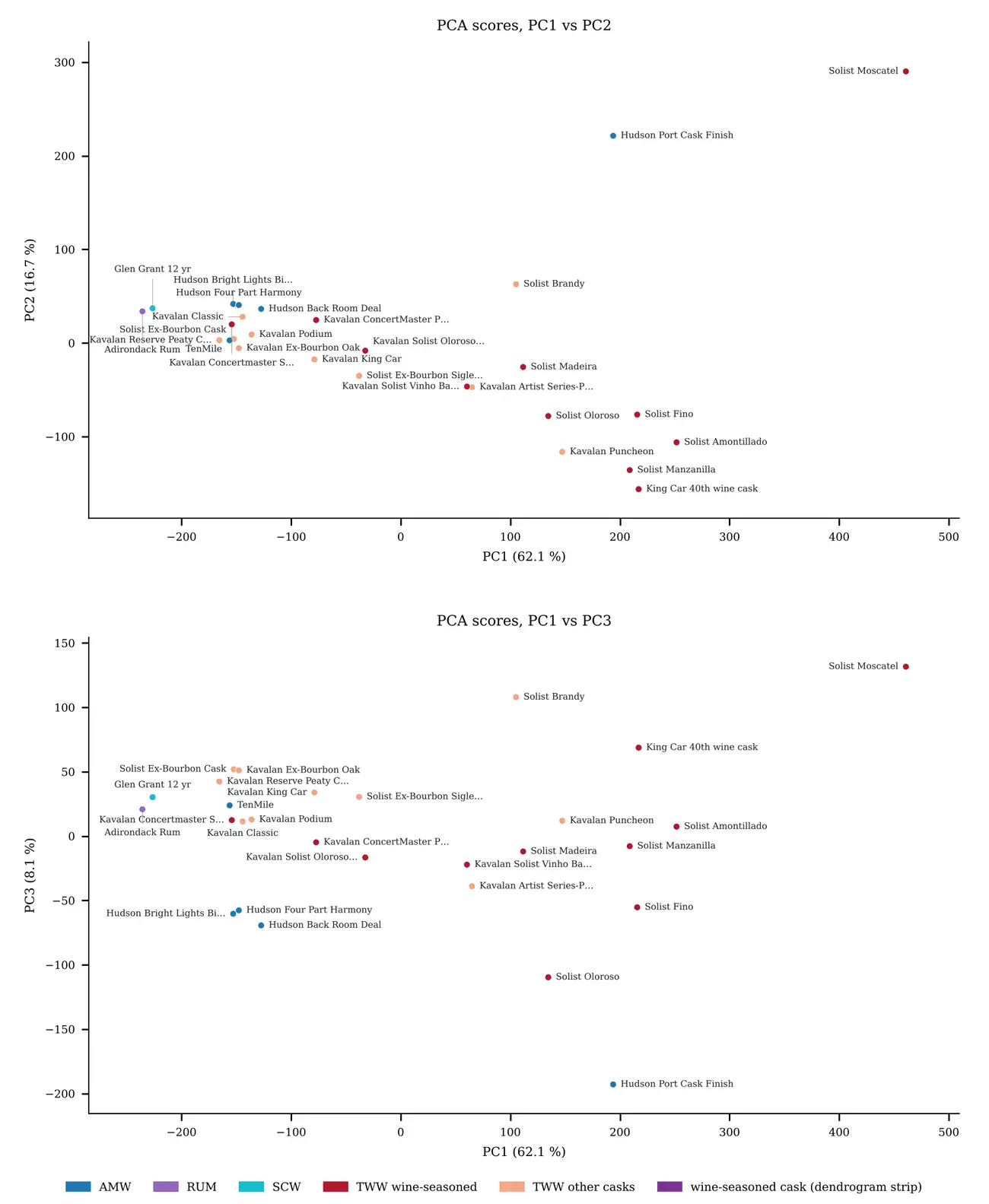
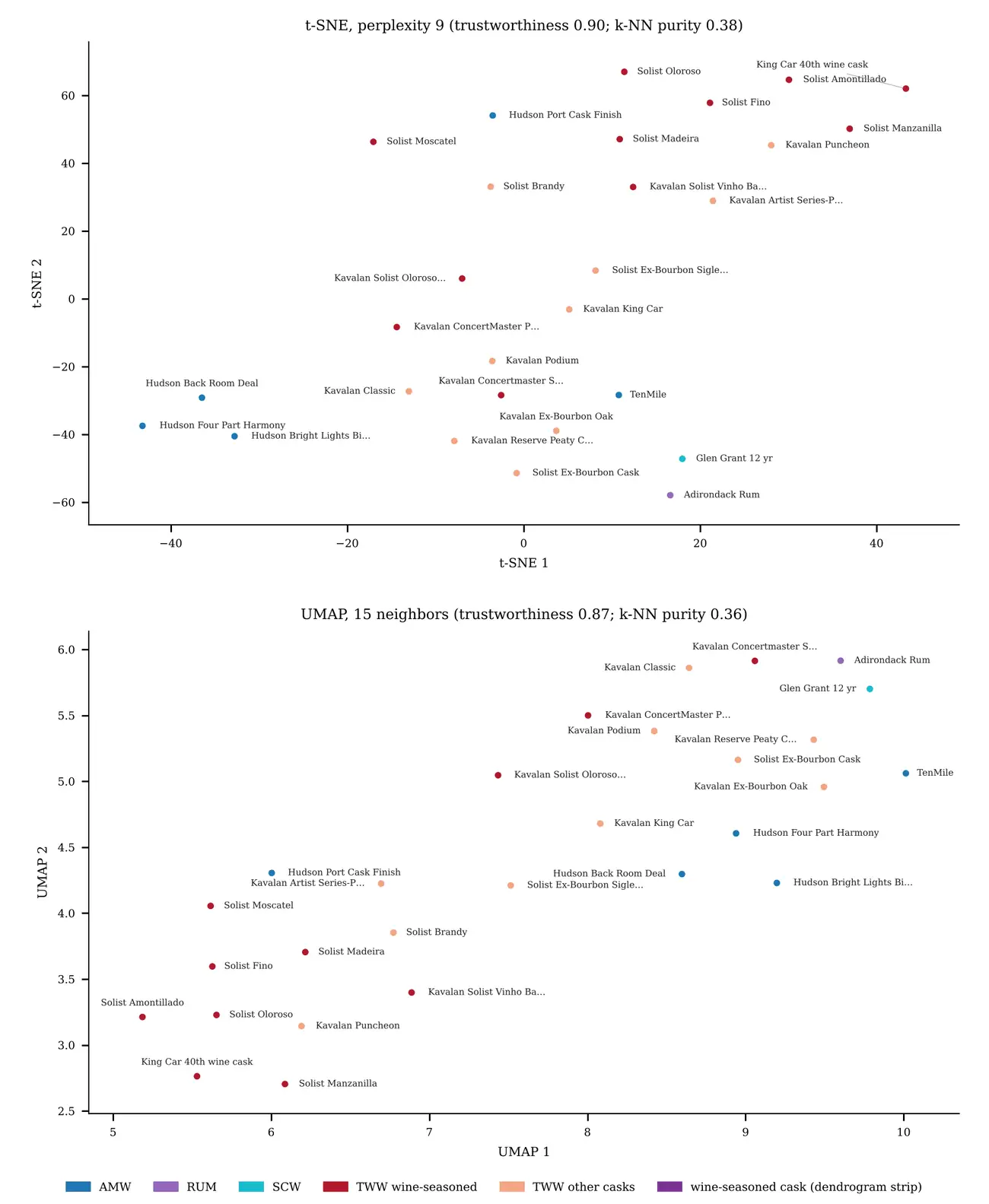
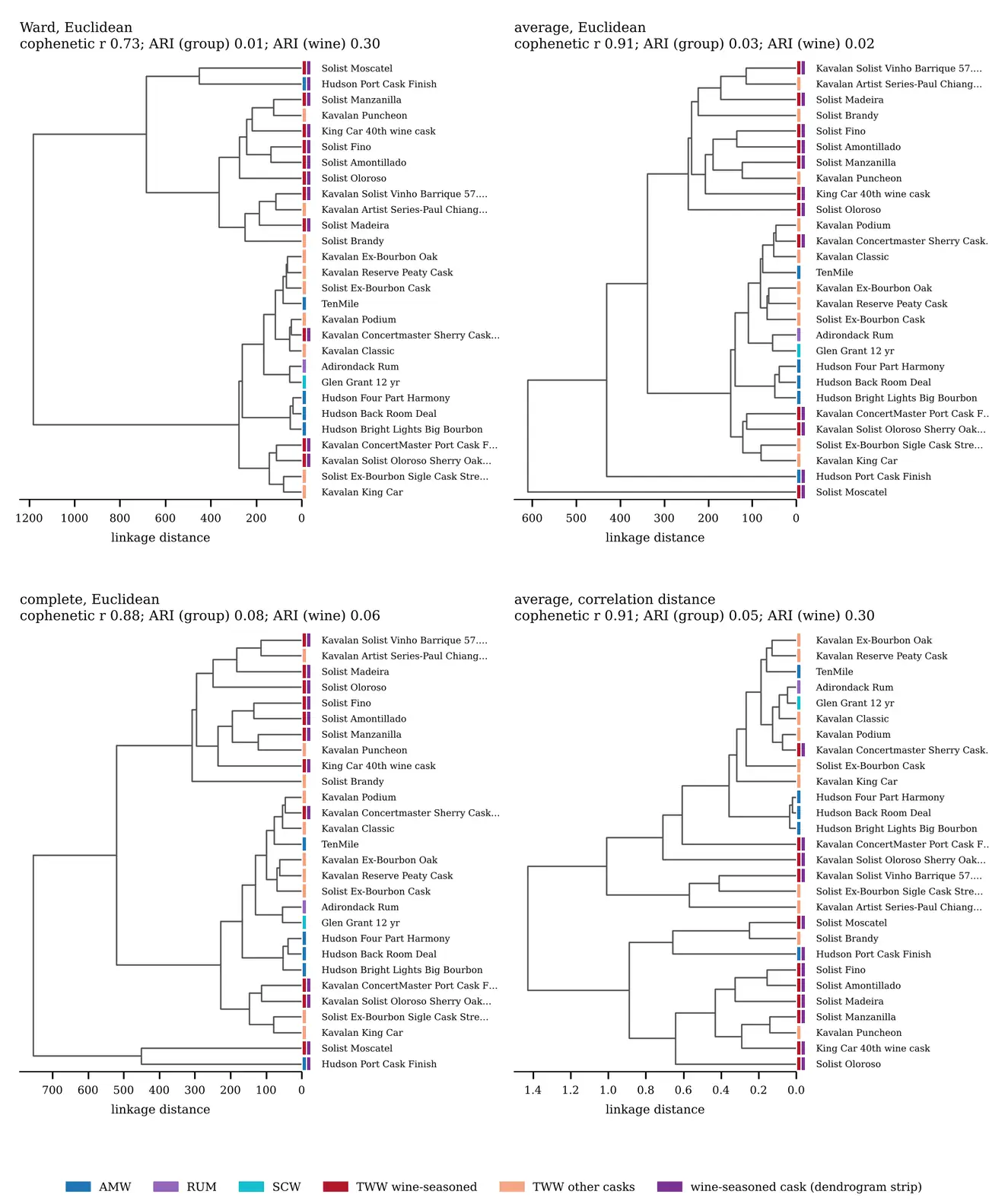
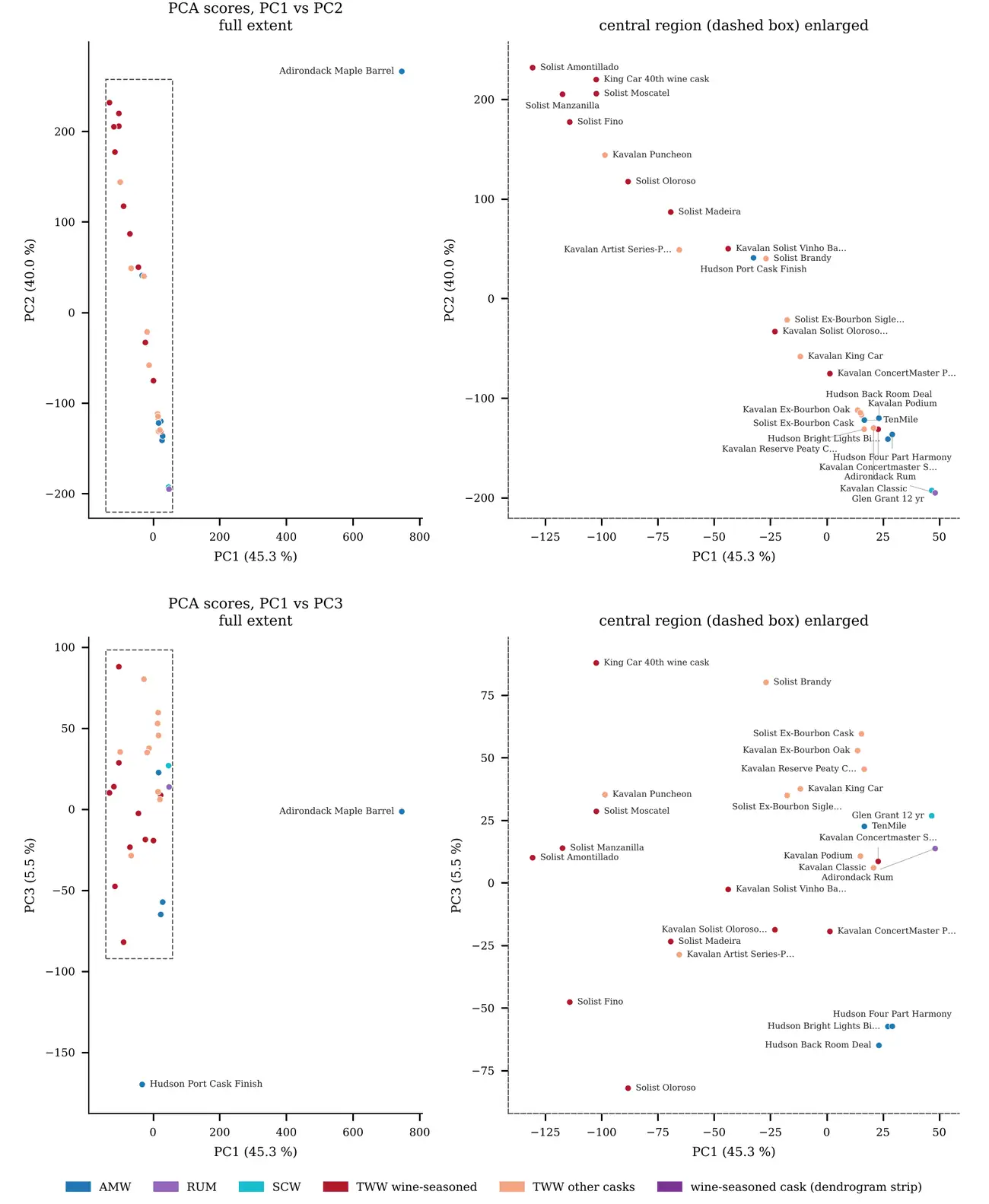
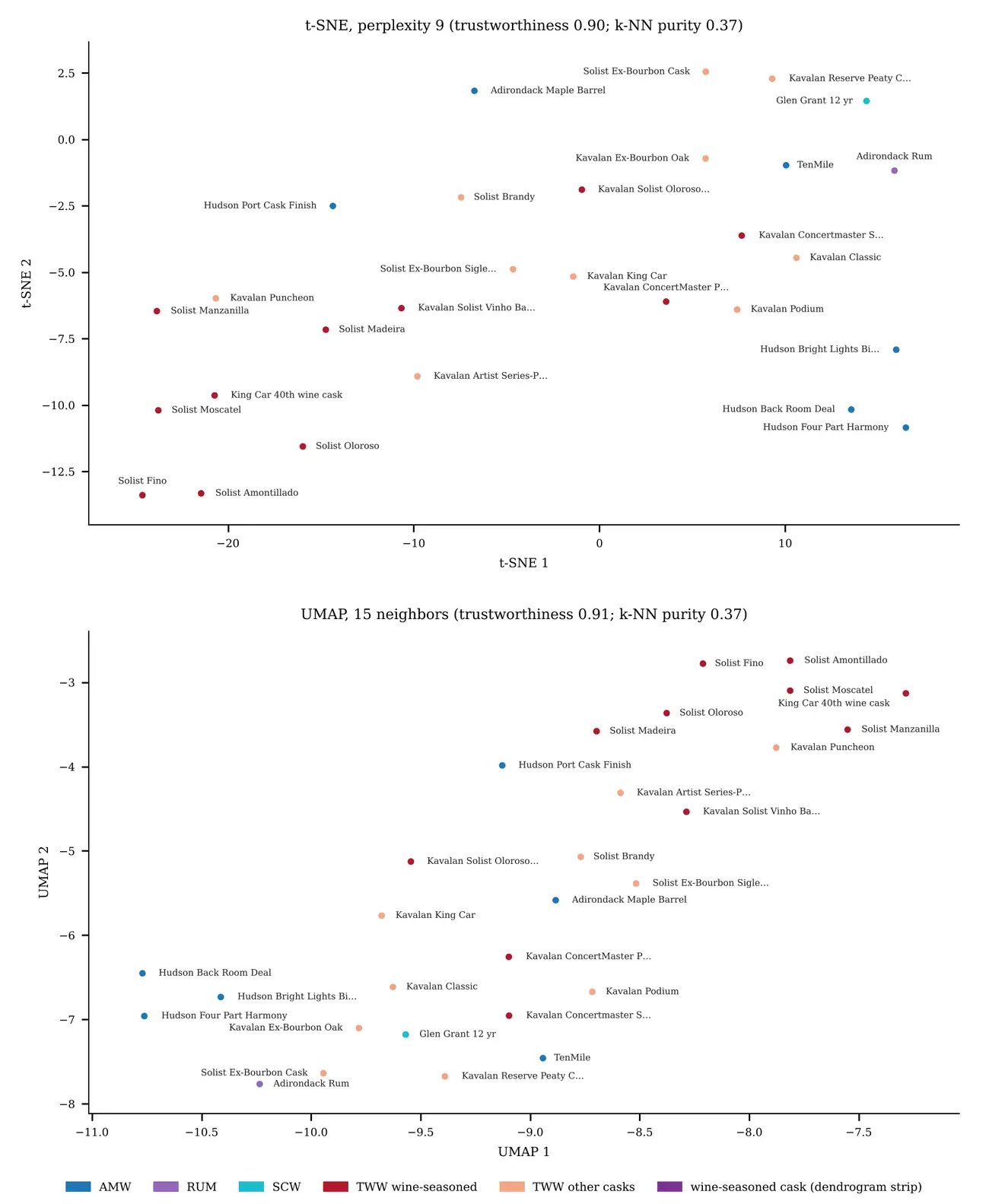
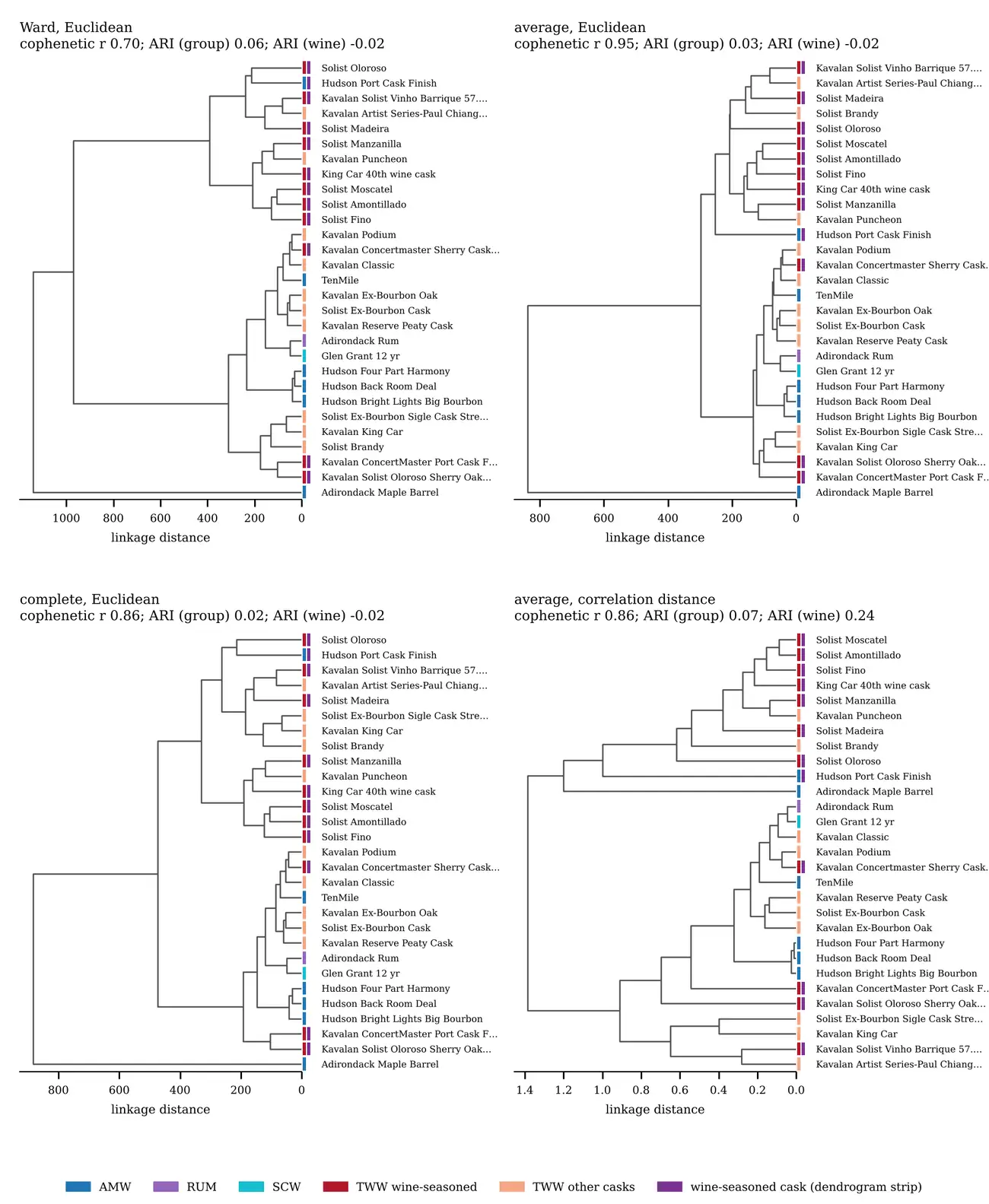
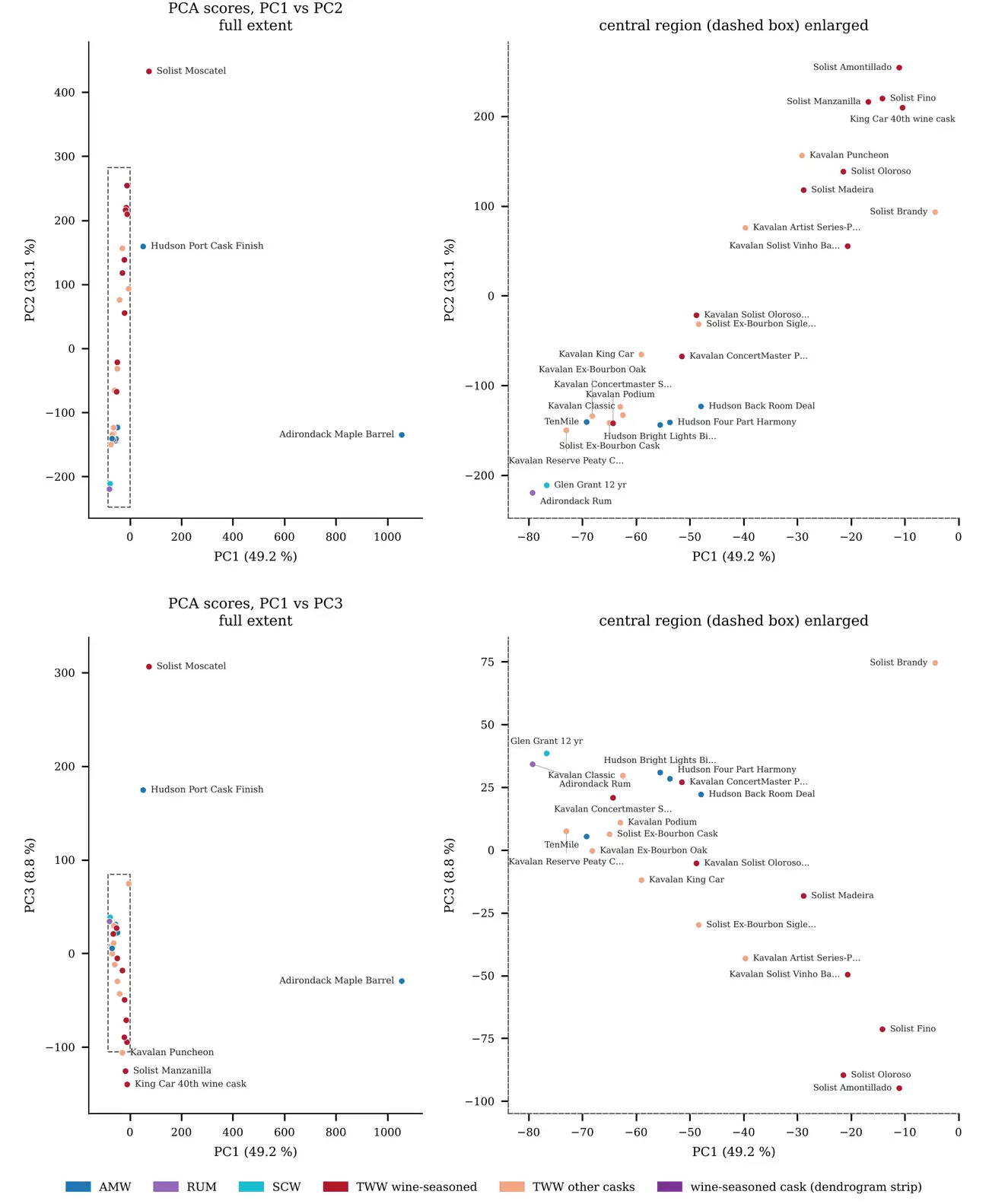
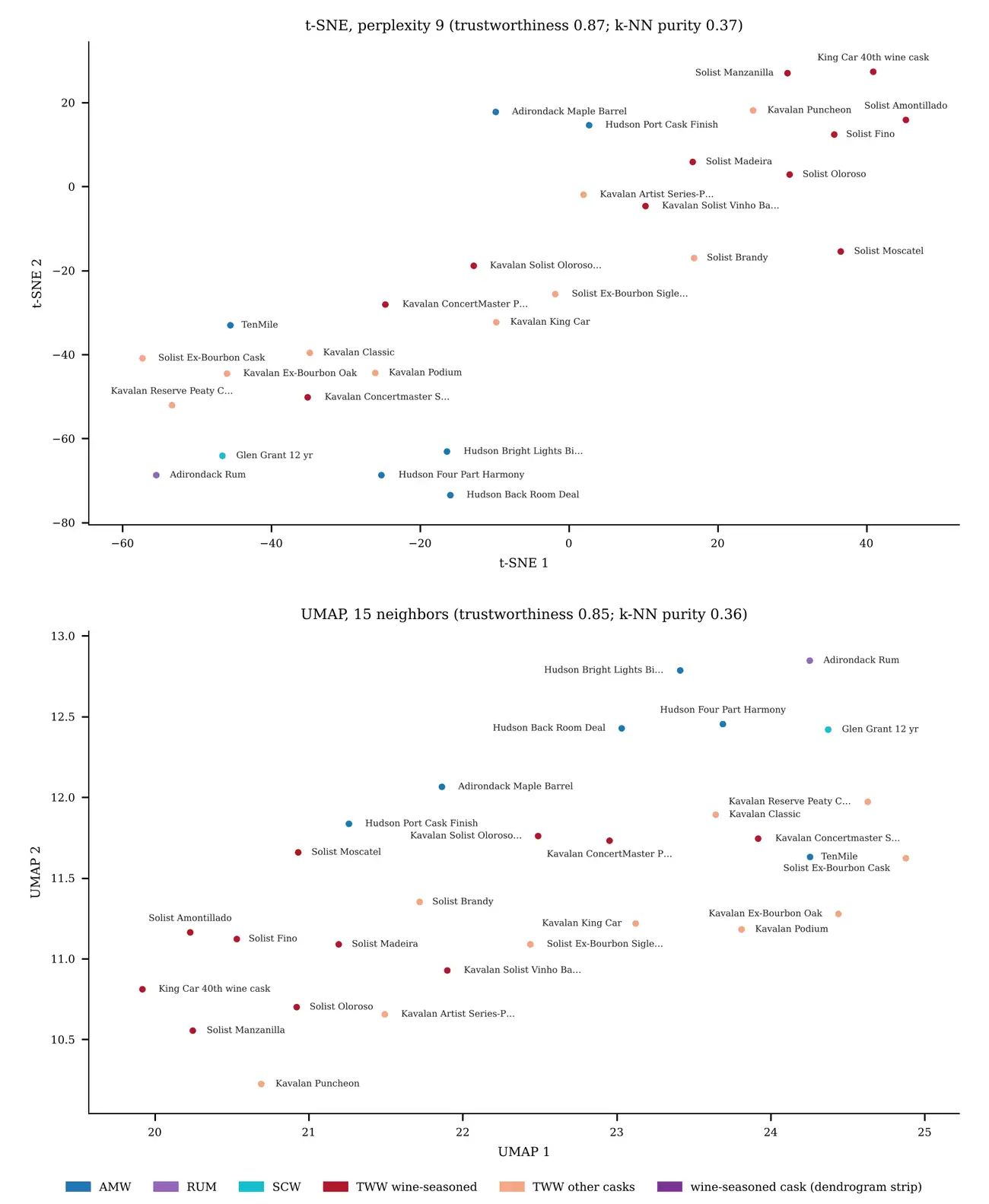
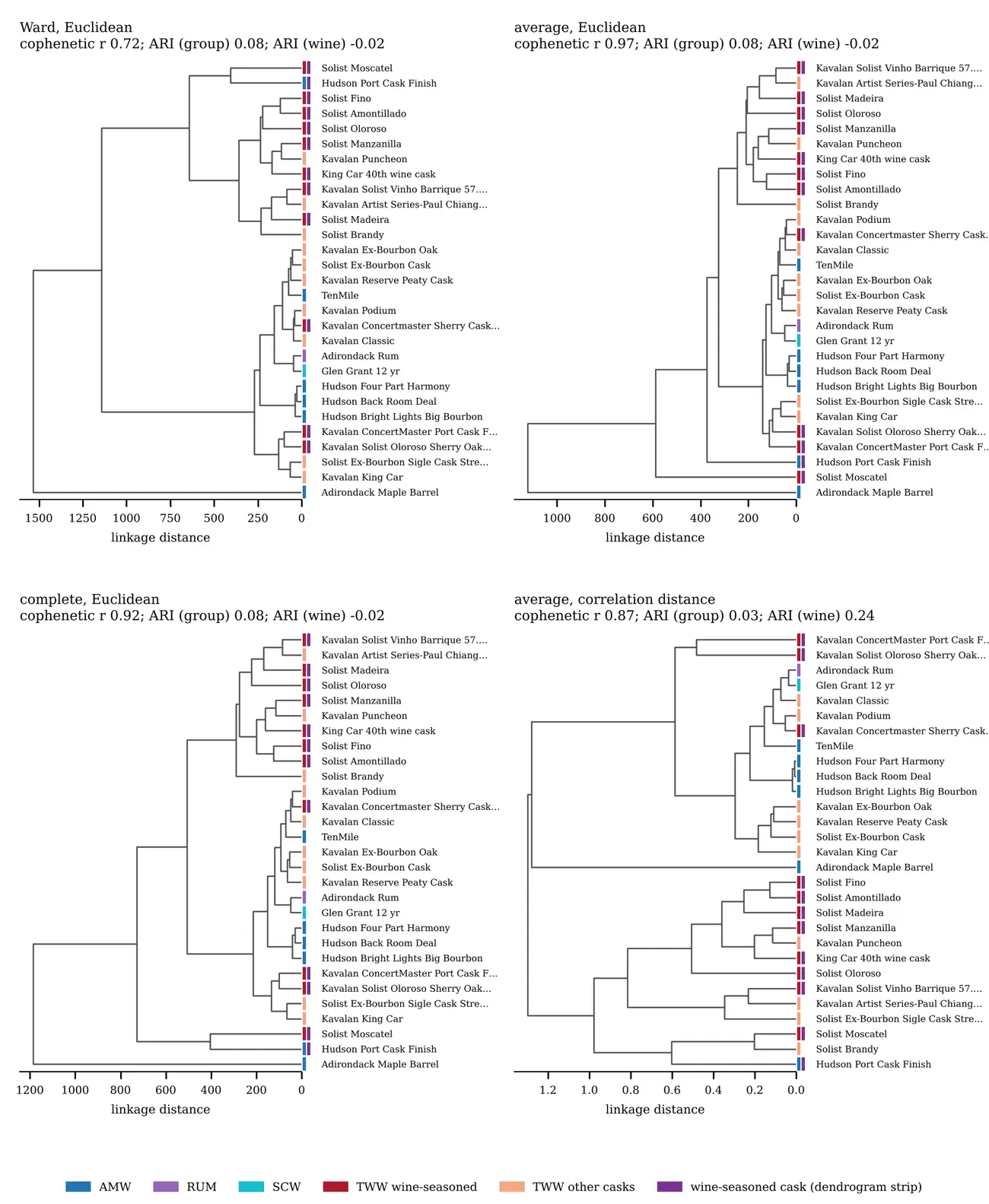
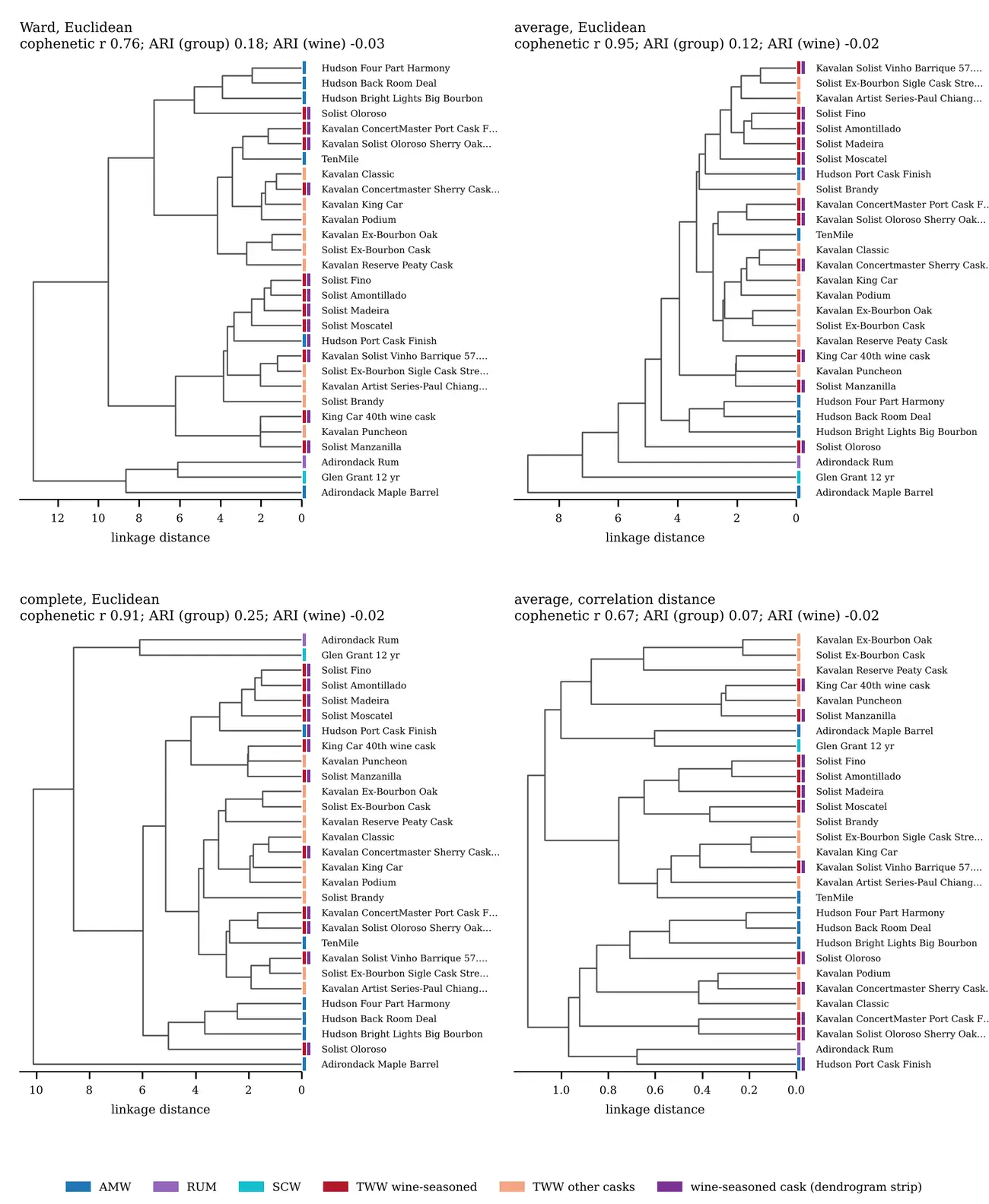
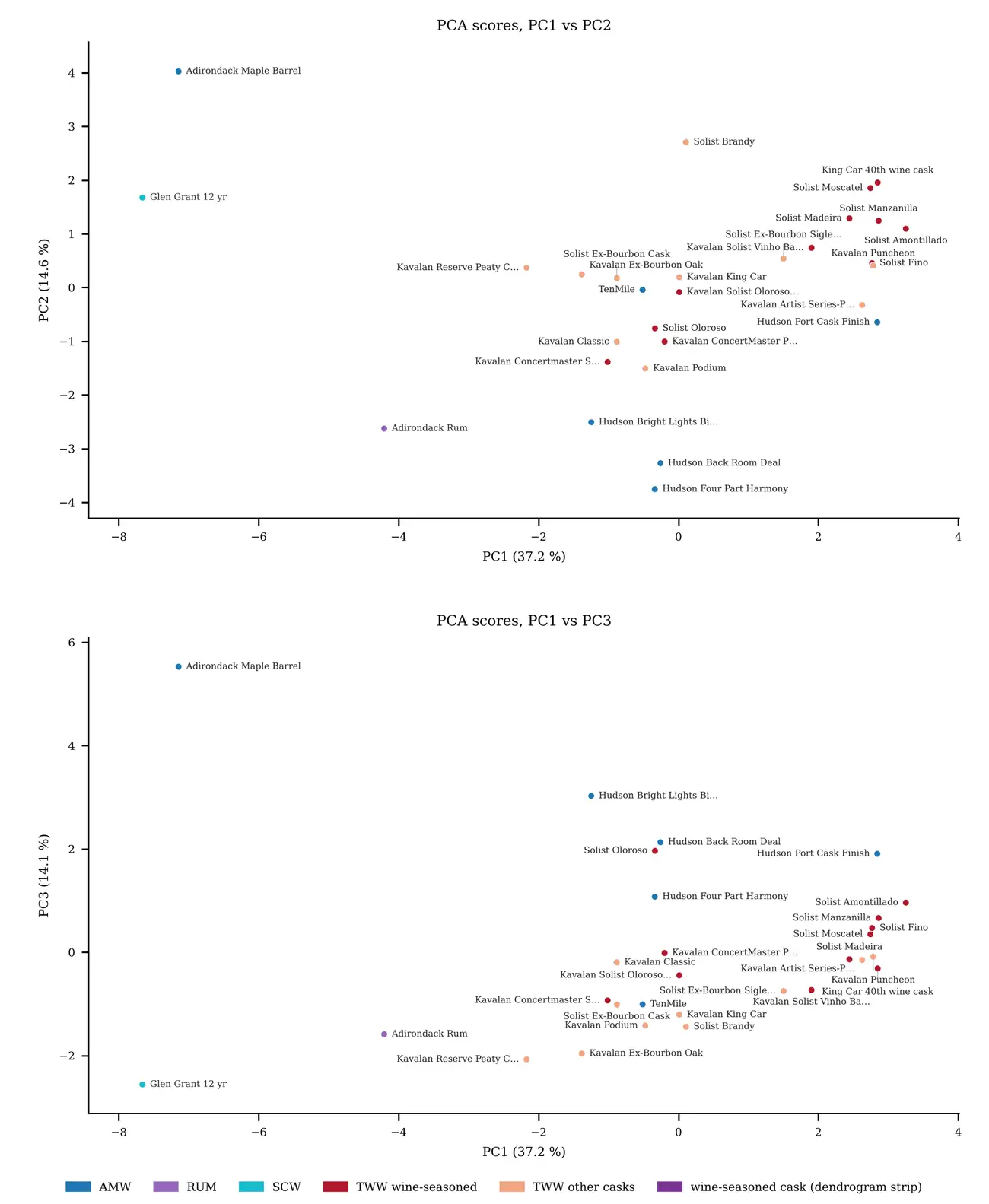
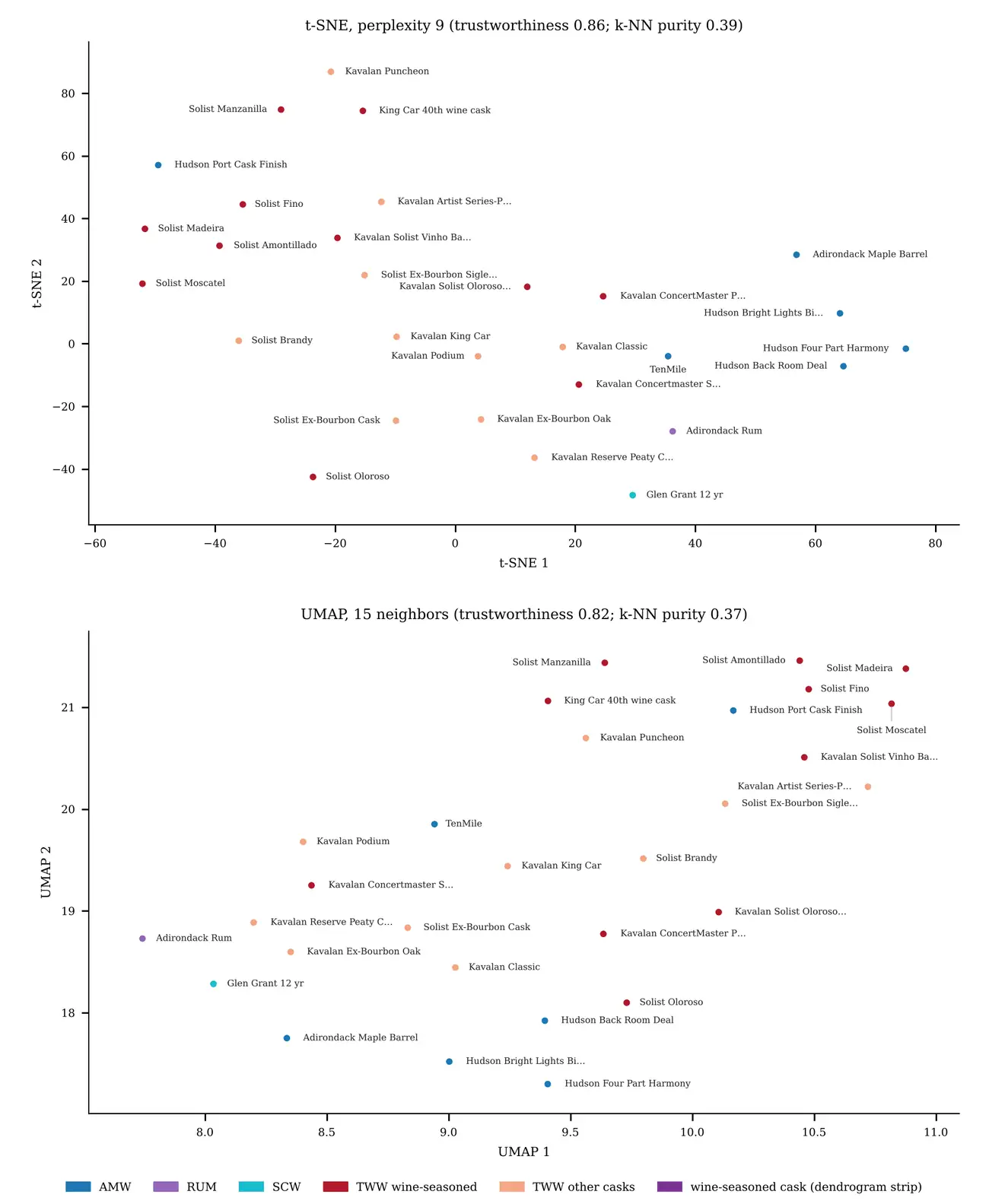
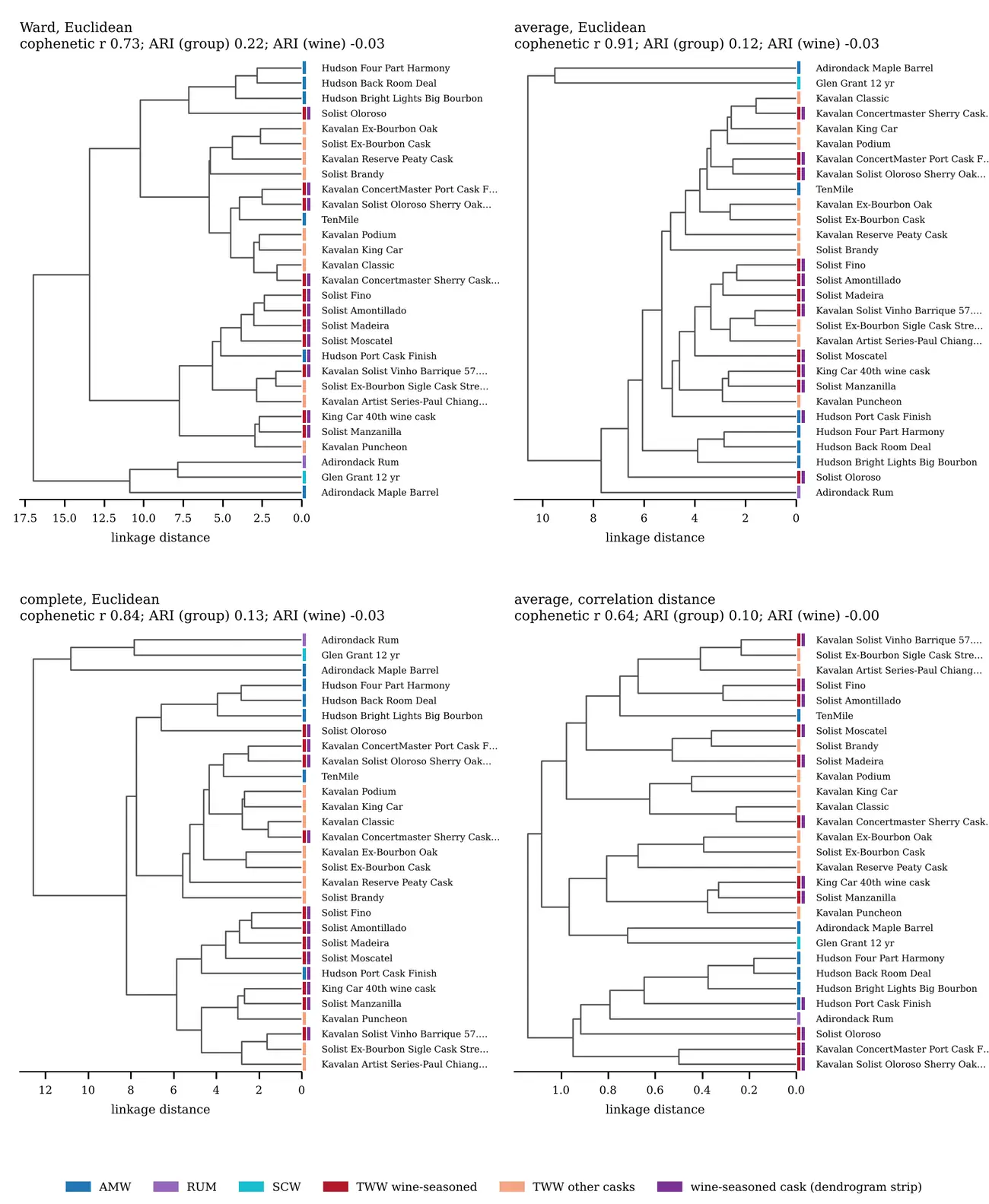
Version 2.1 added the 29 DMSO-d₆ residues, reprocessed from their decays and placed on the same absolute scale. Their residual DMSO-d₅ identified two solvent lots, TMS was absent from 16 spectra, the residual solvent line itself was displaced by up to 0.037 ppm in residues rich in sugars and acids, and two label conflicts were resolved by the chemistry of the residues. HMF, the benzaldehydes and quercitol, quantified from isolated resonances in both polar solvents, were recovered at 1.08, 1.11 and 0.97 times their D₂O/CD₃OD levels in separately prepared residues of the same bottles, which transfers the absolute scale to DMSO-d₆. A single DMSO-d₆ spectrum resolves the individual phenolic aldehydes, ellagic acid, a syringyl singlet assigned tentatively to syringic acid, and the esters and lipids, but glycerol is lost beneath the exchange-averaged water line, the anomeric signals change shape with the rate of hydroxyl exchange, glucose carries an additive interference of about 77 mg L⁻¹, and succinic acid in wine-seasoned residues was recovered at only 0.32 of its D₂O level. The DMSO-d₆ spectra also exposed L-arabinose and D-xylose, overlooked in version 2.0, whose β-arabinopyranose H-1 doublet lies beneath the α-glucose doublet in D₂O/CD₃OD; correcting for that overlap, and refitting the residues whose CD₃OD content had displaced their signals, lowered the median glucose of the American whiskeys from 81.1 to 51.4 mg L⁻¹, beside 57.1 mg L⁻¹ of arabinose, and changed the interpretation of four sweetened products, among them a cognac formerly described as fructose-rich that proved to contain ordinary invert sugar. A full accounting of seventeen chemometric data approaches, each shown with principal components, four hierarchical clusterings, t-SNE and UMAP, established that the linkage giving the most faithful tree was never the one giving the most informative partition, that no approach recovered the spirit categories well (adjusted Rand index ≤ 0.30), and that a moisture artifact formed the second principal component of the CDCl₃ block. On the matched products DMSO-d₆ reproduced the configuration of the fused two-solvent block (modified RV 0.77) and separated wine-seasoned casks as well as the D₂O/CD₃OD block, but the D₂O/CD₃OD residue remains indispensable for authentication, because it alone measures glycerol, the complete sugar profile and the wine-cask acids; DMSO-d₆ is recommended as the second solvent for fingerprints of oak extraction and CDCl₃ where the lipid profile matters.
Version 2.2 corrects two errors of the absolute scale that every earlier version shared. The 90° pulse of the probe is 13 µs rather than the 10 µs stored in the parameter sets, so that the 8 µs and 7 µs pulses delivered 55.4° and 48.5° instead of 72° and 63°, and the maleic acid standard contained 95 % of its nominal content, so that its gravimetric concentration had overstated every result by 5.3 %. With the corrected flip angles, the effective content of the standard and the 6.1 s T₁ of maleic acid, every absolute intensity, saturation correction and concentration was recalculated: the quantified values fell by 1.1–9.5 % (median 4.2 %), the flip angle alone accounting for −4.7 to +4.2 %, the balanced accuracies and the cross-validated Q² moved by no more than 0.034 and 0.015, and none of the conclusions changed. Neither correction can be verified by an internal check of these data; both rest on the pulse calibration and on the determination of the content of the standard made by the author.
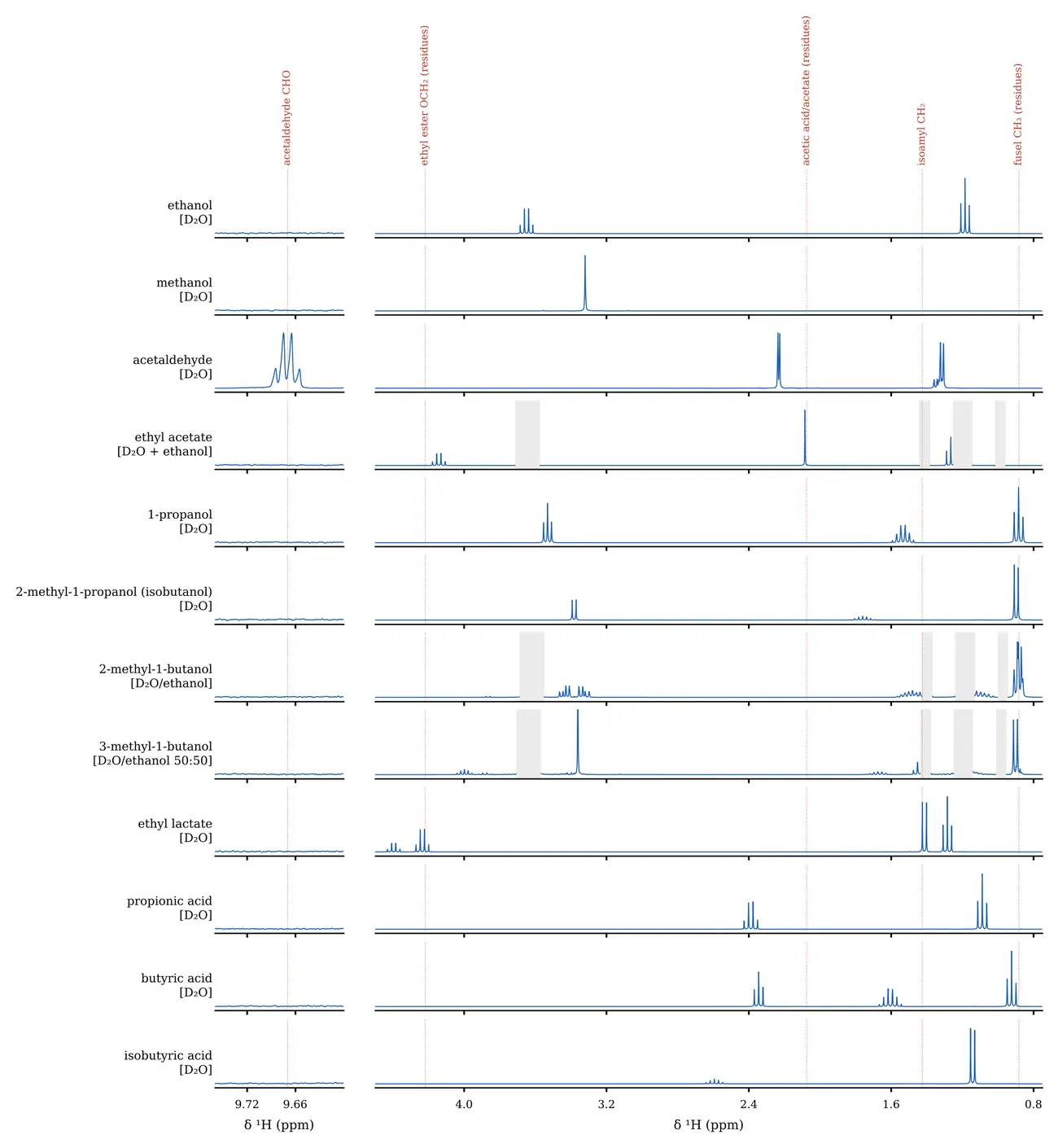
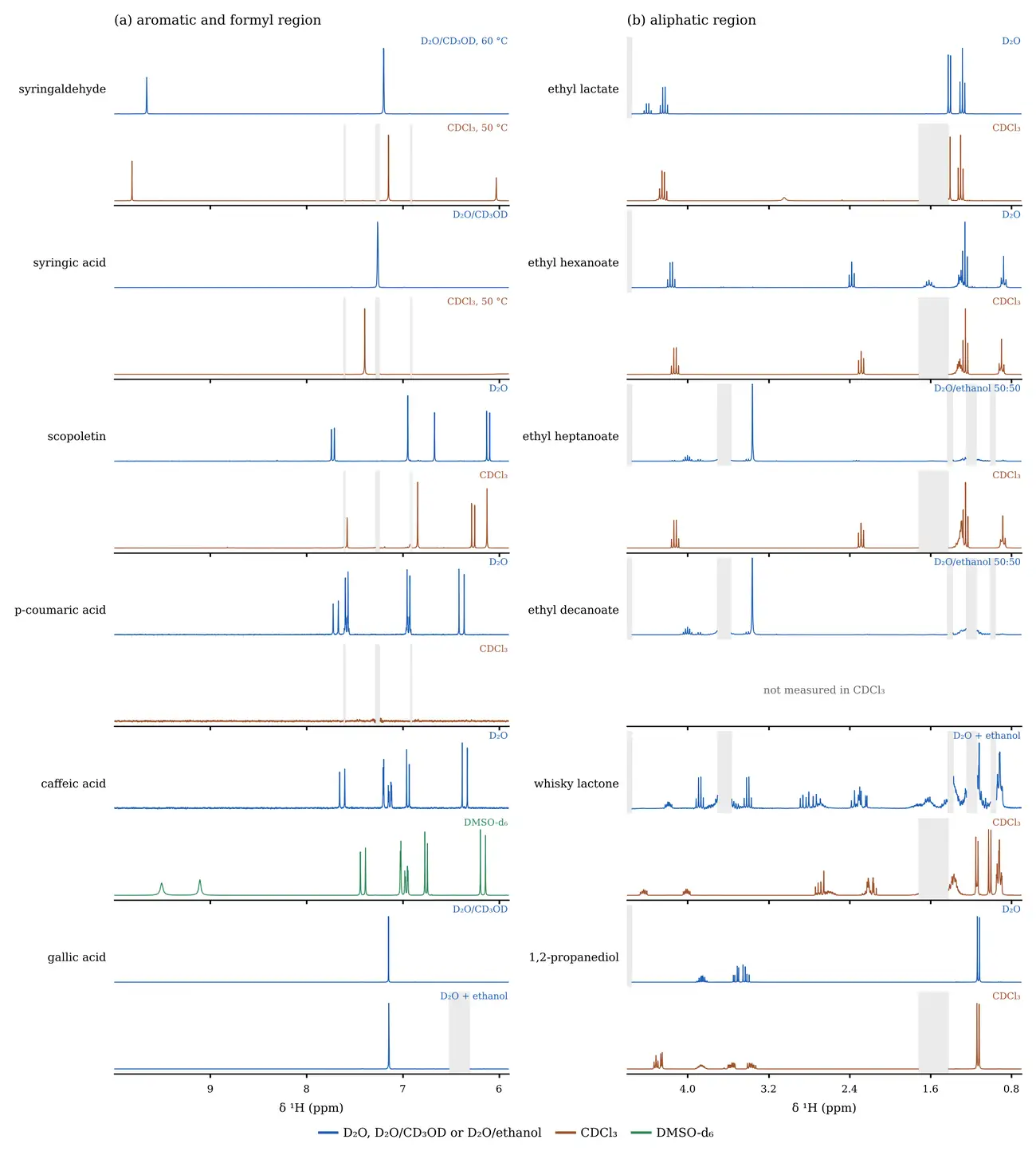
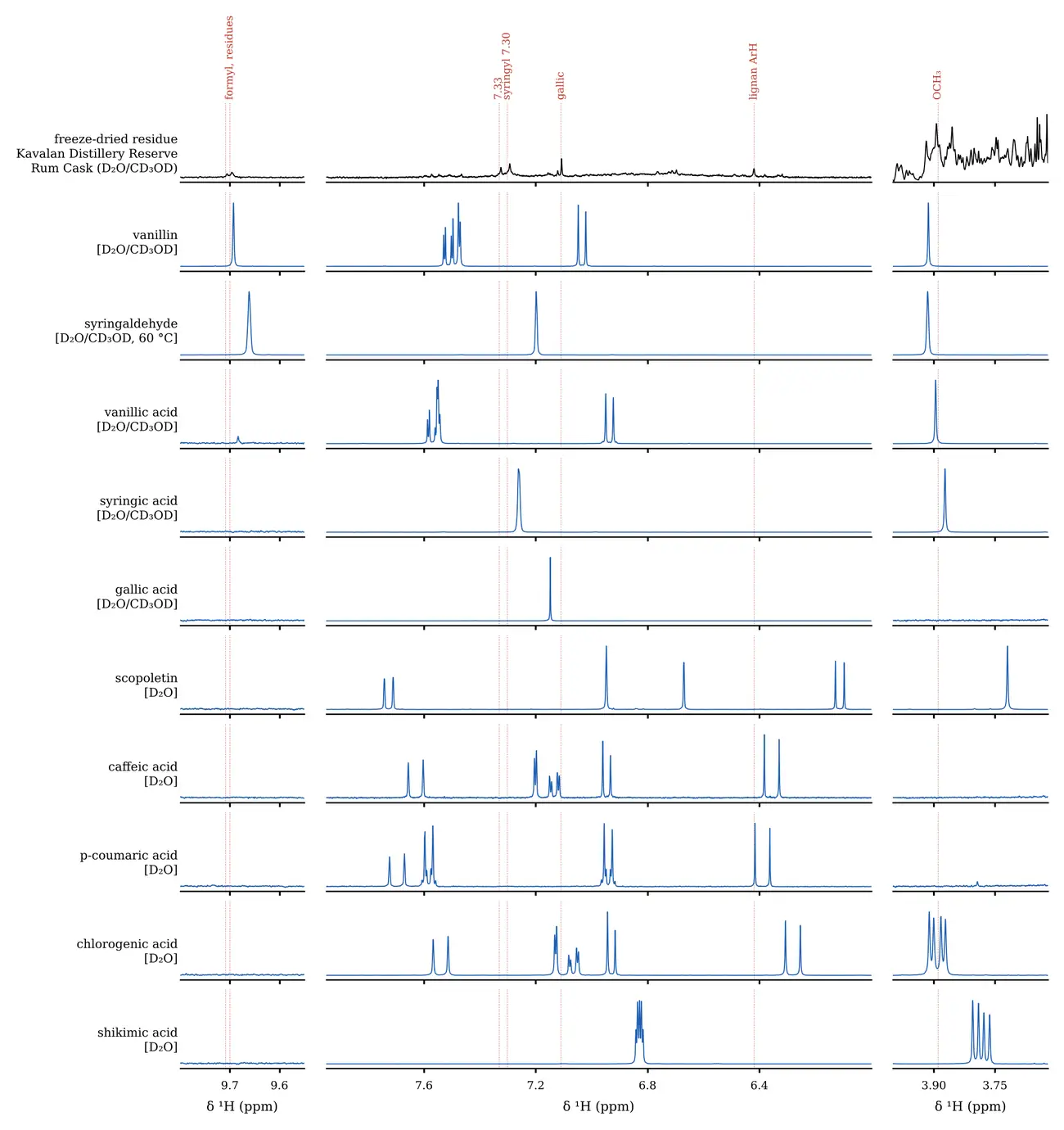
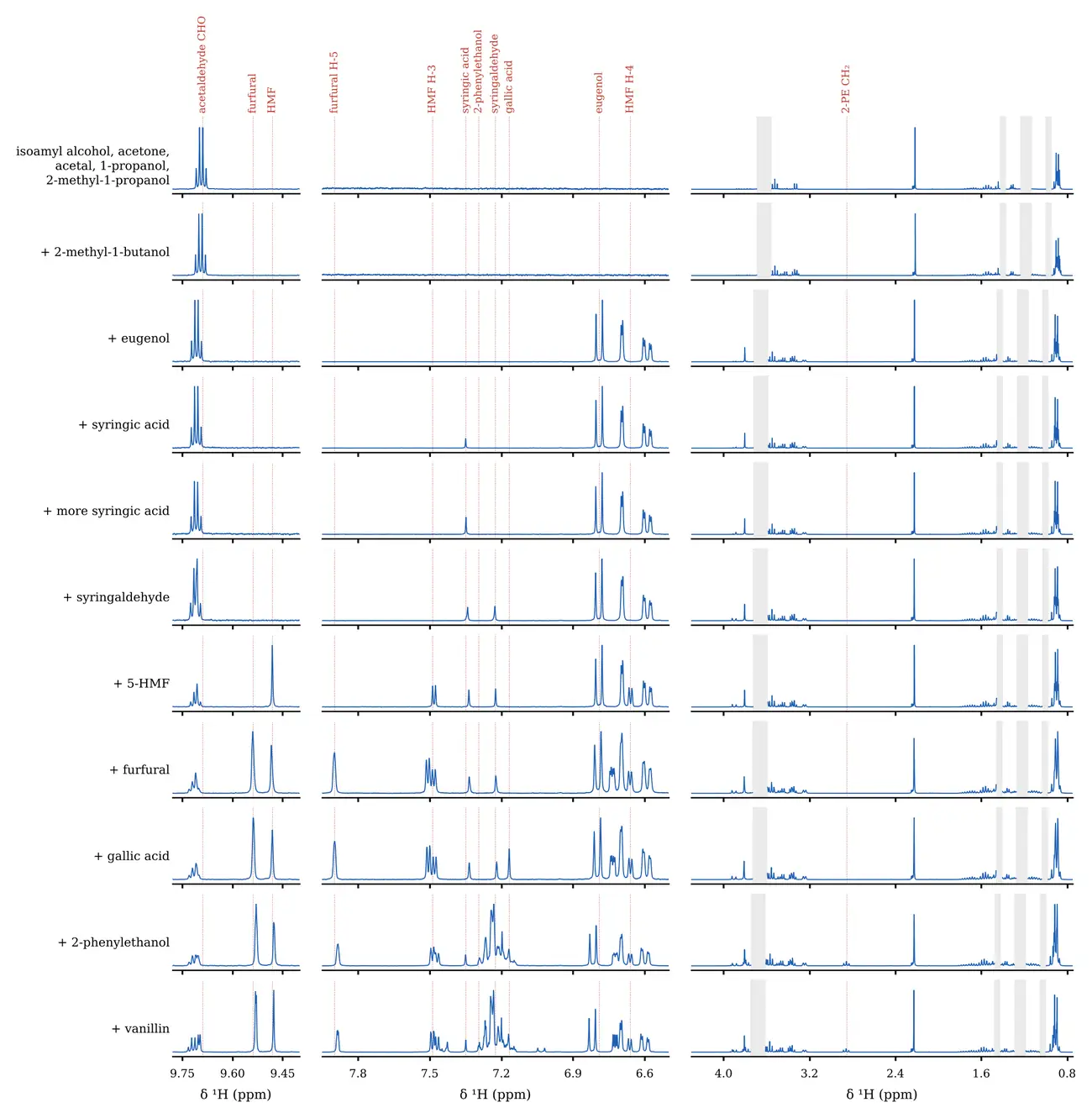
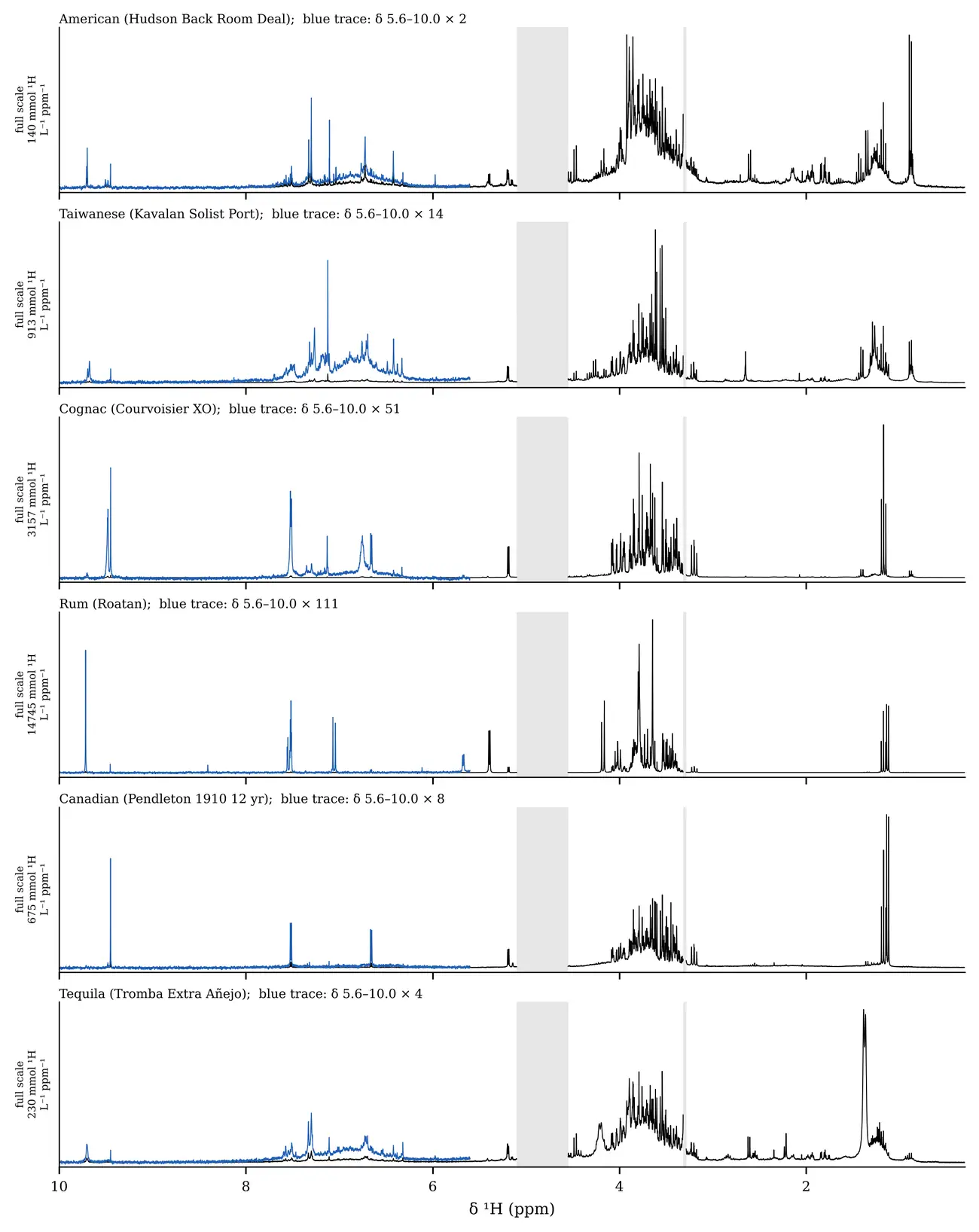
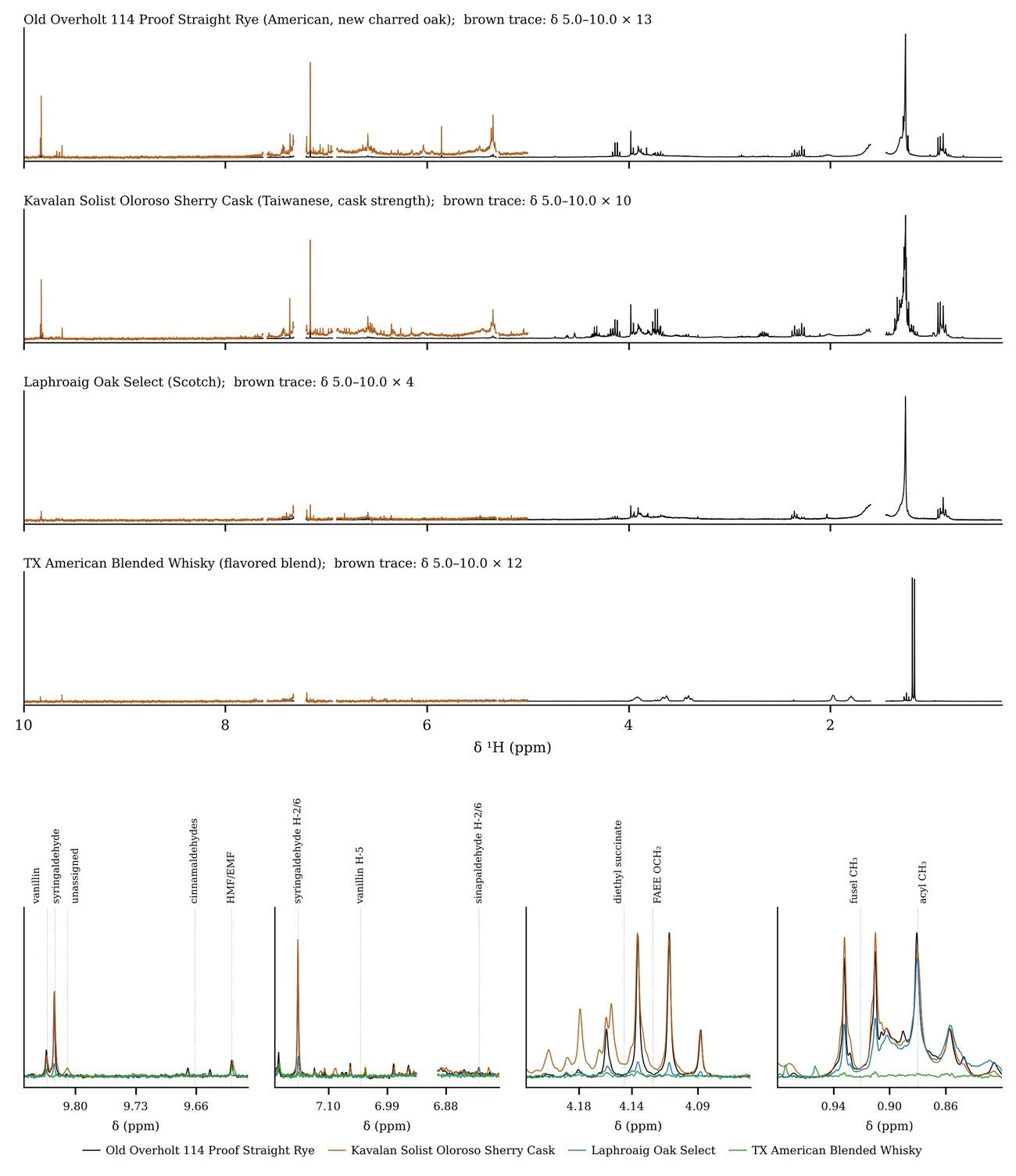
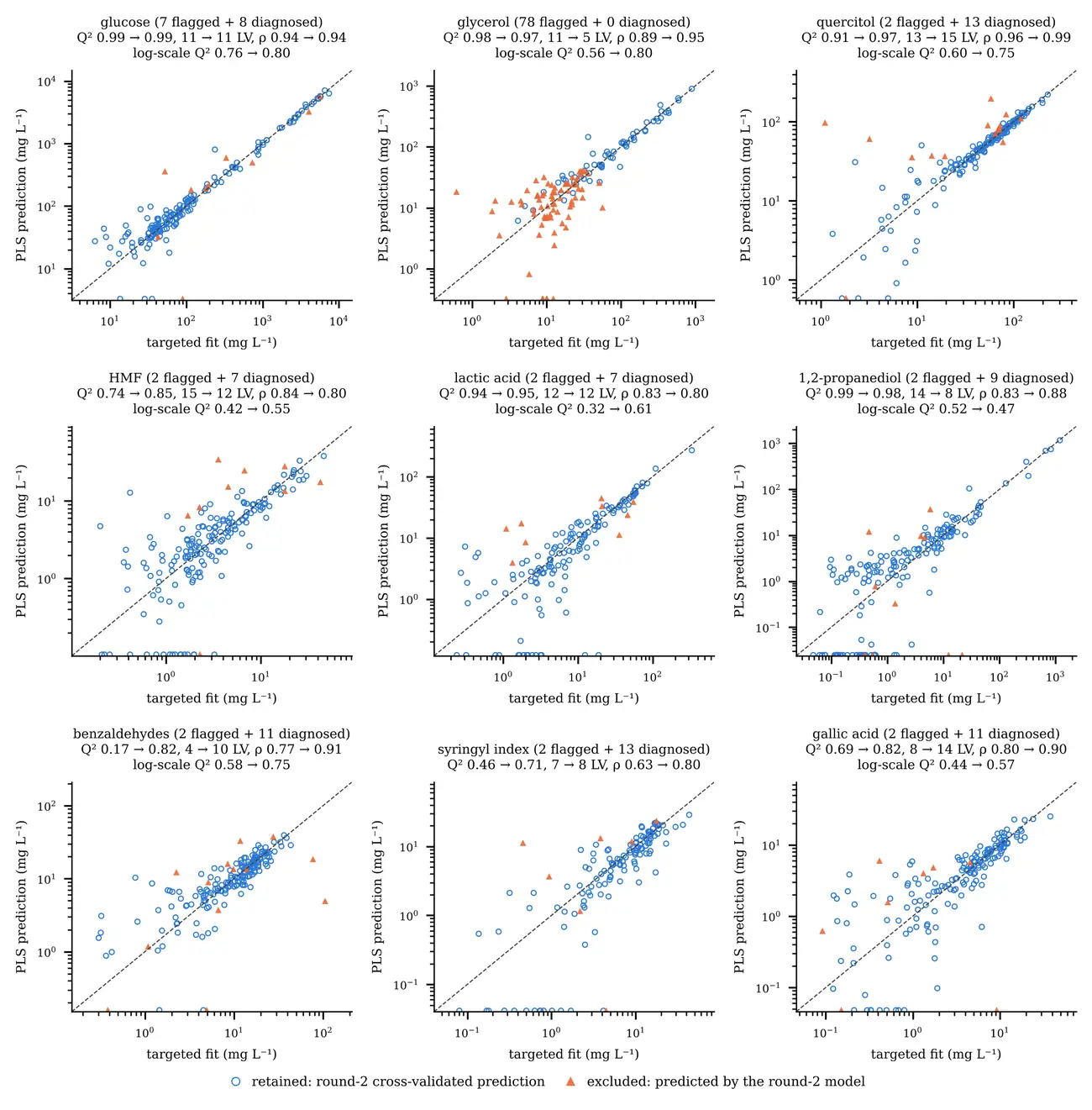
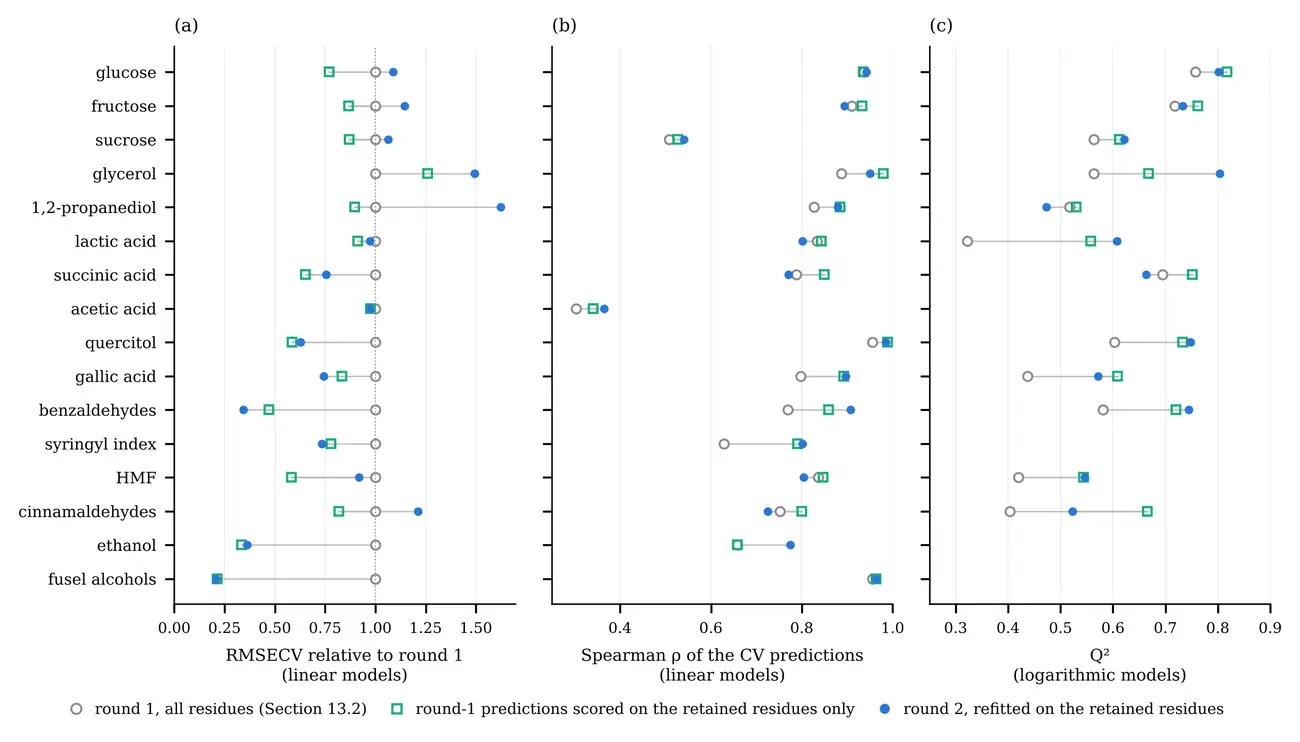
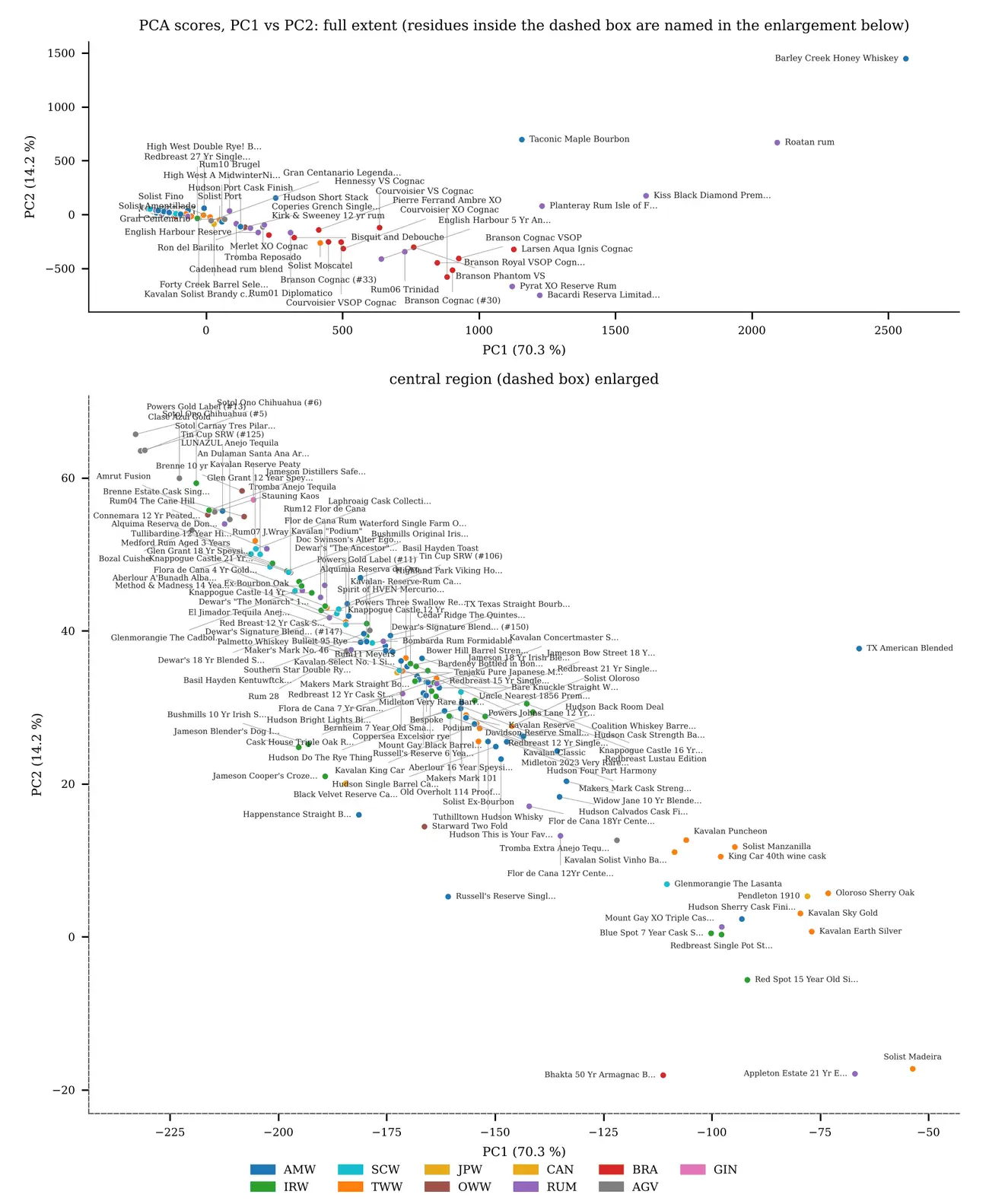
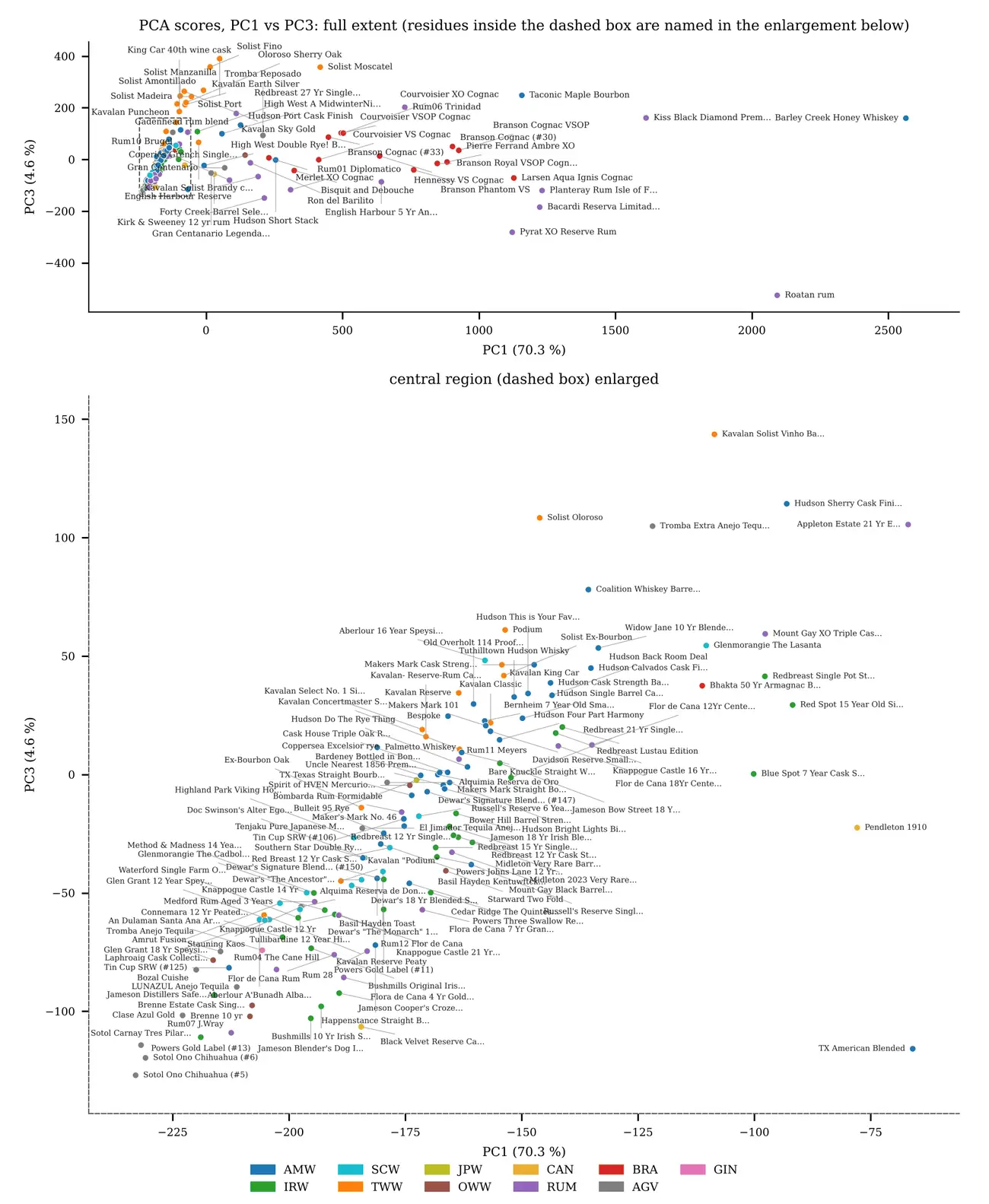
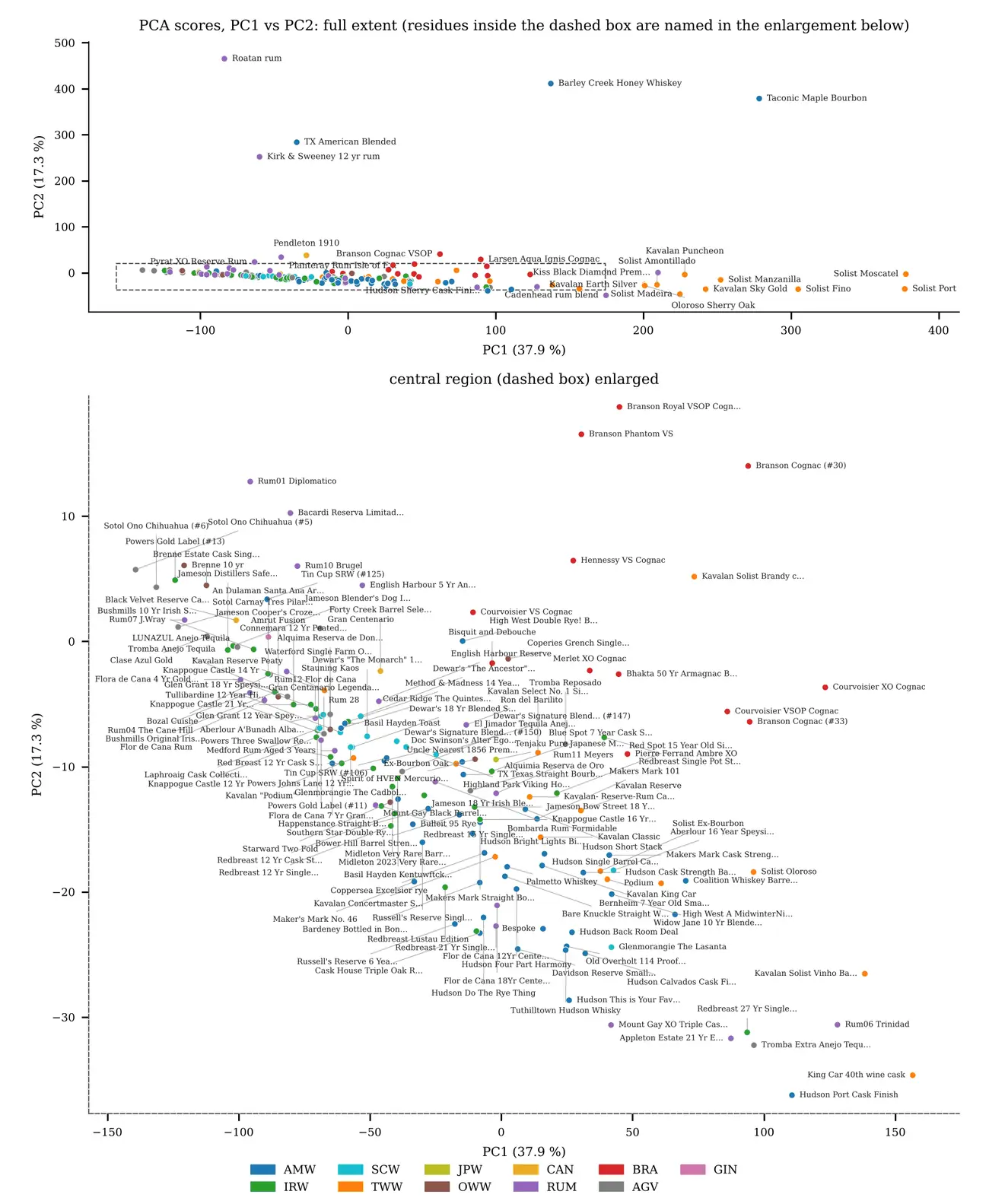
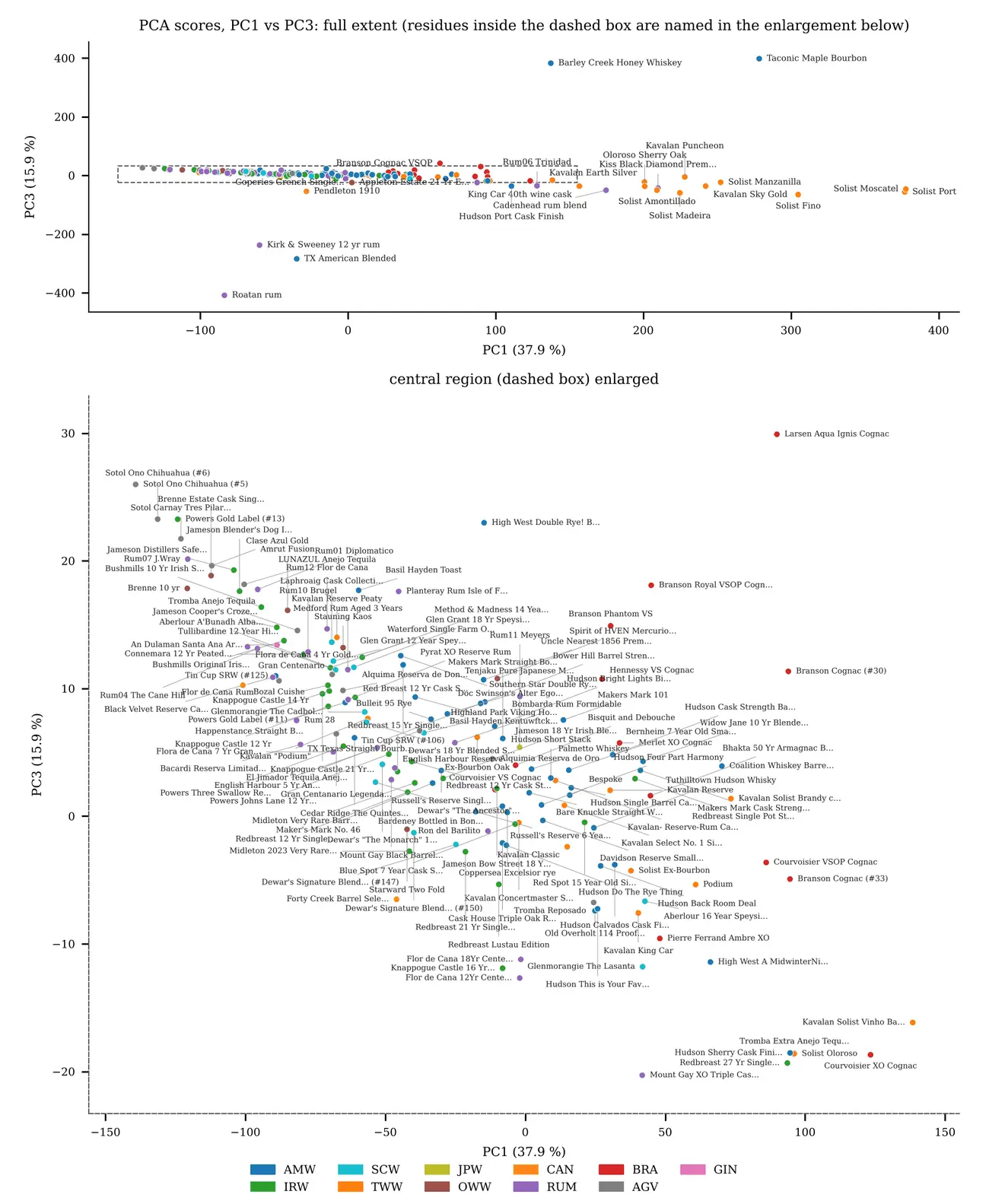
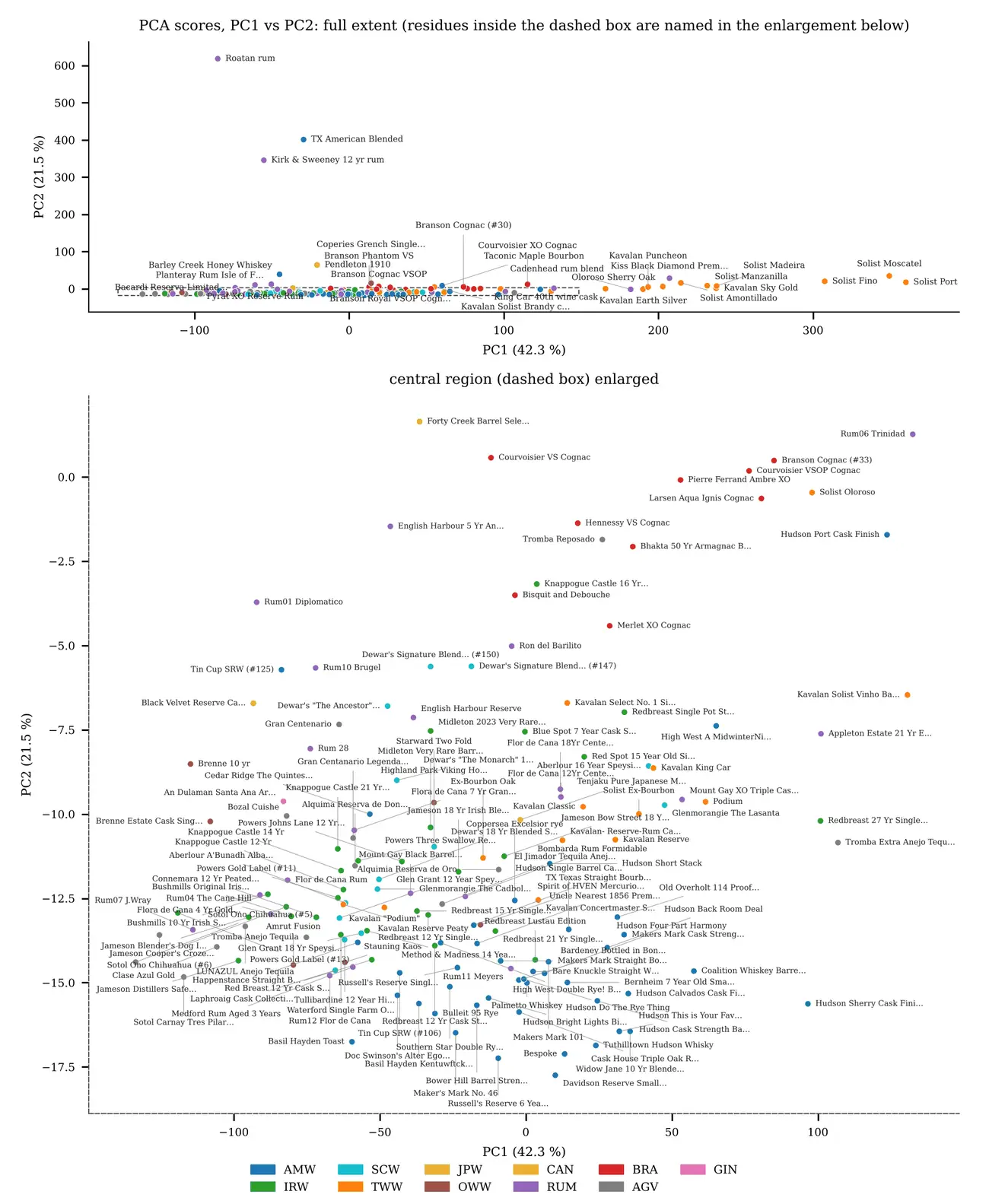
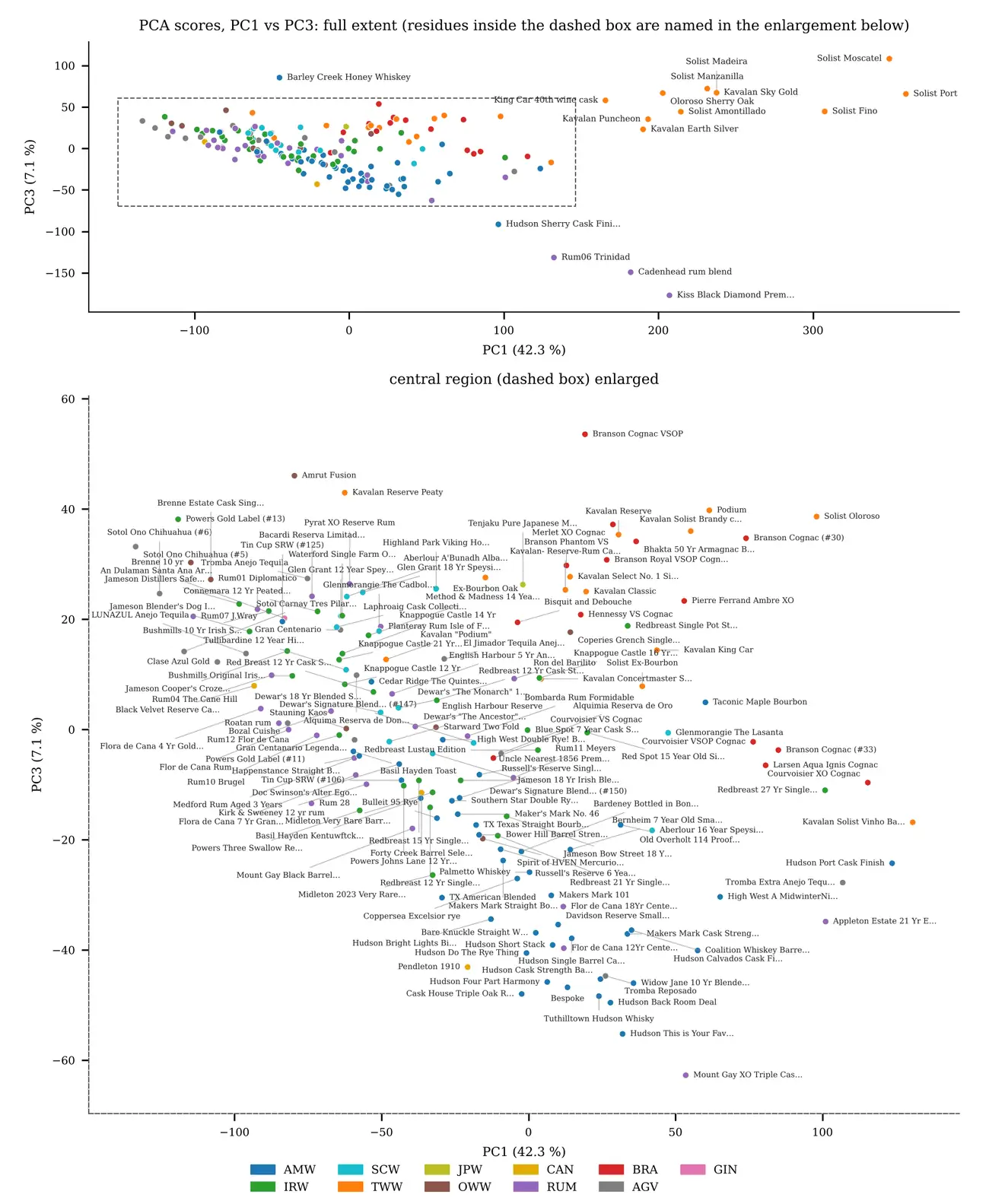
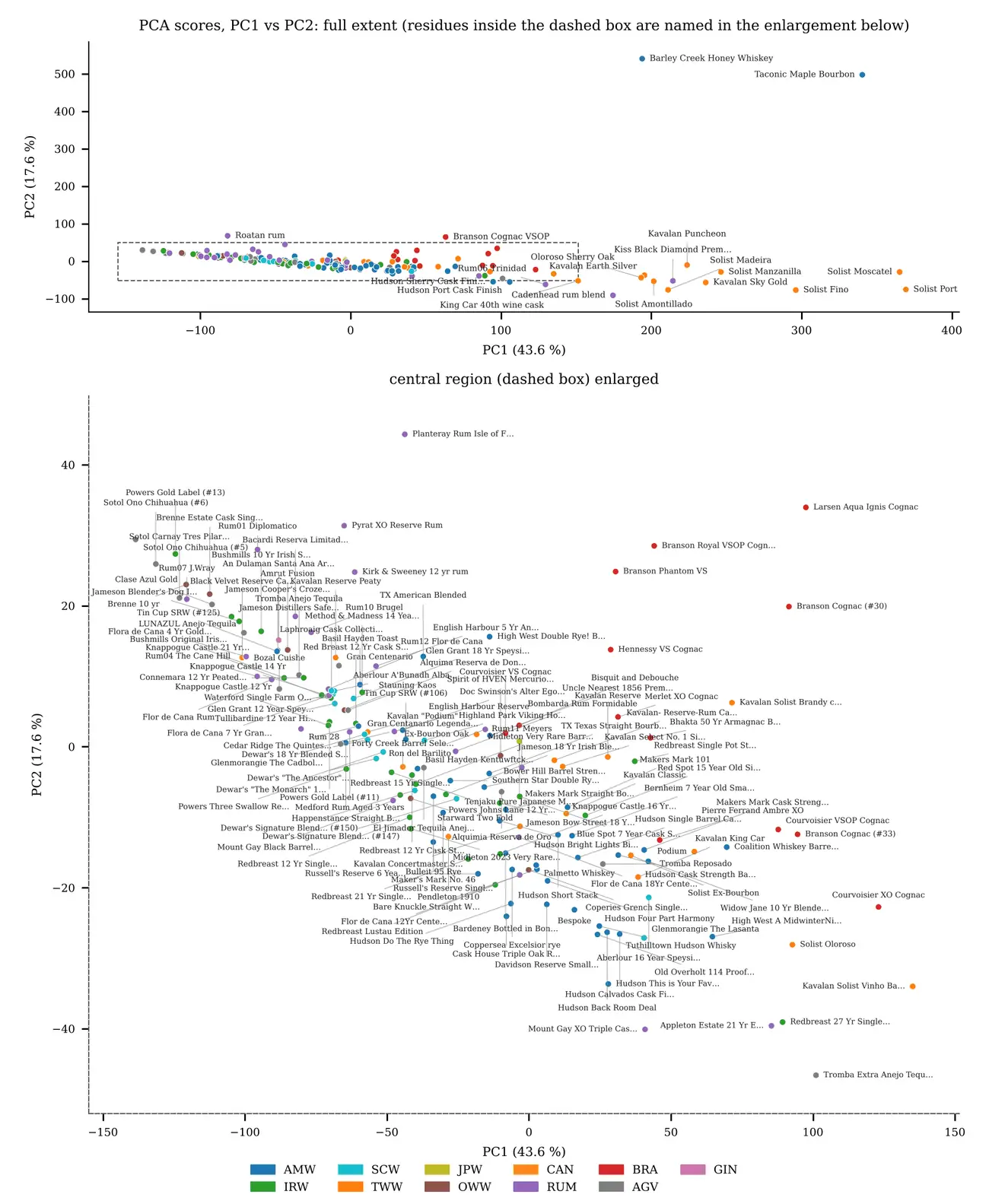
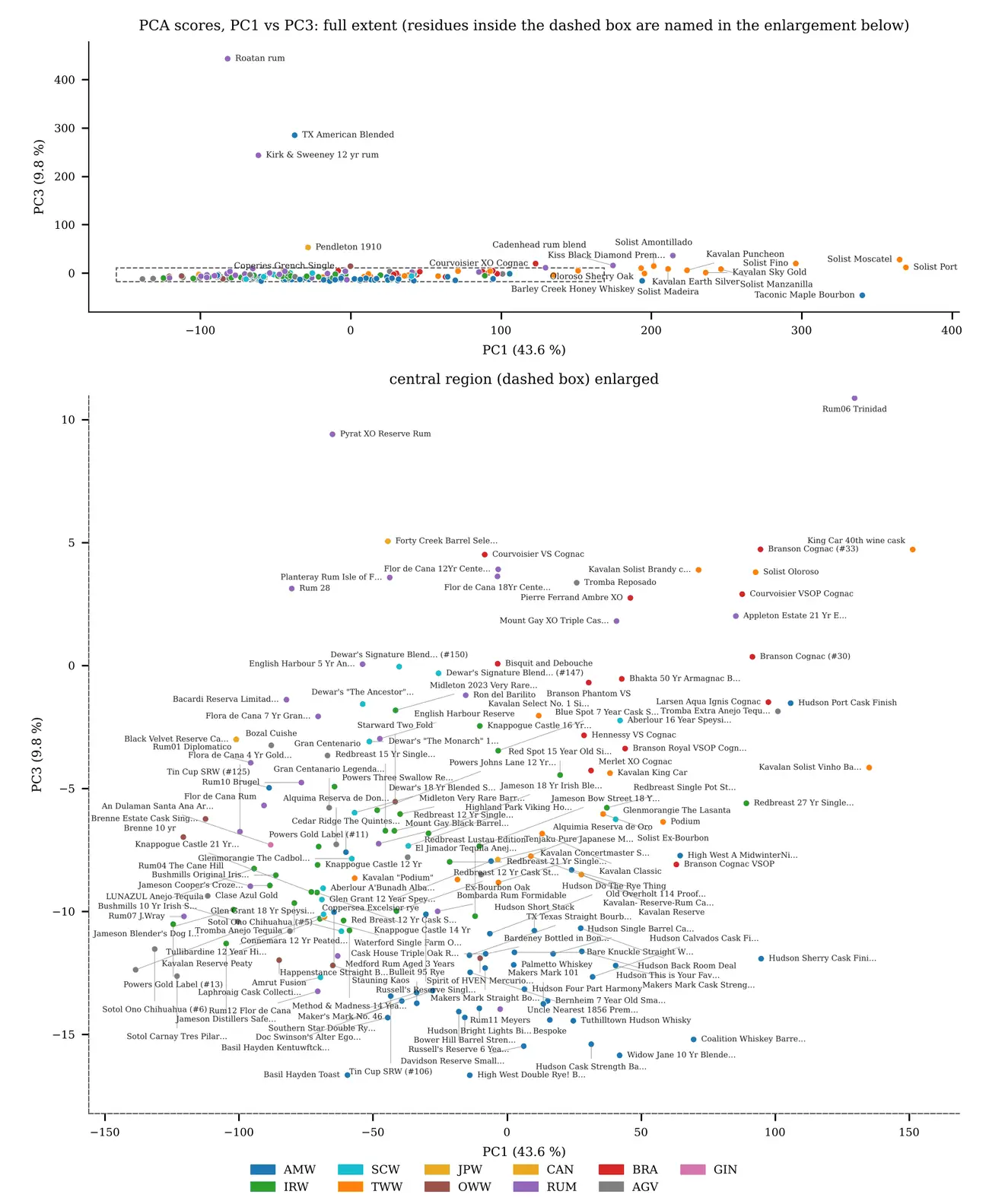
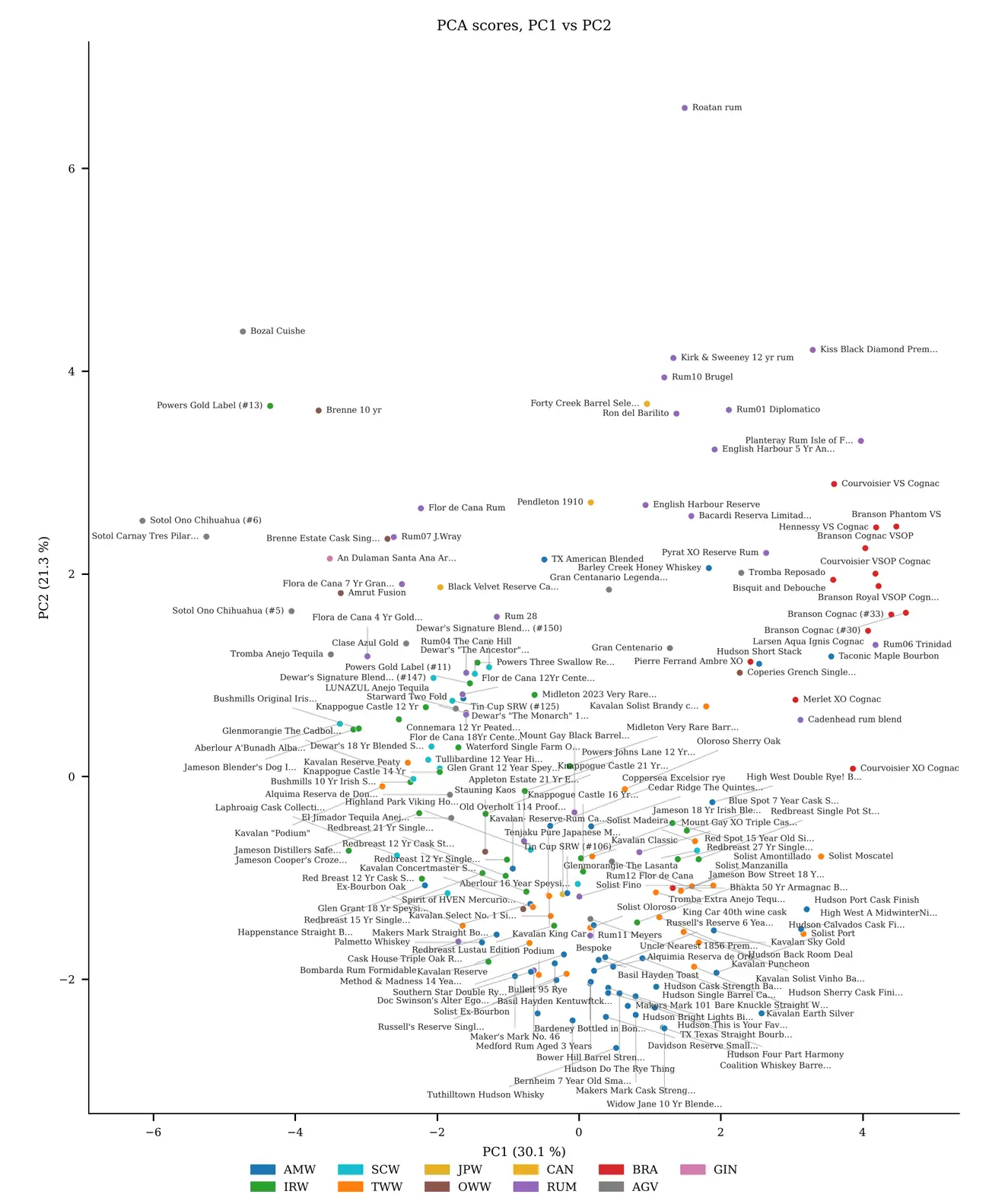
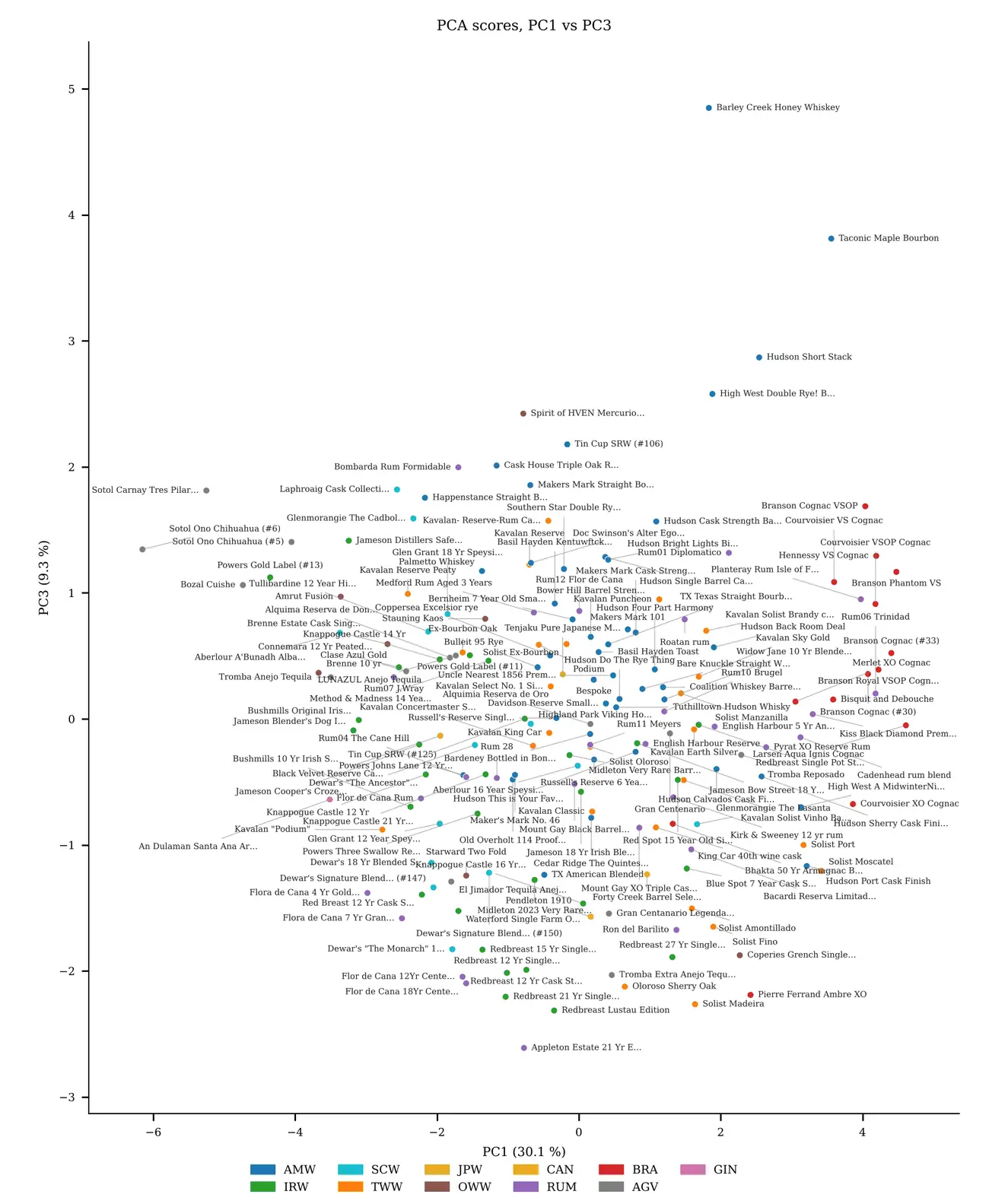
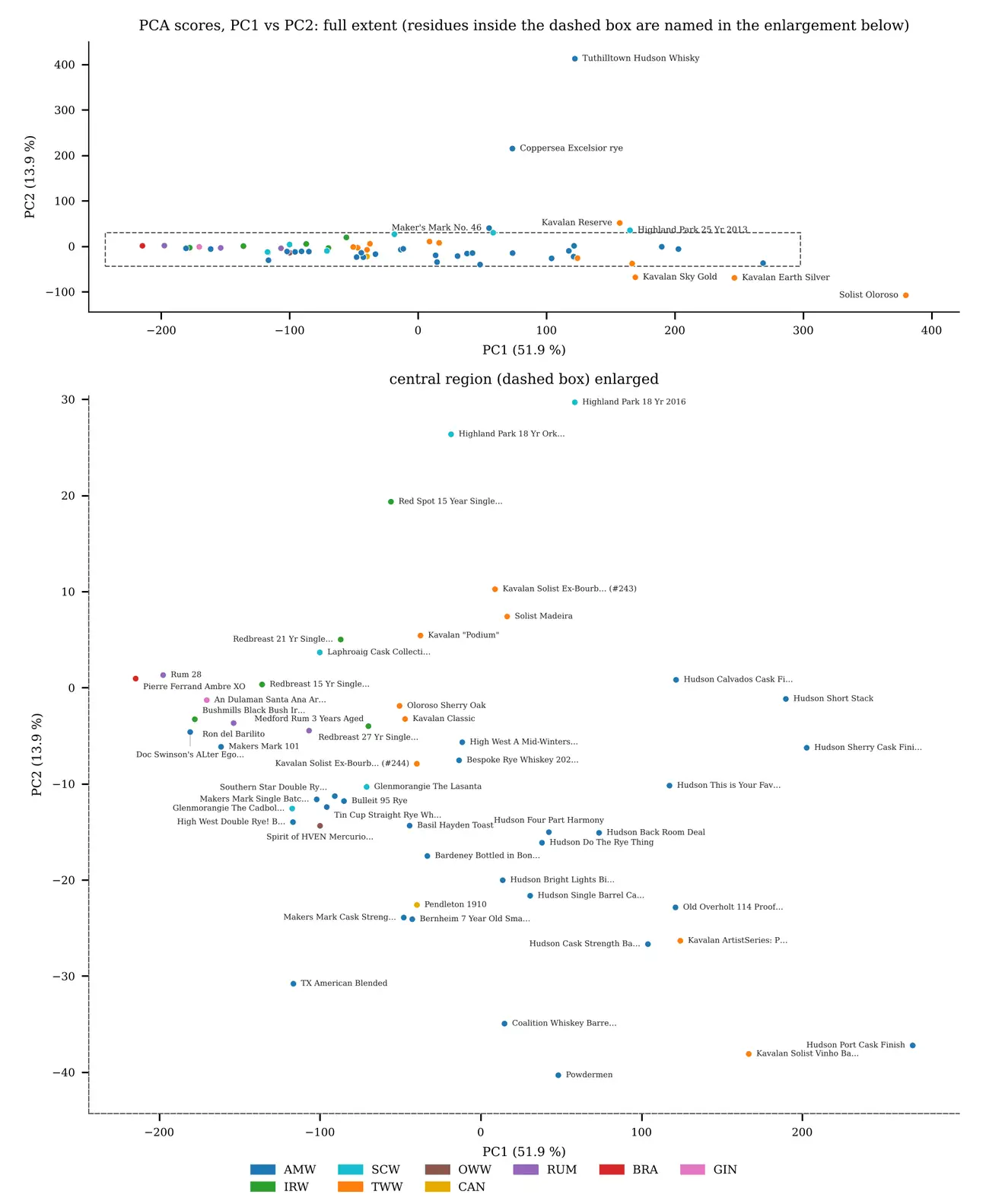
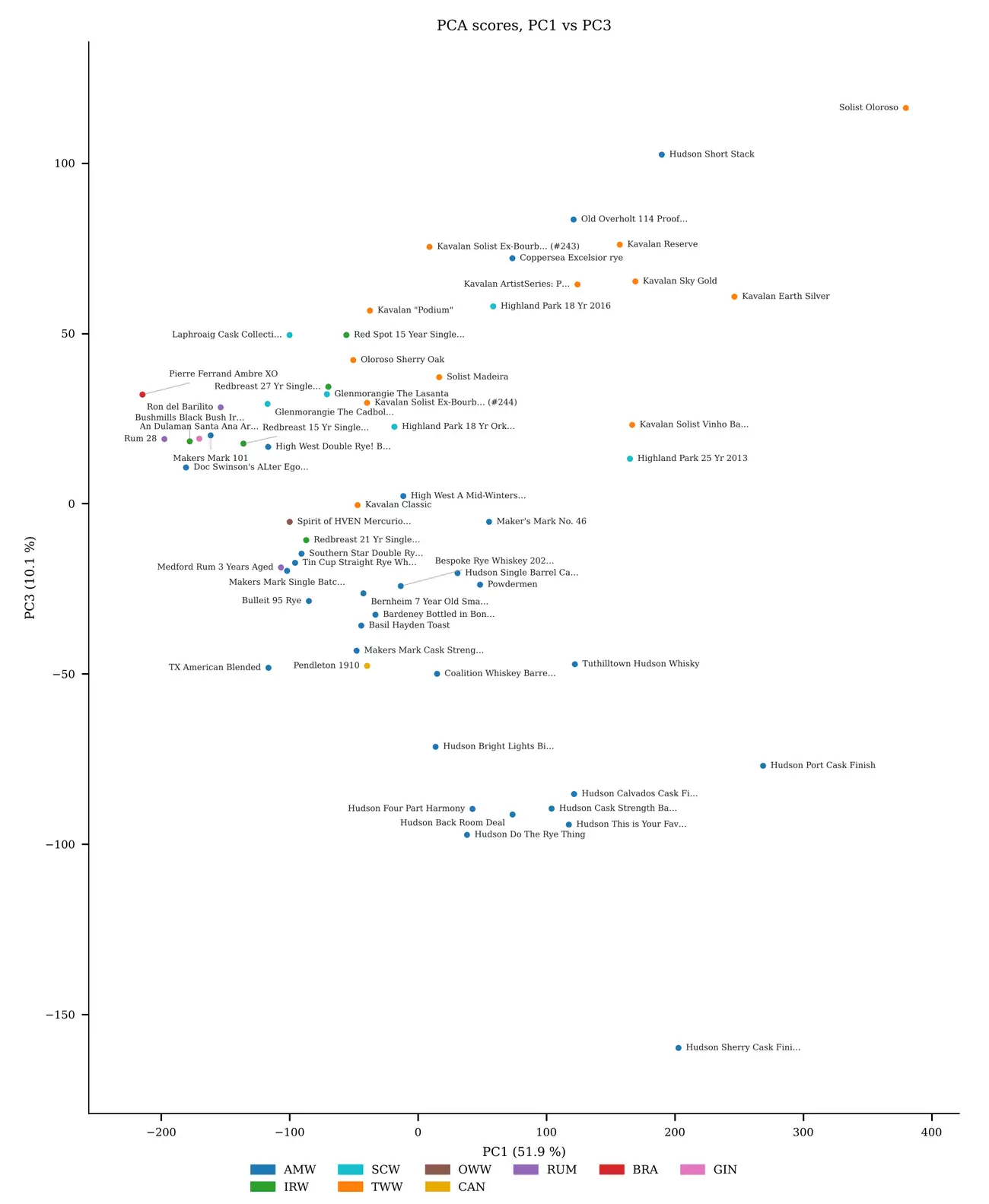
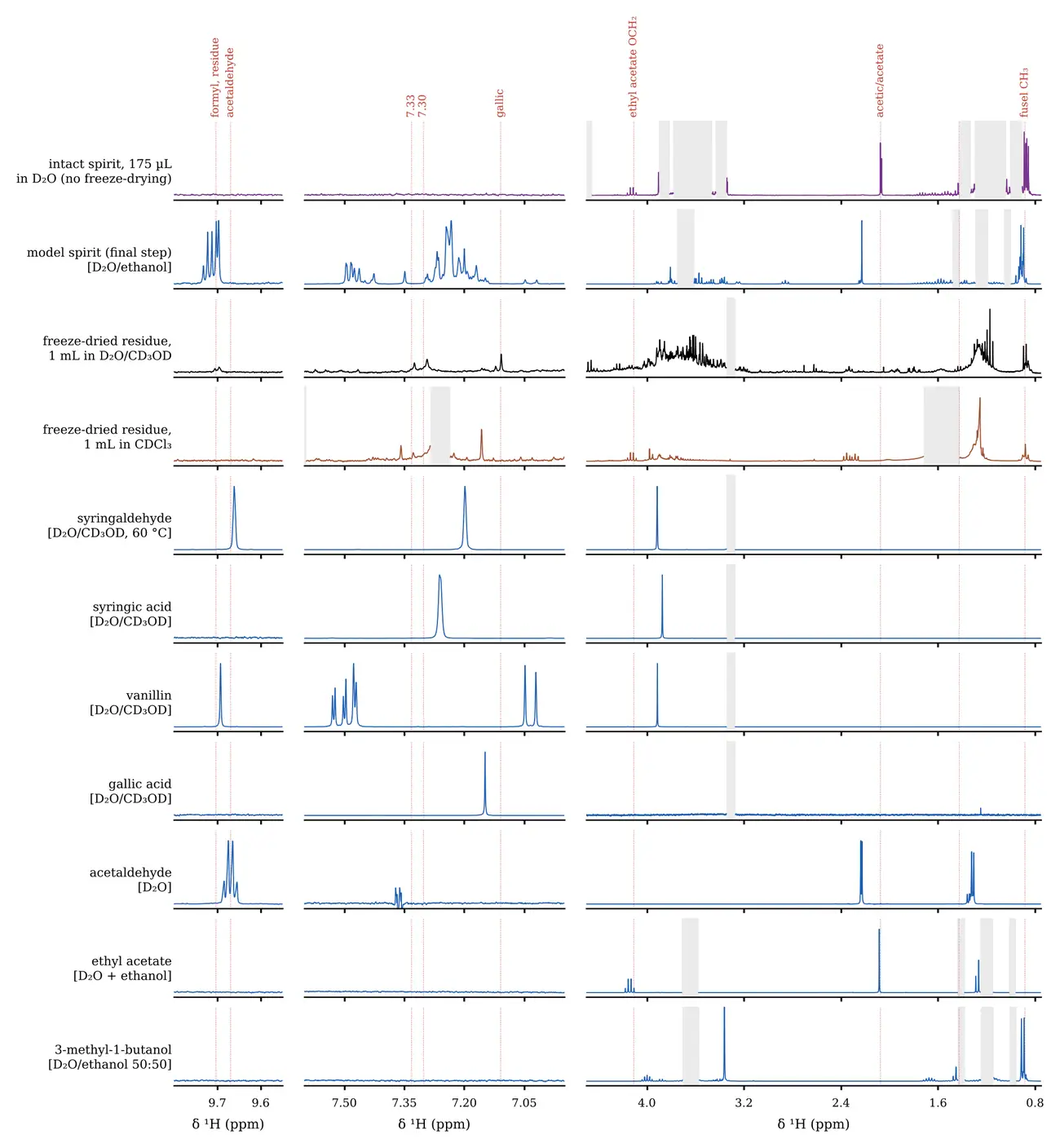
Version 2.3 adds reference spectra of 45 pure congeners (58 spectra in D₂O, D₂O/CD₃OD, D₂O/ethanol, CDCl₃ and DMSO-d₆) and an eleven-step model spirit, and compares them with an intact spirit and with the two residues of the same bottle. The volatile congeners that dominate the native spectrum, ethyl acetate, acetaldehyde, acetic acid and an unassigned singlet at δ 8.217, fell in the residue to at most 1.7 % of complete retention (acetaldehyde to at most 8.0 %), the fusel alcohols and ethanol survived only as trapped traces, and the oak aromatics, at the noise level in the intact spirit, rose by about the 8.4-fold expected from concentration and acquisition. The medium-chain ethyl esters gave strong spectra only in CDCl₃, whereas p-coumaric acid gave no spectrum in CDCl₃ at all, which is the reason for a second solvent. The reference positions agreed with the residues to within about 0.01 ppm for sugars and polyols in matching media, but the syringaldehyde ring protons appeared at δ 7.15–7.23 in every reference medium, 0.08–0.10 ppm upfield of the residue line assigned to them, so that this assignment now rests on its correlation with the formyl line and on its ¹³C shift rather than on its position. A second round of PLS calibrations, after the removal of 226 flagged and 226 diagnosed outliers from 28 models, showed that most of the apparent improvement came from no longer scoring the excluded residues; genuine gains on refitting were confined to the oak aromatics and to the logarithmic glycerol and lactic acid models, while the sugar models became worse. Every stacked spectral figure was redrawn with one vertical-scaling rule, and an Addendum gives full-page versions of the chemometric plots with every residue named.
Keywords: ¹H NMR; qNMR; external standard; absolute intensity; freeze-drying; whiskey; bourbon; rum; cognac; tequila; oak extractives; quercitol; sugars; arabinose; xylose; glycerol; 1,2-propanediol; lipids; DMSO-d₆; ellagic acid; chemometrics; hierarchical clustering; PLS; outliers; SVM; t-SNE; UMAP; time domain; HLSVD; reference spectra; model spirit
Document details and provenance
| Item | Detail |
|---|---|
| Document | PNA-WP-2026-FDSP-01, Version 2.3 (supersedes Version 2.2); file PNA-WP-2026-FDSP-01_v2.3_Freeze-Dried_Spirits_Absolute_1H_NMR.docx |
| Revision | Version 2.3 adds reference spectra of 45 pure congeners (58 spectra) and an eleven-step model spirit, compared with an intact spirit and its residues (Sections 2.8–2.11); redraws every stacked spectral figure with one vertical-scaling rule (Section 4.17); adds a second round of PLS calibrations after the removal of flagged and diagnosed outliers (Section 13.5); and adds an Addendum of full-page chemometric plots with every residue named. Version 2.2 corrected two errors of the absolute scale: the 90° pulse is 13 µs (author's calibration), not the 10 µs stored in the parameter sets, so the 8 µs and 7 µs pulses were 55.4° and 48.5° rather than 72° and 63°; and the maleic acid standard contained 95 % of its nominal content (author's determination), so every earlier concentration was 5.3 % too high. Every absolute intensity, saturation correction and concentration was recalculated, with the maleic acid T₁ of 6.1 s (Section 5.9). Version 2.1 added the DMSO-d₆ residues, the pentoses and corrected glucose, and the full chemometric accounting. |
| Title | Absolute-Intensity ¹H NMR of Freeze-Dried Spirit Residues — Polar (D₂O/CD₃OD), Lipophilic (CDCl₃) and Whole-Residue (DMSO-d₆) Congeners of Whiskeys, Bourbons, Rums, Brandies and Agave Spirits: External-Standard qNMR, Chemometrics and Time-Domain Analysis |
| Author | John C. Edwards, Ph.D., Process NMR Associates, LLC, 84 Patrick Lane, Ste 115, Poughkeepsie, NY 12603 |
| Date | October 23, 2026 |
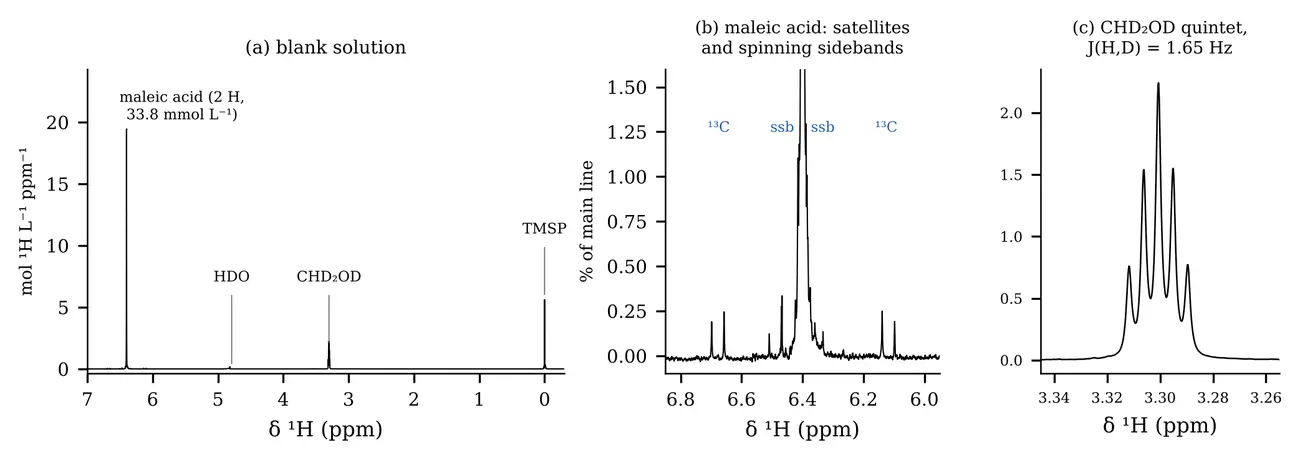
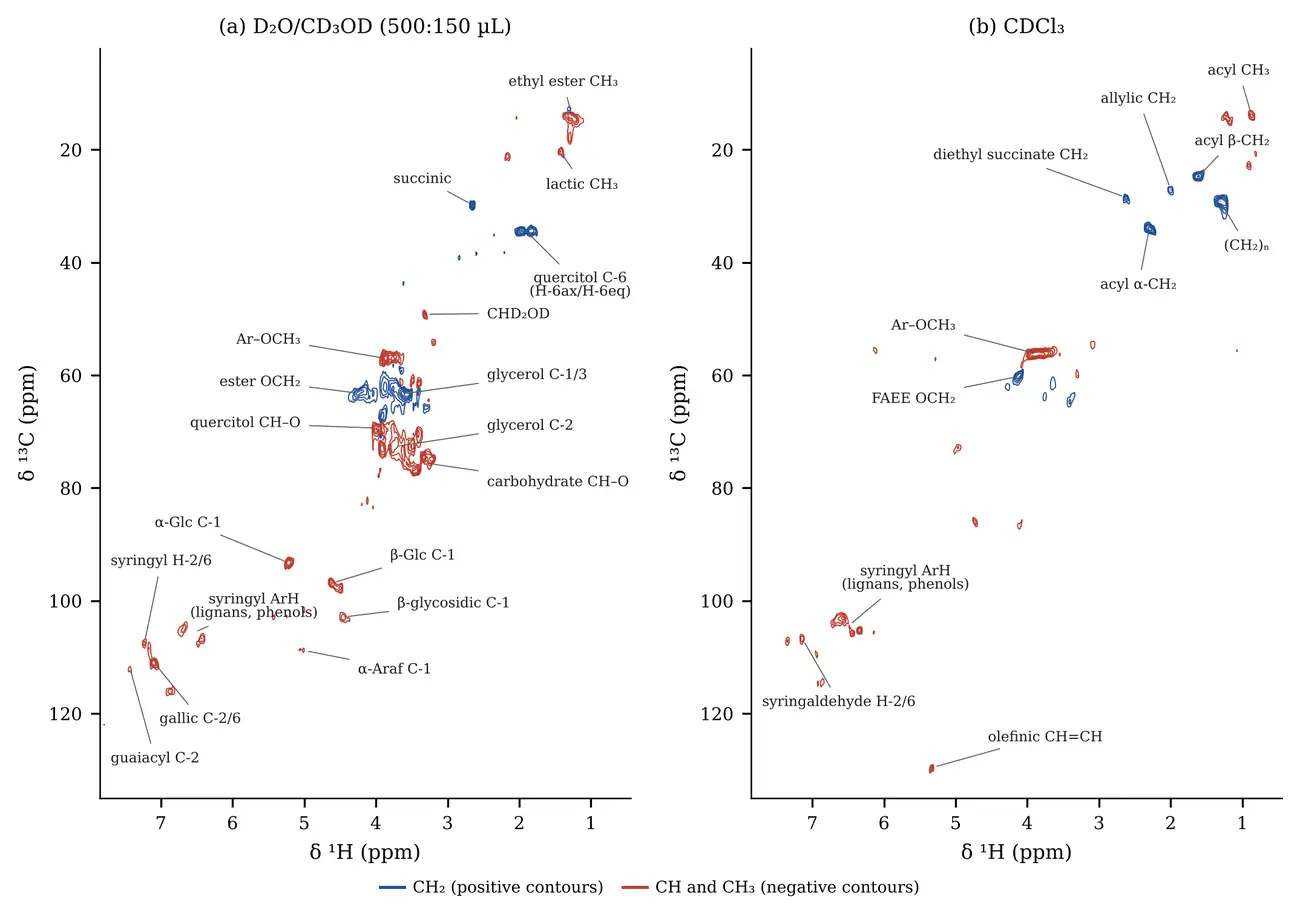
| Data | Four MestReNova documents of ¹H spectra of freeze-dried residues at 299.99 MHz (first D₂O set, 101 spectra; second D₂O set, 113; first CDCl₃ set, 39; second CDCl₃ set, 22), one MestReNova document of ¹H spectra of DMSO-d₆ residues (30 titles, 29 acquisitions), one external-standard blank (2.55 mg maleic acid with TMSP in 500 µL D₂O + 150 µL CD₃OD; effective maleic acid content 95 % of the weighed amount, author's determination; maleic acid T₁ 6.1 s, author's value; 90° pulse 13 µs, author's calibration) two documents of gHSQC, J-resolved, ¹H and DEPT-45 spectra of a concentrated Kavalan Solist Vinho Barrique residue, and one MestReNova document of reference spectra of pure congeners (58 spectra of 45 compounds in D₂O, D₂O/CD₃OD, D₂O/ethanol, CDCl₃ and DMSO-d₆), an eleven-step model spirit and one intact spirit |
| Companion files | PNA-WP-2026-FDSP-01_v2.3_companion_data.xlsx (sample list, absolute quantitation in all three solvents, pentoses and corrected glucose, cross-solvent recoveries, chemometric inputs and outputs of every data approach, matched-product comparisons, PLS calibrations of both rounds with every excluded residue and the reason for its exclusion, the reference library of congener shifts, validation and time-domain checks) and PNA-WP-2026-FDSP-01_v2.3_3D_scores.xlsx (three-dimensional scores of every data approach, with the PLS exclusions of each residue) |
| Software | Python 3.13 (NumPy 2.5, SciPy 1.18, pandas 3.0, scikit-learn 1.9, umap-learn 0.5, Matplotlib 3.11); purpose-written decoder for MestReNova documents; document assembled with docx 9.8 (Node.js) |
| AI assistance | claude-opus-5-5 (as configured; the serving model may differ), Anthropic |
This white paper was prepared with AI assistance. The recovery of the spectra and decays from the MestReNova documents, the absolute scaling, the targeted quantitation, the chemometric and time-domain analyses, the figures and tables and a draft of the text were produced by the AI model named above under the direction of the author, from the author's NMR data. All numerical results in the text are generated by code from those data, and the references were checked against their bibliographic records before use. The interpretation, the conclusions and the responsibility for the content rest with the author.