
Process NMR Associates, LLC
Technical White Paper — PNA-WP-BERBERINE-NMR-001
Nuclear Magnetic Resonance Spectroscopy for the Characterization, Quantification, and Source Authentication of Berberine and the Protoberberine Alkaloids
John C. Edwards, Ph.D.
Principal Scientist, Process NMR Associates, LLC
84 Patrick Lane, Suite 115, Poughkeepsie, NY 12603
john@process-nmr.com • www.process-nmr.com
Abstract
Berberine, a quaternary protoberberine alkaloid of the isoquinoline class, occupies a prominent position in the global dietary-supplement market on the strength of reported hypoglycemic, hypolipidemic, and antimicrobial activities. The expanding commercial demand for the molecule, coupled with the increasing availability of chemically synthesized material, has created economic incentives for the misrepresentation of botanical-origin claims and for the marketing of preparations whose declared content is not met. This white paper provides a comprehensive technical account of the application of nuclear magnetic resonance (NMR) spectroscopy to the structural characterization, quantification, and source discrimination of berberine and its co-occurring protoberberine relatives. The isoquinoline framework, the quaternary iminium architecture, the methylenedioxy and dimethoxy substitution pattern, and the relationship of berberine to palmatine, jatrorrhizine, columbamine, coptisine, berberrubine, and the reduced congeners canadine and dihydroberberine are reviewed in the context of their spectroscopic consequences. Complete ¹H and ¹³C resonance assignments are compiled from the verified literature, the diagnostic value of the iminium H-8 singlet, the methylenedioxy singlet, and the two methoxy singlets is emphasized, and the two-dimensional correlation strategies required for unambiguous assignment are described. Quantitative ¹H NMR (qNMR) methodology for content and purity determination is detailed, including internal-standard selection, the choice of integration windows free of overlap, and cross-validation against high-performance liquid chromatography. The strategic question of source authentication is then addressed. The co-alkaloid impurity fingerprint is presented as the validated, instrument-accessible route to discrimination of botanical origin and of natural versus synthetic material, and the prospective use of site-specific natural-abundance ¹³C isotopic analysis is critically evaluated. The latter approach is presented as mechanistically plausible but not yet demonstrated for berberine, and the analytical demands that would govern any such validation are set out explicitly. Measured ¹H, ¹³C, and gradient-selected HSQC spectra of a reference berberine chloride hydrate, together with a direct comparison against a commercial supplement, are presented to anchor the assignments and to illustrate the matrix complexity confronting real-world analysis. Instrumentation is described throughout on the Varian platform.
(In Microsoft Word, select all and press F9, or right-click and choose “Update Field,” to populate page numbers.)
1. Introduction and Scope
The protoberberine alkaloids constitute a structurally coherent family of nitrogen heterocycles biosynthesized along the benzylisoquinoline pathway, and berberine is the most widely encountered and commercially significant member of the class. Interest in the molecule has grown considerably over the past two decades, driven by a body of clinical and preclinical work reporting anti-diabetic, hypolipidemic, antimicrobial, anti-inflammatory, and antineoplastic activities. A broad spectrum of biological action has been documented in the contemporary review literature, and the consequent demand for berberine-containing dietary supplements has been substantial.
The same commercial momentum that has made berberine a high-volume nutraceutical has also created the conditions under which authentication becomes a regulatory and analytical concern. Two distinct problems arise. The first is the routine quality-control question of whether a marketed preparation contains the quantity of berberine declared on its label; the published record indicates that this expectation is frequently not met.[1] The second, and the principal subject of the strategic sections of this paper, is the question of provenance: whether material represented as plant-derived is in fact of botanical origin, and whether a given botanical claim is consistent with the alkaloid profile of the named source. The increasing availability of synthetically prepared berberine, which can be produced at a cost competitive with extraction from plant material, sharpens the economic incentive for the substitution that authentication methods are intended to detect.
Nuclear magnetic resonance spectroscopy is well suited to both problems. The technique is non-destructive, requires minimal sample preparation, and yields a signal whose integrated area is directly proportional to the number of contributing nuclei, so that quantification can be achieved without compound-specific response factors and, under appropriate conditions, without an identical reference material.[2,3] The present account addresses the chemistry and structure of berberine, its biosynthesis and natural sources, its purification and chemical synthesis, its complete NMR characterization, quantitative NMR methodology, and the spectroscopic basis for source discrimination. Throughout, instrumentation is described on the Varian platform, and the discussion is confined to references whose bibliographic metadata have been verified.
2. Chemistry and Structure of Berberine
2.1 The isoquinoline framework and the quaternary iminium architecture
Berberine is a pentacyclic quaternary protoberberine alkaloid with the molecular formula C20H18NO4 for the cation, corresponding to a cation mass of 336.1236 that is routinely confirmed by high-resolution electrospray mass spectrometry.[4] The skeleton comprises a dibenzo[a,g]quinolizinium core in which two aromatic rings (designated rings A and D in the protoberberine convention) are joined through a central quinolizinium system bearing a formal positive charge on the ring nitrogen. The defining structural feature, and the one of greatest spectroscopic consequence, is the fully aromatic isoquinolinium moiety: the nitrogen is quaternary and is incorporated into an extended, planar, electron-deficient π system rather than existing as a basic amine. Berberine is therefore a permanent cation under all ordinary conditions and is encountered as a salt rather than as a free base.
Ring A carries a methylenedioxy group (the O–CH2–O bridge spanning C-2 and C-3 in the numbering adopted here), while ring D carries two adjacent methoxy substituents at C-9 and C-10. The combination of an aromatic methylenedioxy ring, a dimethoxy aromatic ring, an electron-poor iminium-bearing ring, and a partially saturated ring containing the C-5 and C-6 methylene pair gives berberine a small number of highly characteristic and well-separated proton environments. As will be developed in Section 5, it is precisely this dispersion of diagnostic singlets that makes the molecule unusually amenable to both qualitative identification and quantitative measurement by ¹H NMR.
2.2 Tautomeric and solvent-dependent behavior; solubility
Although the quaternary iminium nitrogen precludes the prototropic tautomerism available to neutral isoquinoline alkaloids, berberine is nonetheless sensitive to its chemical environment. The position C-8, which bears the iminium proton, is electrophilic, and nucleophilic addition of solvent or hydroxide at this center generates pseudobase (8-substituted dihydroberberine) species under basic or strongly nucleophilic conditions. This reactivity has practical analytical consequences: berberine chloride dissolved in dimethyl sulfoxide has been reported to degrade within the first hours after preparation, whereas in deuterated methanol it is appreciably more stable over the timescale of a routine measurement.[5] The choice of deuterated solvent for NMR is therefore not merely a matter of chemical-shift referencing but bears directly on sample integrity.
The solubility behavior of berberine is dominated by its cationic character and by the identity of the counter-ion. Berberine chloride is the salt most commonly encountered, and the published crystallographic and physicochemical work on berberine salts documents both the slight hygroscopicity of the chloride and the markedly different solubilities of alternative salt forms.[6] These differences underlie the classical purification routes discussed in Section 4 and also bear on the correct expression of analytical results, since the mass of “berberine” reported depends on whether the cation or a specific salt is intended.
2.3 The protoberberine class and berberine’s structural relatives
Berberine does not occur in isolation in plant material. It is one node in a biosynthetic network of structurally similar quaternary protoberberines, and the identities and relative proportions of its congeners are central to the authentication argument developed later. The closest relatives differ from berberine only in the substitution pattern of rings A and D. Palmatine replaces the ring-A methylenedioxy bridge of berberine with two methoxy groups, so that palmatine carries four methoxy substituents in total; this single structural difference produces the two additional aromatic methoxy singlets that distinguish palmatine from berberine in the ¹H spectrum.[4] Jatrorrhizine and columbamine are demethylated/hydroxylated analogues differing in the oxygenation of ring D, and coptisine carries methylenedioxy bridges on both rings A and D.
Berberrubine is the 9-O-demethyl derivative of berberine, bearing a hydroxyl in place of the C-9 methoxy group. The structural difference is confined to a single position, yet it produces a measurable rearrangement of the proton resonances in the vicinity of that center and a pronounced difference in biological behavior, a point established by detailed two-dimensional NMR study of the two compounds.[7] The reduced congeners are also relevant: dihydroberberine carries a reduced C-7/C-8 region and is encountered both as a bioconversion product and as a more bioavailable supplement ingredient, while tetrahydroberberine (canadine) is the fully reduced, non-quaternary, stereogenic precursor that immediately precedes berberine in the biosynthetic sequence. The systematic spectroscopic relationships across the quaternary protoberberine class have been comprehensively reviewed.[8] The practical consequence for authentication is that the protoberberine “neighborhood” of a berberine sample—which congeners are present, and in what ratios—constitutes a chemically meaningful signature that is accessible to NMR.
3. Biosynthesis and Natural Sources
3.1 The tyrosine-derived benzylisoquinoline pathway
Berberine arises from the benzylisoquinoline alkaloid pathway, which originates from two molecules of L-tyrosine. One tyrosine-derived unit is processed to dopamine and the other to 4-hydroxyphenylacetaldehyde; their condensation, catalyzed by norcoclaurine synthase, yields (S)-norcoclaurine, the committed entry point to the benzylisoquinoline alkaloids. A sequence of O- and N-methylations and a hydroxylation converts (S)-norcoclaurine to (S)-reticuline, the central branch-point intermediate of the entire class.
The transformation that defines the protoberberine skeleton is the oxidative cyclization of the N-methyl group of (S)-reticuline to form the berberine bridge, generating the new C–C bond (the C-8 methine carbon in the mature alkaloid) and producing (S)-scoulerine. This reaction is catalyzed by the berberine bridge enzyme, a covalently flavinylated oxidase whose mechanism and structure have been characterized in detail.[9,10,11] Subsequent methylenedioxy-bridge formation, O-methylation, and oxidation steps proceed through (S)-tetrahydrocolumbamine and (S)-canadine (tetrahydroberberine) to berberine itself, the final aromatization being effected by the (S)-tetrahydroprotoberberine oxidase system. The mechanistic significance of the berberine-bridge step for the prospective isotopic-authentication discussion is noted here and developed in Section 8: enzymatic C–C bond formation is the kind of step expected to impose a position-specific isotopic signature on the resulting carbon.
3.2 Principal botanical sources and their marker alkaloids
Berberine is distributed across several botanical families but is concentrated, for commercial purposes, in a small number of genera. Species of Berberis (barberry, including B. vulgaris, B. aristata, and the species formerly assigned to Mahonia) are widely used, as are Coptis chinensis (Huang Lian, Chinese goldthread, the source of Rhizoma Coptidis), Hydrastis canadensis (goldenseal), and Phellodendron species (the source of Cortex Phellodendri). These botanical sources are recognized in the herbal-supplement literature, and the plants used to prepare commercial berberine supplements are, in the main, drawn from this group.[1]
For authentication, the diagnostic point is that each source carries a characteristic suite of co-occurring alkaloids in addition to berberine. Rhizoma Coptidis is distinguished by the presence of coptisine together with palmatine, jatrorrhizine, and columbamine, and the relative proportions of these alkaloids have been used to evaluate quality and to differentiate Coptis species by ¹H NMR.[12,13,14] Cortex Phellodendri carries its own protoberberine profile, again amenable to ¹H NMR fingerprinting,[15] while goldenseal is uniquely characterized by the co-occurrence of the phthalide isoquinoline alkaloid hydrastine alongside berberine, a combination that has been quantified by combined NMR approaches and that constitutes a definitive botanical marker for Hydrastis.[16] The analytical implication is direct: the co-alkaloid pattern of a berberine sample is, in effect, a chemical declaration of its botanical origin, and a profile inconsistent with the named source—or devoid of co-alkaloids altogether—is informative.
4. Purification from Plant Material and Chemical Synthesis
4.1 Extraction and classical precipitation routes
The quaternary cationic nature of berberine governs every stage of its isolation. Extraction from comminuted root, rhizome, or stem-bark material is conventionally achieved with acidified alcohol or acidified water, the protonated/quaternary alkaloid partitioning efficiently into the polar phase. Recovery from the crude extract has historically exploited the differing solubilities of berberine salts: the sparingly soluble berberine chloride precipitates on addition of chloride to a concentrated extract, while the bisulfate and sulfate salts have been used in alternative crystallization schemes. The slight hygroscopicity of berberine chloride and the contrasting solubilities of the various salt forms are documented in the physicochemical literature and remain relevant to the preparation of reference-grade material.[6]
The central difficulty in obtaining pure berberine from plant sources is not the separation of berberine from the bulk matrix but its separation from its closest biosynthetic relatives. Palmatine and jatrorrhizine in particular are so similar to berberine in size, charge, and polarity that simple recrystallization does not fully resolve them, and residual co-alkaloid contamination is the norm rather than the exception in extracted material. Modern isolation therefore turns to ion-exchange and resin capture, preparative and flash chromatography, and counter-current chromatography to achieve the resolution that precipitation cannot. From the standpoint of authentication this is a feature rather than a defect: because complete removal of co-alkaloids from naturally sourced berberine is difficult, the persistence of a low-level co-alkaloid signature is itself evidence of botanical origin.
4.2 Chemical synthesis and the synthetic impurity profile
Berberine and its salts are also accessible by chemical synthesis. Classical and modern routes assemble the dibenzoquinolizinium system by condensation strategies that construct the central ring from substituted isoquinoline and benzaldehyde-type building blocks, with the methylenedioxy and methoxy substitution installed on aromatic precursors prior to ring closure. The analytically important point is that synthetic material carries a fundamentally different impurity profile from extracted material. Where natural berberine is accompanied by its biosynthetic congeners—palmatine, jatrorrhizine, columbamine, coptisine—synthetic berberine instead carries the residual intermediates, regiochemical byproducts, and reagent- or catalyst-derived species characteristic of the particular synthetic route, and is conspicuously free of the natural co-alkaloid suite.
This divergence in impurity origin is the chemical foundation of natural-versus-synthetic discrimination. It is what permits the analyst to distinguish the two classes of material not by the berberine signal itself—which is identical regardless of origin—but by the company that the berberine keeps. Section 7 develops the impurity-fingerprint argument in full; Section 8 considers, with appropriate caution, whether the carbon-isotope distribution within the berberine molecule might offer an additional and independent discriminator.
5. NMR Characterization of Berberine
5.1 The ¹H spectrum: diagnostic singlets and the iminium region
The ¹H NMR spectrum of berberine, most commonly recorded as the chloride in methanol-d4 or in dimethyl sulfoxide-d6, is dominated by a small number of well-resolved singlets that together constitute an unambiguous fingerprint. The most downfield resonance is the iminium proton H-8, observed near 9.8 ppm, whose extreme deshielding reflects its position on the electron-poor quaternary nitrogen ring. Two further low-field singlets, H-13 near 8.7 ppm and the aromatic singlets H-1 (near 7.6 ppm) and H-4 (near 7.0 ppm), complete the set of isolated aromatic protons. The two protons H-11 and H-12 form an AB system, the appearance of which is strongly field-dependent: at high field the pair approaches a first-order AX pattern, whereas at low field the inner lines coalesce and the outer lines diminish, a behavior that has been documented explicitly in the comparison of 500 MHz and 60 MHz spectra of the same material.[5]
The aliphatic and substituent region carries equally diagnostic information. The methylenedioxy O–CH2–O group appears as a sharp two-proton singlet near 6.1 ppm, and the two aromatic methoxy groups appear as three-proton singlets near 4.1 and 4.2 ppm. The partially saturated ring contributes the H-5 and H-6 methylene triplets near 3.2 and 4.9 ppm respectively. The methylenedioxy singlet at 6.1 ppm is of particular analytical importance: it is well separated from all other resonances, integrates cleanly, and exhibits no baseline distortion, properties that have led to its repeated selection as the signal of choice for quantification.[5] A complete tabulation of the verified ¹H and ¹³C assignments is provided in Table 1.
5.2 The ¹³C spectrum and the value of broad dispersion
The ¹³C spectrum of berberine spreads its twenty carbons across the full aromatic and aliphatic range, from the aliphatic C-5 near 28 ppm and the two methoxy carbons in the 57–63 ppm region, through the methylenedioxy carbon near 104 ppm, to the dense cluster of aromatic and quaternary aromatic carbons between roughly 105 and 152 ppm. The broad chemical-shift range of ¹³C—of the order of twenty times that of ¹H—largely eliminates the signal overlap that complicates the proton spectrum, and the technique resolves the quaternary aromatic carbons that bear no attached hydrogen and are therefore invisible to direct proton observation.[17] The penalty is sensitivity: the low natural abundance of the ¹³C nucleus (1.1%) and its small gyromagnetic ratio render direct ¹³C detection far less sensitive than ¹H, a constraint that bears heavily on the feasibility of the isotopic measurements discussed in Section 8.
5.3 Two-dimensional correlation strategies and ¹⁵N data
Unambiguous assignment of the berberine spectrum, and the secure differentiation of berberine from its congeners, rests on two-dimensional correlation experiments. Gradient-selected correlation spectroscopy (COSY) establishes the scalar-coupled spin systems, principally the H-5/H-6 methylene pair and the H-11/H-12 AB system. Heteronuclear single-quantum coherence (HSQC) maps each protonated carbon to its directly bound proton, while heteronuclear multiple-bond correlation (HMBC) provides the long-range ¹H–¹³C connectivities—notably from the methoxy protons to their attached aromatic carbons and across the ring-junction quaternary carbons—that are indispensable for placing substituents and for locating the quaternary centers. The combined application of HMBC and double-quantum-filtered COSY has been shown to assign all carbon and proton resonances of both berberine and berberrubine, and rotating-frame nuclear Overhauser effect spectroscopy (ROESY) has been used to define their through-space relationships and solution conformation.[7] Foundational ¹H and ¹³C assignment work on isoquinoline alkaloids provides the broader spectroscopic context for these assignments.[18]
Nitrogen-15 data, although less frequently acquired, are diagnostically valuable for the protoberberine class because the quaternary iminium nitrogen occupies a distinctive chemical-shift region that is sensitive to ring substitution. Systematic ¹⁵N NMR study of isoquinoline alkaloids, including protoberberine representatives, has established the nitrogen chemical-shift ranges characteristic of the class and demonstrated that ¹⁵N shifts respond to the structural variations that distinguish one protoberberine from another.[19] At natural abundance the ¹⁵N nucleus is even less sensitive than ¹³C, so such measurements are ordinarily obtained by inverse-detected ¹H–¹⁵N correlation rather than by direct observation, but where acquired they add an orthogonal dimension to the structural characterization.
5.4 Experimental NMR characterization of berberine and comparison with a commercial supplement
To ground the foregoing discussion in measured data, a reference specimen of berberine chloride hydrate (>98%, TCI) and a commercial berberine dietary supplement were examined under identical conditions at Process NMR Associates. Spectra were acquired on the Varian Mercury-300 MVX spectrometer with the 5 mm ATB probe, the sample dissolved in acetonitrile-d3:deuterium oxide (80:20 v/v), a solvent system chosen to combine adequate solubility of the quaternary alkaloid with sharp, well-dispersed resonances and a manageable residual-water signal. The ¹H spectrum of the reference material, presented in Figure 1, reproduces the diagnostic pattern described above: the iminium proton (position 17 in the numbering adopted here) appears as a one-proton singlet at 9.59 ppm, the singlet of H-13 at 8.53 ppm, the two ring-D doublets of the AB pair (H-18 and H-20) at 8.01 and 7.92 ppm, and the two ring-A aromatic singlets H-7 and H-8 at 7.52 and 6.93 ppm. The methylenedioxy O–CH2–O singlet is observed at 6.08 ppm, the N–CH2 triplet (H-15) at 4.80 ppm, the two aromatic methoxy singlets at 4.10 and 4.05 ppm, and the benzylic CH2 triplet (H-12) at 3.18 ppm. The measured integrals conform closely to the expected proton ratios—each isolated aromatic and iminium CH integrating to unity, the methylenedioxy and methylene groups to two protons each, and the two methoxy groups to three protons each—confirming both the identity and the high purity of the reference material.
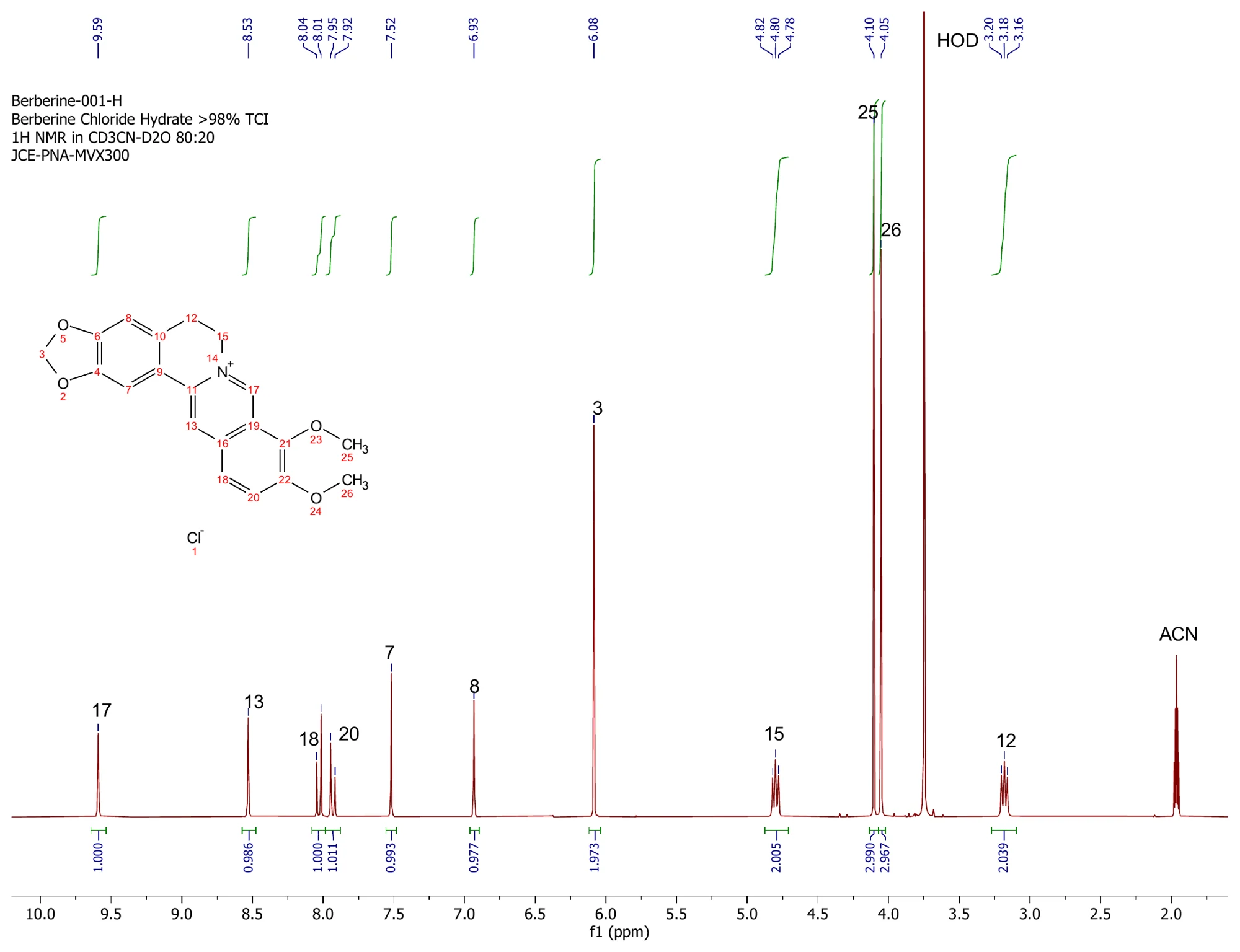
Figure 1. ¹H NMR spectrum (299.99 MHz, CD₃CN:D₂O 80:20) of berberine chloride hydrate reference material (TCI, >98%), acquired on the Varian Mercury-300 MVX. Resonances are labeled according to the atom numbering of the structure shown; integrals appear below the spectrum. The signals of acetonitrile (ACN) and residual water (HOD) are indicated.
The proton-decoupled ¹³C spectrum of the same reference specimen, shown in Figure 2, resolves all twenty carbons of the berberine cation across the characteristic range. The aliphatic benzylic carbon C-12 is observed at 27.66 ppm and the N–CH2 carbon C-15 at 57.00 ppm, with the two methoxy carbons at 57.90 and 62.92 ppm and the methylenedioxy carbon at 103.57 ppm. The aromatic and quaternary aromatic carbons populate the region between 106 and 152 ppm, the most downfield resonances at 151.94 and 151.52 ppm corresponding to the oxygenated ring carbons C-21 and C-6, and the iminium carbon C-17 appearing at 146.01 ppm. The broad ¹³C dispersion resolves resonances that are unresolved or quaternary in the proton spectrum, and the spectrum is fully consistent with the assignments compiled in Table 1.
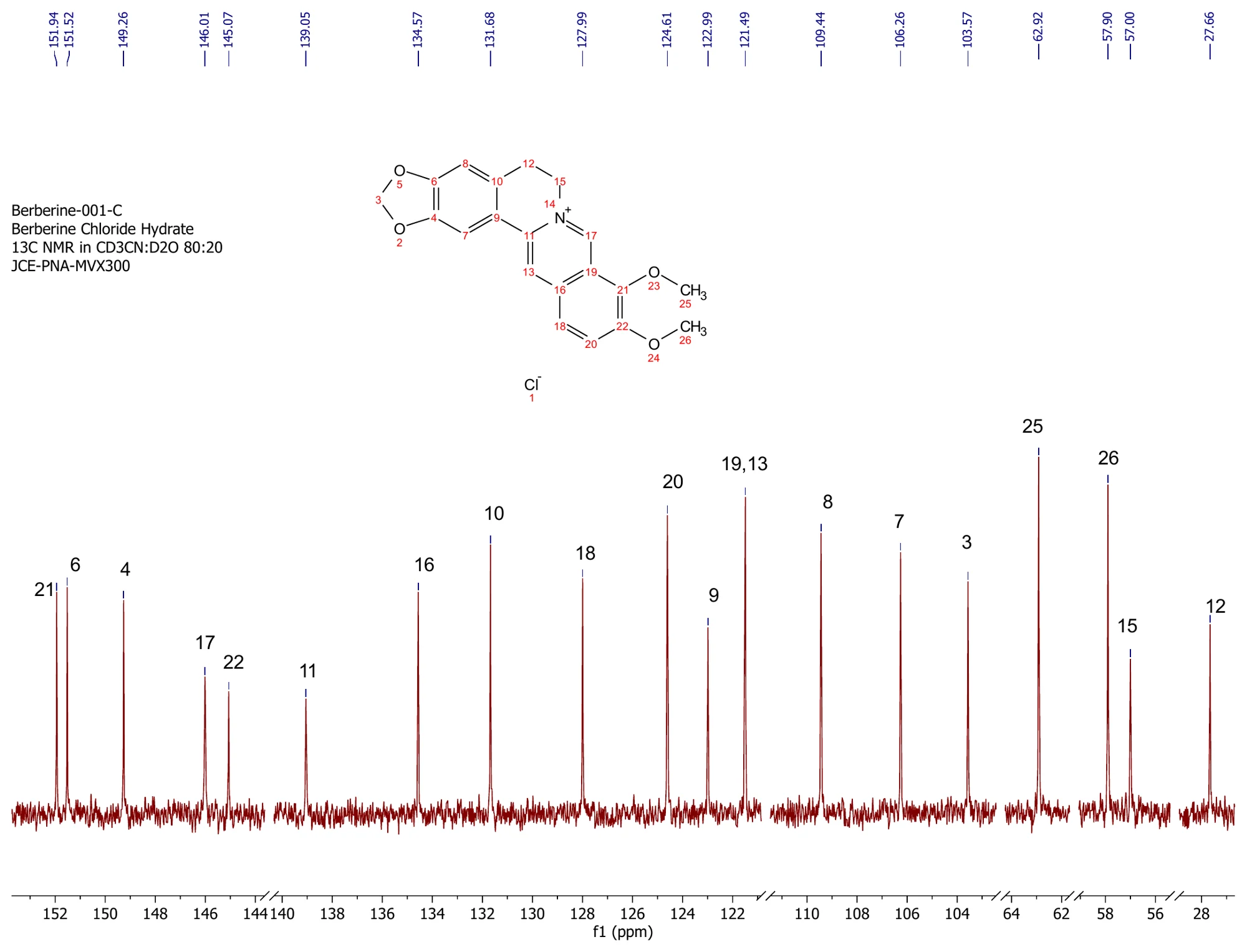
Figure 2. Proton-decoupled ¹³C NMR spectrum (75.43 MHz, CD₃CN:D₂O 80:20) of the berberine chloride hydrate reference material. Carbon resonances are labeled by position; the horizontal axis is broken to display the aliphatic, methoxy, methylenedioxy, and aromatic regions together.
Assignment of the protonated carbons was established directly by gradient-selected heteronuclear single-quantum coherence (gHSQC), the contour plot of which is presented in Figure 3. The one-bond ¹H–¹³C correlations confirm each CH and CH2 pairing without ambiguity: the iminium proton at 9.59 ppm to its carbon near 146 ppm, the ring-A and ring-D aromatic protons to their respective carbons between 106 and 128 ppm, the methylenedioxy protons at 6.08 ppm to the carbon at 103.57 ppm, and the three aliphatic environments—the N–CH2, the two methoxy groups, and the benzylic CH2—to their carbons in the 27–63 ppm region. The absence of cross-peaks at the quaternary aromatic carbons in the gHSQC, taken together with their presence in the 1D ¹³C spectrum, distinguishes the protonated from the non-protonated carbons and completes the assignment.
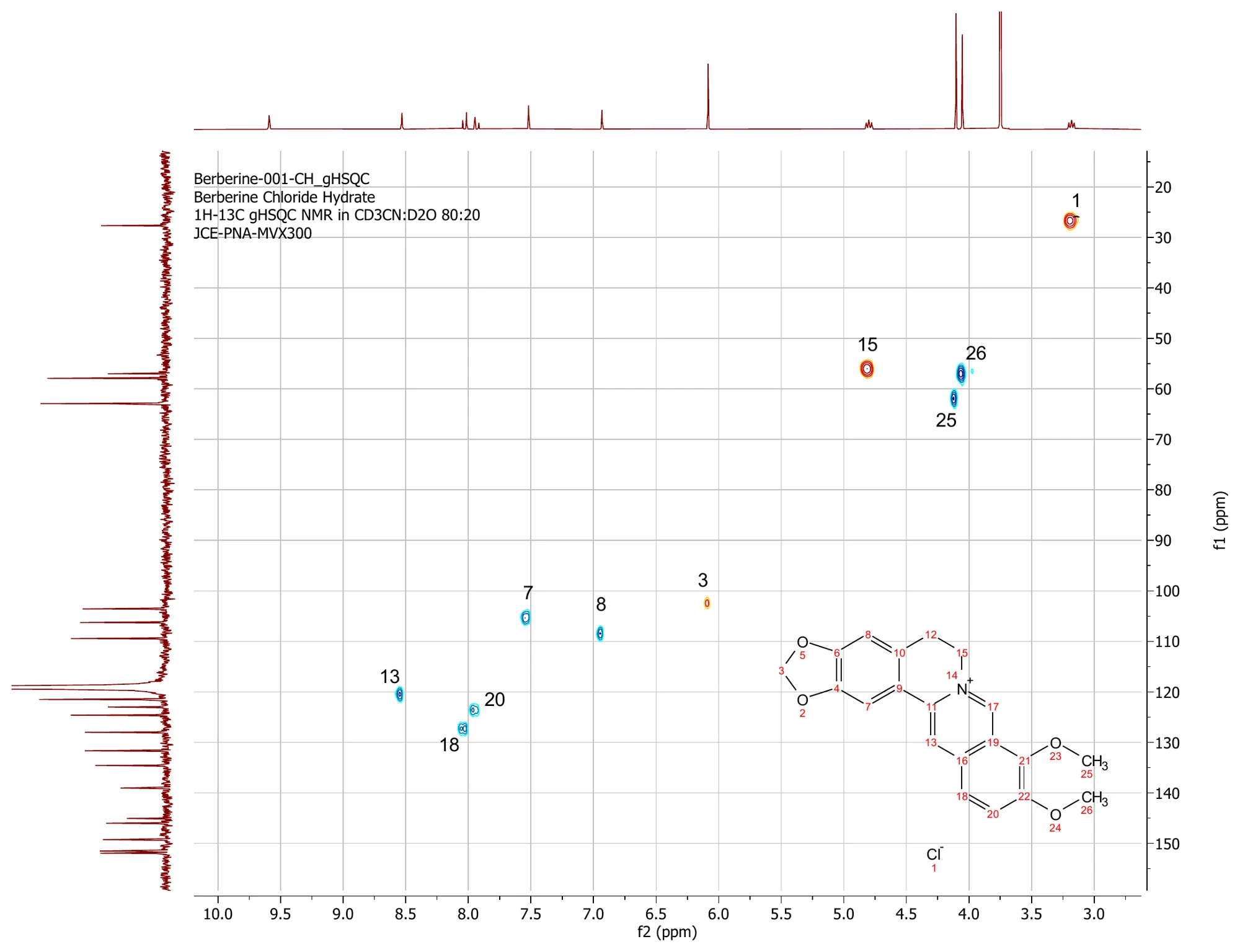
Figure 3. ¹H–¹³C gHSQC spectrum (CD₃CN:D₂O 80:20) of the berberine chloride hydrate reference material, establishing one-bond C–H connectivities. Cross-peaks are labeled by position; the absence of correlations at the quaternary carbons confirms their non-protonated assignment.
The analytical value of the ¹H fingerprint is made plain by direct comparison of the reference material with a commercial supplement product, presented as a stacked plot in Figure 4. The lower trace is the pure reference; the upper trace is the supplement, acquired under identical conditions. The diagnostic berberine resonances—the iminium singlet at 9.59 ppm, H-13 at 8.53 ppm, the methylenedioxy singlet at 6.08 ppm, and the N–CH2 triplet at 4.80 ppm—are unmistakably present in the supplement, confirming the qualitative identity of the labeled active. The supplement spectrum, however, carries a substantial burden of additional signals absent from the reference: a dominant excipient resonance near 3.5 ppm, an extensive group of aromatic and olefinic signals between roughly 6.5 and 7.5 ppm, and numerous aliphatic resonances below 2.5 ppm. These additional features arise from formulation excipients and from co-extracted or co-formulated organic matter, and they reduce the fraction of total spectral intensity attributable to berberine itself. The comparison illustrates two points central to the present paper at once: that ¹H NMR confirms the presence of the declared active in a single non-targeted measurement, and that the same measurement exposes the chemical complexity of the finished product—the very matrix against which quantification (Section 6) and source evaluation (Section 7) must be conducted.
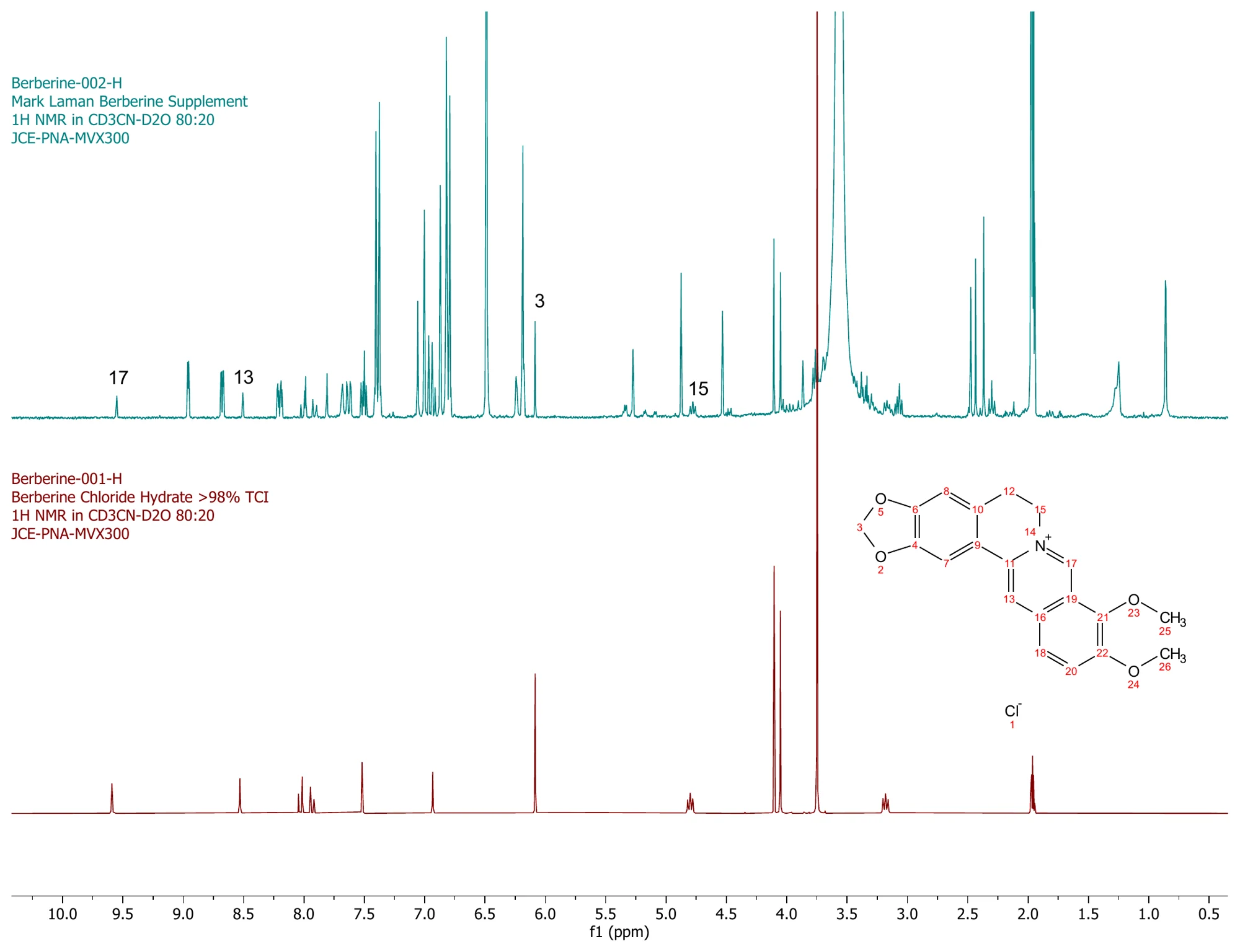
Figure 4. Stacked ¹H NMR comparison (CD₃CN:D₂O 80:20, 299.99 MHz) of a commercial berberine supplement (upper trace) with the berberine chloride hydrate reference material (lower trace). The diagnostic berberine resonances are present in the supplement but are accompanied by extensive excipient and matrix signals not seen in the reference.
5.5 Signals that distinguish berberine from palmatine and other protoberberines
Because authentication frequently turns on the detection and quantification of co-alkaloids, the specific resonances that separate berberine from its nearest neighbors deserve explicit statement. The decisive difference between berberine and palmatine is the substitution of ring A: berberine possesses the methylenedioxy O–CH2–O singlet near 6.1 ppm, whereas palmatine, lacking the bridge, instead displays two additional aromatic methoxy singlets and an extra ring-A aromatic proton. The aromatic CH and the iminium singlets of palmatine are shifted slightly from those of berberine, and these small but reproducible displacements permit palmatine to be detected and quantified in the presence of a large excess of berberine.[5] In practice, palmatine has been detected at levels of the order of one percent relative to berberine in commercial preparations on the basis of exactly these signals, while the absence of coptisine, jatrorrhizine, and phellodendrine resonances has been used to characterize the alkaloid profile of a sample.[5] The diagnostic resonances of the principal co-alkaloids are summarized in Table 2.
Table 1. Experimental ¹H and ¹³C NMR assignments of berberine chloride hydrate (TCI, >98%) in CD₃CN:D₂O (80:20), acquired on the Varian Mercury-300 MVX.
|
Position |
δ ¹H (ppm) |
Multiplicity (integration) |
Assignment |
δ ¹³C (ppm) |
|---|---|---|---|---|
|
17 |
9.59 |
s (1.00) |
iminium N=CH |
146.01 |
|
13 |
8.53 |
s (0.99) |
aromatic CH |
121.49 |
|
18 |
8.01 |
AB, J 9.1 (1.00) |
aromatic CH (ring D) |
127.99 |
|
20 |
7.92 |
AB, J 9.1 (1.01) |
aromatic CH (ring D) |
124.61 |
|
7 |
7.52 |
s (0.99) |
aromatic CH (ring A) |
106.26 |
|
8 |
6.93 |
s (0.98) |
aromatic CH (ring A) |
109.44 |
|
O–CH2–O |
6.08 |
s (1.97) * |
methylenedioxy O–CH2–O |
103.57 |
|
15 |
4.80 |
t, J 6.4 (2.01) |
N–CH2 (C-15) |
57.00 |
|
25 (OCH3) |
4.10 |
s (2.99) † |
aromatic O–CH3 |
62.92 |
|
26 (OCH3) |
4.05 |
s (2.97) † |
aromatic O–CH3 |
57.90 |
|
12 |
3.18 |
t, J 6.4 (2.04) |
Ar–CH2 (C-12) |
27.66 |
|
21 |
— |
— |
aromatic C–O (ring D) |
151.94 |
|
6 |
— |
— |
aromatic C–O (ring A) |
151.52 |
|
4 |
— |
— |
aromatic C–O (ring A) |
149.26 |
|
22 |
— |
— |
aromatic C–O (ring D) |
145.07 |
|
11 |
— |
— |
ring-junction C |
139.05 |
|
16 |
— |
— |
ring-junction C |
134.57 |
|
10 |
— |
— |
ring-junction C |
131.68 |
|
9 |
— |
— |
ring-junction C |
122.99 |
|
19 |
— |
— |
ring-junction C |
121.49 ‡ |
Chemical shifts (ppm) measured at Process NMR Associates; atom numbering follows the structure as drawn. The methylenedioxy O–CH₂–O resonance (bold) is the signal of choice for quantification. * methylenedioxy (2H); † the two aromatic methoxy groups; ‡ C-19 overlaps with C-13 at 121.49 ppm. Multiplicity abbreviations: s, singlet; t, triplet; AB, AB system (J in Hz). Approximate integrals are given in parentheses.
Table 2. Diagnostic ¹H resonances distinguishing berberine from co-occurring protoberberine and isoquinoline alkaloids.
|
Alkaloid |
Diagnostic ¹H resonances, δ (ppm) |
Distinguishing structural feature |
|---|---|---|
|
Berberine |
9.59 (s, iminium CH); 8.53 (s, H-13); 8.01/7.92 (AB, ring-D CH); 7.52 (s, H-7); 6.93 (s, H-8); 6.08 (s, O–CH2–O); 4.10/4.05 (2×s, OCH3) |
Ring-A methylenedioxy + ring-D dimethoxy |
|
Palmatine |
iminium CH and H-13 near 9.7 and 8.8; four OCH3 singlets (≈3.9–4.2); additional ring-A aromatic CH; no methylenedioxy singlet |
Four methoxy groups; no methylenedioxy |
|
Berberrubine |
9-OH in place of a ring-D OCH3; loss of one methoxy singlet; shift of resonances near the demethylated position |
9-O-demethyl derivative of berberine |
|
Coptisine |
two methylenedioxy O–CH2–O singlets (rings A and D); no methoxy singlets |
Marker for Coptis / Rhizoma Coptidis |
|
Hydrastine |
phthalide isoquinoline resonances distinct from the protoberberine set; aliphatic methine/methylene pattern |
Definitive marker for Hydrastis (goldenseal) |
Berberine values are the experimental shifts measured here (CD₃CN:D₂O); co-alkaloid distinguishing features are compiled from the verified literature (refs. 4, 5). The presence, identity, and relative proportions of these congeners constitute the impurity fingerprint used for source discrimination in Section 7.
6. Quantitative ¹H NMR for Content and Purity Determination
6.1 Principle and the choice of integration window
Quantitative ¹H NMR rests on the proportionality between the integrated area of a resonance and the number of nuclei giving rise to it, a relationship that holds rigorously only when the contributing spins are permitted to relax fully between excitation pulses.[2,3,20,21,22] For berberine the analytical task is unusually favorable. The molecule presents several singlets that are both intense and free of overlap, and the methylenedioxy O–CH2–O singlet near 6.1 ppm has emerged as the preferred quantification signal because it is cleanly resolved from neighboring resonances and sits on a flat baseline.[5] Where confirmation is desired, the H-4 singlet near 7.0 ppm and the H-13 singlet near 8.7 ppm provide independent measures of the same analyte, and agreement among the three constitutes an internal consistency check on the integration.
6.2 Internal-standard selection and PNA conventions
Absolute quantification by internal calibration requires a reference compound of known purity whose resonances do not overlap those of the analyte and which is chemically inert toward both analyte and solvent.[3] For berberine dissolved in methanol-d4, the sodium salt of 2,2,3,3-tetradeutero-3-(trimethylsilyl)propanoate (TSP-d4) is the appropriate internal standard, providing a sharp singlet at 0.00 ppm that serves simultaneously as chemical-shift reference and quantification reference; this is the Process NMR Associates default for aqueous and deuterated-methanol systems. For work conducted in chloroform-d or dimethyl sulfoxide-d6, tetramethylsilane (TMS) is used in place of TSP-d4. A practical caution applies to standard selection: the longitudinal relaxation time of the TSP-d4 methyl protons is appreciably longer than that of the berberine resonances—values of the order of 3 s for the standard against roughly 1.5 s for the methylenedioxy protons have been reported—so that the relaxation delay must be set by the standard rather than by the analyte if both are to be fully relaxed.[5]
6.3 Acquisition parameters on the Varian platform
Quantitative spectra at Process NMR Associates are acquired on a Varian Mercury-300 MVX spectrometer (S/N S011111) operating under VnmrJ control with the vnmr1 host, using a 5 mm ATB probe (S/N 4131) and the s2pul pulse sequence. The proton observe frequency is 299.99 MHz. Quantitative acquisition employs a spectral width of 14992.5 Hz and an acquisition time of 4.2688 s, with a relaxation delay of 15 s chosen to guarantee full relaxation of both the berberine resonances and the TSP-d4 internal standard. A calibrated 90° excitation pulse of 8 μs is used, and 96 transients are accumulated; presaturation of the residual solvent resonance is applied where aqueous or methanolic samples require it. Sample temperature is regulated, and masses are determined on a Radwag AS 82/220 Plus analytical balance. The combination of a long relaxation delay with a fully calibrated pulse ensures that the integrated areas faithfully reflect proton populations and that the quantitative result is metrologically defensible.
6.4 Cross-validation against HPLC and the benchtop perspective
The credibility of an NMR assay is strengthened when its results are shown to agree with an orthogonal method. For berberine, concentrations measured by ¹H NMR have been found to be in good agreement with values obtained by ultra-high-performance liquid chromatography with ultraviolet or mass-spectrometric detection across plant extracts and supplement matrices.[12,13,16] High-performance liquid chromatography with diode-array detection, and high-performance thin-layer chromatography, remain the established chromatographic comparators for berberine and its co-alkaloids, the latter capable of the simultaneous estimation of berberine alongside berbamine, palmatine, magnoflorine, and jatrorrhizine,[23] and on-line solid-phase-extraction HPLC has been applied to the simultaneous determination of protoberberines from Coptidis Rhizoma and Phellodendri Cortex.[24] A significant recent development is the demonstration that quantification of berberine in commercial supplements can be transferred from a 500 MHz instrument to a 60 MHz benchtop spectrometer with close agreement—a determination coefficient near 0.99 and a mean deviation of a few percent between fields—provided that a calibration curve established under fixed, incomplete-relaxation conditions is used to compress the acquisition into a routine-compatible interval.[5] This high-field-informed, low-field-deployed pattern is directly aligned with the Process NMR Associates methodology, in which models developed at 300 MHz are translated to benchtop deployment for routine screening.
7. Source Discrimination by the Co-Alkaloid Impurity Fingerprint
7.1 The chemical basis of the fingerprint
The berberine resonance itself carries no information about origin: a berberine molecule extracted from Coptis is spectroscopically indistinguishable from one assembled by synthesis. Discrimination must therefore rest on the molecular context in which the berberine is presented. As established in Sections 3 and 4, that context differs systematically between sources. Naturally extracted berberine is accompanied by a suite of biosynthetic congeners whose identities and relative proportions reflect the botanical source, because the same enzymatic pathway that produces berberine also produces palmatine, jatrorrhizine, columbamine, and—in Coptis—coptisine, and because complete chromatographic removal of these closely related cations is difficult. Synthetic berberine, by contrast, is devoid of this natural suite and instead carries the residual intermediates and byproducts of its synthetic route.
This is the validated, instrument-accessible basis for source discrimination, and it is achievable on the Varian Mercury-300 platform using the routine ¹H qNMR acquisition described in Section 6, supplemented where necessary by the two-dimensional experiments of Section 5.3 for unambiguous identification of minor components. The diagnostic resonances that separate the principal co-alkaloids from berberine are compiled in Table 2.
7.2 Botanical-origin classification from the co-alkaloid profile
The published ¹H NMR record demonstrates that the co-alkaloid profile functions as a botanical signature. The relative proportions of coptisine, palmatine, jatrorrhizine, and columbamine have been used both to evaluate the quality of Rhizoma Coptidis and to differentiate among Coptis species,[13,14] while the protoberberine profile of Cortex Phellodendri has likewise been characterized by ¹H NMR.[15] Goldenseal is the most clear-cut case: the co-occurrence of the phthalide isoquinoline hydrastine with berberine is unique to Hydrastis, and the simultaneous NMR quantification of hydrastine and berberine provides an unambiguous test of a goldenseal claim.[16] In the analysis of commercial supplements, palmatine has been detected by ¹H NMR in the majority of products examined, at ratios reaching the order of one percent relative to berberine, while coptisine, jatrorrhizine, and phellodendrine were absent—a profile that is itself informative about source and degree of purification.[5] The classification problem is well matched to chemometric treatment: multivariate analysis of the binned ¹H profile, by principal component analysis or by supervised classification, can formalize the assignment of an unknown to a botanical class on the basis of the full pattern rather than a single ratio, in the same manner that such methods have been applied to other authentication problems.
7.3 Natural versus synthetic discrimination and label-claim significance
The same fingerprint distinguishes natural from synthetic material. The presence of the natural co-alkaloid suite is positive evidence of botanical origin; its complete absence, particularly in conjunction with synthetic-route byproducts, is evidence of synthetic origin or of a degree of purification inconsistent with a crude-extract claim. The regulatory relevance is considerable. The dietary-supplement sector has repeatedly been shown to mislabel berberine products: independent studies have found that a substantial fraction of marketed preparations fail to contain the declared quantity of berberine,[1,5] and the variability in potency among commercial preparations has been documented directly.[25] Where a botanical-source claim carries a price premium—as a wildcrafted or specific-species designation may—the economic incentive for substitution is real, and an analytical method capable of testing the claim is correspondingly valuable. The co-alkaloid fingerprint provides that capability today, without recourse to specialized isotopic measurement.
8. Site-Specific ¹³C Isotopic Analysis: A Prospective and Critically Evaluated Approach
The sections above describe methods that are established and, in the Process NMR Associates workflow, deployable now. The present section addresses a different question, and it is presented deliberately as prospective and exploratory rather than as a validated procedure. The question is whether the distribution of ¹³C among the individual carbon positions of the berberine molecule—the intramolecular, position-specific isotopic signature measurable at natural abundance by quantitative ¹³C NMR—might provide an independent discriminator of natural versus synthetic origin. The honest answer is that the approach is mechanistically plausible, that it is supported by strong precedents in other molecular systems, and that it has not, to the present author’s knowledge, been demonstrated for berberine. The analytical demands that any such demonstration would have to meet are severe, and they are set out explicitly so that the claim is neither overstated nor dismissed.
8.1 The mechanistic rationale
Position-specific isotopic patterns arise because enzymatic and chemical bond-forming steps discriminate, to a small but reproducible degree, between ¹²C and ¹³C. In a biosynthetic product the cumulative effect of the enzymatic steps along the pathway imprints a non-statistical ¹³C distribution across the carbon skeleton, with particular positions enriched or depleted relative to the molecular mean according to the kinetic isotope effects of the reactions that formed them. For berberine, the carbon of greatest a priori interest is C-8, the methine carbon generated in the berberine-bridge reaction—the oxidative C–C bond formation catalyzed by the berberine bridge enzyme described in Section 3.1.[9,10,11] The methylenedioxy carbon and the two methoxy carbons, installed by distinct enzymatic transfer and oxidation steps, are further candidates for source-dependent isotopic character. Synthetic berberine, assembled from petrochemically derived building blocks through chemical bond formation, would be expected to carry both a different overall δ¹³C (reflecting fossil-carbon precursors) and a flatter, more nearly statistical intramolecular distribution lacking the specific enzymatic fingerprint.
8.2 The strength of the precedents — and the limits of their transfer
That site-specific natural-abundance ¹³C NMR can resolve origin is not in doubt as a general proposition. The approach has been validated for the authentication of vanillin, where it distinguishes biosynthetic, fermentation-derived, and synthetic material,[26] for the determination of the intramolecular ¹³C distribution in glucose at natural abundance,[27] and, in the food-authentication arena most directly analogous to the present problem, for the differentiation of cane sugar from beet sugar through the position-specific ¹³C content of sucrose.[28] The same isotopic-NMR principle has been carried into pharmaceutical anti-counterfeiting, where the site-specific ¹³C contents of aspirin and paracetamol, and the isotopic fingerprints of active ingredients obtained with polarization-transfer enhancement, have been used to distinguish sources of nominally identical drugs.[29,30]
The critical point—and the reason the approach cannot simply be asserted for berberine—is that these precedents do not transfer automatically. Two considerations limit the analogy. First, the sucrose case exploits a large, mechanism-driven contrast: the C3 (Calvin) and C4 (Hatch–Slack) photosynthetic pathways impose systematically different intramolecular isotopic distributions, and that contrast is what makes the discrimination tractable. No comparable dichotomy exists among the botanical sources of berberine; all of them—Berberis, Coptis, Hydrastis, Phellodendron—synthesize berberine by the same benzylisoquinoline route, so that whatever inter-source isotopic differences exist are expected to be small and to demand careful inter-laboratory threshold-setting of the kind that even the validated sucrose method was acknowledged still to require. The natural-versus-synthetic contrast is expected to be larger and is the more promising target, but it too remains undemonstrated for this molecule.
8.3 The measurement is far harder than for the precedent molecules
Quantitative ¹³C NMR for isotopic measurement is among the most demanding of all NMR experiments. The published methodology requires per-position coefficients of variation below about 0.2%, signal-to-noise ratios of the order of 150 or greater, relaxation delays set to at least five times the longest T₁ (frequently necessitating paramagnetic relaxation agents), inverse-gated decoupling to suppress the variable nuclear Overhauser enhancement, and hundreds of transients per spectrum.[17,28] Methods to reduce the otherwise prohibitive acquisition time, including optimized pulse sequences and polarization-transfer schemes, have been developed but add their own complexity.[30,31] Sucrose, vanillin, and glucose are small molecules with a handful of carbons; berberine presents twenty distinct carbons, several of them quaternary aromatic centers with long longitudinal relaxation times and modest signal intensity. Achieving the requisite precision simultaneously across the diagnostically interesting positions of such a molecule, at natural abundance, is a materially harder undertaking, and the field strength, probe sensitivity, and acquisition time required exceed what routine quality-control practice can accommodate.
8.4 Honest status and recommended posture
The position taken in this paper is therefore the following. Site-specific natural-abundance ¹³C isotopic analysis of berberine is a legitimate and scientifically interesting prospective method for natural-versus-synthetic discrimination, grounded in a sound mechanistic rationale and supported by robust proof of concept in other systems. It is not, at present, a validated method for berberine: no published study establishes the position-specific isotopic baseline for berberine of defined origin, nor the threshold that would separate natural from synthetic material. Any operational deployment would require a dedicated validation program—the acquisition of position-specific ¹³C profiles on authenticated natural berberine from each major botanical source and on synthetic material of known route, conducted under the high-precision protocol above, with inter-laboratory confirmation and explicit threshold determination. Absent that program, the method should be represented to clients, regulators, and any opposing technical reviewer as exploratory. For present authentication needs, the co-alkaloid impurity fingerprint of Section 7 remains the defensible and instrument-accessible route, and it is the approach recommended for routine use; the isotopic approach is best regarded as a candidate for future methodological development, including the high-field-informed model building that characterizes the Process NMR Associates research program.
9. Conclusions
Nuclear magnetic resonance spectroscopy provides a coherent and powerful toolkit for the characterization, quantification, and source evaluation of berberine and the protoberberine alkaloids. The molecule’s quaternary isoquinolinium architecture, its methylenedioxy and dimethoxy substitution, and its relationship to palmatine, jatrorrhizine, coptisine, berberrubine, and the reduced congeners are all expressed in a ¹H spectrum of unusually well-separated diagnostic singlets and in a broadly dispersed ¹³C spectrum, with two-dimensional and ¹⁵N experiments available where unambiguous assignment is required. Quantification by ¹H qNMR, anchored on the methylenedioxy singlet and cross-validated against chromatography, is robust and is now transferable to benchtop fields for routine screening.
For source authentication, the analysis distinguishes sharply between what is established and what is prospective. The co-alkaloid impurity fingerprint is the validated, instrument-accessible basis for discriminating botanical origin and for separating natural from synthetic material, and it carries direct significance for a dietary-supplement sector in which mislabeling and potency variability are demonstrably common. Site-specific natural-abundance ¹³C isotopic analysis, by contrast, is a mechanistically plausible but as-yet-undemonstrated approach for berberine whose validation would demand a dedicated high-precision program; it is presented here as a candidate for future development rather than as a current capability. The practical recommendation that follows is to deploy the co-alkaloid fingerprint, supported by chemometric classification, as the working authentication method, while reserving the isotopic approach for methodological investigation under the high-field-informed, low-field-deployed paradigm.
References
All references below were verified against CrossRef for DOI, author list, title, and journal metadata prior to drafting. Full author lists are given; “et al.” is not used.
1. Och A., Podgórski R., Nowak R.. Biological activity of berberine — a summary update. Toxins 12, 713 (2020). DOI: 10.3390/toxins12110713
2. Pauli G. F., Jaki B. U., Lankin D. C.. Quantitative ¹H NMR: development and potential of a method for natural products analysis. Journal of Natural Products 68, 133–149 (2004). DOI: 10.1021/np0497301
3. Holzgrabe U.. Quantitative NMR spectroscopy in pharmaceutical applications. Progress in Nuclear Magnetic Resonance Spectroscopy 57, 229–240 (2010). DOI: 10.1016/j.pnmrs.2010.05.001
4. Danoun S., Balayssac S., Gilard V., Martino R., Malet-Martino M.. Quality evaluation of berberine food supplements with high-field and compact ¹H NMR spectrometers. Journal of Pharmaceutical and Biomedical Analysis 223, 115161 (2023). DOI: 10.1016/j.jpba.2022.115161
5. Wang C., Perumalla S. R., Lu R., Fang J., Sun C. C.. Sweet berberine. Crystal Growth & Design 16, 933–939 (2016). DOI: 10.1021/acs.cgd.5b01484
6. Jeon Y. W., Jung J. W., Kang M., Chung I. K., Lee W.. NMR studies on antitumor drug candidates, berberine and berberrubine. Bulletin of the Korean Chemical Society 23, 391–394 (2002). DOI: 10.5012/bkcs.2002.23.3.391
7. Grycová L., Dostál J., Marek R.. Quaternary protoberberine alkaloids. Phytochemistry 68, 150–175 (2007). DOI: 10.1016/j.phytochem.2006.10.004
8. Bird D. A., Facchini P. J.. Berberine bridge enzyme, a key branch-point enzyme in benzylisoquinoline alkaloid biosynthesis, contains a vacuolar sorting determinant. Planta 213, 888–897 (2001). DOI: 10.1007/s004250100582
9. Kutchan T. M., Dittrich H.. Characterization and mechanism of the berberine bridge enzyme, a covalently flavinylated oxidase of benzophenanthridine alkaloid biosynthesis in plants. Journal of Biological Chemistry 270, 24475–24481 (1995). DOI: 10.1074/jbc.270.41.24475
10. Winkler A., Łyskowski A., Riedl S., Puhl M., Kutchan T. M., Macheroux P., Gruber K.. A concerted mechanism for berberine bridge enzyme. Nature Chemical Biology 4, 739–741 (2008). DOI: 10.1038/nchembio.123
11. Li C. Y., Lu H. J., Lin C. H., Wu T. S.. A rapid and simple determination of protoberberine alkaloids in cortex phellodendri by ¹H NMR and its application for quality control of commercial traditional Chinese medicine prescriptions. Journal of Pharmaceutical and Biomedical Analysis 40, 173–178 (2006). DOI: 10.1016/j.jpba.2005.06.017
12. Li C. Y., Tsai S. I., Damu A. G., Wu T. S.. A rapid and simple determination of protoberberine alkaloids in Rhizoma Coptidis by ¹H NMR and its application for quality control of commercial prescriptions. Journal of Pharmaceutical and Biomedical Analysis 49, 1272–1276 (2009). DOI: 10.1016/j.jpba.2009.02.028
13. Hasada K., Yoshida T., Yamazaki T., Sugimoto N., Nishimura T., Nagatsu A., Mizukami H.. Application of ¹H-NMR spectroscopy to validation of berberine alkaloid reagents and to chemical evaluation of Coptidis Rhizoma. Journal of Natural Medicines 65, 262–267 (2011). DOI: 10.1007/s11418-010-0490-x
14. Ding P. L., Chen L. Q., Lu Y., Li Y. G.. Determination of protoberberine alkaloids in Rhizoma Coptidis by ERETIC ¹H NMR method. Journal of Pharmaceutical and Biomedical Analysis 60, 44–50 (2012). DOI: 10.1016/j.jpba.2011.10.030
15. Fan G., Zhang M. Y., Zhou X. D., Lai X. R., Yue Q. H., Tang C., Luo W. Z., Zhang Y.. Quality evaluation and species differentiation of Rhizoma coptidis by using proton nuclear magnetic resonance spectroscopy. Analytica Chimica Acta 747, 76–83 (2012). DOI: 10.1016/j.aca.2012.08.038
16. Le P. M., Milande C., Martineau E., Giraudeau P., Farjon J.. Quantification of natural products in herbal supplements: a combined NMR approach applied on goldenseal. Journal of Pharmaceutical and Biomedical Analysis 165, 155–161 (2019). DOI: 10.1016/j.jpba.2018.11.062
17. Tang Q., Wang S., Zhai X., Kim S. B., Achanta P., Malca-Garcia G. R., Nishizaki Y., Wang Y., Tang Y.. Applications of quantitative ¹³C NMR in pharmaceutical analysis: from small molecule drugs to biopolymers. Journal of Pharmaceutical Analysis 16, 101346 (2026). DOI: 10.1016/j.jpha.2025.101346
18. Janssen R. H. A. M., Lousberg R. J. J. Ch., Wijkens P., Kruk C., Theuns H. G.. Assignment of ¹H and ¹³C NMR resonances of some isoquinoline alkaloids. Phytochemistry 28, 2833–2839 (1989). DOI: 10.1016/S0031-9422(00)98100-7
19. Marek R., Humpa O., Dostál J., Slavík J., Sklenář V.. ¹⁵N NMR study of isoquinoline alkaloids. Magnetic Resonance in Chemistry 37, 195–202 (1999). DOI: 10.1002/(SICI)1097-458X(199903)37:3<195::AID-MRC435>3.0.CO;2-D
20. Pauli G. F., Gödecke T., Jaki B. U., Lankin D. C.. Quantitative ¹H NMR. Development and potential of an analytical method: an update. Journal of Natural Products 75, 834–851 (2012). DOI: 10.1021/np200993k
21. Malz F., Jancke H.. Validation of quantitative NMR. Journal of Pharmaceutical and Biomedical Analysis 38, 813–823 (2005). DOI: 10.1016/j.jpba.2005.01.043
22. Shoolery J. N.. Some quantitative applications of ¹³C NMR spectroscopy. Progress in Nuclear Magnetic Resonance Spectroscopy 11, 79–93 (1977). DOI: 10.1016/0079-6565(77)80003-4
23. Basera I. A., Girme A., Bhatt V. P., Shah M. B.. A validated high-performance thin-layer chromatography method for the simultaneous estimation of berberine, berbamine, palmatine, magnoflorine and jatrorrhizine from Berberis aristata. JPC – Journal of Planar Chromatography – Modern TLC 34, 147–155 (2021). DOI: 10.1007/s00764-021-00094-9
24. Yang Y., Liu L., Wang Z., Jin Y., Zhang Y.. Simultaneous determination of protoberberine alkaloids derived from Coptidis Rhizoma and Phellodendri Cortex in pharmaceuticals by on-line solid-phase extraction (SPE)–high performance liquid chromatography with ultraviolet detection (HPLC-UV). Analytical Letters 56, 1256–1269 (2022). DOI: 10.1080/00032719.2022.2125525
25. Funk R. S., Singh R. K., Winefield R. D., Kandel S. E., Ruisinger J. F., Moriarty P. M., Backes J. M.. Variability in potency among commercial preparations of berberine. Journal of Dietary Supplements 15, 343–351 (2018). DOI: 10.1080/19390211.2017.1347227
26. Tenailleau E. J., Lancelin P., Robins R. J., Akoka S.. Authentication of the origin of vanillin using quantitative natural abundance ¹³C NMR. Journal of Agricultural and Food Chemistry 52, 7782–7787 (2004). DOI: 10.1021/jf048847s
27. Gilbert A., Silvestre V., Robins R. J., Remaud G. S.. Accurate quantitative isotopic ¹³C NMR spectroscopy for the determination of the intramolecular distribution of ¹³C in glucose at natural abundance. Analytical Chemistry 81, 8978–8985 (2009). DOI: 10.1021/ac901441g
28. Monakhova Y. B., Diehl B. W. K.. Authentication of the origin of sucrose-based sugar products using quantitative natural abundance ¹³C NMR. Journal of the Science of Food and Agriculture 96, 2861–2866 (2016). DOI: 10.1002/jsfa.7456
29. Silvestre V., Mboula V. M., Jouitteau C., Akoka S., Robins R. J., Remaud G. S.. Isotopic ¹³C NMR spectrometry to assess counterfeiting of active pharmaceutical ingredients: site-specific ¹³C content of aspirin and paracetamol. Journal of Pharmaceutical and Biomedical Analysis 50, 336–341 (2009). DOI: 10.1016/j.jpba.2009.04.030
30. Bussy U., Thibaudeau C., Thomas F., Desmurs J. R., Jamin E., Remaud G. S., Silvestre V., Akoka S.. Isotopic finger-printing of active pharmaceutical ingredients by ¹³C NMR and polarization transfer techniques as a tool to fight against counterfeiting. Talanta 85, 1909–1914 (2011). DOI: 10.1016/j.talanta.2011.07.022
31. Caytan E., Remaud G. S., Tenailleau E., Akoka S.. Precise and accurate quantitative ¹³C NMR with reduced experimental time. Talanta 71, 1016–1021 (2007). DOI: 10.1016/j.talanta.2006.05.075
Summary
This white paper has set out the application of NMR spectroscopy to berberine and the protoberberine alkaloids across the full analytical chain, from structure to authentication. Berberine’s quaternary isoquinolinium framework, with its ring-A methylenedioxy bridge and ring-D dimethoxy substitution, gives rise to a ¹H spectrum of well-resolved diagnostic singlets—the iminium H-8 near 9.8 ppm, the methylenedioxy singlet near 6.1 ppm, and the two methoxy singlets near 4.1 and 4.2 ppm being the most analytically useful—and to a broadly dispersed ¹³C spectrum in which the quaternary aromatic centers are resolved. Complete verified ¹H and ¹³C assignments are tabulated, the two-dimensional and ¹⁵N strategies for unambiguous assignment are described, and the specific resonances separating berberine from palmatine and the other co-alkaloids are identified.
Quantification by ¹H qNMR, anchored on the methylenedioxy singlet, cross-validated against HPLC, and acquired on the Varian Mercury-300 MVX platform with TSP-d4 or TMS internal standardization, is established and is transferable to 60 MHz benchtop instrumentation for routine screening. On the central question of source authentication, the paper draws a deliberate distinction. The co-alkaloid impurity fingerprint—the identity and relative proportions of the biosynthetic congeners that accompany naturally extracted berberine, and their absence in synthetic material—is the validated, instrument-accessible route to discriminating botanical origin and natural-versus-synthetic status, and it is the approach recommended for routine deployment. Site-specific natural-abundance ¹³C isotopic analysis is presented, with full transparency, as mechanistically plausible and well-precedented in other systems but not yet demonstrated for berberine; the severe precision demands and the absence of a validated isotopic baseline place it in the category of prospective methodological development rather than current capability. The recommended posture is to use the co-alkaloid fingerprint and chemometric classification now, while pursuing the isotopic approach as a research objective under the high-field-informed, low-field-deployed paradigm.
Process NMR Associates, LLC — PNA-WP-BERBERINE-NMR-001. Prepared by John C. Edwards, Ph.D. This document provides background, structure, and methodology to support AI-assisted technical reporting; experimental data, instrument-specific results, and interpretive conclusions are to be supplied and verified by the author prior to release.