1. Secretaría de Economía (Mexico). NORMA Oficial Mexicana
NOM-006-SCFI-2012, Bebidas alcohólicas-Tequila-Especificaciones. Diario
Oficial de la Federación (Primera Sección), 13 December 2012.
https://platiica.economia.gob.mx/wp-content/uploads/sites/2/PDF_Normas_Publicas/006scfi2012m.pdf.
2. Secretaría de Economía (Mexico). NORMA Oficial Mexicana
NOM-070-SCFI-2016, Bebidas alcohólicas-Mezcal-Especificaciones. Diario
Oficial de la Federación (Primera Sección), 23 February 2017.
https://platiica.economia.gob.mx/wp-content/uploads/sites/2/PDF_Normas_Publicas/070scfi2017.pdf.
3. Instituto Mexicano de la Propiedad Industrial (IMPI). Declaración
General de Protección de la Denominación de Origen “Raicilla”. Diario
Oficial de la Federación (Primera Sección), 28 June 2019.
https://sidof.segob.gob.mx/notas/5564454.
4. Secretaría de Economía (Mexico). NORMA Oficial Mexicana
NOM-199-SCFI-2017, Bebidas alcohólicas-Denominación, especificaciones
fisicoquímicas, información comercial y métodos de prueba. Diario
Oficial de la Federación (Primera Sección), 30 October 2017.
https://platiica.economia.gob.mx/wp-content/uploads/sites/2/PDF_Normas_Publicas/199scfi2017.pdf.
5. Secretaría de Economía (Mexico). PROYECTO de Norma Oficial
Mexicana PROY-NOM-257-SE-2021, Bebidas
alcohólicas-Raicilla-Denominación, especificaciones, información
comercial y métodos de prueba. Diario Oficial de la Federación, 27 April
2022.
https://platiica.economia.gob.mx/wp-content/uploads/sites/2/historialdocumental/PROY-NOM-257-SE-2021.pdf.
6. Secretaría de Economía (Mexico). NORMA Oficial Mexicana
NOM-168-SCFI-2004, Bebidas alcohólicas-Bacanora-Especificaciones de
elaboración, envasado y etiquetado. Diario Oficial de la Federación
(Primera Sección), 14 December 2005.
https://platiica.economia.gob.mx/wp-content/uploads/sites/2/PDF_Normas_Publicas/NOM-168-SCFI-2005.pdf.
7. Secretaría de Economía (Mexico). NORMA Oficial Mexicana
NOM-159-SCFI-2004, Bebidas alcohólicas-Sotol-Especificaciones y métodos
de prueba. Diario Oficial de la Federación (Primera Sección), 16 June
2004.
https://platiica.economia.gob.mx/wp-content/uploads/sites/2/PDF_Normas_Publicas/159scfi.pdf.
8. U.S. Alcohol and Tobacco Tax and Trade Bureau (TTB). 27 CFR §
5.148 Agave spirits (Electronic Code of Federal Regulations, Title 27
current to 2026-09-28). Code of Federal Regulations, Title 27, Part 5,
Subpart I (2026).
https://www.ecfr.gov/current/title-27/chapter-I/subchapter-A/part-5/subpart-I/section-5.148.
9. Mancilla-Margalli, N. A.; López, M. G. Generation of Maillard
Compounds from Inulin during the Thermal Processing of Agave tequilana
Weber Var. azul. Journal of Agricultural and Food Chemistry
2002, 50 (4), 806–812. https://doi.org/10.1021/jf0110295.
10. Mancilla-Margalli, N. A.; López, M. G. Water-Soluble
Carbohydrates and Fructan Structure Patterns from Agave and Dasylirion
Species. Journal of Agricultural and Food Chemistry 2006,
54 (20), 7832–7839. https://doi.org/10.1021/jf060354v.
11. González Seguí, H. O.; Giersiepen, J. H.; Hernández López, J. de
J. Methanol in Mezcal: Is it Possible to Increase the Current Thresholds
Allowed by Mexican Standards? RIVAR 2021, 8 (24),
56–75. https://doi.org/10.35588/rivar.v8i24.4886.
12. Nolasco Cancino, H.; Jarquín Martínez, D.; Ruiz Terán, F.;
Santiago Urbina, J. A. Behavior of the volatile compounds regulated by
the Mexican Official Standard NOM-070-SCFI-2016 during the distillation
of artisanal Mezcal. Biotecnia 2022, 24 (2), 20–27.
https://doi.org/10.18633/biotecnia.v24i2.1577.
13. Prado-Ramírez, R.; Gonzáles-Alvarez, V.; Pelayo-Ortiz, C.;
Casillas, N.; Estarrón, M.; Gómez-Hernández, H. E. The role of
distillation on the quality of tequila. International Journal of
Food Science and Technology 2005, 40 (7), 701–708.
https://doi.org/10.1111/j.1365-2621.2005.00983.x.
14. Vera-Guzmán, A. M.; Guzmán-Gerónimo, R. I.; López, M. G. Major
and minor compounds in a Mexican spirit, young Mezcal coming from two
Agave species. Czech Journal of Food Sciences 2010, 28
(2), 127–132. https://doi.org/10.17221/56/2009-cjfs.
15. Vera-Guzmán, A.; Guzmán-Gerónimo, R.; López, M.; Chávez-Servia,
J. Volatile Compound Profiles in Mezcal Spirits as Influenced by Agave
Species and Production Processes. Beverages 2018, 4
(1), 9. https://doi.org/10.3390/beverages4010009.
16. Sánchez-Fernández, R. E.; Pérez-López, A.; Morales-Solis, A.;
Manilla-Tellez, Y.; Reyes-Carmona, E. D.; Avila-Uribe, G. Chemistry of
Mezcal: Volatile Profile of Artisanal Mezcal Made from Wild Agaves of
Oaxaca. Foods 2025, 14 (7), 1222.
https://doi.org/10.3390/foods14071222.
17. Lachenmeier, D. W.; Sohnius, E.-M.; Attig, R.; López, M. G.
Quantification of Selected Volatile Constituents and Anions in Mexican
Agave Spirits (Tequila, Mezcal, Sotol, Bacanora). Journal of
Agricultural and Food Chemistry 2006, 54 (11), 3911–3915.
https://doi.org/10.1021/jf060094h.
18. de la Garza, H.; Buenrostro, J.; Reyes-Vega, M.; Rodríguez, R.;
Martinez, D. G.; Aguilar, C. N. Chemical Profile of Sotol Analyzed by
Solid Phase Microextraction-Gas Chromatography. American Journal of
Agricultural and Biological Sciences 2010, 5 (3), 261–268.
https://doi.org/10.3844/ajabssp.2010.261.268.
19. Zavala-Díaz de la Serna, F. J.; Contreras-López, R.;
Lerma-Torres, L. P.; Ruiz-Terán, F.; Rocha-Gutiérrez, B. A.; Pérez-Vega,
S. B.; Elías-Ogaz, L. R.; Salmerón, I. Understanding the Biosynthetic
Changes that Give Origin to the Distinctive Flavor of Sotol: Microbial
Identification and Analysis of the Volatile Metabolites Profiles During
Sotol (Dasylirion sp.) Must Fermentation. Biomolecules 2020,
10 (7), 1063. https://doi.org/10.3390/biom10071063.
20. Muñoz-Muñoz, A. C.; Grenier, A. C.; Gutiérrez-Pulido, H.;
Cervantes-Martínez, J. Development and validation of a High Performance
Liquid Chromatography-Diode Array Detection method for the determination
of aging markers in tequila. Journal of Chromatography A 2008,
1213 (2), 218–223.
https://doi.org/10.1016/j.chroma.2008.10.018.
21. González-Robles, I. W.; Cook, D. J. The impact of maturation on
concentrations of key odour active compounds which determine the aroma
of tequila. Journal of the Institute of Brewing 2016,
122 (3), 369–380. https://doi.org/10.1002/jib.333.
22. Teipel, J. C.; Hausler, T.; Sommerfeld, K.; Scharinger, A.;
Walch, S. G.; Lachenmeier, D. W.; Kuballa, T. Application of ¹H Nuclear
Magnetic Resonance Spectroscopy as Spirit Drinks Screener for Quality
and Authenticity Control. Foods 2020, 9 (10), 1355.
https://doi.org/10.3390/foods9101355.
23. Kuballa, T.; Hausler, T.; Okaru, A. O.; Neufeld, M.; Abuga, K.
O.; Kibwage, I. O.; Rehm, J.; Luy, B.; Walch, S. G.; Lachenmeier, D. W.
Detection of counterfeit brand spirits using ¹H NMR fingerprints in
comparison to sensory analysis. Food Chemistry 2018,
245, 112–118.
https://doi.org/10.1016/j.foodchem.2017.10.065.
24. Kew, W.; Goodall, I.; Uhrín, D. Analysis of Scotch Whisky by ¹H
NMR and chemometrics yields insight into its complex chemistry. Food
Chemistry 2019, 298, 125052.
https://doi.org/10.1016/j.foodchem.2019.125052.
25. Monakhova, Y. B.; Schäfer, H.; Humpfer, E.; Spraul, M.; Kuballa,
T.; Lachenmeier, D. W. Application of automated eightfold suppression of
water and ethanol signals in ¹H NMR to provide sensitivity for analyzing
alcoholic beverages. Magnetic Resonance in Chemistry 2011,
49 (11), 734–739. https://doi.org/10.1002/mrc.2823.
26. López-Aguilar, R.; Zuleta-Prada, H.; Hernández-Montes, A.;
Herbert-Pucheta, J. E. Comparative NMR Metabolomics Profiling between
Mexican Ancestral & Artisanal Mezcals and Industrialized Wines to
Discriminate Geographical Origins, Agave Species or Grape Varieties and
Manufacturing Processes as a Function of Their Quality Attributes.
Foods 2021, 10 (1), 157.
https://doi.org/10.3390/foods10010157.
27. Pineda-Amaya, A. del C.; Ocaña-Rios, I.; García-Aguilera, M. E.;
Nolasco-Cancino, H.; Quiroz-García, B.; Esturau-Escofet, N.; Ruiz-Terán,
F. ¹H-NMR profile of mezcal and its distillation fractions using two
sample preparation methods: direct analysis and solid-phase extraction.
Chemical Papers 2021, 75 (8), 4249–4259.
https://doi.org/10.1007/s11696-021-01660-5.
28. Peterson, A. L.; Waterhouse, A. L. ¹H NMR: A Novel Approach To
Determining the Thermodynamic Properties of Acetaldehyde Condensation
Reactions with Glycerol, (+)-Catechin, and Glutathione in Model Wine.
Journal of Agricultural and Food Chemistry 2016, 64
(36), 6869–6878. https://doi.org/10.1021/acs.jafc.6b02077.
29. Kächele, M.; Monakhova, Y. B.; Kuballa, T.; Lachenmeier, D. W.
NMR investigation of acrolein stability in hydroalcoholic solution as a
foundation for the valid HS-SPME/GC–MS quantification of the unsaturated
aldehyde in beverages. Analytica Chimica Acta 2014,
820, 112–118. https://doi.org/10.1016/j.aca.2014.02.030.
30. Aguilar-Cisneros, B. O.; López, M. G.; Richling, E.; Heckel, F.;
Schreier, P. Tequila Authenticity Assessment by Headspace SPME-HRGC-IRMS
Analysis of ¹³C/¹²C and ¹⁸O/¹⁶O Ratios of Ethanol. Journal of
Agricultural and Food Chemistry 2002, 50 (26), 7520–7523.
https://doi.org/10.1021/jf0207777.
31. Bauer-Christoph, C.; Christoph, N.; Aguilar-Cisneros, B. O.;
López, M. G.; Richling, E.; Rossmann, A.; Schreier, P. Authentication of
tequila by gas chromatography and stable isotope ratio analyses.
European Food Research and Technology 2003, 217 (5),
438–443. https://doi.org/10.1007/s00217-003-0782-4.
32. Thomas, F.; Randet, C.; Gilbert, A.; Silvestre, V.; Jamin, E.;
Akoka, S.; Remaud, G.; Segebarth, N.; Guillou, C. Improved
Characterization of the Botanical Origin of Sugar by Carbon-13 SNIF-NMR
Applied to Ethanol. Journal of Agricultural and Food Chemistry
2010, 58 (22), 11580–11585.
https://doi.org/10.1021/jf102983v.
33. Portaluri, V.; Thomas, F.; Jamin, E.; Akoka, S.; Remaud, G. S.
Authentication of Agave Products through Isotopic Intramolecular ¹³C
Content of Ethanol: Optimization and Validation of ¹³C Quantitative NMR
Methodology. ACS Food Science & Technology 2021, 1
(7), 1316–1322. https://doi.org/10.1021/acsfoodscitech.1c00177.
34. Fonseca-Aguiñaga, R.; Navarro-Arteaga, U. E.; Muñoz-Sánchez, M.;
Gómez-Ruiz, H.; Warren-Vega, W. M.; Romero-Cano, L. A. Design of a Novel
Auxiliary Diagnostic Test for the Determination of Authenticity of
Tequila 100% Agave Silver Class Based on Chemometrics Analysis of the
Isotopic Fingerprint of the Beverage. Foods 2023, 12
(13), 2605. https://doi.org/10.3390/foods12132605.
35. Lachenmeier, D. W.; Richling, E.; López, M. G.; Frank, W.;
Schreier, P. Multivariate Analysis of FTIR and Ion Chromatographic Data
for the Quality Control of Tequila. Journal of Agricultural and Food
Chemistry 2005, 53 (6), 2151–2157.
https://doi.org/10.1021/jf048637f.
36. Pérez-Beltrán, C. H.; Zúñiga-Arroyo, V. M.; Andrade, J. M.;
Cuadros-Rodríguez, L.; Pérez-Caballero, G.; Jiménez-Carvelo, A. M. A
Sensor-Based Methodology to Differentiate Pure and Mixed White Tequilas
Based on Fused Infrared Spectra and Multivariate Data Treatment.
Chemosensors 2021, 9 (3), 47.
https://doi.org/10.3390/chemosensors9030047.
37. Pérez-Beltrán, C. H.; León-López, L.; Jiménez-Carvelo, A. M.;
Pérez-Caballero, G.; Olmos-Espejel, J. J.; Cuevas-Rodríguez, E. O.
Método analítico multivariable basado en espectroscopía NIR y
herramientas quimiométricas para diferenciar entre Tequila Blanco '100%
agave' y 'mixto' [Multivariable analytical method based on NIR
spectroscopy and chemometric tools to differentiate between '100% agave'
and 'mixed' white tequila]. QUIBIOUAS Revista de Ciencias Químico
Biológicas 2025, 3 (3), 8–17.
https://revistas.uas.edu.mx/index.php/QBU/article/view/953.
38. Pontes, M. J. C.; Santos, S. R. B.; Araújo, M. C. U.; Almeida, L.
F.; Lima, R. A. C.; Gaião, E. N.; Souto, U. T. C. P. Classification of
distilled alcoholic beverages and verification of adulteration by near
infrared spectrometry. Food Research International 2006,
39 (2), 182–189.
https://doi.org/10.1016/j.foodres.2005.07.005.
39. Kolomiets, O. A.; Lachenmeier, D. W.; Hoffmann, U.; Siesler, H.
W. Quantitative Determination of Quality Parameters and Authentication
of Vodka Using near Infrared Spectroscopy. Journal of Near Infrared
Spectroscopy 2010, 18 (1), 59–67.
https://doi.org/10.1255/jnirs.866.
40. Borràs, E.; Ferré, J.; Boqué, R.; Mestres, M.; Aceña, L.; Busto,
O. Data fusion methodologies for food and beverage authentication and
quality assessment – A review. Analytica Chimica Acta 2015,
891, 1–14. https://doi.org/10.1016/j.aca.2015.04.042.
41. Azcarate, S. M.; Ríos-Reina, R.; Amigo, J. M.; Goicoechea, H. C.
Data handling in data fusion: Methodologies and applications. TrAC
Trends in Analytical Chemistry 2021, 143, 116355.
https://doi.org/10.1016/j.trac.2021.116355.
42. Biancolillo, A.; Bucci, R.; Magrì, A. L.; Magrì, A. D.; Marini,
F. Data-fusion for multiplatform characterization of an italian craft
beer aimed at its authentication. Analytica Chimica Acta 2014,
820, 23–31. https://doi.org/10.1016/j.aca.2014.02.024.
43. Rundlöf, T.; Mathiasson, M.; Bekiroglu, S.; Hakkarainen, B.;
Bowden, T.; Arvidsson, T. Survey and qualification of internal standards
for quantification by ¹H NMR spectroscopy. Journal of Pharmaceutical
and Biomedical Analysis 2010, 52 (5), 645–651.
https://doi.org/10.1016/j.jpba.2010.02.007.
44. Ernst, R. R.; Anderson, W. A. Application of Fourier Transform
Spectroscopy to Magnetic Resonance. Review of Scientific
Instruments 1966, 37 (1), 93–102.
https://doi.org/10.1063/1.1719961.
45. Bharti, S. K.; Roy, R. Quantitative ¹H NMR spectroscopy. TrAC
Trends in Analytical Chemistry 2012, 35, 5–26.
https://doi.org/10.1016/j.trac.2012.02.007.
46. Malz, F.; Jancke, H. Validation of quantitative NMR. Journal
of Pharmaceutical and Biomedical Analysis 2005, 38 (5),
813–823. https://doi.org/10.1016/j.jpba.2005.01.043.
47. Apelblat, A.; Manzurola, E. Cryoscopic and Volumetric Studies in
the Maleic Acid + Water System. Journal of Chemical &
Engineering Data 2009, 54 (2), 333–337.
https://doi.org/10.1021/je800357c.
48. Barclay, T.; Ginic-Markovic, M.; Johnston, M. R.; Cooper, P.;
Petrovsky, N. Observation of the keto tautomer of D-fructose in D₂O
using ¹H NMR spectroscopy. Carbohydrate Research 2012,
347 (1), 136–141.
https://doi.org/10.1016/j.carres.2011.11.003.
49. van den Berg, R. A.; Hoefsloot, H. C. J.; Westerhuis, J. A.;
Smilde, A. K.; van der Werf, M. J. Centering, scaling, and
transformations: improving the biological information content of
metabolomics data. BMC Genomics 2006, 7 (1), 142.
https://doi.org/10.1186/1471-2164-7-142.
50. Barnes, R. J.; Dhanoa, M. S.; Lister, S. J. Standard Normal
Variate Transformation and De-Trending of Near-Infrared Diffuse
Reflectance Spectra. Applied Spectroscopy 1989, 43
(5), 772–777. https://doi.org/10.1366/0003702894202201.
51. Savitzky, A.; Golay, M. J. E. Smoothing and Differentiation of
Data by Simplified Least Squares Procedures. Analytical
Chemistry 1964, 36 (8), 1627–1639.
https://doi.org/10.1021/ac60214a047.
52. Westerhuis, J. A.; Hoefsloot, H. C. J.; Smit, S.; Vis, D. J.;
Smilde, A. K.; van Velzen, E. J. J.; van Duijnhoven, J. P. M.; van
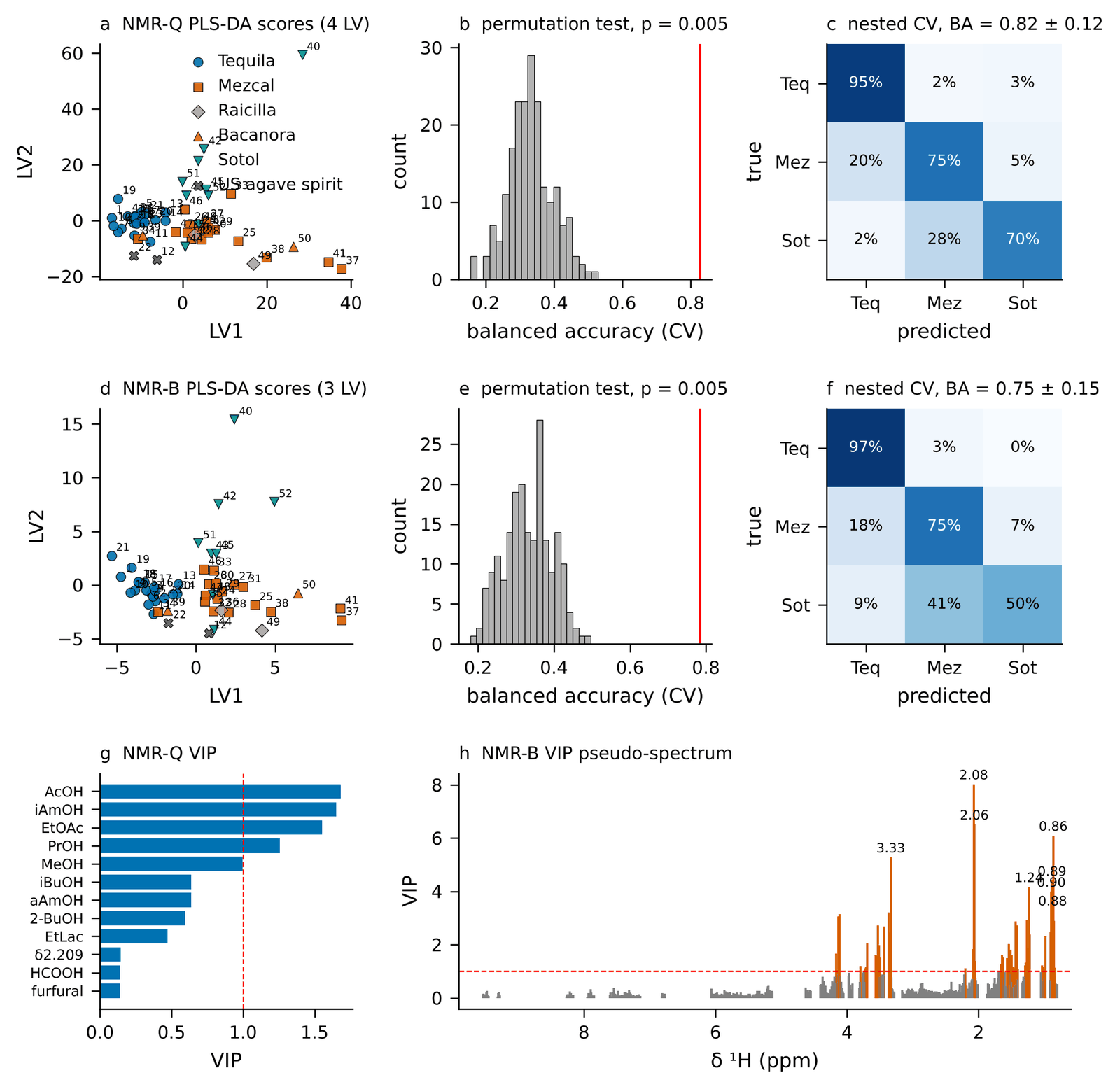
Dorsten, F. A. Assessment of PLSDA cross validation.
Metabolomics 2008, 4 (1), 81–89.
https://doi.org/10.1007/s11306-007-0099-6.
53. Szymańska, E.; Saccenti, E.; Smilde, A. K.; Westerhuis, J. A.
Double-check: validation of diagnostic statistics for PLS-DA models in
metabolomics studies. Metabolomics 2012, 8 (S1), 3–16.
https://doi.org/10.1007/s11306-011-0330-3.
54. Cortes, C.; Vapnik, V. Support-vector networks. Machine
Learning 1995, 20 (3), 273–297.
https://doi.org/10.1007/bf00994018.
55. Breiman, L. Random Forests. Machine Learning 2001,
45 (1), 5–32. https://doi.org/10.1023/a:1010933404324.
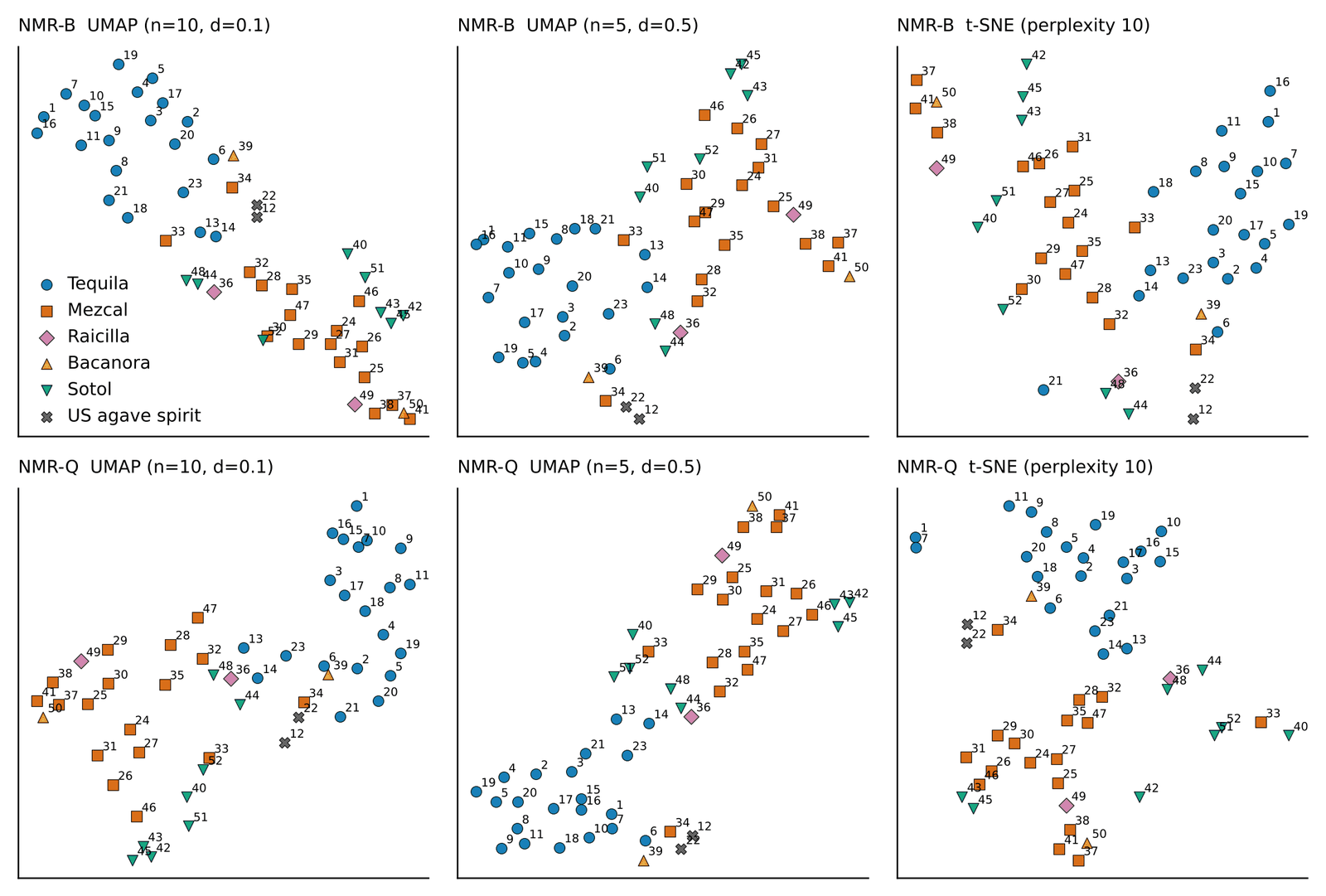
56. van der Maaten, L.; Hinton, G. Visualizing Data using t-SNE.
Journal of Machine Learning Research 2008, 9 (86),
2579–2605. https://www.jmlr.org/papers/v9/vandermaaten08a.html.
57. McInnes, L.; Healy, J.; Melville, J. UMAP: Uniform Manifold
Approximation and Projection for Dimension Reduction. arXiv preprint
2018, arXiv:1802.03426. https://doi.org/10.48550/arXiv.1802.03426.
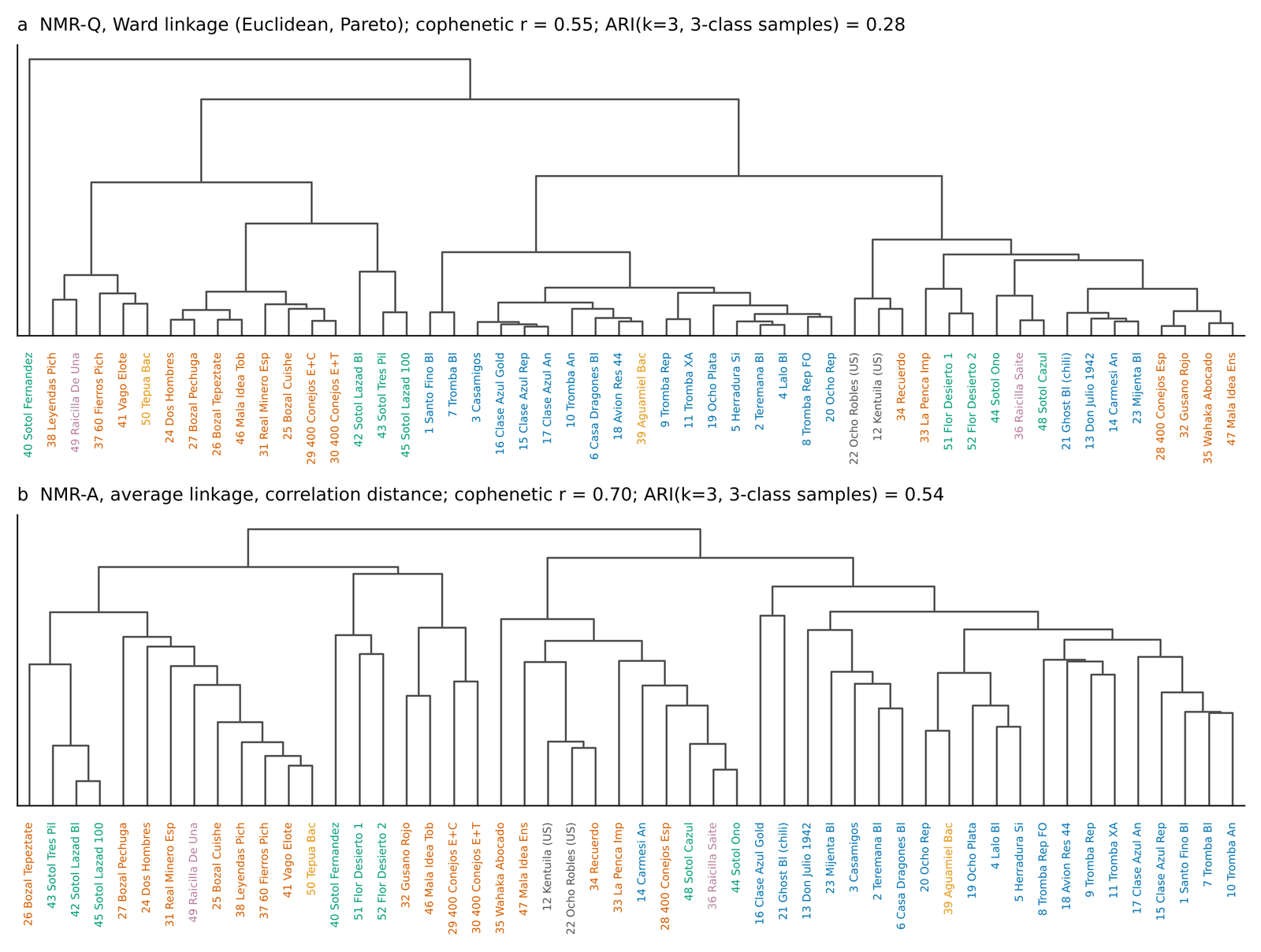
58. Ward, J. H. Hierarchical Grouping to Optimize an Objective
Function. Journal of the American Statistical Association 1963,
58 (301), 236–244.
https://doi.org/10.1080/01621459.1963.10500845.
59. Cloarec, O.; Dumas, M.-E.; Craig, A.; Barton, R. H.; Trygg, J.;
Hudson, J.; Blancher, C.; Gauguier, D.; Lindon, J. C.; Holmes, E.;
Nicholson, J. Statistical Total Correlation Spectroscopy: An Exploratory
Approach for Latent Biomarker Identification from Metabolic ¹H NMR Data
Sets. Analytical Chemistry 2005, 77 (5), 1282–1289.
https://doi.org/10.1021/ac048630x.
60. Radler, F.; Zorg, J. Characterization of the Enzyme Involved in
Formation of 2-Butanol from meso-2,3-Butanediol by Lactic Acid Bacteria.
American Journal of Enology and Viticulture 1986, 37
(3), 206–210. https://doi.org/10.5344/ajev.1986.37.3.206.
61. Mellado-Mojica, E.; López, M. G. Identification, classification,
and discrimination of agave syrups from natural sweeteners by infrared
spectroscopy and HPAEC-PAD. Food Chemistry 2015, 167,
349–357. https://doi.org/10.1016/j.foodchem.2014.06.111.
62. Velázquez Ríos, I. O.; González-García, G.; Mellado-Mojica, E.;
Veloz García, R. A.; Dzul Cauich, J. G.; López, M. G.; García-Vieyra, M.
I. Phytochemical profiles and classification of Agave syrups using
¹H-NMR and chemometrics. Food Science & Nutrition 2019,
7 (1), 3–13. https://doi.org/10.1002/fsn3.755.